Comparative Evaluation of Single and Hybrid Metal Oxide Nanoparticles for Multifunctional Hemp Textiles with Enhanced UV Protection and Self-Cleaning Performance
DOI:
https://doi.org/10.59796/jcst.V16N4.2026.211Keywords:
hemp, titanium dioxide nanoparticles, zinc oxide nanoparticles, silicon dioxide nanoparticles, nanocomposite finishing, photocatalysis, wettability, UV protection, self-cleaningAbstract
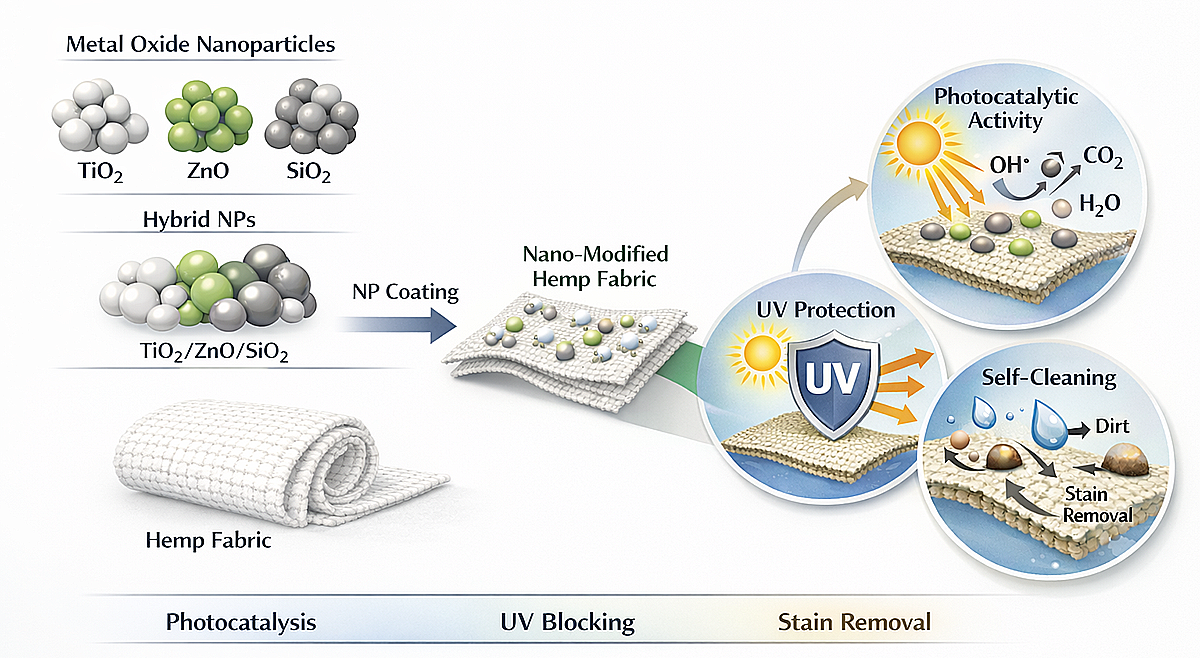
This study systematically investigated and compared the efficacy of single and hybrid metal oxide nanoparticles (NPs), including TiO2, ZnO, and SiO2, and their combinations, in imparting multifunctional properties to hemp fabrics. Despite increasing interest in multifunctional textile finishing, systematic comparative studies on single and hybrid metal oxide NP systems applied to hemp fabrics remain limited. For scalability and industrial applicability, commercial NPs were employed and applied to hemp textiles using a conventional pad-dry-cure method to evaluate wettability, UV protection, and photocatalytic self-cleaning performance. A commercial styrene–acrylic copolymer (SAC) emulsion was employed as a binder to facilitate the incorporation and adhesion of NPs onto the hemp fabric. XRD analysis confirmed the anatase phase of TiO2, wurtzite structure of ZnO, and the amorphous nature of SiO2, with crystallite sizes of 19.9, 36.2, and 22.4 nm, respectively. SEM–EDS examinations verified successful NP deposition and improved dispersion in hybrid and ternary systems. Contact angle measurements revealed a progressive increase in surface hydrophobicity from single to hybrid systems, with the ternary TiO2-ZnO-SiO2 nanocomposites exhibiting the highest water repellency due to hierarchical micro-nano surface structuring. UV protection was significantly enhanced after NP incorporation. The pristine hemp fabric exhibited moderate protection (UPF≈14), while the ternary nanocomposites achieved excellent protection (UPF 50++) with approximately 98-99% UV blocking, attributed to synergistic UV absorption and scattering effects. Assessment of photocatalytic self-cleaning based on methylene blue (MB) degradation showed superior performance for hemp finished with semiconductor NPs. The ternary nanocomposites exhibited the highest degradation efficiency (≈91%), followed by TiO2-ZnO (≈89%), attributable to enhanced charge separation, reduced electron-hole recombination, and increased reactive oxygen species (ROS) generation. Overall, hybrid and ternary nanocomposite systems surpassed single oxides, highlighting the essential role of SiO2 as a dispersion-supporting component. This work presents a practical and scalable approach for developing high-performance, multifunctional hemp textiles suitable for protective, healthcare, and sustainable apparel applications.
References
Akram, W., Mia, R., Ullah, S., Assiri, M. A., & Fang, J. (2024). Simultaneous synthesis and application of TiO2 nanoparticles using mulberry leaves for functionalization of organic cotton fabric. Journal of Cleaner Production, 440, Article 140939. https://doi.org/10.1016/j.jclepro.2024.140939
Ali, S. A. K., Abudi, Z. N., Abbas, M. N., Alsaffar, M. A., & Ibrahim, T. A. (2024). Synthesis of nano-silica particles using Eucalyptus globulus leaf extract and their innovative application as an adsorbent for malachite green dye. Russian Journal of Applied Chemistry, 97(1), 75-87. https://doi.org/10.1134/S1070427224010099
Araújo, J. C., Fangueiro, R., & Ferreira, D. P. (2021). Protective multifunctional fibrous systems based on natural fibers and metal oxide nanoparticles. Polymers, 13(16), Article 2654. https://doi.org/10.3390/polym13162654
Attia, N. F., Moussa, M., Sheta, A. M., Taha, R., & Gamal, H. (2017). Effect of different nanoparticles based coating on the performance of textile properties. Progress in Organic Coatings, 104, 72-80. https://doi.org/10.1016/j.porgcoat.2016.12.007
Dalawai, S. P., Aly, M. A. S., Latthe, S. S., Xing, R., Sutar, R. S., Nagappan, S., ... & Liu, S. (2020). Recent advances in durability of superhydrophobic self-cleaning technology: A critical review. Progress in Organic Coatings, 138, Article 105381. https://doi.org/10.1016/j.porgcoat.2019.105381
Dhineshbabu, N. R., Arunmetha, S., Manivasakan, P., Karunakaran, G., & Rajendran, V. (2016). Enhanced functional properties of cotton fabrics using TiO2/SiO2 nanocomposites. Journal of Industrial Textiles, 45(5), 674-692. https://doi.org/10.1177/1528083714538684
Diaa, M., & Hassabo, A. G. (2022). Self-cleaning properties of cellulosic fabrics (a review). Biointerface Research in Applied Chemistry, 12(2), 1847-1855. https://doi.org/10.33263/BRIAC122.18471855
Edan, T. S., Haider, A. J., & Sultan, F. I. (2025). Core–shell nanostructures in self-cleaning surface technology: A mini review. Plasmonics, 20(11), 10469-10488. https://doi.org/10.1007/s11468-025-03128-8
El-Naggar, M. E., Hassabo, A. G., Mohamed, A. L., & Shaheen, T. I. (2017). Surface modification of SiO2 coated ZnO nanoparticles for multifunctional cotton fabrics. Journal of Colloid and Interface Science, 498, 413-422. https://doi.org/10.1016/j.jcis.2017.03.080
Enarevba, D. R., & Haapala, K. R. (2024). The emerging hemp industry: A review of industrial hemp materials and product manufacturing. AgriEngineering, 6(3), 2891-2925. https://doi.org/10.3390/agriengineering6030167
Gao, L. Z., Bao, Y., Cai, H. H., Zhang, A. P., Ma, Y., Tong, X. L., ... & Dai, F. Y. (2020). Multifunctional silk fabric via surface modification of nano-SiO2. Textile Research Journal, 90(13-14), 1616-1627. https://doi.org/10.1177/0040517519897112
Hirano, T., Kaseda, S., Le Anh Cao, K., Iskandar, F., Tanabe, E., & Ogi, T. (2022). Multiple ZnO core nanoparticles embedded in TiO2 nanoparticles as agents for acid resistance and UV protection. ACS Applied Nano Materials, 5(10), 15449-15456. https://doi.org/10.1021/acsanm.2c03489
Jariyaboon, M., Masrinoul, P., Komaikul, J., Muenkaew, K., Juntarapornchai, S., Ketsuwan, K., Rodpai, E., Ruangdachsuwan, S., Palabodeewat, S., & Chitichotpanya, C. (2023). Optimization of Ag-TiO2 nanocomposite at a low toxicity dose as a self-virucidal disinfectant against COVID-19. Emergent Materials, 6(4), 1259-1272. https://doi.org/10.1007/s42247-023-00520-0
Kara, S., Nurlu, T., & Yavaş, A. (2024). Single and hybrid effects of nano‐TiO2 and‐ZnO particles on multifunctional properties of textiles. Journal of Applied Polymer Science, 141(11), Article e55101. https://doi.org/10.1002/app.55101
Khan, M. Z., Baheti, V., Ashraf, M., Hussain, T., Ali, A., Javid, A., & Rehman, A. (2018). Development of UV protective, superhydrophobic and antibacterial textiles using ZnO and TiO2 nanoparticles. Fibers and Polymers, 19(8), 1647-1654. https://doi.org/10.1007/s12221-018-7935-3
Kibria, G., Repon, M. R., Hossain, M. F., Islam, T., Jalil, M. A., Aljabri, M. D., & Rahman, M. M. (2022). UV-blocking cotton fabric design for comfortable summer wears: Factors, durability and nanomaterials. Cellulose, 29(14), 7555-7585. https://doi.org/10.1007/s10570-022-04710-7
Klaykruayat, B., Pisitsak, P., Chitichotpanya, P., & Klanthip, R. (2026). In situ synthesis of ZnO nanoparticles using soy protein isolate for sustainable and multifunctional finishing of hemp fabrics. Polymers, 18(1), Article 116. https://doi.org/10.3390/polym18010116
Lam, S. M., Lim, C. L., Sin, J. C., Zeng, H., Lin, H., & Li, H. (2021). Facile synthesis of MnO2/ZnO coated on cotton fabric for boosted antimicrobial, self-cleaning and photocatalytic activities under sunlight. Materials Letters, 305, Article 130818. https://doi.org/10.1016/j.matlet.2021.130818
Liu, I. C., Hu, X., Fei, B., Lee, C., Fan, S., Xin, J. H., & Noor, N. (2024). Fluorine-free nanoparticle coatings on cotton fabric: Comparing the UV-protective and hydrophobic capabilities of silica vs. silica-ZnO nanostructures. RSC Advances, 14(7), 4301-4314. https://doi.org/10.1039/d3ra08835a
Manaia, J. P., Manaia, A. T., & Rodriges, L. (2019). Industrial hemp fibers: An overview. Fibers, 7(12), Article 106. https://doi.org/10.3390/fib7120106
Marinho, E. (2025). Cellulose: A comprehensive review of its properties and applications. Sustainable Chemistry for the Environment, 11, Article 100283. https://doi.org/10.1016/j.scenv.2025.100283
Mollick, S., Repon, M. R., Haji, A., Jalil, M. A., Islam, T., & Khan, M. M. (2023). Progress in self-cleaning textiles: Parameters, mechanism and applications. Cellulose, 30(17), 10633-10680. https://doi.org/10.1007/s10570-023-05539-4
Mondal, S. (2022). Nanomaterials for UV protective textiles. Journal of Industrial Textiles, 51(4_suppl), 5592S-5621S. https://doi.org/10.1177/1528083721988949
Mushtaq, Q., Awan, T., Momna, M., Amjad, M., Intisar, A., & Afzal, A. (2024). Sustainable self-cleaning fabrics enabled by sunlit metal oxide catalysts: A critical review. Sustainable Materials and Technologies, 41, Article e01009. https://doi.org/10.1016/j.susmat.2024.e01009
Nautiyal, A., Shukla, S. R., & Prasad, V. (2022). ZnO-TiO2 hybrid nanocrystal-loaded, wash durable, multifunction cotton textiles. Cellulose, 29(10), 5923-5941. https://doi.org/10.1007/s10570-022-04595-6
Nitayaphat, W., Jirawongcharoen, P., & Trijaturon, T. (2018). Self-cleaning properties of silk fabrics functionalized with TiO2/SiO2 composites. Journal of Natural Fibers, 15(2), 262-272. https://doi.org/10.1080/15440478.2017.1325428
Pakdel, E., Sharp, J., Kashi, S., Bai, W., Gashti, M. P., & Wang, X. (2023). Antibacterial superhydrophobic cotton fabric with photothermal, self-cleaning, and ultraviolet protection functionalities. ACS Applied Materials & Interfaces, 15(28), 34031-34043. https://doi.org/10.1021/acsami.3c04598
Rabiei, H., Farhang Dehghan, S., Montazer, M., Khaloo, S. S., & Koozekonan, A. G. (2022). UV protection properties of workwear fabrics coated with TiO2 nanoparticles. Frontiers in Public Health, 10, Article 929095. https://doi.org/10.3389/fpubh.2022.929095
Rananavare, A. P., Jain, R., & Lee, J. (2025). Recent developments in superhydrophobic textiles: A status review. Journal of Coatings Technology and Research, 22(2), 549-580. https://doi.org/10.1007/s11998-024-01016-0
Rangelova, N., Aleksandrov, L., & Yaneva, S. (2022). Synthesis and structure of amorphous SiO2/ZnO composites with potential application for azo dye degradation. Materials Today: Proceedings, 61, 1272-1279. https://doi.org/10.1016/j.matpr.2022.03.064
Rehan, M., Elshemy, N. S., Haggag, K., Montaser, A. S., & Ibrahim, G. E. (2020). Phytochemicals and volatile compounds of peanut red skin extract: Simultaneous coloration and in situ synthesis of silver nanoparticles for multifunctional viscose fibers. Cellulose, 27(17), 9893-9912. https://doi.org/10.1007/s10570-020-03452-8
Saha, B., Saha, A., Das, P., Kakati, A., Banerjee, A., & Chattopadhyay, P. (2024). A comprehensive review of ultraviolet radiation and functionally modified textile fabric with special emphasis on UV protection. Heliyon, 10(22), Article e40027. https://doi.org/10.1016/j.heliyon.2024.e40027
Sakti, L. K., Eddy, D. R., Permana, M. D., Firdaus, M. L., Deawati, Y., & Rahayu, I. (2024). Utilizing TiO2 photocatalysis and natural SiO2 superhydrophilicity synergy to improve self-cleaning activity in cotton fabric. Cellulose, 31(9), 5885-5898. https://doi.org/10.1007/s10570-024-05938-1
Saleem, H., & Zaidi, S. J. (2020). Sustainable use of nanomaterials in textiles and their environmental impact. Materials, 13(22), Article 5134. https://doi.org/10.3390/ma13225134
Sarvalkar, P. D., Barawkar, S. D., Karvekar, O. S., Patil, P. D., Prasad, S. R., Sharma, K. K., ... & Vhatkar, R. S. (2022). A review on multifunctional nanotechnological aspects in modern textile. The Journal of the Textile Institute, 114(3), 470-487. https://doi.org/10.1080/00405000.2022.2046304
Sasunthon, N., Laksee, S., & Pisitsak, P. (2025). Preparation of hemp fabrics with durable UV‐protective and antibacterial properties using silver nanoparticles. Journal of Nanotechnology, 2025(1), Article 9695944. https://doi.org/10.1155/jnt/9695944
Schellbach, S. L., Monteiro, S. N., & Drelich, J. W. (2016). A novel method for contact angle measurements on natural fibers. Materials Letters, 164, 599-604. https://doi.org/10.1016/j.matlet.2015.11.039
Schumacher, A. G. D., Pequito, S., & Pazour, J. (2020). Industrial hemp fiber: A sustainable and economical alternative to cotton. Journal of Cleaner Production, 268, Article 122180. https://doi.org/10.1016/j.jclepro.2020.122180
Wang, H., Yu, H., Wang, J., Li, T. T., Lin, J. H., & Lou, C. W. (2024). Superhydrophobic and photocatalytic self-cleaning cotton fabrics coated with SiO2–TiO2 Janus particles and PDMS. Fibers and Polymers, 25(3), 891-900. https://doi.org/10.1007/s12221-023-00451-x
Zhang, Y., Xia, X., Ma, K., Xia, G., Wu, M., Cheung, Y. H., ... & Xin, J. H. (2023). Functional textiles with smart properties: Their fabrications and sustainable applications. Advanced functional materials, 33(33), Article 2301607. https://doi.org/10.1002/adfm.202301607
Downloads
Published
How to Cite
Issue
Section
Categories
License
Copyright (c) 2026 Journal of Current Science and Technology

This work is licensed under a Creative Commons Attribution-NonCommercial-NoDerivatives 4.0 International License.