Nitrogen Use Efficiency of Maize Hybrids under Contrasting Nitrogen Levels in Post-Rice Field Conditions
DOI:
https://doi.org/10.59796/jcst.V16N1.2026.162Keywords:
correlation, low nitrogen tolerance index, nitrogen deficiency index, nitrogen fertilizerAbstract
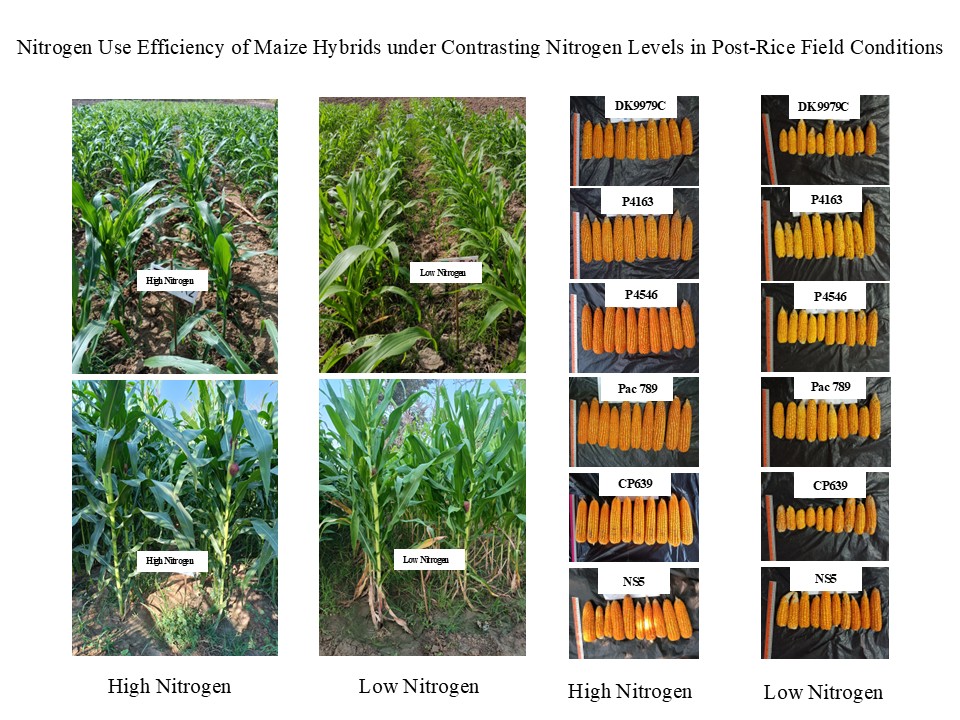
Growing maize under both high and low nitrogen conditions in post-rice fields is essential for understanding the factors influencing nitrogen fertilizer efficiency. This study aimed to identify maize hybrids with high nitrogen use efficiency (NUE) and stable performance across different nitrogen levels for potential use in low-input systems and breeding programs. A field experiment was conducted during the dry season of 2023/24 to assess six maize hybrid varieties. The experiment followed a randomized complete block design with two factors, including maize variety and nitrogen fertilizer level, with three replications. Data were collected on yield, yield components, and agronomic traits to assess the effects of nitrogen fertilizer, variety, and their interaction. Among the tested hybrids, Pac789, CP639, P4163, and DK9979C recorded the highest average yields. Under nitrogen-deficient conditions, P4546 exhibited strong tolerance, maintaining stable yield levels with minimal reduction. Under sufficient nitrogen conditions, CP639, P4163, Pac789, and DK9979C demonstrated high NUE values. Across nitrogen treatments, Pac789 displayed both a high shelling percentage and dark green foliage, indicating broad adaptability. Yield under high nitrogen conditions was positively correlated with NUE, while under low nitrogen conditions, yield was closely associated with the low nitrogen tolerance index and the nitrogen deficiency index. P4546 stood out as the most tolerant hybrid under nitrogen-limited conditions, showing only a slight yield reduction. These findings provide valuable insights for farmers selecting hybrids suited to varying soil fertility and nitrogen availability. Moreover, the results offer practical guidance for breeding programs aiming to develop maize varieties with improved NUE, contributing to more productive and sustainable maize cultivation in post-rice agroecosystems.
References
Ali, A., Jabeen, N., Farruhbek, R., Chachar, Z., Laghari, A. A., Chachar, S., ... & Yang, Z. (2025). Enhancing nitrogen use efficiency in agriculture by integrating agronomic practices and genetic advances. Frontiers in Plant Science, 16, Article 1543714. https://doi.org/10.3389/fpls.2025.1543714
Barrios, E., Kwesiga, F., Buresh, R. J., Coe, R., & Sprent, J. I. (1998). Relating preseason soil nitrogen to maize yield in tree legume‐maize rotations. Soil Science Society of America Journal, 62(6), 1604-1609. https://doi.org/10.2136/sssaj1998.03615995006200060018x
Bray, R. H., & Kurtz, L. T. (1945). Determination of total, organic, and available forms of phosphorus in soils. Soil Science, 59(1), 39-46. https://doi.org/10.1097/00010694-194501000-00006
Congreves, K. A., Otchere, O., Ferland, D., Farzadfar, S., Williams, S., & Arcand, M. M. (2021). Nitrogen use efficiency definitions of today and tomorrow. Frontiers in Plant Science, 12, Article 637108. https://doi.org/10.3389/fpls.2021.637108
Department of Agriculture. (2020). Guidebook: Maize production technology. Institute of Agronomy and renewable energy, Ministry of Agriculture and Cooperatives, Thailand. https://pubhtml5.com/iytc/cjgc/
Department of Land Development. (2007). Soil management with organic fertilizer to increase maize yield. Ministry of Agriculture and Cooperatives, Thailand. Retrieved form http://www1.ldd.go.th/menu_Dataonline/G2/G2_09.pdf
Fritsche-Neto, R., Galli, G., Borges, K. L. R., Costa-Neto, G., Alves, F. C., Sabadin, F., ... & Crossa, J. (2021). Optimizing genomic-enabled prediction in small-scale maize hybrid breeding programs: A roadmap review. Frontiers in Plant Science, 12, Article 658267. https://doi.org/10.3389/fpls.2021.658267
Fukai, S., & Mitchell, J. (2024). Crop diversification in rainfed lowland rice ecosystems in tropical Asia. Advances in Agronomy, 188, 207-246. https://doi.org/10.1016/bs.agron.2024.06.002
Gallais, A., & Hirel, B. (2004). An approach to the genetics of nitrogen use efficiency in maize. Journal of Experimental Botany, 55(396), 295-306. https://doi.org/10.1093/jxb/erh006
Ghosh, D., Brahmachari, K., Das, A., Hassan, M. M., Mukherjee, P. K., Sarkar, S., ... & Hossain, A. (2021). Assessment of energy budgeting and its indicator for sustainable nutrient and weed management in a rice-maize-green gram cropping system. Agronomy, 11(1), Article 166. https://doi.org/10.3390/agronomy11010166
Govindasamy, P., Muthusamy, S. K., Bagavathiannan, M., Mowrer, J., Jagannadham, P. T. K., Maity, A., ... & Tiwari, G. (2023). Nitrogen use efficiency a key to enhance crop productivity under a changing climate. Frontiers in Plant Science, 14, Article 1121073. https://doi.org/10.3389/fpls.2023.1121073
Hirel, B., Bertin, P., Quilleré, I., Bourdoncle, W., Attagnant, C., Dellay, C., ... & Gallais, A. (2001). Towards a better understanding of the genetic and physiological basis for nitrogen use efficiency in maize. Plant Physiology, 125(3), 1258-1270. https://doi.org/10.1104/pp.125.3.1258
Kamprath, E. J., Moll, R. H., & Rodriguez, N. (1982). Effects of nitrogen fertilization and recurrent selection on performance of hybrid populations of corn 1. Agronomy Journal, 74(6), 955-958. https://doi.org/10.2134/agronj1982.00021962007400060007x
Kaewtaphan, P., Maniin, P., Nilkong, P., Aninbon, C., & Teamkao, P. (2024). Effect of organic fertilizer quantity on yield and seed qualities of rice. International Journal of Agricultural Technology, 20(3), 1067–1074.
Ma, C., Liu, C., & Ye, Z. (2024). Influence of genotype × environment interaction on yield stability of maize hybrids with AMMI Model and GGE Biplot. Agronomy, 14(5), Article 1000. https://doi.org/10.3390/agronomy14051000
Moll, R. H., Kamprath, E. J., & Jackson, W. A. (1982). Analysis and interpretation of factors which contribute to efficiency of nitrogen utilization 1. Agronomy Journal, 74(3), 562-564. https://doi.org/10.2134/agronj1982.00021962007400030037x
Mozaffari, H., Moosavi, A. A., Baghernejad, M., & Cornelis, W. (2024). Revisiting soil texture analysis: Introducing a rapid single-reading hydrometer approach. Measurement, 228, Article 114330. https://doi.org/10.1016/j.measurement.2024.114330
Ndlovu, N., Spillane, C., McKeown, P. C., Cairns, J. E., Das, B., & Gowda, M. (2022). Genome-wide association studies of grain yield and quality traits under optimum and low-nitrogen stress in tropical maize (Zea mays L.). Theoretical and Applied Genetics, 135(12), 4351-4370. https://doi.org/10.1007/s00122-022-04224-7
Peech, M. (1965). Hydrogen-ion activity. Methods of Soil Analysis. CA Black, ed., Part 2-Chemical and Microbiological Properties. Washington DC, US: American Society of Agronomy, Inc. https://doi.org/10.2134/agronmonogr9.2.c9
Piekielek, W. (1997). The early season chlorophyll meter test for maize. The Pennsylvania State University. USA. Retrieved from https://www.specmeters.com/info/4.html
Presterl, T., Seitz, G., Landbeck, M., Thiemt, E. M., Schmidt, W., & Geiger, H. H. (2003). Improving nitrogen‐use efficiency in European maize: Estimation of quantitative genetic parameters. Crop Science, 43(4), 1259-1265. https://doi.org/10.2135/cropsci2003.1259
Reddy, M. B., Sravani, P., Kumar, S., Rajawat, M. V. S., Jaiswal, D. K., Dhar, S., ... & Kumar, S. (2025). Nitrogen use efficiency reimagined: Advancements in agronomic, ecophysiological, and molecular strategies. Journal of Plant Nutrition, 48(9), 1577-1603. https://doi.org/10.1080/01904167.2024.2447840
Schollenberger, C. J., & Simon, R. H. (1945). Determination of exchange capacity and exchangeable bases in soil ammonium acetate method. Soil Science, 59(1), 13-24. https://doi.org/10.1097/00010694-194501000-00004
Sharma, N., Sinha, V. B., Prem Kumar, N. A., Subrahmanyam, D., Neeraja, C. N., Kuchi, S., ... & Raghuram, N. (2021). Nitrogen use efficiency phenotype and associated genes: Roles of germination, flowering, root/shoot length and biomass. Frontiers in Plant Science, 11, Article 587464. https://doi.org/10.3389/fpls.2020.587464
Shirinzadeh, A., Zarghami, R., Azghandi, A. V., Shiri, M. R., & Mirabdulbaghi, M. (2010). Evaluation of drought tolerance in mid and late mature corn hybrids using stress tolerance indices. Asian Journal of Plant Sciences, 9(2), 67-73. https://doi.org/10.3923/ajps.2010.67.73
Sukto, S., Nolapuat, W., Luanmanee, S., Thiansirirerk, A., Saipan, P., & Duangkaew, S. (2017). Study of response to nitrogen fertilizer of maize variety NSX042022 in the clay loam soil group, sandy-loamy silt, Uthai Thani province. Ministry of Agriculture and Cooperatives, Thailand. Retrieved from https://info.doa.go.th/research/frontend/download.php?id=4869
Walkley, A., & Black, I. A. (1934). An examination of the Degtjareff method for determining soil organic matter, and a proposed modification of the chromic acid titration method. Soil Science, 37(1), 29-38. https://doi.org/10.1097/00010694-193401000-00003
Wang, X., Bai, J., Xie, T., Wang, W., Zhang, G., Yin, S., & Wang, D. (2021). Effects of biological nitrification inhibitors on nitrogen use efficiency and greenhouse gas emissions in agricultural soils: A review. Ecotoxicology and Environmental Safety, 220, Article 112338. https://doi.org/10.1016/j.ecoenv.2021.112338
Welutung, P., Pengthamkeerati, P., Kachenchart, B., & Tawornpruek, S. (2025). Effects of nitrogen fertilizer rate with urease and nitrification inhibitors on certain morphological traits and quality of sugarcane (Saccharum officinarum L.). Current Applied Science and Technology, 25(3), Article e0261218
Yu, Q., Nguyen, T. P. L., Shrestha, R. P., & Nitivattananon, V. (2025). Impacts and implications of agronomic efficiency on rice and maize productivity among small-scale farmers in Chiang Mai, Thailand. Cogent Food & Agriculture, 11(1), Article 2496697. https://doi.org/10.1080/23311932.2025.2496697
Yue, H., Olivoto, T., Bu, J., Li, J., Wei, J., Xie, J., ... & Jiang, X. (2022). Multi-trait selection for mean performance and stability of maize hybrids in mega-environments delineated using envirotyping techniques. Frontiers in Plant Science, 13, Article 1030521. https://doi.org/10.3389/fpls.2022.1030521
Yue, K., Li, L., Xie, J., Fudjoe, S. K., Zhang, R., Luo, Z., & Anwar, S. (2021). Nitrogen supply affects grain yield by regulating antioxidant enzyme activity and photosynthetic capacity of maize plant in the loess plateau. Agronomy, 11(6), Article 1094. https://doi.org/10.3390/agronomy11061094
Downloads
Published
How to Cite
License
Copyright (c) 2025 Journal of Current Science and Technology

This work is licensed under a Creative Commons Attribution-NonCommercial-NoDerivatives 4.0 International License.