Polyester That is Degradable by Sodium Bicarbonate After Oxidation of Sulfide to Sulfone: Polyester from Glyceraldehyde Ethylene-Thioacetal
DOI:
https://doi.org/10.59796/jcst.V16N4.2026.227Keywords:
β-elimination, glyceraldehyde, oxidative degradation, polyester, sodium bicarbonate, sulfone, thioacetalAbstract
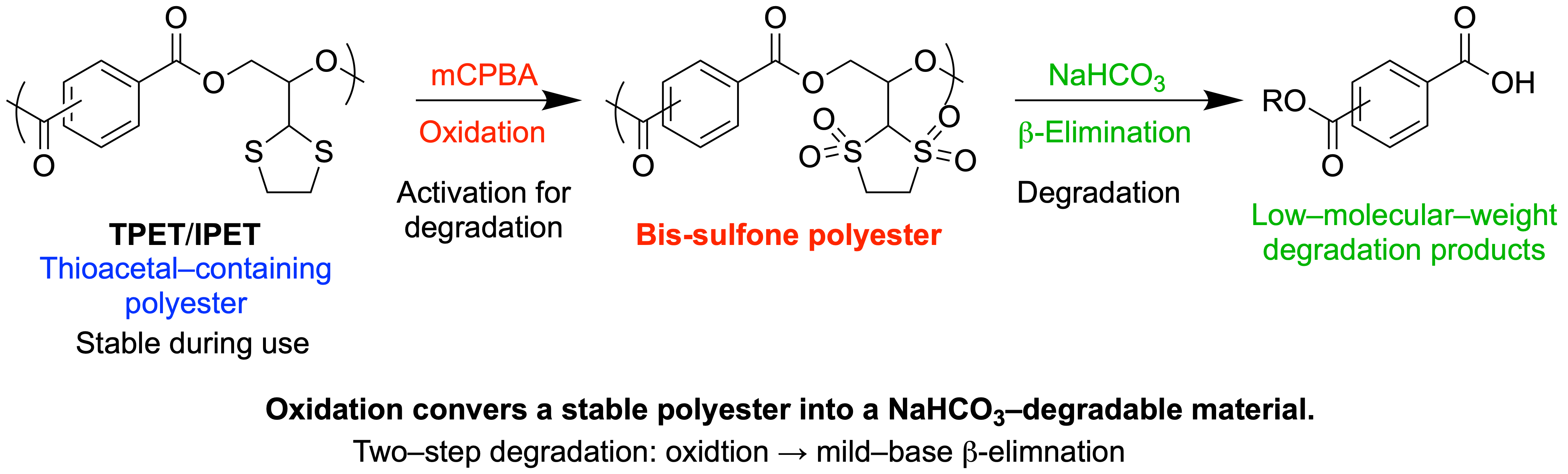
Polyesters bearing the 2-thioethyl ester moiety degrade through oxidation to sulfone followed by b-elimination promoted by a base. The basicity of sodium carbonate is essential for the b-elimination process, while degradation using sodium bicarbonate has proven unsuccessful. To achieve highly selective degradation, novel polyesters were developed in which sodium bicarbonate can promote the b-elimination process. A thioacetal of glyceraldehyde was synthesized as the monomer for the preparation of a model ester and of polyesters. The model diester was prepared by reaction with benzoyl chloride. Quantitative oxidation of the model diester to the bis-sulfone and subsequent b-elimination using sodium bicarbonate solution were monitored by 1H-NMR spectroscopy. Polyesters were synthesized through reactions with terephthaloyl chloride and isophthaloyl chloride. The oxidative degradation of these polyesters was successfully carried out via oxidation followed by treatment with sodium bicarbonate solution.
References
Ahrendt, K. A., & Williams, R. M. (2004). A concise asymmetric synthesis of the ADE fragment of nakadomarin A. Organic Letters, 6(24), 4539-4541. https://doi.org/10.1021/ol048126e
Banerjee, A. K. & Laya, M. (2000). Reagents for the preparation and cleavage of 1, 3-dithiolanes. Russian Chemical Reviews, 69(11), 947-955. https://doi.org/10.1070/RC2000v069n11ABEH000583
Banno, M., Aoshima, S., & Kanazawa, A. (2026). Acid-labile moiety-containing polyesters: Cationic ring-opening copolymerization of cyclic esters and cyclic hemiacetal esters. Macromolecules, 59(13), 7837–7848. https://doi.org/10.1021/acs.macromol.6c01281
Buensoz, O., Picken, C. A., Price, P., Fidge, C., & Shaver, M. P. (2024). Degradable branched and cross-linked polyesters from a bis (1, 3-dioxolan-4-one) core. Polymer Chemistry, 15(39), 3983-3990. https://doi.org/10.1039/d4py00551a
El Darai, T., Ter-Halle, A., Blanzat, M., Despras, G., Sartor, V., Bordeau, G., ... & Garrigues, J. C. (2024). Chemical recycling of polyester textile wastes: Shifting towards sustainability. Green Chemistry, 26(12), 6857-6885. https://doi.org/10.1039/d4gc00911h
Hardy, P. M., Rydon, H. N., & Thompson, R. C. (1968). The use of beta-methylthioethyl esters for the protection of carboxyl groups in peptide synthesis: Removal through the beta-methylsulphonylethyl ester. Tetrahedron Letters, (21), 2525-2526. https://doi.org/10.1016/s0040-4039(00)89689-6
Hatch, R. P., Shringarpure, J., & Weinreb, S. M. (1978). Studies on total synthesis of the olivomycins. The Journal of Organic Chemistry, 43(21), 4172-4177. https://doi.org/10.1021/jo00415a041
Inoue, S., Okada, K., Tanino, H., Hashizume, K., & Kakoi, H. (1994). Total synthesis of (±)-surugatoxin. Tetrahedron, 50(9), 2729-2752. https://doi.org/10.1016/S0040-4020(01)86989-1
Kihara, N., Ii, R., & Ogawa, A. (2007). Synthesis and properties of nylon‐0, 2-oxidatively degradable polymer that is stable in air. Journal of Polymer Science Part A: Polymer Chemistry, 45(5), 963-967. https://doi.org/10.1002/pola.21824
Kihara, N., Iino, Y., & Misawa, T. (2008). Oxidative degradation of poly (isophthaloylhydrazine‐1, 2‐diyl) s. Journal of Polymer Science Part A: Polymer Chemistry, 46(18), 6255-6262. https://doi.org/10.1002/pola.22935
Kihara, N., Mochizuki, M., Yamaguchi, H., & Endo, A. (2026). Highly degradable polyester with chemical and thermal stability utilizing oxidative degradation of 2‐Thioethyl Ester. Journal of Polymer Science, 64(5), 1130-1136. https://doi.org/10.1002/pol.20250924
Kint, D. P., de Ilarduya, A. M., Bou, J. J., & Muñoz‐Guerra, S. (2001). Poly (ethylene terephthalate) copolymers containing 5‐nitroisophthalic units. III. Methanolytic degradation. Journal of Polymer Science Part A: Polymer Chemistry, 40(1), 76-87. https://doi.org/10.1002/pola.10094
Kunz, H., & Waldmann, H. (1983). 1, 3‐Dithian‐2‐yl methyl ester as two‐step protecting group for the carboxy function in peptide synthesis. Angewandte Chemie International Edition in English, 22(1), Article 62. https://doi.org/10.1002/anie.198300621
Labiad, B., & Villemin, D. (1989). Clay catalysis: Synthesis of organosulphur synthons. Synthetic Communications, 19(1-2), 31-38. https://doi.org/10.1080/00397918908050949
Leblanc, Y., Fitzsimmons, B. J., Adams, J., Perez, F., & Rokach, J. (1986). The total synthesis of 12-HETE (12-hydroxyeicosatetraenoic acid) and 12, 20-diHETE. The Journal of Organic Chemistry, 51(6), 789-793. https://doi.org/10.1021/jo00356a004
Molina, A. M., Liang, Z., Kubo, T., & Satoh, K. (2026). Sequence modulated thionoester‐containing poly (ε‐caprolactone) for stimuli‐triggered degradation. Macromolecular Chemistry and Physics, 227(14), Article e70297. https://doi.org/10.1002/macp.70297
Nagashima, K., Kihara, N., & Iino, Y. (2012). Oxidative coupling polymerization of bishydrazide for the synthesis of poly (diacylhydrazine): Oxidative preparation of oxidatively degradable polymer. Journal of Polymer Science Part A: Polymer Chemistry, 50(20), 4230-4238. https://doi.org/10.1002/pola.26225
Oguri, T., Kawahara, A., & Kihara, N. (2016). Epoxy resin bearing diacylhydrazine moiety as a degradable adhesive for traceless oxidative removal. Polymer, 99, 83-89. https://doi.org/10.1016/j.polymer.2016.06.066
Simpkins, N. S. (2013). Sulphones in organic synthesis (Vol. 10). Oxford, UK: Pergamon Press.
Villemin, D., Labiad, B., & Hammadi, M. (1992). Formation of dithianes and dithiolanes catalysed by clay. An unexpected functional selectivity. Journal of the Chemical Society, Chemical Communications, 28(17), 1192-1193. https://doi.org/10.1039/C39920001192
Waldmann, H., & Kunz, H. (1988). 1, 3-Dithian-2-ylmethyl esters as two-step carboxy-protecting groups in the synthesis of N-glycopeptides. The Journal of Organic Chemistry, 53(18), 4172-4175. https://doi.org/10.1021/jo00253a003
Weinberg, J. M., Gitto, S. P., & Wooley, K. L. (1998). Synthesis and characterization of degradable poly (silyl ester) s. Macromolecules, 31(1), 15-21. https://doi.org/10.1021/ma971168g
Wongwailikhit, K., Suwannakeeree, R., & Kihara, N. (2024). Synthesis and oxidative degradation of leucine-based poly(diacylhydrazine). Polymers, 16(9), Article 1222. https://doi.org/10.3390/polym16091222
Yanaze, K., & Kihara, N. (2021). Superabsorbent polymer solubilized instantly by decrosslinking with sodium hypochlorite. Polymer Journal, 53(10), 1153-1155. https://doi.org/10.1038/s41428-021-00499-7
Yanaze, K., & Kihara, N. (2025). Preparation of carbon fiber-reinforced polymer using oxidatively degradable matrix polymer: Recovery and reuse of carbon fiber sheet. Journal of Applied Polymer Science, 142(23), Article e56985. https://doi.org/10.1002/app.56985
Zheng, S., Chen, S. S., Li, Y. Y., Liao, M., Liang, X., Li, K., ... & Chen, D. F. (2025). Monomer design enables mechanistic mapping of anionic ring‐opening polymerization of aromatic thionolactones. Angewandte Chemie International Edition, 64(14), Article e202500581. https://doi.org/10.1002/anie.202500581
Downloads
Published
How to Cite
Issue
Section
Categories
License
Copyright (c) 2026 Journal of Current Science and Technology

This work is licensed under a Creative Commons Attribution-NonCommercial-NoDerivatives 4.0 International License.