Morphology and Anisotomous Branching of rhizoids in Non-terminal Cells of a Spirogyra sp.
DOI:
https://doi.org/10.59796/jcst.V16N4.2026.224Keywords:
aniline blue, anisotomous branching, calcofluor white, developmental plasticity, rhizoid, spirogyraAbstract
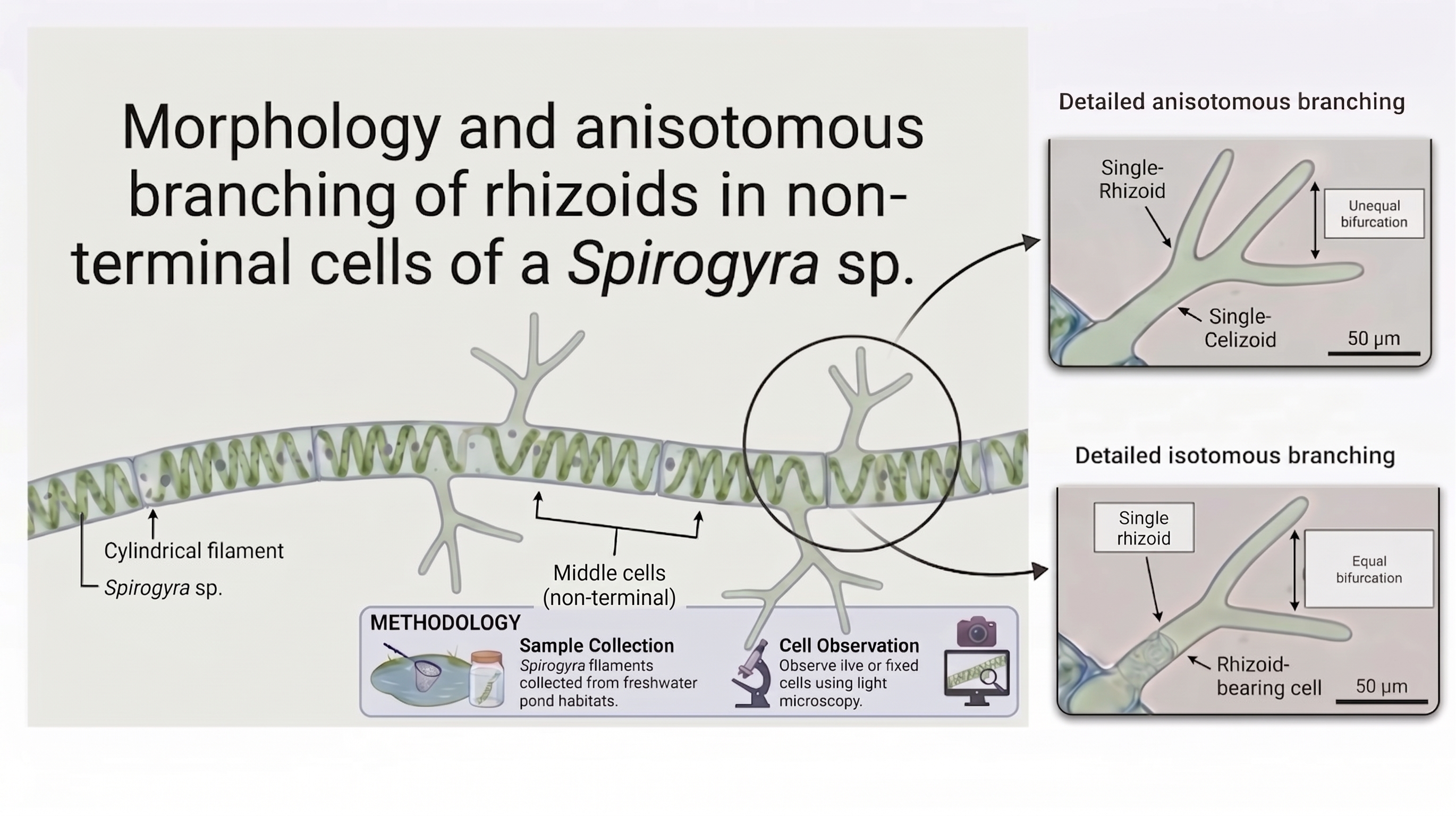
Spirogyra, a widespread filamentous green alga, typically anchors to substrates via rhizoids at the filament termini, an anchoring strategy that enhances their resilience to environmental disturbance. In this descriptive study, we examined rhizoid morphology in a Spirogyra unialgal culture using light and epifluorescence microscopy coupled with Calcofluor white and aniline blue staining. We observed rhizoid-like structures associated with non-terminal (intercalary) cells, suggesting that these cells may possess an inducible developmental potential beyond terminal cell identity. The observed rhizoids were consistently rod-shaped and dichotomously branched; however, rosette morphologies were not observed, possibly due to culture conditions or species-level variation. Notably, these single-celled rhizoids also exhibited anisotomous branching (unequal bifurcation). To our knowledge, this is a previously uncharacterized morphological feature in Spirogyra and a novel observation for unicellular rhizoids, raising important questions about developmental plasticity in streptophyte algae.
References
Davis, D. J., Wang, M., Sørensen, I., Rose, J. K., Domozych, D. S., & Drakakaki, G. (2020). Callose deposition is essential for the completion of cytokinesis in the unicellular alga Penium margaritaceum. Journal of Cell Science, 133(19), Article jcs249599. https://doi.org/10.1242/jcs.249599
Gallego, I., Casas, J. J., Fuentes-Rodríguez, F., Juan, M., Sánchez-Castillo, P., & Pérez-Martínez, C. (2013). Culture of Spirogyra africana from farm ponds for long-term experiments and stock maintenance. Biotechnologie, Agronomie, Société et Environnement/Biotechnology, Agronomy, Society and Environment, 17(3), 423-430. http://hdl.handle.net/10481/32297
Hepler, P. K., Vidali, L., & Cheung, A. Y. (2001). Polarized cell growth in higher plants. Annual Review of Cell and Developmental Biology, 17(1), 159-187. https://doi.org/10.1146/annurev.cellbio.17.1.159
Herburger, K., & Holzinger, A. (2015). Localization and quantification of callose in the streptophyte green algae Zygnema and Klebsormidium: Correlation with desiccation tolerance. Plant and Cell Physiology, 56(11), 2259-2270. https://doi.org/10.1093/pcp/pcv139
Herburger, K., & Holzinger, A. (2016). Aniline blue and Calcofluor white staining of callose and cellulose in the streptophyte green algae Zygnema and Klebsormidium. Bio-protocol, 6(20), Article e1969. https://doi.org/10.21769/BioProtoc.1969
Hodgetts, W. J. (1920). A new species of Spirogyra. Annals of Botany, 34(136), 519-524. https://doi.org/10.1093/aob/os-34.4.519
Ikegaya, H., Hayashi, T., Kaku, T., Iwata, K., Sonobe, S., & Shimmen, T. (2008a). Presence of xyloglucan‐like polysaccharide in Spirogyra and possible involvement in cell–cell attachment. Phycological Research, 56(3), 216-222. https://doi.org/10.1111/j.1440-1835.2008.00503.x
Ikegaya, H., Sonobe, S., Murakami, K., & Shimmen, T. (2008b). Rhizoid differentiation of Spirogyra is regulated by substratum. Journal of Plant Research, 121(6), 571-579. https://doi.org/10.1007/s10265-008-0182-8
Inoue, N., Yamada, S. Y., Nagata, Y., & Shimmen, T. (2002). Rhizoid differentiation in Spirogyra: Position sensing by terminal cells. Plant and Cell Physiology, 43(5), 479-483. https://doi.org/10.1093/pcp/pcf056
Nagata, Y. (1973a). Rhizoid differentiation in Spirogyra I. Basic features of rhizoid formation. Plant and Cell Physiology, 14(3), 531-541. https://doi.org/10.1093/oxfordjournals.pcp.a074889
Nagata, Y. (1973b). Rhizoid differentiation in Spirogyra II. Photoreversibility of rhizoid induction by red and far-red light. Plant and Cell Physiology, 14(3), 543-554. https://doi.org/10.1093/oxfordjournals.pcp.a074890
Wongsawad, P., & Peerapornpisal, Y. (2015). Morphological and molecular profiling of Spirogyra from northeastern and northern Thailand using inter simple sequence repeat (ISSR) markers. Saudi Journal of Biological Sciences, 22(4), 382-389. https://doi.org/10.1016/j.sjbs.2014.10.004
Yamada, S. Y., Sonobe, S., & Shimmen, T. (2003). Synthesis of a callosic substance during rhizoid differentiation in Spirogyra. Plant and Cell Physiology, 44(11), 1225-1228. https://doi.org/10.1093/pcp/pcg152
Yoshida, K., & Shimmen, T. (2009). Involvement of actin filaments in rhizoid morphogenesis of Spirogyra. Physiologia Plantarum, 135(1), 98-107. https://doi.org/10.1111/j.1399-3054.2008.01172.x
Yoshida, K., Inoue, N., Sonobe, S., & Shimmen, T. (2003). Involvement of microtubules in rhizoid differentiation of Spirogyra species. Protoplasma, 221(3), 227-235. https://doi.org/10.1007/s00709-002-0078-8
Yoshida, K., Ohtani, A., Mimura, T., & Shimmen, T. (2008). Adjustment of osmotic pressure coupled with change of growth mode in Spirogyra. Functional Plant Biology, 35(7), 580-584. https://doi.org/10.1071/FP08138
Downloads
Published
How to Cite
Issue
Section
Categories
License
Copyright (c) 2026 Journal of Current Science and Technology

This work is licensed under a Creative Commons Attribution-NonCommercial-NoDerivatives 4.0 International License.