Optimization of Extraction and Drying Methods of Low-Grade Mulberry Leaf Tea Extract for Encapsulation in Alginate-Pea Protein Hydrogels with pH-Responsive Release Behavior
DOI:
https://doi.org/10.59796/jcst.V16N4.2026.221Keywords:
Alginate–pea protein hydrogel, encapsulation efficiency, phenolic compound encapsulation, mulberry leaf tea residue, phenolic compounds, pH responsive releaseAbstract
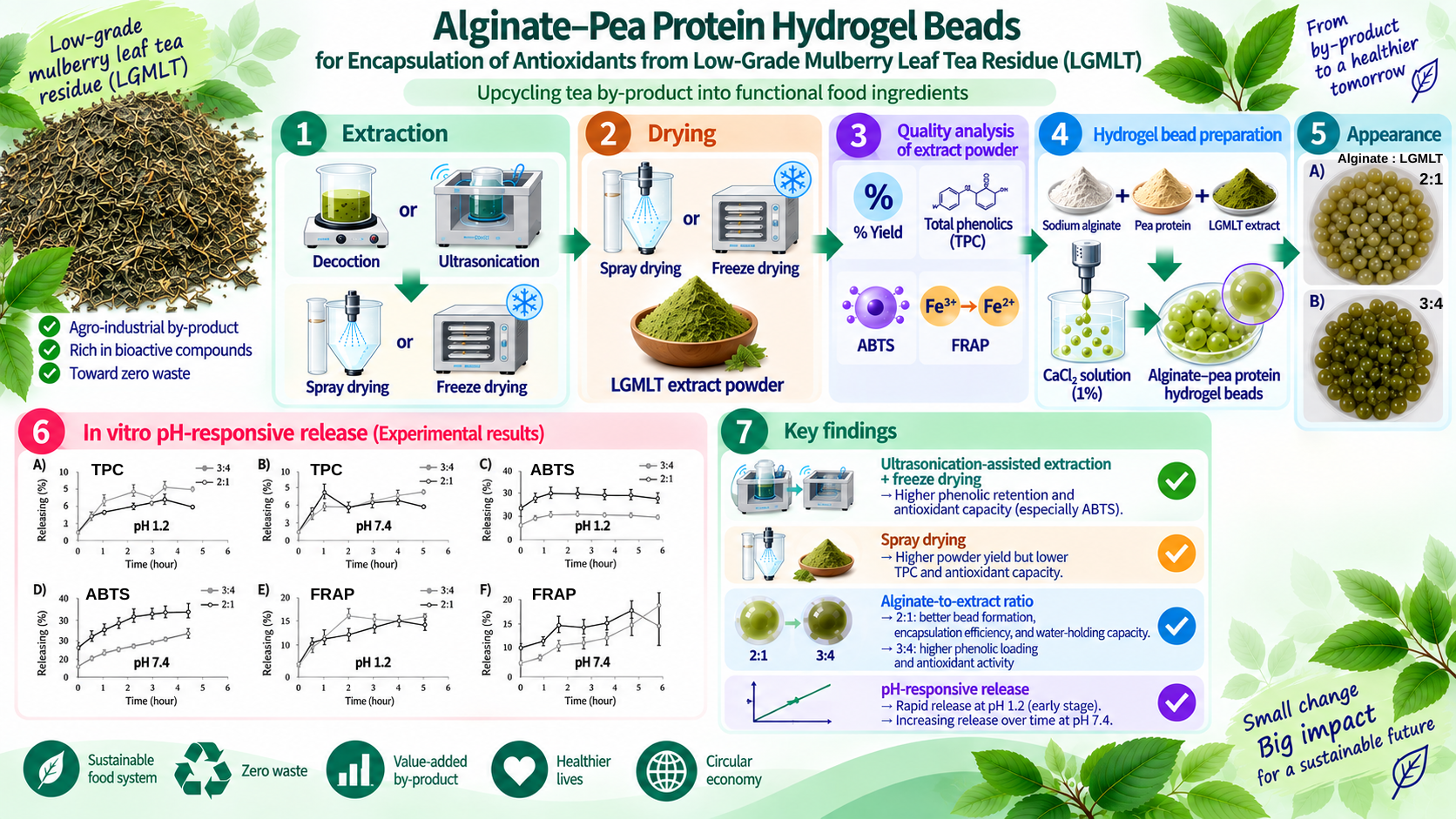
This study investigated alginate–pea protein hydrogel beads as an encapsulation material for antioxidants derived from low-grade mulberry leaf tea residue (LGMLT). The quality of LGMLT extract powder was significantly influenced by both extraction and drying methods with freeze drying, particularly when combined with ultrasonication-assisted extraction, providing the highest antioxidant activities (ABTS: 37.12 mg of Trolox equivalents/g and FRAP: 43.90 mg of Trolox equivalents/g) and a total phenolic content (22.97 mg gallic acid equivalents/g) statistically comparable to decoction–freeze drying, while spray drying consistently resulted in higher powder yield across extraction methods. The physicochemical and antioxidant properties of hydrogel beads were strongly dependent on the alginate-to-LGMLT extract ratio; higher alginate content improved bead uniformity, encapsulation efficiency (95.90%), and water-holding capacity (55.94%), whereas increased extract loading enhanced total phenolic content and antioxidant activity. In vitro pH-responsive release studies demonstrated a rapid release of phenolic compounds under pH 1.2, followed by a more sustained release at pH 7.4, reflecting the pH-dependent behavior of the hydrogel matrix. Differences between ABTS and FRAP responses indicated assay-dependent antioxidant capacities influenced by hydrogel composition. Based on these findings, alginate–pea protein hydrogels represent a tunable, food-grade encapsulation system for antioxidants and offer an alternative approach for the valorization of tea-processing residues in functional food applications, contributing to sustainable food production and food security.
References
Ali, K., Niaz, N., Mgomi, F. C., Haq, F. U., Ashraf, W., Khalid, M. U., ... & Wu, M. (2026). pH-responsive pea protein-sodium alginate hydrogel beads for freshness monitoring in protein drinks: Structural and molecular insight. Food Hydrocolloids, 171, Article 111848. https://doi.org/10.1016/j.foodhyd.2025.111848
Boye, J., Zare, F., & Pletch, A. (2010). Pulse proteins: Processing, characterization, functional properties and applications in food and feed. Food Research International, 43(2), 414-431. https://doi.org/10.1016/j.foodres.2009.09.003
Bunsong, D., Chatchumni, M., Kaewsuk, U., & Boonkrong, P. (2026). Health promotion research at Rangsit University: A scoping review using the HURS framework for institutional policy development. Journal of Current Science and Technology, 16(1), Article 160. https://doi.org/10.59796/jcst.V16N1.2026.160
Călina, I., Demeter, M., Crăciun, G., Scărișoreanu, A., & Mănăilă, E. (2024). The influence of the structural architecture on the swelling kinetics and the network behavior of sodium-alginate-based hydrogels cross-linked with ionizing radiation. Gels, 10(9), Article 588. https://doi.org/10.3390/gels10090588
Campos, T. A., Alves, E. S., Silva, N. M., Feihrmann, A. C., Cardozo‐Filho, L., & Junior, O. O. S. (2025). Bioactive compounds from black mulberry (Morus nigra L.) leaves: Optimization of ultrasonic extraction and encapsulation with sodium alginate. LWT, 232, Article 118469. https://doi.org/10.1016/j.lwt.2025.118469
Chemat, F., Rombaut, N., Sicaire, A. G., Meullemiestre, A., Fabiano-Tixier, A. S., & Abert-Vian, M. (2017). Ultrasound assisted extraction of food and natural products. Mechanisms, techniques, combinations, protocols and applications. A review. Ultrasonics Sonochemistry, 34, 540-560. https://doi.org/10.1016/j.ultsonch.2016.06.035
Draget, K. I., Smidsrød, O., & Skjåk-Bræk, G. (2005). Alginates from algae. Weinheim, Germany: Wiley-VCH Verlag GMBH & Co. KGaA
Dudonné, S., Vitrac, X., Coutiere, P., Woillez, M., & Mérillon, J. M. (2009). Comparative study of antioxidant properties and total phenolic content of 30 plant extracts of industrial interest using DPPH, ABTS, FRAP, SOD, and ORAC assays. Journal of Agricultural and Food Chemistry, 57(5), 1768-1774. https://doi.org/10.1021/jf803011r
Grgić, J., Šelo, G., Planinić, M., Tišma, M., & Bucić-Kojić, A. (2020). Role of the encapsulation in bioavailability of phenolic compounds. Antioxidants, 9(10), Article 923. https://doi.org/10.3390/antiox9100923
Guo, J., Giusti, M. M., & Kaletunç, G. (2018). Encapsulation of purple corn and blueberry extracts in alginate-pectin hydrogel particles: Impact of processing and storage parameters on encapsulation efficiency. Food Research International, 107, 414-422. https://doi.org/10.1016/j.foodres.2018.02.035
Haideri, M. H., Phanjaroen, T., Khiaolaongam, W., Boonchalaem, T., Laoung-on, J., Chaipoot, S., Hongsibsong, S., Boonyapranai, K., & Ounjaijean, S. (2024). Effect of different extraction techniques on phenolic profile and phytochemical potential of Gymnema inodorum leaf extract. Molecules, 29, Article 5457. https://doi.org/10.3390/molecules29225475
Heo, H. J., Kim, Y. J., Chung, D., & Kim, D.-O. (2007). Antioxidant capacities of individual and combined phenolics in a model system. Food Chemistry, 104(1), 87–92. https://doi.org/10.1016/j.foodchem.2006.11.002
Huang, D., Ou, B., & Prior, R. L. (2005). The chemistry behind antioxidant capacity assays. Journal of Agricultural and Food Chemistry, 53(6), 1841-1856. https://doi.org/10.1021/jf030723c
Jakobek, L. (2015). Interactions of polyphenols with carbohydrates, lipids and proteins. Food Chemistry, 175, 556-567. https://doi.org/10.1016/j.foodchem.2014.12.013
Le, X. T., Rioux, L. E., & Turgeon, S. L. (2017). Formation and functional properties of protein–polysaccharide electrostatic hydrogels in comparison to protein or polysaccharide hydrogels. Advances in Colloid and Interface Science, 239, 127-135. https://doi.org/10.1016/j.cis.2016.04.006
Lee, K. Y., & Mooney, D. J. (2012). Alginate: Properties and biomedical applications. Progress in Polymer Science, 37(1), 106-126. https://doi.org/10.1016/j.progpolymsci.2011.06.003
Li, H. B., Cheng, K. W., Wong, C. C., Fan, K. W., Chen, F., & Jiang, Y. (2007). Evaluation of antioxidant capacity and total phenolic content of different fractions of selected microalgae. Food Chemistry, 102(3), 771-776. https://doi.org/10.1016/j.foodchem.2006.06.022
Li, X., Cheng, X., Fan, G., & Wu, C. (2025). Physicochemical and sustained-release properties of double-crosslinked apricot polysaccharides hydrogels encapsulating blueberry anthocyanins. Food Bioscience, 69, Article 106647. https://doi.org/10.1016/j.fbio.2025.106647
Liu, H., Liu, Y., Peng, S., Zhou, L., McClements, D. J., Fang, S., & Liu, W. (2025). Colonic delivery and controlled release of curcumin encapsulated within plant-based extracellular vesicles loaded into hydrogel beads. Food Research International, 202, Article 115540. https://doi.org/10.1016/j.foodres.2024.115540
Machado, A. R., Silva, P. M., Vicente, A. A., Souza-Soares, L. A., Pinheiro, A. C., & Cerqueira, M. A. (2022). Alginate particles for encapsulation of phenolic extract from Spirulina sp. LEB-18: Physicochemical characterization and assessment of in vitro gastrointestinal behavior. Polymers, 14(21), Article 4759. https://doi.org/10.3390/polym14214759
Martinović, J., Lukinac, J., Jukić, M., Ambrus, R., Planinić, M., Šelo, G., ... & Bucić-Kojić, A. (2023). The release of grape pomace phenolics from alginate-based microbeads during simulated digestion in vitro: The influence of coatings and drying method. Gels, 9(11), Article 870. https://doi.org/10.3390/gels9110870
Meesat, R., Srithon, A., & Subkaree, Y. (2025). The effect of extraction methods and Centella asiatica species on yield, total phenolic content and antioxidant activity of extract. Bulletin of Applied Sciences, 14(1), 66–78. https://doi.org/10.60136/bas.v14.2025.3130
Noipan, S., & Wutticharoenmongkol, P. (2026). Encapsulation of cinnamic acid in cellulose acetate hybrid membranes via electrospinning and electrospraying: A preliminary study toward wound dressing applications. Journal of Current Science and Technology, 16(1), Article 163. https://doi.org/10.59796/jcst.V16N1.2026.163
Pakamwong, B., Thongdee, P., Pornprom, T., Phusi, N., Taveepanich, S., Chayarus, K., … & Pungpo, P. (2024). Antioxidant activity and total phenolic compound of leaves of Bauhinia sirindhorniae [Conference presentation]. Proceedings of the 17th Ubon Ratchathani University Research Conference. Ubon Ratchathani, Thailand. Retrieved from https://www.ubu.ac.th/web/files_up/00008f2023083122350953.pdf (In Thai)
Pedrali, D., Barbarito, S., & Lavelli, V. (2020). Encapsulation of grape seed phenolics from winemaking byproducts in hydrogel microbeads–Impact of food matrix and processing on the inhibitory activity towards α-glucosidase. LWT, 133, Article 109952. https://doi.org/10.1016/j.lwt.2020.109952
Peppas, N. A., & Khare, A. R. (1993). Preparation, structure and diffusional behavior of hydrogels in controlled release. Advanced Drug Delivery Reviews, 11(1-2), 1-35. https://doi.org/10.1016/0169-409X(93)90025-Y
Pisoschi, A. M., & Pop, A. (2015). The role of antioxidants in the chemistry of oxidative stress: A review. European Journal of Medicinal Chemistry, 97, 55-74. https://doi.org/10.1016/j.ejmech.2015.04.040
Pothinuch, P., & Tongchitpakdee, S. (2011). Melatonin contents in mulberry (Morus spp.) leaves: Effects of sample preparation, cultivar, leaf age and tea processing. Food chemistry, 128(2), 415-419. https://doi.org/10.1016/j.foodchem.2011.03.045
Pothinuch, P., & Tongchitpakdee, S. (2019). Phenolic analysis for classification of mulberry (Morus spp.) leaves according to cultivar and leaf age. Journal of Food Quality, 2019(1), Article 2807690. https://doi.org/10.1155/2019/2807690
Pothinuch, P., Jongrattanavit, K., Leelajaluwan, K., & Prichapan, N. (2024). Effects of anaerobic germination and enzymatic saccharification on chemical compositions of functional drink from riceberry rice. Journal of Current Science and Technology, 14(1), Article 2. https://doi.org/10.59796/jcst.V14N1.2024.2
Ratti, C. (2001). Hot air and freeze-drying of high-value foods: A review. Journal of Food Engineering, 49(4), 311-319. https://doi.org/10.1016/S0260-8774(00)00228-4
Shahidi, F., & Ambigaipalan, P. (2015). Phenolics and polyphenolics in foods, beverages and spices: Antioxidant activity and health effects–A review. Journal of Functional Foods, 18(B), 820-897. https://doi.org/10.1016/j.jff.2015.06.018
Sidlagatta, V., Chilukuri, S. V. V., Devana, B. R., Dasi, S. D., & Rangaswamy, L. (2020). Effect of maltodextrin concentration and inlet air temperature on properties of spray dried powder from reverse osmosis concentrated sweet orange juice. Brazilian Archives of Biology and Technology, 63, Article e20190538. https://doi.org/10.1590/1678-4324-2020190538
Tchabo, W., Kaptso, G. K., Bao, G., Wang, K., Afoakwah, N. A., Mbofung, C. M., & Wang, X. (2022). Impact of encapsulation techniques (drying methods and carrier materials) on the nutraceuticals release and absorption mechanism of mulberry leaf. Journal of Food Processing and Preservation, 46(8), Article e16730. https://doi.org/10.1111/jfpp.16730
Thammawong, W., Hemung, B. O., & Chanshotikul, N. (2025). Production and characterization of edible beads using natural calcium extracted from catfish bone powder through direct and reverse gelation techniques. Journal of Current Science and Technology, 15(4), Article 131. https://doi.org/10.59796/jcst.V15N4.2025.131
Tonon, R. V., Brabet, C., & Hubinger, M. D. (2008). Influence of process conditions on the physicochemical properties of açai (Euterpe oleraceae Mart.) powder produced by spray drying. Journal of Food Engineering, 88(3), 411-418. https://doi.org/10.1016/j.jfoodeng.2008.02.029
Vallejo‐Castillo, V., Rodríguez‐Stouvenel, A., Martínez, R., & Bernal, C. (2020). Development of alginate‐pectin microcapsules by the extrusion for encapsulation and controlled release of polyphenols from papaya (Carica papaya L.). Journal of Food Biochemistry, 44(9), Article e13331. https://doi.org/10.1111/jfbc.13331
Vilkhu, K., Mawson, R., Simons, L., & Bates, D. (2008). Applications and opportunities for ultrasound assisted extraction in the food industry – A review. Innovative Food Science & Emerging Technologies, 9(2), 161-169. https://doi.org/10.1016/j.ifset.2007.04.014
Wang, P., Wang, K., Wu, S., Liang, K., Wu, F., Fang, G., ... & Wu, C. (2025). Fabrication and characterization of whey protein-sodium alginate-based emulsion gel beads and their controlled release of curcumin. International Journal of Biological Macromolecules, 333(1), Article 148897. https://doi.org/10.1016/j.ijbiomac.2025.148897
World Health Organization. (2022). Noncommunicable diseases progress monitor 2022. Retrieved from https://www.who.int/publications/i/item/9789240047761
Yoo, S. H., Song, Y. B., Chang, P. S., & Lee, H. G. (2006). Microencapsulation of α-tocopherol using sodium alginate and its controlled release properties. International Journal of Biological Macromolecules, 38(1), 25-30. https://doi.org/10.1016/j.ijbiomac.2005.12.013
Zhang, A., Liu, X., Xia, X., Yang, B., Yan, W., Dong, H., ... & He, Q. (2025). Protein-polysaccharide composite design via molecular engineering: Tailored fat mimetics for multifunctional food applications. Food Chemistry: X, 32, Article 103359. https://doi.org/10.1016/j.fochx.2025.103359
Downloads
Published
How to Cite
Issue
Section
Categories
License
Copyright (c) 2026 Journal of Current Science and Technology

This work is licensed under a Creative Commons Attribution-NonCommercial-NoDerivatives 4.0 International License.