Safety and Dose-Related Glycemic Signals of a Gymnema inodorum-Based Beverage in Type 2 Diabetes: An Open-Label Randomized Pilot Study
DOI:
https://doi.org/10.59796/jcst.V16N3.2026.203Keywords:
type 2 diabetes mellitus, Gymnema inodorum, safety, glycemic control, randomized clinical trial, herbal beverageAbstract
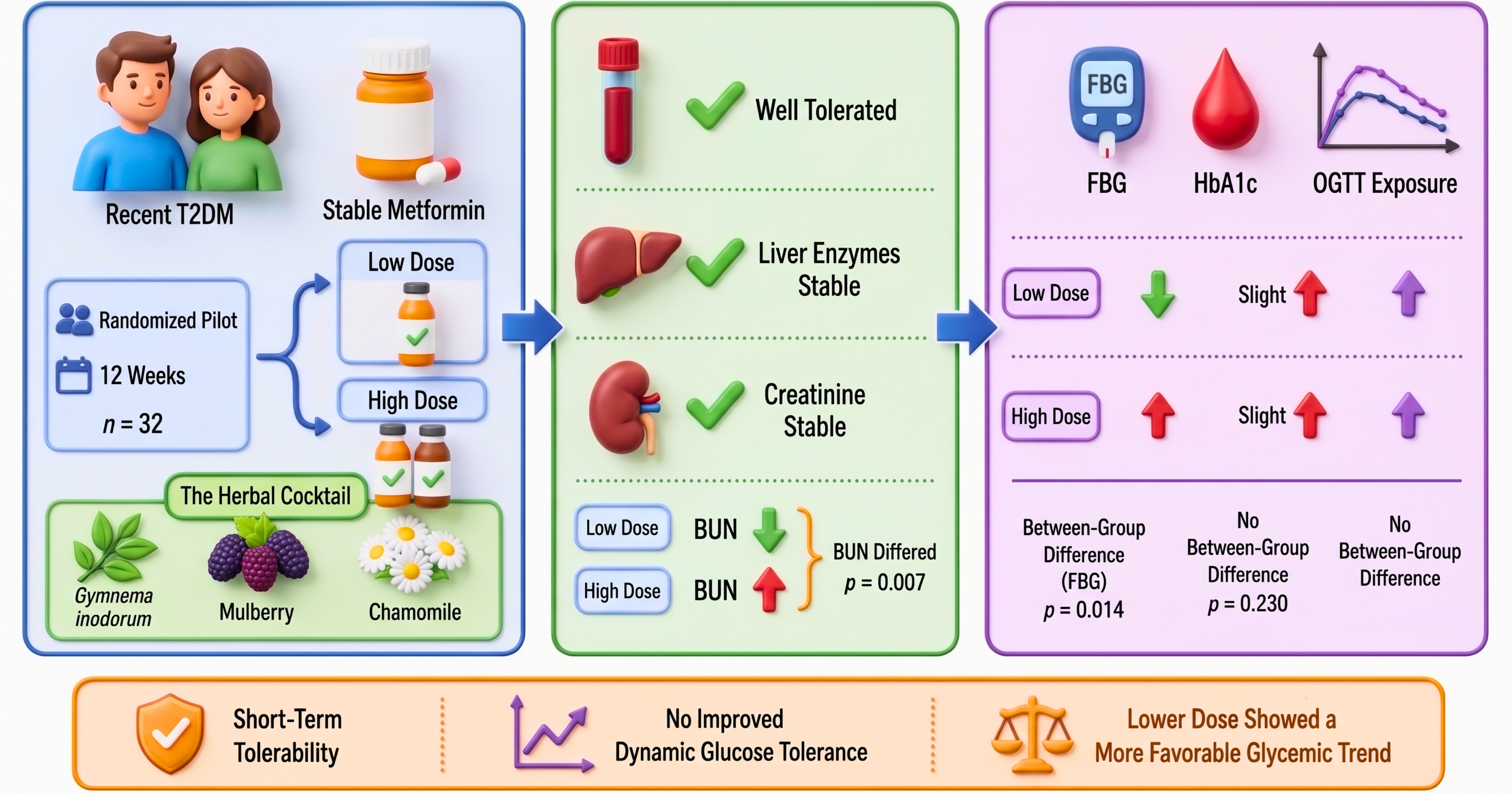
Gymnema inodorum is a popular traditional remedy for diabetes, yet clinical safety data for multi-herb beverages combined with metformin remain limited. This 12-week, open-label, randomized pilot study compared two daily doses of a G. inodorum–mulberry–chamomile beverage in adults with recently diagnosed type 2 diabetes mellitus (≤6 months since diagnosis) receiving stable metformin monotherapy. Thirty-two T2DM patients receiving metformin were assigned to consume the beverage at 150 mL/day (Group A) or 300 mL/day (Group B). The primary outcomes assessed safety markers, including hematology and hepatic and renal function. Secondary outcomes included fasting blood glucose (FBG), HbA1C, and oral glucose tolerance test (OGTT) indices. The beverage was generally well tolerated over 12 weeks; liver enzymes and serum creatinine remained stable in both groups. BUN changed differently between groups (p = 0.007), decreasing slightly in Group A but increasing in Group B. FBG changed by −6.21 mg/dL in Group A and +22.25 mg/dL in Group B (between-group p = 0.014), whereas HbA1C changed by +0.23% in Group A and +0.42% in Group B, with no significant between-group difference (p = 0.230). OGTT glucose exposure increased within both groups (Group A: tAUC +12,821 and iAUC +12,209; Group B: tAUC +15,504 and iAUC +12,651), with no significant between-group difference. These findings indicate short-term tolerability but do not demonstrate improved dynamic glucose tolerance; the lower dose showed a more favorable glycemic trend than the higher dose in this small non-placebo pilot. However, this observation is hypothesis-generating and should not be interpreted as a clinical recommendation.
References
Alasvand Zarasvand, S., Ogawa, S., Nestor, B., Bridges, W., & Haley-Zitlin, V. (2025). Effects of herbal tea (Non–Camellia sinensis) on glucose homeostasis and serum lipids in type 2 diabetes mellitus: A systematic review and meta-analysis. Nutrition Reviews, 83(3), e1128-e1145. https://doi.org/10.1093/nutrit/nuae068
An, J. P., Park, E. J., Ryu, B., Lee, B. W., Cho, H. M., Doan, T. P., ... & Oh, W. K. (2020). Oleanane triterpenoids from the leaves of Gymnema inodorum and their insulin mimetic activities. Journal of Natural Products, 83(4), 1265-1274. https://doi.org/10.1021/acs.jnatprod.0c00051
Beck, R. W., Bergenstal, R. M., Riddlesworth, T. D., Kollman, C., Li, Z., Brown, A. S., & Close, K. L. (2019). Validation of time in range as an outcome measure for diabetes clinical trials. Diabetes Care, 42(3), 400-405. https://doi.org/10.2337/dc18-1444
Bespinyowong, R., Pongthananikorn, S., & Chiabchalard, A. (2013). Efficacy and safety of Gymnema inodorum tea consumption in type 2 diabetic patients. Chulalongkorn Medical Journal, 57(5), 587-599. https://doi.org/10.58837/CHULA.CMJ.57.5.3
Cuschieri, S. (2019). Type 2 diabetes–An unresolved disease across centuries contributing to a public health emergency. Diabetes & Metabolic Syndrome: Clinical Research & Reviews, 13(1), 450-453. https://doi.org/10.1016/j.dsx.2018.11.010
Davies, M. J., Aroda, V. R., Collins, B. S., Gabbay, R. A., Green, J., Maruthur, N. M., … & Buse, J. B. (2022). Management of hyperglycemia in type 2 diabetes, 2022: A consensus report by the American Diabetes Association and the European Association for the Study of Diabetes. Diabetes Care, 45(11), 2753–2786. https://doi.org/10.2337/dci22-0034
Fongsodsri, K., Thaipitakwong, T., Rujimongkon, K., Kanjanapruthipong, T., Ampawong, S., Reamtong, O., & Aramwit, P. (2022). Mulberry-derived 1-deoxynojirimycin prevents type 2 diabetes mellitus progression via modulation of retinol-binding protein 4 and haptoglobin. Nutrients, 14(21), Article 4538. https://doi.org/10.3390/nu14214538
Gupta, R. C., Chang, D., Nammi, S., Bensoussan, A., Bilinski, K., & Roufogalis, B. D. (2017). Interactions between antidiabetic drugs and herbs: An overview of mechanisms of action and clinical implications. Diabetology & Metabolic Syndrome, 9(1), Article 59. https://doi.org/10.1186/s13098-017-0254-9
Haideri, M. H., Phanjaroen, T., Khiaolaongam, W., Boonchalaem, T., Laoung-On, J., Chaipoot, S., ... & Ounjaijean, S. (2024). Effect of different extraction techniques on phenolic profile and phytochemical potential of Gymnema inodorum leaf extract. Molecules, 29(22), Article 5475. https://doi.org/10.3390/molecules29225475
Hajizadeh-Sharafabad, F., Varshosaz, P., Jafari-Vayghan, H., Alizadeh, M., & Maleki, V. (2020). Chamomile (Matricaria recutita L.) and diabetes mellitus, current knowledge and the way forward: A systematic review. Complementary Therapies in Medicine, 48, Article 102284. https://doi.org/10.1016/j.ctim.2019.102284
Hwang, S. H., Li, H. M., Lim, S. S., Wang, Z., Hong, J. S., & Huang, B. (2016). Evaluation of a standardized extract from Morus alba against α‐Glucosidase inhibitory effect and postprandial antihyperglycemic in patients with impaired glucose tolerance: A randomized double‐blind clinical trial. Evidence‐Based Complementary and Alternative Medicine, 2016(1), Article 8983232. https://doi.org/10.1155/2016/8983232
Karthigesu, K., Sivapalan, S., Rajendra, S., Navaratinaraja, T. S., Kesavan, V., & Premakumara, S. (2024). Effect of Gymnema lactiferum tea brew on type 2 diabetes mellitus: A double-blind, randomised active-controlled phase III clinical trial. Clinical Traditional Medicine and Pharmacology, 5(3), Article 200164. https://doi.org/10.1016/j.ctmp.2024.200164
Kaseb, F., Yazdanpanah, Z., Biregani, A. N., Yazdi, N. B., & Yazdanpanah, Z. (2018). The effect of chamomile (Matricaria recutita L.) infusion on blood glucose, lipid profile and kidney function in type 2 diabetic patients: A randomized clinical trial. Progress in Nutrition, 20(1), 110-118. https://doi.org/10.23751/pn.v20i1-S.5884
Knopp, J. L., Holder-Pearson, L., & Chase, J. G. (2019). Insulin units and conversion factors: A story of truth, boots, and faster half-truths. Journal of Diabetes Science and Technology, 13(3), 597-600. https://doi.org/10.1177/1932296818805074
Kumar, S., Sharma, S. K., Mudgal, S. K., Gaur, R., Agarwal, R., Singh, H., & Kalra, S. (2023). Comparative effectiveness of six herbs in the management of glycemic status of type 2 diabetes mellitus patients: A systematic review and network meta-analysis of randomized controlled trials. Diabetes & Metabolic Syndrome: Clinical Research & Reviews, 17(8), Article 102826. https://doi.org/10.1016/j.dsx.2023.102826
LeRoith, D. (2002). β-cell dysfunction and insulin resistance in type 2 diabetes: Role of metabolic and genetic abnormalities. The American Journal of Medicine, 113(6), 3-11. https://doi.org/10.1016/S0002-9343(02)01276-7
Magliano, D. J., Boyko, E. J., & IDF Diabetes Atlas 10th Edition Scientific Committee. (2021). IDF diabetes atlas (10th ed.). International Diabetes Federation. Retrieved from www.diabetesatlas.org
Majeed, M., Majeed, A., Nagabhusahnam, K., Mundkur, L., & Paulose, S. (2021). A randomized, double-blind clinical trial of a herbal formulation (GlycaCare-II) for the management of type 2 diabetes in comparison with metformin. Diabetology & Metabolic Syndrome, 13(1), Article 132. https://doi.org/10.1186/s13098-021-00746-0
Nayebi, N., Esteghamati, A., Meysamie, A., Khalili, N., Kamalinejad, M., Emtiazy, M., & Hashempur, M. H. (2019). The effects of a Melissa officinalis L. based product on metabolic parameters in patients with type 2 diabetes mellitus: A randomized double-blinded controlled clinical trial. Journal of Complementary and Integrative Medicine, 16(3), Article 20180088. https://doi.org/10.1515/jcim-2018-0088
Ota, A., & Ulrih, N. P. (2017). An overview of herbal products and secondary metabolites used for management of type two diabetes. Frontiers in Pharmacology, 8, Article 436. https://doi.org/10.3389/fphar.2017.00436
Permsuwan, U., & Deerochanawong, C. (2025). Budget impact analysis of insulin glargine vs. isophane protamine insulin treatment for patients with type-2 diabetes and severe hypoglycemia in Thailand. Frontiers in Public Health, 12, Article 1415908. https://doi.org/10.3389/fpubh.2024.1415908
Phanjaroen, T., Haideri, M. H., Khiaolaongam, W., Somsak, V., Boonyapranai, K., & Ounjaijean, S. (2024). Phytochemical content, antioxidant and α-glucosidase inhibitory activities of Gynostemma pentaphyllum and Gymnema inodorum extracts. Journal of Current Science and Technology, 14(3), Article 54. https://doi.org/10.59796/jcst.V14N3.2024.54
Rafraf, M., Zemestani, M., & Asghari-Jafarabadi, M. (2015). Effectiveness of chamomile tea on glycemic control and serum lipid profile in patients with type 2 diabetes. Journal of Endocrinological Investigation, 38(2), 163-170. https://doi.org/10.1007/s40618-014-0170-x
Stage, T. B., Brøsen, K., & Christensen, M. M. H. (2015). A comprehensive review of drug–drug interactions with metformin. Clinical Pharmacokinetics, 54(8), 811-824. https://doi.org/10.1007/s40262-015-0270-6
Taghizadeh, M., Zadeh, A. M., Asemi, Z., Farrokhnezhad, A. H., Memarzadeh, M. R., Banikazemi, Z., ... & Shafabakhsh, R. (2022). Morus Alba leaf extract affects metabolic profiles, biomarkers inflammation and oxidative stress in patients with type 2 diabetes mellitus: A double-blind clinical trial. Clinical Nutrition ESPEN, 49, 68-73. https://doi.org/10.1016/j.clnesp.2022.03.027
Xu, R., Bai, Y., Yang, K., & Chen, G. (2020). Effects of green tea consumption on glycemic control: A systematic review and meta-analysis of randomized controlled trials. Nutrition & Metabolism, 17(1), Article 56. https://doi.org/10.1186/s12986-020-00469-5
Yoon, H. (2020). Relationship between metabolic syndrome, metabolic syndrome score, insulin resistance and beta cell function in Korean adults with obesity. Korean Journal of Clinical Laboratory Science, 52(4), 327-334. https://doi.org/10.15324/kjcls.2020.52.4.327
Zhang, J., Liu, M., Hu, B., & Wang, L. (2022a). Exercise combined with a Chinese medicine herbal tea for patients with type 2 diabetes mellitus: a randomized controlled trial. Journal of Integrative and Complementary Medicine, 28(11), 878-886. https://doi.org/10.1089/jicm.2022.0580
Zhang, X., Zhang, L., Zhang, B., Liu, K., Sun, J., Li, Q., & Zhao, L. (2022b). Herbal tea, a novel adjuvant therapy for treating type 2 diabetes mellitus: A review. Frontiers in Pharmacology, 13, Article 982387. https://doi.org/10.3389/fphar.2022.982387
Zheng, Y., Ley, S. H., & Hu, F. B. (2018). Global aetiology and epidemiology of type 2 diabetes mellitus and its complications. Nature Reviews Endocrinology, 14(2), 88-98. https://doi.org/10.1038/nrendo.2017.151
Zubair, M., & Launico, M. V. (2025). Glucose tolerance test. In StatPearls. StatPearls Publishing. Retrieved from https://www.ncbi.nlm.nih.gov/books/NBK532915/
Downloads
Published
How to Cite
Issue
Section
Categories
License
Copyright (c) 2026 Journal of Current Science and Technology

This work is licensed under a Creative Commons Attribution-NonCommercial-NoDerivatives 4.0 International License.