Efficacy of Collagen Biostimulator Injections for Facial Aesthetics: A Systematic Review and Meta-analysis Based on Global Aesthetic Improvement Scale (GAIS) Outcomes
DOI:
https://doi.org/10.59796/jcst.V16N3.2026.199Keywords:
adverse events, collagen biostimulators, facial aesthetics, Global Aesthetic Improvement Scale (GAIS), systematic review and meta-analysisAbstract
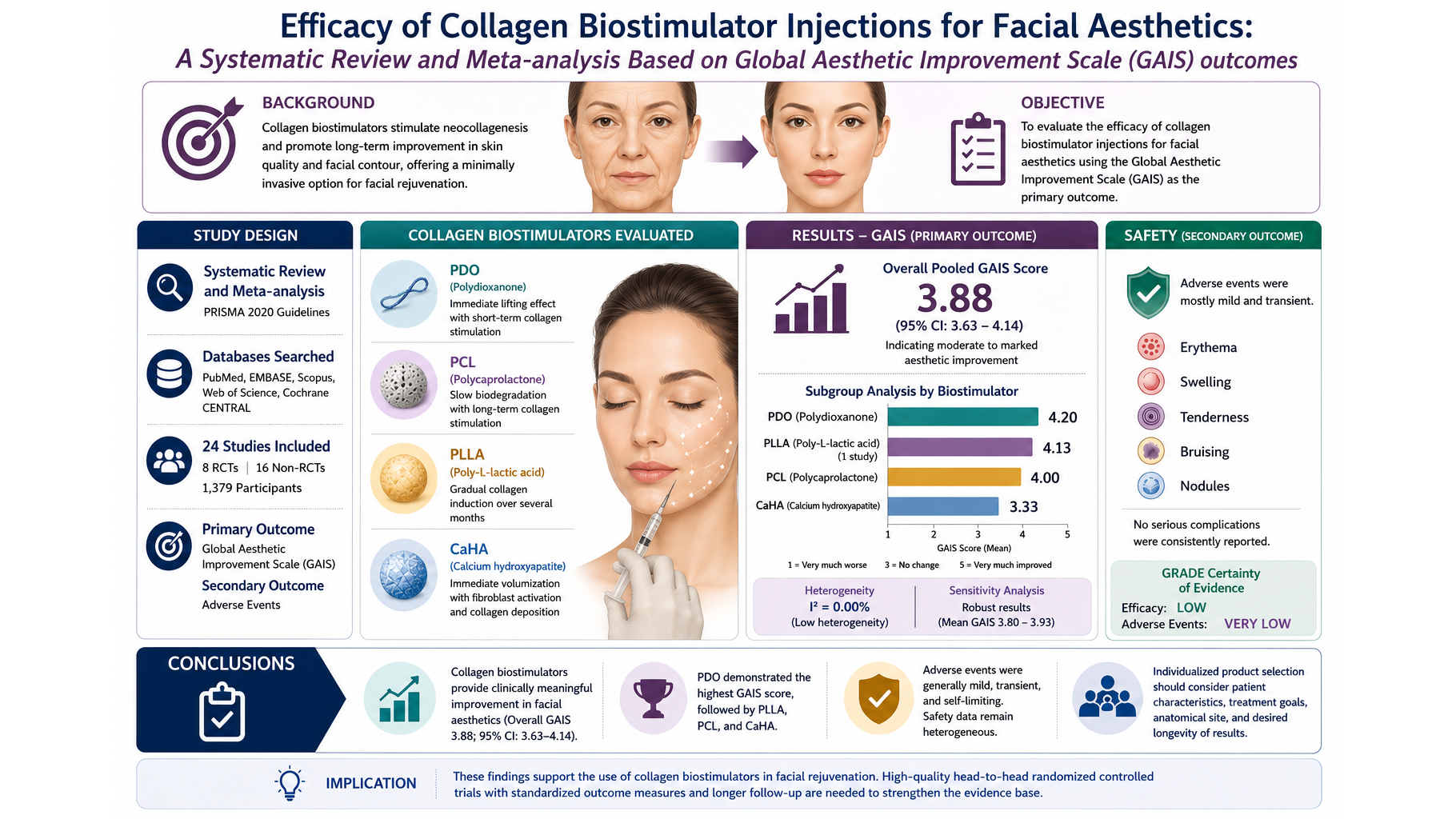
This systematic review and meta-analysis evaluated the efficacy of injectable collagen biostimulators for facial aesthetic enhancement. The primary outcome was the Global Aesthetic Improvement Scale (GAIS), with adverse events assessed as a secondary outcome. A comprehensive literature search was conducted across five databases (PubMed, Embase, Scopus, Web of Science, and Cochrane CENTRAL) following the PRISMA 2020 guidelines. Eligible studies included healthy adults receiving facial injections of poly-L-lactic acid (PLLA), polydioxanone (PDO), calcium hydroxylapatite (CaHA), polycaprolactone (PCL), or poly-D,L-lactic acid (PDLLA); however, no eligible PDLLA studies were identified. The included studies consisted of randomized controlled trials and observational studies. Data were synthesized using a random-effects meta-analysis model, and the risk of bias was evaluated using the RoB 2 and ROBINS-I tools. Twenty-four studies were included in the quantitative synthesis. The pooled mean GAIS score was 3.88 (95% CI: 3.63–4.14), indicating moderate to marked aesthetic improvement. Subgroup analysis revealed the highest GAIS scores with PDO (4.20), followed by PLLA (4.13, single study), PCL (4.00), and CaHA (3.33). Reported adverse events were mostly mild and transient, including erythema, swelling, and tenderness. Based on the GRADE assessment, the overall certainty of evidence was low for efficacy and very low for adverse events. Collagen biostimulators demonstrated favorable efficacy profiles for facial rejuvenation. Although all four agents were effective, outcomes varied by product type, suggesting the importance of personalized treatment selection. These findings provide evidence-based support for clinical application and highlight the need for future comparative studies with standardized outcome reporting.
References
Amiri, M., Mecani, R., Llanaj, E., Niehot, C. D., Phillips, T. L., Goldie, K., ... & Daughtry, H. (2024). Calcium hydroxylapatite (CaHA) and aesthetic outcomes: A systematic review of controlled clinical trials. Journal of Clinical Medicine, 13(6), Article 1686. https://doi.org/10.3390/jcm13061686
Bae, B., Lee, G., & Hong, K. (2016). Safety and long-term efficacy of forehead contouring with a polycaprolactone-based dermal filler. Dermatologic Surgery, 42(11), 1256-1260. https://doi.org/10.1097/DSS.0000000000000913
Barbarino, S. C. (2021). Correction of temporal wasting using calcium hydroxylapatite with integral lidocaine: An underused procedure for enhancing overall facial appearance. Journal of Cosmetic Dermatology, 20(1), 62-66. https://doi.org/10.1111/jocd.13505
Bass, L. S., Smith, S., Busso, M., & McClaren, M. (2010). Calcium hydroxylapatite (Radiesse) for treatment of nasolabial folds: Long-term safety and efficacy results. Aesthetic Surgery Journal, 30(2), 235-238. https://doi.org/10.1177/1090820X10366549
Boen, M., Alhaddad, M., Goldman, M. P., Kollipara, R., Hoss, E., & Wu, D. C. (2020). A randomized, evaluator-blind, split-face study evaluating the safety and efficacy of calcium hydroxylapatite for jawline augmentation. Dermatologic Surgery, 48(1), 76-81. https://doi.org/10.1097/DSS.0000000000002582
Borenstein, M., Hedges, L. V., Higgins, J. P. T., & Rothstein, H. R. (2009). Introduction to meta-analysis. John Wiley & Sons. https://doi.org/10.1002/9780470743386
Chandler, J., Cumpston, M., Li, T., Page, M. J., & Welch, V. J. H. W. (2019). Cochrane handbook for systematic reviews of interventions (2nd ed.). Hoboken: Wiley, 4(1002), Article 14651858.
Corduff, N. (2020). An alternative periorbital treatment option using calcium hydroxyapatite for hyperpigmentation associated with the tear trough deformity. Plastic and Reconstructive Surgery–Global Open, 8(2), Article e2633. https://doi.org/10.1097/GOX.0000000000002633
Fu, X., Qiao, J., Liu, J., Chen, Y., Jin, Q., Xu, S., ... & Niu, F. (2023). Stab access fascia suspension lift: A facelift technique without skin excision and visible scar. Journal of Cosmetic Dermatology, 22(3), 897-906. https://doi.org/10.1111/jocd.15496
Galadari, H., van Abel, D., Al Nuami, K., Al Faresi, F., & Galadari, I. (2015). A randomized, prospective, blinded, split‐face, single‐center study comparing polycaprolactone to hyaluronic acid for treatment of nasolabial folds. Journal of Cosmetic Dermatology, 14(1), 27-32. https://doi.org/10.1111/jocd.12126
Green, J. B., Del Campo, R., Durkin, A. J., Funt, D. K., Nasrallah, N., Martinez, K., & Moradi, A. (2024). Long‐term duration and safety of Radiesse (+) for the treatment of jawline. Journal of Cosmetic Dermatology, 23(10), 3202-3209. https://doi.org/10.1111/jocd.16436
Higgins, J. P., Thompson, S. G., Deeks, J. J., & Altman, D. G. (2003). Measuring inconsistency in meta-analyses. BMJ, 327(7414), 557-560. https://doi.org/10.1136/bmj.327.7414.557
Jeong, G. J., Ahn, G. R., Park, S. J., Hong, J. Y., & Kim, B. J. (2020). A randomized, patient/evaluator‐blinded, split‐face study to compare the efficacy and safety of polycaprolactone and polynucleotide fillers in the correction of crow's feet: the latest biostimulatory dermal filler for crow's feet. Journal of Cosmetic Dermatology, 19(7), 1593-1599. https://doi.org/10.1111/jocd.13199
Juhász, M. L., Levin, M. K., & Marmur, E. S. (2018). Pilot study examining the safety and efficacy of calcium hydroxylapatite filler with integral lidocaine over a 12-month period to correct temporal fossa volume loss. Dermatologic Surgery, 44(1), 93-100. https://doi.org/10.1097/DSS.0000000000001268
Kang, S. H., Moon, S. H., Rho, B. I., Youn, S. J., & Kim, H. S. (2019). Wedge‐shaped polydioxanone threads in a folded configuration (“Solid fillers”): A treatment option for deep static wrinkles on the upper face. Journal of Cosmetic Dermatology, 18(1), 65-70. https://doi.org/10.1111/jocd.12557
Khan, G., Ahn, K. H., Kim, S. Y., & Park, E. (2021). Combined press cog type and cog PDO threads in comparison with the cog PDO threads in facial rejuvenation. Journal of Cosmetic Dermatology, 20(10), 3294-3298. https://doi.org/10.1111/jocd.14092
Khan, G., Kim, B. J., Kim, D. G., & Park, E. (2022). Retrospective study of the absorbable braided polydioxanone threads’ usefulness in the aged lower eyelids' rejuvenation. Journal of Cosmetic Dermatology, 21(11), 5952-5956. https://doi.org/10.1111/jocd.15257
Liao, Z. F., She, Y. H., Huang, J. M., Yang, W., Lou, X., Pan, B. H., ... & Luo, S. K. (2024). Cross-linked sodium hyaluronate gel with PLLA-b-PEG microsphere for facial contouring in Chinese: A retrospective study. Aesthetic Plastic Surgery, 48(21), 4252-4261. https://doi.org/10.1007/s00266-024-04195-8
Moers-Carpi, M., Christen, M. O., Delmar, H., Brun, P., Bodokh, I., & Kestemont, P. (2021). European multicenter prospective study evaluating long-term safety and efficacy of the polycaprolactone-based dermal filler in nasolabial fold correction. Dermatologic Surgery, 47(7), 960-965. https://doi.org/10.1097/DSS.0000000000002978
Moers‐Carpi, M. M., & Tufet, J. O. (2008). Calcium hydroxylapatite versus nonanimal stabilized hyaluronic acid for the correction of nasolabial folds: A 12‐month, multicenter, prospective, randomized, controlled, split‐face trial. Dermatologic Surgery, 34(2), 210-215. https://doi.org/10.1097/00042728-200802000-00010
Moers‐Carpi, M. M., & Sherwood, S. (2013). Polycaprolactone for the correction of nasolabial folds: A 24‐month, prospective, randomized, controlled clinical trial. Dermatologic Surgery, 39(3pt1), 457-463. https://doi.org/10.1111/dsu.12054
Moers‐Carpi, M. M., Vogt, S., Santos, B. M., Planas, J., Vallve, S. R., & Howell, D. J. (2007). A multicenter, randomized trial comparing calcium hydroxylapatite to two hyaluronic acids for treatment of nasolabial folds. Dermatologic Surgery, 33, S144-S151. https://doi.org/10.1111/j.1524-4725.2007.33354.x
Moon, H. J., Chang, D., & Lee, W. (2020). Short-term treatment outcomes of facial rejuvenation using the mint lift fine. Plastic and Reconstructive Surgery–Global Open, 8(4), Article e2775. https://doi.org/10.1097/GOX.0000000000002775
Page, M. J., McKenzie, J. E., Bossuyt, P. M., Boutron, I., Hoffmann, T. C., Mulrow, C. D., ... & Moher, D. (2021). The PRISMA 2020 statement: an updated guideline for reporting systematic reviews. BMJ, 372, Article n71. https://doi.org/10.1136/bmj.n71
Park, J. W., Choi, S. Y., Kim, K. R., Jin, M., Seok, J., Yoo, K. H., & Kim, B. J. (2022). A randomized, participant‐and evaluator‐blinded, matched‐pair prospective study to compare the safety and efficacy between polycaprolactone‐based fillers in the correction of nasolabial folds. Dermatologic Therapy, 35(7), Article e15508. https://doi.org/10.1111/dth.15508
Preibisz, L., Boulmé, F., & Paul Lorenc, Z. (2022). Barbed polydioxanone sutures for face recontouring: six-month safety and effectiveness data supported by objective markerless tracking analysis. Aesthetic Surgery Journal, 42(1), NP41-NP54. https://doi.org/10.1093/asj/sjab359
Scardua, N., Rovaris, D. P., Moreira, K. M. S., Guimarães, A. L. S., & Scardua, M. T. (2024). Supraperiosteal technique protocol for forehead filling with a mixture of calcium hydroxyapatite and hyaluronic acid: Double‐blind, randomized controlled clinical trial. Journal of Cosmetic Dermatology, 23(12), 4116-4122. https://doi.org/10.1111/jocd.16488
Sterne, J. A., Savović, J., Page, M. J., Elbers, R. G., Blencowe, N. S., Boutron, I., ... & Higgins, J. P. (2019). RoB 2: A revised tool for assessing risk of bias in randomised trials. BMJ, 366, Article l4898. https://doi.org/10.1136/bmj.l4898
Trinh, L. N., Grond, S. E., & Gupta, A. (2022). Dermal fillers for tear trough rejuvenation: A systematic review. Facial Plastic Surgery, 38(03), 228-239. https://doi.org/10.1055/s-0041-1731348
Unal, M., İslamoğlu, G. K., Ürün Unal, G., & Köylü, N. (2021). Experiences of barbed polydioxanone (PDO) cog thread for facial rejuvenation and our technique to prevent thread migration. Journal of Dermatological Treatment, 32(2), 227-230. https://doi.org/10.1080/09546634.2019.1640347
Wollina, U., & Goldman, A. (2020). Long lasting facial rejuvenation by repeated placement of calcium hydroxylapatite in elderly women. Dermatologic Therapy, 33(6), Article e14183. https://doi.org/10.1111/dth.14183
Downloads
Published
How to Cite
Issue
Section
Categories
License
Copyright (c) 2026 Journal of Current Science and Technology

This work is licensed under a Creative Commons Attribution-NonCommercial-NoDerivatives 4.0 International License.