Oral Health-promoting Potential of Standardized Cyanthillium cinereum (Ya Dok Kao) Extract: Anti-inflammatory and Cytoprotective Activities
DOI:
https://doi.org/10.59796/jcst.V16N3.2026.196Keywords:
COX-2, flavonoids, iNOS, nitric oxide, smoking, TNF-α, oxidative stress.Abstract
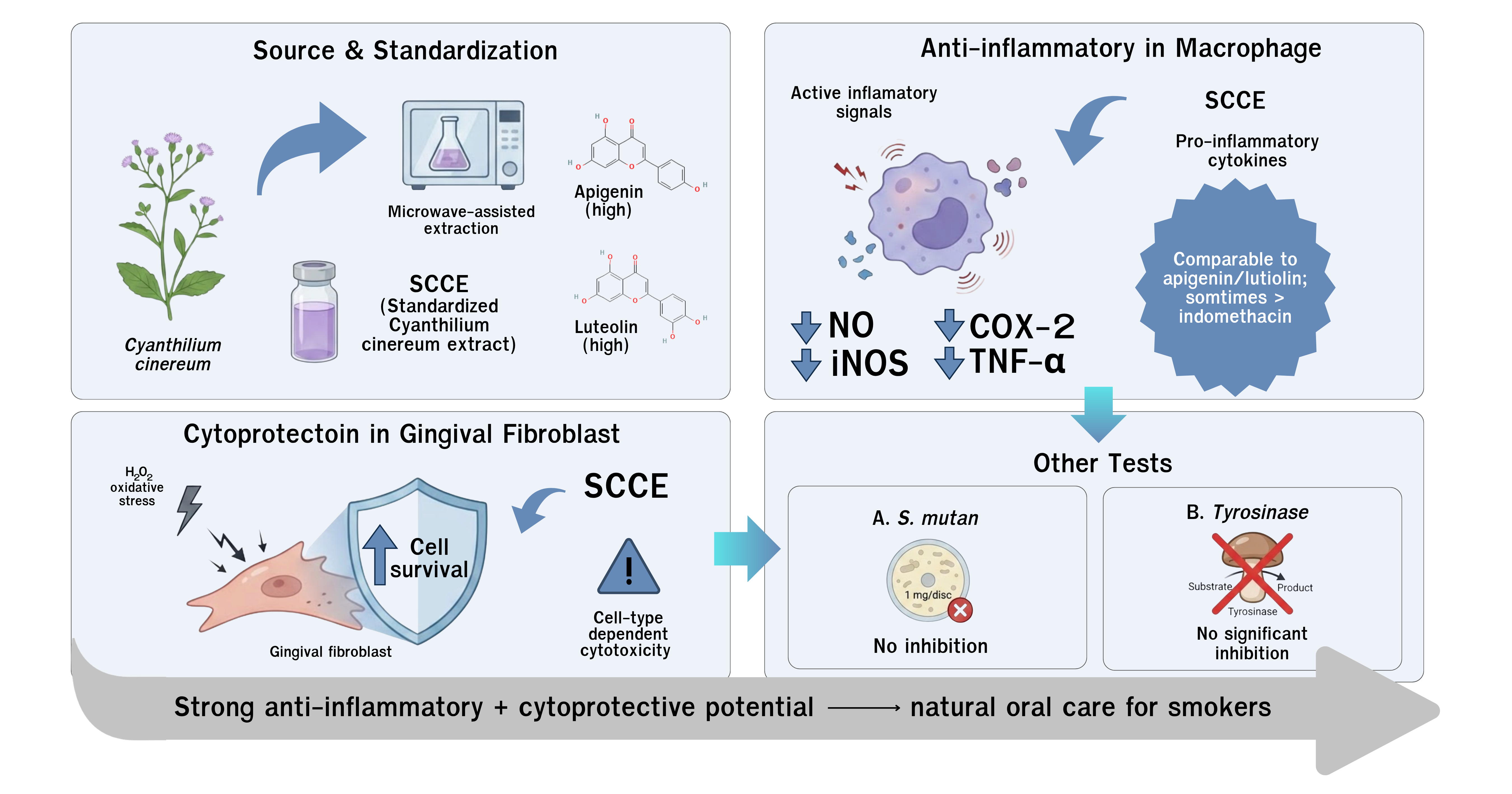
Cigarette smoking causes oral inflammation, dental caries, and gingival hyperpigmentation, thereby impairing oral health and self-confidence. This study evaluated the potential of standardized Cyanthillium cinereum extract (SCCE) in oral health promotion, focusing on its anti-inflammatory, cytoprotective, antibacterial, and anti-tyrosinase activities. SCCE was prepared using microwave-assisted extraction and standardized to contain high levels of apigenin and luteolin contents. Anti-inflammatory effects were assessed in murine macrophages by measuring nitric oxide scavenging activity and the expression of inducible nitric oxide synthase (iNOS), cyclooxygenase-2 (COX-2), and tumor necrosis factor-α (TNF-α). Cytoprotective activity was evaluated in human gingival fibroblasts exposed to H₂O₂. Antibacterial activity against Streptococcus mutans was tested using disc diffusion method, while tyrosinase inhibitory activity was examined using enzymatic assays. SCCE effectively scavenged nitric oxide (IC50 of 189.20 mg/mL) and significantly suppressed iNOS, COX-2, and TNF-α expression in macrophages. Its activity was comparable to apigenin and luteolin, and in some assays superior to indomethacin. SCCE also protected gingival fibroblasts from H₂O₂-induced cell death, with cell viability up to 57.29 - 73.66%, though its cytotoxicity profile varied by cell type. However, SCCE demonstrated no antibacterial activity against S. mutans at 1 mg/disc and showed no significant tyrosinase inhibition. SCCE exhibits strong anti-inflammatory and cytoprotective effects, supporting its potential as a natural oral healthcare product for smokers. Despite its limited antibacterial and tyrosinase inhibitory activities, its anti-inflammatory and antioxidative properties highlight its promise in mitigating smoking-related oral health problems. Further clinical studies and prototype formulation development are warranted to advance its application.
References
Aziz, N., Kim, M. Y., & Cho, J. Y. (2018). Anti-inflammatory effects of luteolin: A review of in vitro, in vivo, and in silico studies. Journal of Ethnopharmacology, 225, 342-358. https://doi.org/10.1016/j.jep.2018.05.019
Bielecka-Kowalska, N. P., Bielicka, S., & Lewkowicz, N. (2022). Effects of tobacco smoking and electronic nicotine delivery systems on oral health–a narrative review. Journal of Pre-Clinical and Clinical Research, 16(3), 118-125. https://doi.org/10.26444/jpccr/154648
Bradbury, C. M., Markovina, S., Wei, S. J., Rene, L. M., Zoberi, I., Horikoshi, N., & Gius, D. (2001). Indomethacin-induced radiosensitization and inhibition of ionizing radiation-induced NF-κB activation in HeLa cells occur via a mechanism involving p38 MAP kinase. Cancer Research, 61(20), 7689-7696.
Chaiwong, S., Puttarak, P., Sretrirutchai, S., & Kaewsuwan, S. (2019). In vitro anti-inflammatory and antioxidative activities of isolated interruptins from Cyclosorus terminans. Latin American Journal of Pharmacy, 38(8), 1677-82.
Chaiwong, S., Sretrirutchai, S., Sung, J. H., & Kaewsuwan, S. (2024). Antioxidative and anti-photooxidative potential of interruptins from the edible fern Cyclosorus terminans in human skin cells. Current Pharmaceutical Biotechnology, 25(4), 468-476. https://doi.org/10.2174/1389201024666230614162152
Chen, C. Y., Peng, W. H., Tsai, K. D., & Hsu, S. L. (2007). Luteolin suppresses inflammation-associated gene expression by blocking NF-κB and AP-1 activation pathway in mouse alveolar macrophages. Life Sciences, 81(23-24), 1602-1614. https://doi.org/10.1016/j.lfs.2007.09.028
Chen, H. I., Hu, W. S., Hung, M. Y., Ou, H. C., Huang, S. H., Hsu, P. T., ... & Huang, C. Y. (2020). Protective effects of luteolin against oxidative stress and mitochondrial dysfunction in endothelial cells. Nutrition, Metabolism and Cardiovascular Diseases, 30(6), 1032-1043. https://doi.org/10.1016/j.numecd.2020.02.014
Chen, L. Y., Cheng, H. L., Kuan, Y. H., Liang, T. J., Chao, Y. Y., & Lin, H. C. (2021). Therapeutic potential of luteolin on impaired wound healing in streptozotocin-induced rats. Biomedicines, 9(7), Article 761. https://doi.org/10.3390/biomedicines9070761
Crascì, L., Cardile, V., Longhitano, G., Nanfitò, F., & Panico, A. (2018). Anti-degenerative effect of Apigenin, Luteolin and Quercetin on human keratinocyte and chondrocyte cultures: SAR evaluation. Drug Research, 68(03), 132-138. https://doi.org/10.1055/s-0043-120662
Dej-Adisai, S., Parndaeng, K., Wattanapiromsakul, C., & Hwang, J. S. (2021). Three new isoprenylated flavones from Artocarpus chama stem and their bioactivities. Molecules, 27(1), Article 3. https://doi.org/10.3390/molecules27010003
Ebrahimzadeh, M. A., Nabavi, S. F., Nabavi, S. M., & Pourmorad, F. (2010). Nitric oxide radical scavenging potential of some Elburz medicinal plants. African Journal of Biotechnology, 9(32), 5212–5217. https://doi.org/10.5897/AJB10.101
Funakoshi-Tago, M., Nakamura, K., Tago, K., Mashino, T., & Kasahara, T. (2011). Anti-inflammatory activity of structurally related flavonoids, Apigenin, Luteolin and Fisetin. International Immunopharmacology, 11(9), 1150-1159. https://doi.org/10.1016/j.intimp.2011.03.012
Gajendra, S., McIntosh, S., & Ghosh, S. (2023). Effects of tobacco product use on oral health and the role of oral healthcare providers in cessation: A narrative review. Tobacco Induced Diseases, 21, Article 12. https://doi.org/10.18332/tid/157203
Gupta, S. C., Sundaram, C., Reuter, S., & Aggarwal, B. B. (2010). Inhibiting NF-κB activation by small molecules as a therapeutic strategy. Biochimica et Biophysica Acta (BBA)-Gene Regulatory Mechanisms, 1799(10-12), 775-787. https://doi.org/10.1016/j.bbagrm.2010.05.004
Hedin, C. A., Pindborg, J. J., & Axell, T. (1993). Disappearance of smoker's melanosis after reducing smoking. Journal of Oral Pathology & Medicine, 22(5), 228-230. https://doi.org/10.1111/j.1600-0714.1993.tb01061.x
Huang, R., Li, M., & Gregory, R. L. (2012). Effect of nicotine on growth and metabolism of Streptococcus mutans. European Journal of Oral Sciences, 120(4), 319-325. https://doi.org/10.1111/j.1600-0722.2012.00971.x
International Organization for Standardization (ISO). (2009). 10993–5: 2009 Biological evaluation of medical devices part 5: tests for in vitro cytotoxicity. International Organization for Standardization, Geneva.
Jin, B. H., Qian, L. B., Chen, S., Li, J., Wang, H. P., Bruce, I. C., ... & Xia, Q. (2009). Apigenin protects endothelium-dependent relaxation of rat aorta against oxidative stress. European Journal of Pharmacology, 616(1-3), 200-205. https://doi.org/10.1016/j.ejphar.2009.06.020
Johnson, N. W., & Bain, C. A. (2000). Tobacco and oral disease. British Dental Journal, 189(4), 200-206. https://doi.org/10.1038/sj.bdj.4800721
Kaji, M., & Puttarak, P. (2022). Development of standardized Cyanthillium cinereum (L.) H. Rob. Extract and determination of its biological activities. The Natural Products Journal, 12(5), 46-54. https://doi.org/10.2174/2210315511666210927122616
Kashyap, P., Shikha, D., Thakur, M., & Aneja, A. (2022). Functionality of apigenin as a potent antioxidant with emphasis on bioavailability, metabolism, action mechanism and in vitro and in vivo studies: A review. Journal of Food Biochemistry, 46(4), Article e13950. https://doi.org/10.1111/jfbc.13950
Lee, S. M. (2014). Anti‐inflammatory effects of ginsenosides Rg5, Rz1, and Rk1: Inhibition of TNF‐α‐induced NF‐κB, COX‐2, and iNOS transcriptional expression. Phytotherapy Research, 28(12), 1893-1896. https://doi.org/10.1002/ptr.5203
Leo, M., D’Angeli, F., Genovese, C., Spila, A., Miele, C., Ramadan, D., ... & Guadagni, F. (2024). Oral health and nutraceutical agents. International Journal of Molecular Sciences, 25(17), Article 9733. https://doi.org/10.3390/ijms25179733
López-García, J., Lehocký, M., Humpolíček, P., & Sáha, P. (2014). HaCaT keratinocytes response on antimicrobial atelocollagen substrates: Extent of cytotoxicity, cell viability and proliferation. Journal of Functional Biomaterials, 5(2), 43-57. https://doi.org/10.3390/jfb5020043
Macambira, D. V. D. C., Almeida Júnior, J. S. D., Silveira, C. F. D. M., Sarrazin, S. L. F., Moraes, T. M. P., da Silva, B. A., ... & Barata, L. E. S. (2024). Antimicrobial activity on Streptococcus mutans and Enterococcus faecalis of Cyperus articulatus ethanolic extracts. Plants, 13(5), Article 689. https://doi.org/10.3390/plants13050689
Malcangi, G., Patano, A., Ciocia, A. M., Netti, A., Viapiano, F., Palumbo, I., ... & Inchingolo, A. M. (2023). Benefits of natural antioxidants on oral health. Antioxidants, 12(6), Article 1309. https://doi.org/10.3390/antiox12061309
McRobbie, H., Lee, M., & Juniper, Z. (2005). Non-nicotine pharmacotherapies for smoking cessation. Respiratory Medicine, 99(10), 1203-1212. https://doi.org/10.1016/j.rmed.2005.05.016
Prasopthum, A., Pouyfung, P., Sarapusit, S., Srisook, E., & Rongnoparut, P. (2015). Inhibition effects of Vernonia cinerea active compounds against cytochrome P450 2A6 and human monoamine oxidases, possible targets for reduction of tobacco dependence. Drug Metabolism and Pharmacokinetics, 30(2), 174-181. https://doi.org/10.1016/j.dmpk.2014.12.005
Puttarak, P., Pornpanyanukul, P., Meetam, T., Bunditanukul, K., & Chaiyakunapruk, N. (2018). Efficacy and safety of Vernonia cinerea (L.) Less. for smoking cessation: A systematic review and meta-analysis of randomized controlled trials. Complementary Therapies in Medicine, 37, 37-42. https://doi.org/10.1016/j.ctim.2018.01.009
Reibel, J. (2003). Tobacco and oral diseases update on the evidence, with recommendations. Medical Principles Practice, 12(suppl 1), 22-32. https://doi.org/10.1159/000069845
Sae-wong, C., Tansakul, P., & Tewtrakul, S. (2009). Anti-inflammatory mechanism of Kaempferia parviflora in murine macrophage cells (RAW 264.7) and in experimental animals. Journal of Ethnopharmacology, 124(3), 576-580. https://doi.org/10.1016/j.jep.2009.04.059
Shukla, S., & Gupta, S. (2010). Apigenin: A promising molecule for cancer prevention. Pharmaceutical research, 27(6), 962-978. https://doi.org/10.1007/s11095-010-0089-7
Sowmya, N. K., Sree, G. N., Patil, P., & Mehta, D. S. (2022). Depigmenting effect of banana stem and flower on melanocytes. Journal of Oral Biology and Craniofacial Research, 12(4), 454-457. https://doi.org/10.1016/j.jobcr.2022.05.015
Suriyaprom, S., Ngamsaard, P., Intachaisri, V., Cheepchirasuk, N., Panya, A., Kaewkod, T., & Tragoolpua, Y. (2024). Inhibition of oral pathogenic bacteria, suppression of bacterial adhesion and invasion on human squamous carcinoma cell line (HSC-4 cells), and antioxidant activity of plant extracts from Acanthaceae family. Plants, 13(18), Article 2622. https://doi.org/10.3390/plants13182622
Techaoei, S. (2022). Time-kill kinetics and antimicrobial activities of Thai medical plant extracts against fish pathogenic bacteria. Journal of Advanced Pharmaceutical Technology & Research, 13(1), 25-29. https://doi.org/10.4103/japtr.japtr_241_21
Warnakulasuriya, S., Dietrich, T., Bornstein, M. M., Peidró, E. C., Preshaw, P. M., Walter, C., ... & Bergström, J. (2010). Oral health risks of tobacco use and effects of cessation. International Dental Journal, 60(1), 7-30. https://doi.org/10.1922/IDJ_2532Warnakulasuriya24
Winn, D. M. (2001). Tobacco use and oral disease. Journal of Dental Education, 65(4), 306-312. https://doi.org/10.1002/j.0022-0337.2001.65.4.tb03400.x
Wu, J., Li, M., & Huang, R. (2019). The effect of smoking on caries-related microorganisms. Tobacco Induced Diseases, 17, Article 32. https://doi.org/10.18332/tid/105913
Xu, H., Linn, B. S., Zhang, Y., & Ren, J. (2019). A review on the antioxidative and prooxidative properties of luteolin. React Oxygen Species, 7, 136-147. https://doi.org/10.20455/ros.2019.833
Ysrafil, Y., Sapiun, Z., Slamet, N. S., Mohamad, F., Hartati, H., Damiti, S. A., ... & Nainu, F. (2023). Anti-inflammatory activities of flavonoid derivates. ADMET and DMPK, 11(3), 331-359. https://doi.org/10.5599/admet.1918
Zhu, T., Zuo, W., Yan, J., Wen, P., Pei, Z., Lian, H., & Yang, H. C. (2020). Comparative assessment of the antioxidant activities among the extracts of different parts of Clausena lansium (Lour.) Skeels in human gingival fibroblast cells. Evidence‐Based Complementary and Alternative Medicine, 2020(1), Article 3958098. https://doi.org/10.1155/2020/3958098
Zonuz, A. T., Rahmati, A., Mortazavi, H., Khashabi, E., & Farahani, R. M. Z. (2008). Effect of cigarette smoke exposure on the growth of" Streptococcus mutans" and" Streptococcus sanguis": An in vitro study. Nicotine & Tobacco Research, 10(1), 63-67. https://doi.org/10.1080/14622200701705035
Downloads
Published
How to Cite
License
Copyright (c) 2026 Journal of Current Science and Technology

This work is licensed under a Creative Commons Attribution-NonCommercial-NoDerivatives 4.0 International License.