Transient Embryotoxicity and Disrupted Forebrain Architecture Following in Ovo Cannabidiol Exposure in Chick Embryo
DOI:
https://doi.org/10.59796/jcst.V16N4.2026.214Keywords:
cannabidiol, forebrain development, in ovo model, chick embryoAbstract
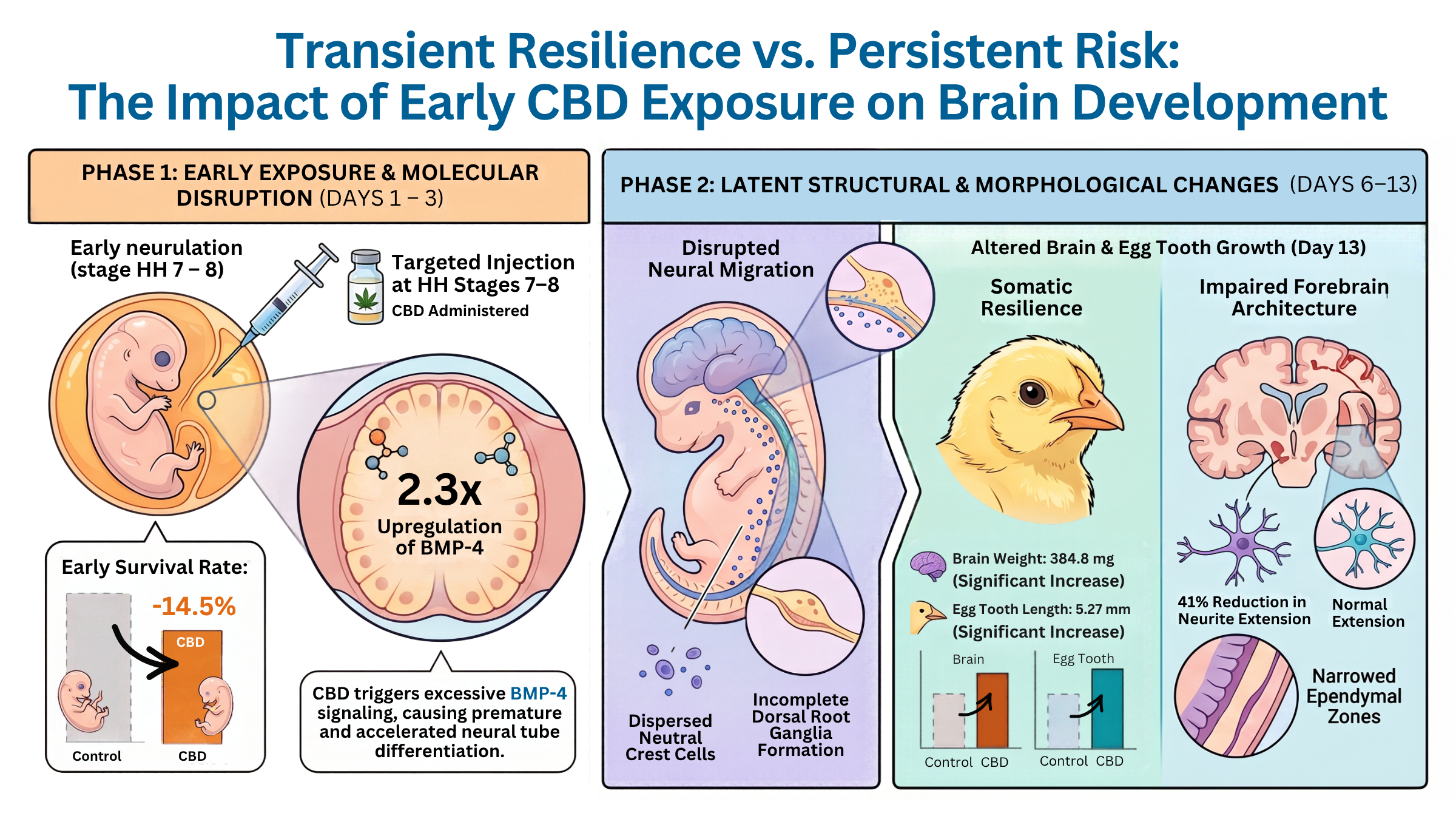
The increasing prevalence of cannabidiol (CBD) use during pregnancy raises concerns regarding its impact on fetal neurodevelopment. This study examined how the administration of CBD in ovo influences mortality rates, physical development, and the structural arrangement of the forebrain in avian embryos. Fertilized eggs were injected with 10 µM CBD or vehicle control into the yolk sac at Hamburger–Hamilton (HH) stages 7–8 (24 hours of incubation). Embryos were evaluated at Days 3, 6, and 13 using morphological, histological, and molecular analyses. Early exposure significantly reduced survival at Day 3 (79.3% vs. 93.8%, p = 0.041) and accelerated neural tube differentiation, coinciding with a 2.3-fold upregulation of Bone Morphogenetic Protein 4 (BMP-4) (p = 0.009). While survival rates showed a non-significant reduction by Day 6, transient growth retardation was observed. By Day 13, CBD-treated embryos exhibited distinct morphological alterations, including increased egg tooth length (p = 0.023) and brain weight (p = 0.007). Histological examination of the forebrain revealed narrowed ependymal zones, aberrant mesenchymal-like cell infiltration, and significantly reduced neurite extension. These findings suggest that early CBD exposure disrupts neurodevelopmental timing and forebrain architecture, potentially mediated through dysregulated BMP-4 signaling. Although embryos demonstrated somatic resilience, the persistent cellular and structural anomalies highlight the potential neuroteratogenic risks of CBD exposure during early embryogenesis.
References
Alves, P., Amaral, C., Teixeira, N., & Correia-da-Silva, G. (2020). Cannabis sativa: Much more beyond Δ9-tetrahydrocannabinol. Pharmacological Research, 157, Article 104822. https://doi.org/10.1016/j.phrs.2020.104822
Anderson, M. J., Schimmang, T., & Lewandoski, M. (2016). An FGF3-BMP signaling axis regulates caudal neural tube closure, neural crest specification and anterior-posterior axis extension. PLoS Genetics, 12(5), Article e1006018. https://doi.org/10.1371/journal.pgen.1006018
Dennis, D., Picketts, D., Slack, R. S., & Schuurmans, C. (2016). Forebrain neurogenesis: From embryo to adult. Trends in Developmental Biology, 9(1), 77-90. PMCID: PMC5373848
Duncan, R. S., Riordan, S. M., Gernon, M. C., & Koulen, P. (2024). Cannabinoids and endocannabinoids as therapeutics for nervous system disorders: Preclinical models and clinical studies. Neural Regeneration Research, 19(4), 788-799. https://doi.org/10.4103/1673-5374.382220
El‐Magd, M. A., Allen, S., McGonnell, I., Otto, A., & Patel, K. (2013). Bmp4 regulates chick Ebf2 and Ebf3 gene expression in somite development. Development, Growth & Differentiation, 55(8), 710-722. https://doi.org/10.1111/dgd.12077
Gheasuddin, Y., & Galea, G. L. (2022). Cannabidiol impairs neural tube closure in mouse whole embryo culture. Birth Defects Research, 114(18), 1186-1193. https://doi.org/10.1002/bdr2.2013
Gustafsson, S. B., & Jacobsson, S. O. (2019). Effects of cannabinoids on the development of chick embryos in ovo. Scientific Reports, 9(1), Article 13486. https://doi.org/10.1038/s41598-019-50004-7
Heanue, T. A., Shepherd, I. T., & Burns, A. J. (2016). Enteric nervous system development in avian and zebrafish models. Developmental Biology, 417(2), 129-138. https://doi.org/10.1016/j.ydbio.2016.05.017
Hilliard, A., Stott, C., Wright, S., Guy, G., Pryce, G., Al-Izki, S., ... & Giovannoni, G. (2012). Evaluation of the effects of Sativex (THC BDS: CBD BDS) on inhibition of spasticity in a chronic relapsing experimental allergic autoimmune encephalomyelitis: A model of multiple sclerosis. International Scholarly Research Notices, 2012(1), Article 802649. https://doi.org/10.5402/2012/802649
Lossi, L., Castagna, C., & Merighi, A. (2018). Caspase-3 mediated cell death in the normal development of the mammalian cerebellum. International Journal of Molecular Sciences, 19(12), Article 3999. https://doi.org/10.3390/ijms19123999
Mahomed, A., Girn, D., Pattani, A., Wells, B. K., King, C. C., Patel, S., ... & Elul, T. (2023). Cannabinoid receptor type 1 regulates sequential stages of migration and morphogenesis of neural crest cells and derivatives in chicken and frog embryos. Journal of Morphology, 284(7), Article e21606. https://doi.org/10.1002/jmor.21606
Manzari-Tavakoli, A., Babajani, A., Farjoo, M. H., Hajinasrollah, M., Bahrami, S., & Niknejad, H. (2022). The cross-talks among bone morphogenetic protein (BMP) signaling and other prominent pathways involved in neural differentiation. Frontiers in Molecular Neuroscience, 15, Article 827275. https://doi.org/10.3389/fnmol.2022.827275
Marković, A., Briscoe, J., & Page, K. M. (2024). Dynamics of positional information in the vertebrate neural tube. Journal of the Royal Society Interface, 21(221), Article 20240414. https://doi.org/10.1098/rsif.2024.0414
Monsoro-Burq, A. H., & Le Douarin, N. M. (2001). BMP4 plays a key role in left–right patterning in chick embryos by maintaining Sonic Hedgehog asymmetry. Molecular Cell, 7(4), 789-799. https://doi.org/10.1016/S1097-2765(01)00223-4
Moreno-Martet, M., Feliú, A., Espejo-Porras, F., Mecha, M., Carrillo-Salinas, F. J., Fernández-Ruiz, J., ... & de Lago, E. (2015). The disease-modifying effects of a Sativex-like combination of phytocannabinoids in mice with experimental autoimmune encephalomyelitis are preferentially due to Δ9-tetrahydrocannabinol acting through CB1 receptors. Multiple Sclerosis and Related Disorders, 4(6), 505-511. https://doi.org/10.1016/j.msard.2015.08.001
Mori, M. A., Meyer, E., Da Silva, F. F., Milani, H., Guimarães, F. S., & Oliveira, R. M. W. (2021). Differential contribution of CB1, CB2, 5‐HT1A, and PPAR-γ receptors to cannabidiol effects on ischemia‐induced emotional and cognitive impairments. European Journal of Neuroscience, 53(6), 1738-1751. https://doi.org/10.1111/ejn.15134
Morozov, Y. M., & Rakic, P. (2025). The role of endocannabinoid signaling in the cytoskeleton functionality in migrating neurons. Medical Research Archives, 13(10), Article 7041. https://doi.org/10.18103/mra.v13i10.7041
Muchacka, R. (2025). Dose-and tissue-dependent effects of cannabidiol on antioxidant status in developing chicken embryos. Scientific Reports, 16(1), Article 1365. https://doi.org/10.1038/s41598-025-31097-9
Pagano, C., Navarra, G., Coppola, L., Avilia, G., Bifulco, M., & Laezza, C. (2022). Cannabinoids: Therapeutic use in clinical practice. International Journal of Molecular Sciences, 23(6), Article 3344. https://doi.org/10.3390/ijms23063344
Pandelides, Z., Aluru, N., Thornton, C., Watts, H. E., & Willett, K. L. (2021). Transcriptomic changes and the roles of cannabinoid receptors and PPARγ in developmental toxicities following exposure to Δ9-tetrahydrocannabinol and cannabidiol. Toxicological Sciences, 182(1), 44-59. https://doi.org/10.1093/toxsci/kfab046
Psychoyos, D., Vinod, K. Y., Cao, J., Xie, S., Hyson, R. L., Wlodarczyk, B., ... & Finnell, R. H. (2012). Cannabinoid receptor 1 signaling in embryo neurodevelopment. Birth Defects Research Part B: Developmental and Reproductive Toxicology, 95(2), 137-150. https://doi.org/10.1002/bdrb.20348
Reece, A. S., & Hulse, G. K. (2019). Cannabis consumption patterns explain the east-west gradient in Canadian neural tube defect incidence: An ecological study. Global Pediatric Health, 6, Article 2333794X19894798. https://doi.org/10.1177/2333794X19894798
Rodrigues, R. J., Marques, J. M., & Köfalvi, A. (2024). Cannabis, endocannabinoids and brain development: From embryogenesis to adolescence. Cells, 13(22), Article 1875. https://doi.org/10.3390/cells13221875
Śmiarowska, M., Białecka, M., & Machoy-Mokrzyńska, A. (2022). Cannabis and cannabinoids: Pharmacology and therapeutic potential. Neurologia i Neurochirurgia Polska, 56(1), 4-13. https://doi.org/10.5603/PJNNS.a2022.0015
Soderstrom, K., Soliman, E., & Van Dross, R. (2017). Cannabinoids modulate neuronal activity and cancer by CB1 and CB2 receptor-independent mechanisms. Frontiers in Pharmacology, 8, Article 720. https://doi.org/10.3389/fphar.2017.00720
Szaflarski, J. P., Hernando, K., Bebin, E. M., Gaston, T. E., Grayson, L. E., Ampah, S. B., & Moreadith, R. (2019). Higher cannabidiol plasma levels are associated with better seizure response following treatment with a pharmaceutical grade cannabidiol. Epilepsy & Behavior, 95, 131-136. https://doi.org/10.1016/j.yebeh.2019.03.042
Walsh, K. B., McKinney, A. E., & Holmes, A. E. (2021). Minor cannabinoids: Biosynthesis, molecular pharmacology and potential therapeutic uses. Frontiers in Pharmacology, 12, Article 777804. https://doi.org/10.3389/fphar.2021.777804
Downloads
Published
How to Cite
Issue
Section
Categories
License
Copyright (c) 2026 Journal of Current Science and Technology

This work is licensed under a Creative Commons Attribution-NonCommercial-NoDerivatives 4.0 International License.