Roles of CCL2 Gene Expression in Peripheral Blood of Patients with Kidney Disease
DOI:
https://doi.org/10.59796/jcst.V16N3.2026.192Keywords:
kidney disease, CKD, AKI, IgAN, CCL2 geneAbstract
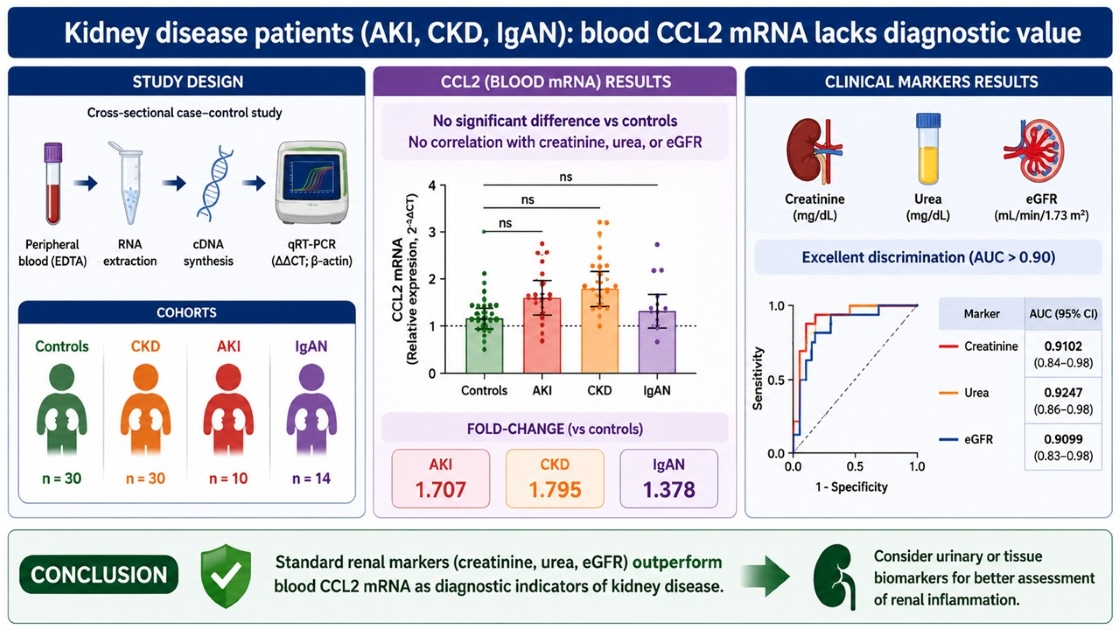
Chronic kidney disease (CKD), acute kidney injury (AKI), and IgA nephropathy (IgAN) are kidney disorders that lead to progressive impairment of filtration. Standard diagnostic markers (creatinine, urea, and eGFR) remain the cornerstone of clinical detection, but they are still insufficient for early diagnosis. Recent studies highlight the potential role of genetic indicators such as CCL2, which are involved in inflammatory signaling and renal tissue injury by attracting monocytes and macrophages into the damaged kidney. This study was designed as a cross-sectional case-control investigation aimed at assessing fold-change expression of CCL2 in the peripheral blood of patients with CKD (n = 30), AKI (n = 10) and IgAN (n = 14), compared with healthy controls (n = 30) after clinical diagnosis of patients with physiological markers. Creatinine, urea and eGFR exhibited highly significant differences between patients and controls, demonstrating strong diagnostic ability (AUC > 0.90 for all markers). Conversely, CCL2 expression showed no significant difference between patient groups and controls, and no significant correlation with physiological markers. Mean CCL2 fold-change were 1.707 in AKI, 1.795 in CKD, and 1.378 in IgAN, indicating only mild elevation without statistical significance. These findings contribute to the evaluation of inflammatory molecular biomarkers in renal diseases by indicating that circulating CCL2 mRNA expression in peripheral blood does not offer additional diagnostic value beyond established physiological markers within this cohort. The results indicate that physiological markers such as creatinine, urea, and eGFR are still good indicators and highlight the limitations of blood-based transcriptional assessment of CCL2 for reflecting renal inflammatory activity, suggesting that tissue-specific or urinary biomarkers may better represent the underlying renal pathological processes. Therefore, blood-based CCL2 in this cohort lacks diagnostic utility, whereas tissue-based or urinary biomarkers could provide enhanced distinction.
References
Alani, H. T., & Al-Lami, M. Q. (2024). Evaluation of some biochemical and hematological parameters in patients with chronic kidney disease. Journal of the Faculty of Medicine Baghdad, 66(2), 154-161. https://doi.org/10.32007/jfacmedbagdad.2269
Alani, M. S., & Al-Mayaly, I. K. (2022). Detection of albumin and urea in kidney failure patients by optical biosensor. Iraqi Journal of Science, 63(1), 43-52. https://doi.org/10.24996/ijs.2022.63.1.5
Al-Jewari, K., Baban, R., & Manuti, J. (2021). Serum and urinary soluble α-Klotho levels in patients with chronic kidney disease. Baghdad Journal of Biochemistry and Applied Biological Sciences, 2(01), 29-38. https://doi.org/10.47419/bjbabs.v2i01.35
Al-Musawi, H. S., Al-Lami, M., & Al-Saadi, A. H. (2021). Assessment of glycemic control, renal function, and oxidative stress parameters in type 2 diabetes Mellitus Patients. Iraqi Journal of Science, 62(12), 4628-4638. https://doi.org/10.24996/ijs.2021.62.12.4
Al-Razak, M. A., Al-Saadi, B., & Al Saedi, A. (2024). Evaluation of the role of two SNPs in MTHFR gene polymorphisms (rs1801133) 677 C> T and (rs 1801131) 1298A> C with homocysteine level in Iraqi patients with chronic kidney disease. Medicina Moderna, 31(3), 227-236. https://doi.org/10.31689/rmm.2024.31.3.227
Al-Razak, M., AlSaadi, B., & Al Saedi, A. (2025). Investigation of interleukines-4, 6 and malondialdehyde levels in serum of Iraqi patients with chronic kidney diseases. Human Antibodies, 33(1-2), 40-47. https://doi.org/10.1177/10932607251322055
Ávila, M., Mora Sánchez, M. G., Bernal Amador, A. S., & Paniagua, R. (2025). The metabolism of creatinine and its usefulness to evaluate kidney function and body composition in clinical practice. Biomolecules, 15(1), Article 41. https://doi.org/10.3390/biom15010041
Bakdash, K., Schramm, K. M., Annam, A., Brown, M., Kondo, K., & Lindquist, J. D. (2019). Complications of percutaneous renal biopsy. Seminars in Interventional Radiology, 36(2), 97-103. https://doi.org/10.1055/s-0039-1688422
Baran, J., Rogalska, M., Kuryk, L., & Staniszewska, M. (2022). Practical applications of peripheral blood mononuclear cells (PBMCs) in immunotherapy preclinical research. Journal of Current Science and Technology, 12(3), 592–604. https://doi.org/10.14456/jcst.2022.45
Barratt, J., Mariani, L. H., Radhakrishnan, J., Rizk, D. V., Tumlin, J. A., & Lafayette, R. A. (2025). Defining disease modification in IgA nephropathy: Toward a paradigm shift in management. Kidney International Reports, 10(12), 4174-4187. https://doi.org/10.1016/j.ekir.2025.09.025
Brookes, E. M., & Power, D. A. (2022). Elevated serum urea-to-creatinine ratio is associated with adverse inpatient clinical outcomes in non-end stage chronic kidney disease. Scientific Reports, 12(1), Article 20827. https://doi.org/10.1038/s41598-022-25254-7
Choi, Y., Jacobs Jr, D. R., Shroff, G. R., Kramer, H., Chang, A. R., & Duprez, D. A. (2022). Progression of chronic kidney disease risk categories and risk of cardiovascular disease and total mortality: Coronary artery risk development in young adults cohort. Journal of the American Heart Association, 11(21), Article e026685. https://doi.org/10.1161/JAHA.122.026685
Delrue, C., & Speeckaert, M. M. (2025). Transcriptomic signatures in IgA nephropathy: From renal tissue to precision risk stratification. International Journal of Molecular Sciences, 26(20), Article 10055. https://doi.org/10.3390/ijms262010055
Duan, Z. Y., Zhang, C., Chen, X. M., & Cai, G. Y. (2024). Blood and urine biomarkers of disease progression in IgA nephropathy. Biomarker Research, 12(1), Article 72. https://doi.org/10.1186/s40364-024-00619-4
Eardley, K. S., Kubal, C., Zehnder, D., Quinkler, M., Lepenies, J., Savage, C. O., ... & Cockwell, P. (2008). The role of capillary density, macrophage infiltration and interstitial scarring in the pathogenesis of human chronic kidney disease. Kidney International, 74(4), 495-504. https://doi.org/10.1038/ki.2008.183
Feng, Y., Lv, L. L., Wu, W. J., Li, Z. L., Chen, J., Ni, H. F., ... & Liu, B. C. (2018). Urinary exosomes and exosomal CCL2 mRNA as biomarkers of active histologic injury in IgA nephropathy. The American Journal of Pathology, 188(11), 2542-2552. https://doi.org/10.1016/j.ajpath.2018.07.017
Gao, Z., Zhu, Y., Sun, X., Zhu, H., Jiang, W., Sun, M., ... & Chang, B. (2022). Establishment and validation of the cut-off values of estimated glomerular filtration rate and urinary albumin-to-creatinine ratio for diabetic kidney disease: A multi-center, prospective cohort study. Frontiers in Endocrinology, 13, Article 1064665. https://doi.org/10.3389/fendo.2022.1064665
Guo, S., Zhang, Q., Guo, Y., Yin, X., Zhang, P., Mao, T., ... & Li, X. (2025). The role and therapeutic targeting of the CCL2/CCR2 signaling axis in inflammatory and fibrotic diseases. Frontiers in Immunology, 15, Article 1497026. https://doi.org/10.3389/fimmu.2024.1497026
Habas, E., Ali, E., Farfar, K., Errayes, M., Alfitori, J., Habas, E., ... & Elzouki, A. N. (2022). IgA nephropathy pathogenesis and therapy: Review & updates. Medicine, 101(48), Article e31219. https://doi.org/10.1097/MD.0000000000031219
Han, S. Y., Jeong, K. H., Ihm, C. G., Kang, Y. S., & Cha, D. R. (2021). Serum interferon-γ and urinary monocyte chemoattractant peptide-1 are important factors in the pathogenesis of immunoglobulin A nephropathy. Kidney Research and Clinical Practice, 40(1), Article 69. https://doi.org/10.23876/j.krcp.20.157
Ibrahim, R. K., Ghudhaib, K. K., & Allawi, A. A. D. (2024). Early prediction of nephropathy in Iraqi patient with diabetes type II by evaluating some relevant biochemical factors. Baghdad Science Journal, 21(5), 1549-1549. https://doi.org/10.21123/bsj.2023.8008
Kahindo, C. K., Mukuku, O., & Mokoli, V. M. (2022). Diagnostic value of serum creatinine versus urinary neutrophil gelatinase-associated lipocalin (uNGAL) in acute kidney injury in resource-limited settings. Urology & Nephrology Open Access Journal, 10(1), 20-23. https://doi.org/10.15406/unoaj.2022.10.00318
Keskinis, C., Moysidou, E., Stai, S., Christodoulou, M., Lioulios, G., Vamvakas, S. S., ... & Stangou, M. (2025). Prognostic value of urinary biomarkers in proteinuria progression in IgA nephropathy patients treated with budesonide. Medicina, 61(5), Article 807. https://doi.org/10.3390/medicina61050807
Lameire, N. H., Levin, A., Kellum, J. A., Cheung, M., Jadoul, M., Winkelmayer, W. C., ... & Srisawat, N. (2021). Harmonizing acute and chronic kidney disease definition and classification: Report of a kidney disease: Improving Global Outcomes (KDIGO) consensus conference. Kidney International, 100(3), 516-526. https://doi.org/10.1016/j.kint.2021.06.028
Lateef, A. S., Alkubaisi, M. R., AL-Hitti, I. K., AL-Rawi, K. F., Freah, Y. T., Khalaf, A. J., ... & Dawood, M. H. (2024). Evaluation of serum lipid profile and renal function levels in Iraqi patients with chronic kidney disease (CKD). Iraqi Journal of Science, 65(4), 1877-1885. https://doi.org/10.24996/ijs.2024.65.4.8
Ling, S., Xu, G., Zaccardi, F., Khunti, K., & Brunskill, N. J. (2023). Kidney function and long-term risk of end-stage kidney disease and mortality in a multiethnic population. Kidney International Reports, 8(9), 1761-1771. https://doi.org/10.1016/j.ekir.2023.06.014
Liu, Y., Gong, Y., & Xu, G. (2023). The role of mononuclear phagocyte system in IgA nephropathy: Pathogenesis and prognosis. Frontiers in Immunology, 14, Article 1192941. https://doi.org/10.3389/fimmu.2023.1192941
Livak, K. J., & Schmittgen, T. D. (2001). Analysis of relative gene expression data using real-time quantitative PCR and the 2−ΔΔCT method. Methods, 25(4), 402–408. https://doi.org/10.1006/meth.2001.1262
Luciano, R. L., & Moeckel, G. W. (2019). Update on the native kidney biopsy: Core curriculum 2019. American Journal of Kidney Diseases, 73(3), 404-415. https://doi.org/10.1053/j.ajkd.2018.10.011
Lv, L. L., Feng, Y. E., Wen, Y. I., Wu, W. J., Ni, H. F., Li, Z. L., ... & Liu, B. C. (2018). Exosomal CCL2 from tubular epithelial cells is critical for albumin-induced tubulointerstitial inflammation. Journal of the American Society of Nephrology, 29(3), 919-935. https://doi.org/10.1681/ASN.2017050523
Obrișcă, B., Mocanu, V., Jurubiță, R., Vrabie, A., Berechet, A., Lujinschi, Ș., ... & Ismail, G. (2024). Histological reappraisal of IgA nephropathy: The role of glomerular pattern of injury and mesangial complement deposition. BMC Nephrology, 25(1), Article 145. https://doi.org/10.1186/s12882-024-03577-z
Osborn, J. W., Tyshynsky, R., & Vulchanova, L. (2021). Function of renal nerves in kidney physiology and pathophysiology. Annual Review of Physiology, 83(1), 429-450. https://doi.org/10.1146/annurev-physiol-031620-091656
Pattrapornpisut, P., Avila-Casado, C., & Reich, H. N. (2021). IgA nephropathy: Core curriculum 2021. American Journal of Kidney Diseases, 78(3), 429-441. https://doi.org/10.1053/j.ajkd.2021.01.024
Pradeep, U., Chiwhane, A., Acharya, S., Daiya, V., Kasat, P. R., Sachani, P., ... & Bedi, G. N. (2024). A comprehensive review of advanced biomarkers for chronic kidney disease in older adults: Current insights and future directions. Cureus, 16(9), Article e70413. https://doi.org/10.7759/cureus.70413
Provenzano, M., Hu, L., Abenavoli, C., Cianciolo, G., Coppolino, G., De Nicola, L., ... & Baraldi, O. (2024). Estimated glomerular filtration rate in observational and interventional studies in chronic kidney disease. Journal of Nephrology, 37(3), 573-586. https://doi.org/10.1007/s40620-024-01887-x
Saitoh, A., Suzuki, Y., Takeda, M., Kubota, K., Itoh, K., & Tomino, Y. (1998). Urinary levels of monocyte chemoattractant protein (MCP)‐1 and disease activity in patients with IgA nephropathy. Journal of Clinical Laboratory Analysis, 12(1), 1-5. https://doi.org/10.1002/(SICI)1098-2825(1998)12:1%3C1::AID-JCLA1%3E3.0.CO;2-F
Salih, S. S., & Yenzeel, J. H. (2020). Evaluation of thyroid hormones and some biochemical variables in patients with chronic kidney disease. Iraqi Journal of Science, 61(5), 985-992. https://doi.org/10.24996/ijs.2020.61.5.6
Siribamrungwong, M., & Chaikomon, K. (2025). Clinical characteristics and risk factors associated with acute kidney injury among hospitalized primary COVID-19 infected patients. Chulalongkorn Medical Journal, 69(6), Article 5. https://doi.org/10.56808/2673-060X.5724
Tan, L., Jin, L. H., Wang, Y. Q., Chen, W., & Wen, Q. (2025). Clinical features, pathological characteristics, and prognosis of patients with IgA nephropathy complicated with nephrotic syndrome. Scientific Reports, 15(1), Article 1804. https://doi.org/10.1038/s41598-025-86081-0
Wang, C., & Liu, H. (2022). Factors influencing degradation kinetics of mRNAs and half-lives of microRNAs, circRNAs, lncRNAs in blood in vitro using quantitative PCR. Scientific Reports, 12(1), Article 7259. https://doi.org/10.1038/s41598-022-11339-w
Younes-Ibrahim, M. S., & Younes-Ibrahim, M. (2022). Biomarkers and kidney diseases: A brief narrative review. Journal of Laboratory And Precision Medicine, 7, 1-16. https://doi.org/10.21037/jlpm-22-1
Zheng, Y., Lu, P., Deng, Y., Wen, L., Wang, Y., Ma, X., ... & Tang, F. (2020). Single-cell transcriptomics reveal immune mechanisms of the onset and progression of IgA nephropathy. Cell Reports, 33(12), Article 108525. https://doi.org/10.1016/j.celrep.2020.108525
Zhou, X., Wang, N., Zhang, Y., & Yu, P. (2022). Expression of CCL2, FOS, and JUN may help to distinguish patients with IgA nephropathy from healthy controls. Frontiers in Physiology, 13, Article 840890. https://doi.org/10.3389/fphys.2022.840890
Zsom, L., Zsom, M., Salim, S. A., & Fülöp, T. (2022). Estimated glomerular filtration rate in chronic kidney disease: a critical review of estimate-based predictions of individual outcomes in kidney disease. Toxins, 14(2), Article 127. https://doi.org/10.3390/toxins14020127
Downloads
Published
How to Cite
Issue
Section
Categories
License
Copyright (c) 2026 Journal of Current Science and Technology

This work is licensed under a Creative Commons Attribution-NonCommercial-NoDerivatives 4.0 International License.