
Improving radar rainfall estimation accuracy in the composite area of Takhli and Sattahip radars using spatial and hourly time-varying bias adjustment
Article Sidebar
Main Article Content
Abstract
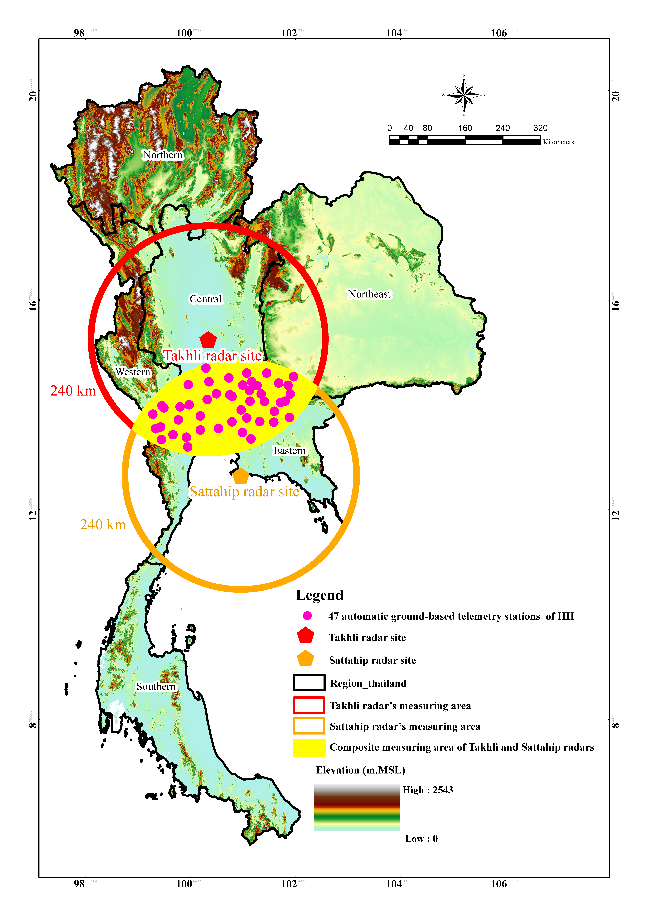
In estimating rainfall over the composite coverage area of the Takhli and Sattahip radars, the use of a composite Z–R relationship may still result in residual errors due to differences in the physical characteristics of rainfall. These differences can be attributed to the effects of the Earth’s curvature, variations in terrain characteristics, and event-to-event differences in rainfall, including variations in the spatial distribution of raindrops over time. In this study, a total of 267 rainfall events occurring between August 2018 and August 2020 were collected and analyzed. The dataset consisted of hourly rainfall measurements from 47 automatic ground-based telemetry stations and radar reflectivity data obtained within a 240 km detection range of the Takhli and Sattahip radars. These data were used to determine pixel-specific bias adjustment factors that varied on an hourly basis using the Inverse Distance Weighting (IDW) method. The adjustment factors were estimated from neighboring pixels with known values derived from both radar observations and automatic ground-based telemetry stations located within a 20 km radius of each target pixel. The results showed that the Composite radar rainfall intensity estimated using the Z = 138R1.6 relationship for the Takhli radar and the Z = 170R1.6 relationship for the Sattahip radar, combined with the proposed hourly time-varying bias adjustment factors, provided the greatest improvement in radar rainfall estimation accuracy over the composite coverage area of the Takhli and Sattahip radars. This approach yielded the lowest RMSE (Root Mean Squared Error), MAE (Mean Absolute Error), and BIAS values compared with the other bias adjustment methods. The proposed approach improved rainfall estimation accuracy by 50.24%, 16.83%, and 8.33% in terms of RMSE, MAE, and BIAS, respectively, compared with the unadjusted composite rainfall intensity estimated using the Z = 138R1.6 relationship for the Takhli radar and the Z = 170R1.6 relationship for the Sattahip radar.
Article Details

This work is licensed under a Creative Commons Attribution-NonCommercial-NoDerivatives 4.0 International License.
References
Morin E, Gabella M. Radar-based quantitative precipitation estimation over Mediterranean and dry climate regimes. J Geophys Res. 2007;112:D20108. https://doi.org/10.1029/2006JD008206.
AghaKouchak A, Habib E, Bardossy A. Modeling Radar Rainfall Estimation Uncertainties: Random Error Model. J Hydrol Eng. 2010;15(4):265-74. https://doi.org/10.1061/(ASCE)HE.1943-5584.0000185.
Zhang Q, Shi PJ, Singh VP, Fan KK, Huang JJ. Spatial downscaling of TRMM-based precipitation data using vegetative response in Xinjiang, China Int J Climatol. 2017;37(10):3895-909. https://doi.org/10.1002/joc.4964.
Einfalt T, Arnbjergnielsen K, Golz C, Jensen N, Quirmbach M, Vaes G, Vieux B. Towards a roadmap for use of radar rainfall data in urban drainage. J Hydrol. 2004;299(3-4):186-202. https://doi.org/10.1016/S0022-1694(04)00365-8.
Kumjian MR. Principles and applications of dual-polarization weather radar. Part I: Description of the polarimetric radar variables. J Oper Meteorol. 2013;1(19):226-42. https://doi.org/10.15191/nwajom.2013.0119.
Gires A, Tchiguirinskaia I, Schertzer D, Schellart A, Berne A, Lovejoy S. Influence of small scale rainfall variability on standard comparison tools between radar and rain gauge data. Atmos Res. 2014;138:125-38. https://doi.org/10.1016/j.atmosres.2013.11.008.
Ochoa-Rodriguez S, Wang L-P, Gires A, Pina RD, Reinoso-Rondinel R, Bruni G, Ichiba A, Gaitan S, Cristiano E, van Assel J, Kroll S, Murl`a-Tuyls D, Tisserand B, Schertzer D, Tchiguirinskaia I, Onof C, Willems P, Veldhuis M-C. Impact of spatial and temporal resolution of rainfall inputs on urban hydrodynamic modelling outputs: A multi-catchment investigation. J Hydrol. 2015;531:389-407. https://doi.org/10.1016/j.jhydrol.2015.05.035.
Thorndahl S, Einfalt T, Willems P, Nielsen JE, ten Veldhuis M-C, Arnbjerg-Nielsen K, Rasmussen MR, Molnar P. Weather radar rainfall data in urban hydrology. Hydrol Earth Syst Sci. 2017;21(3):1359-80. https://doi.org/10.5194/hess-21-1359-2017.
Hou J, Wang NA, Guo K, Li D, Jing H, Wang T, Hinkelmann R. Effects of the temporal resolution of storm data on numerical simulations of urban flood inundation. J Hydrol. 2020;589(6):125100. https://doi.org/10.1016/j.jhydrol.2020.125100.
Hosseini SH. Disastrous floods after prolonged droughts have challenged Iran [Internet]. 2019 [28 July 2026]. Available from: https://fuf.se/magjuni-disastrous-floods-after-prolonged-droughts-have-challenged-iran/.
Kaiser M, Günnemann S, Disse M. Spatiotemporal analysis of heavy rain-induced flood occurrences in Germany using a novel event database approach. J Hydrol. 2021;595:125985. https://doi.org/10.1016/j.jhydrol.2021.125985.
Mobini S, Nilsson E, Persson A, Becker P, Larsson R. Analysis of pluvial flood damage costs in residential buildings-A case study in Malmo. Int J Disaster Risk Reduct. 2021;62:102407. https://doi.org/10.1016/j.ijdrr.2021.102407.
Hanchoowong R. Range dependent errors in radar rainfall estimation. Agricultural and Biological Engineering. 2024;1(2):45-7.
Battan LJ. Radar Observation of the Atmosphere. Chicago; The University of Chicago Press; 1973. pp.324.
Gabella M, Perona G. Simulation of the orographic influence on weather radar using a geometric–optics approach. J Atmos Oceanic Technol. 1998;15(6):1485-94. https://doi.org/10.1175/1520-0426(1998)015<1485:SOTOIO>2.0.CO;2.
Hildebrand P H. Iterative correction for attenuation of 5 cm radar in rain. J Atmos Oceanic Technol. 1978;17(4):508-14. https://doi.org/10.1175/1520-0450(1978)017<0508:ICFAOC>2.0.CO;2.
Van de Beek CZ, Leijnse H, Hazenberg P, Uijlenhoet R. Close-range radar rainfall estimation and error analysis. Atmos Meas Tech. 2016;9(8):3837-50. https://doi.org/10.5194/amt-9-3837-2016.
Hosseini SH, Hashemi H, Berndtsson R, South N, Aspegren H, Larsson R, Olsson J, Persson A, Olsson L. Evaluation of a new X-band weather radar for operational use in south Sweden. Water Sci Technol. 2020;81(8):1623-35. https://doi.org/10.2166/wst.2020.066.
Austin PM. Relation between measured radar reflectivity and surface rainfall. Monthly Weather 520 Review. 1987;115:1053-70. https://doi.org/10.1175/1520-0493(1987)115<1053:RBMRRA>2.0.CO;2.
Williams CR, Ecklund WL, Gage KS. Classification of precipitating clouds in the tropics using 915-MHz wind profilers. J Atmos Oceanic Technol. 1995;12(5):996-1012. https://doi.org/10.1175/1520-0426(1995)012<0996:COPCIT>2.0.CO;2.
Atlas D, Ulbrich CW, Marks Jr FD, Amitai E, Williams CR. Systematic variation of drop size and radar‐rainfall relations. J Geophys Res. 1999;104(D6):6155-69. https://doi.org/10.1029/1998JD200098.
Harrison DL, Driscoll SJ, Kitchen M. Improving precipitation estimates from weather radar using quality control and correction techniques. Meteorol Appl. 2000;6:135-44. https://doi.org/10.1017/S1350482700001468.
Hanchoowong R, Kaewplang S. Analysis of Z-R relationship equations varying by rain cluster for rainfall estimation using Sattahip radar. Agricultural and Biological Engineering. 2025;2(4):145-51. https://doi1.nrct.go.th/ListDoi/listDetail?Resolve_DOI=10.14456/abe.2025.20.
Smith JA, Krajewski WF. Estimation of the mean field bias of radar rainfall estimates. J Appl Meteorol. 1991;30:397-412. https://doi.org/10.1175/1520-0450(1991)030<0397:EOTMFB>2.0.CO;2.
Hitschfeld W, Bordan J. Errors inherent in the radar measurement of rainfall at attenuating wavelengths. J Atmos Sci. 1954;11(1):58-67. https://doi.org/10.1175/1520-0469(1954)011<0058:EIITRM>2.0.CO;2.
Chumchean S, Seed A, Sharma A. Correcting of radar mean field bias using Kalman filtering approach. J Hydrol. 2006;317:123-37. https://doi.org/10.1016/j.jhydrol.2005.05.013.
Silver M, Karnieli A, Marra F, Fredj E. An evaluation of weather radar adjustment algorithms using synthetic data. J Hydrol. 2019;576:408-21. https://doi.org/10.1016/j.jhydrol.2019.06.064.
Yoo C, Yoon J-H. A proposal of quality evaluation methodology for radar data, Journal of The Korean Society of Civil Engineers. 2010;30:429-35.
Hanchoowong R, Weesakul U, Chumchean, S. Bias correction of radar rainfall estimates based on a geostatistical technique. ScienceAsia. 2012;38:373-85. https://doi.org/10.2306/scienceasia1513-1874.2012.38.373.
Michelson DB, Koistinen J. Gauge-radar network adjustment for the baltic sea experiment. Physics and Chemistry of the Earth, Part B: Hydrology, Ocean and Atmosphere. 2000;25(10):915-20. https://doi.org/10.1016/S1464-1909(00)00125-8.
Hanchoowong R. Adjustment of radar rainfall using rain gauge measurement. Agricultural and Biological Engineering. 2024;1(3):73-6.
Collier CG, Larke P, May BA. weather radar correction procedure for real-time estimation of surface rainfall. Q J Roy Meteorol Soc. 1983;109:589-608. https://doi.org/10.1256/smsqj.46109.
Kitchen M, Brown R, Davies, AG. Real-time correction of weather radar data for the effects of bright band, range and orographic growth in widespread precipitation. Q J. Roy Meteorol Soc. 1994;120:1231-54. https://doi.org/10.1256/smsqj.51905.
Seo DJ. Real-time estimation of rainfall fields using radar rainfall and rain gage data. J Hydrol. 1998;208:37-52. https://doi.org/10.1016/S0022-1694(98)00141-3.
Chumchean S, Sharma A, Seed A. An integrated approach to error correction for real-time radar-rainfall estimation. J Atmos Ocean Tech. 2006;23:67-79. https://doi.org/10.1175/JTECH1832.1.
Rabiei E, Haberlandt U. Applying bias correction for merging rain gauge and radar data. J Hydrol. 2015;522:544-57. https://doi.org/10.1016/j.jhydrol.2015.01.020.
Kim J, Yoo C. Using extended kalman filter for real-time decision of parameters of Z-R relationship. Journal of Korea Water Resources Association. 2014;47(2):119-33. https://doi.org/10.3741/JKWRA.2014.47.2.119.
Shi Z, Wei F, Venkatachalam C. Radar-based quantitative precipitation estimation for the identification of Debris-Flow occurrence over earthquake affected region in Sichuan, China. Nat Hazards Earth Syst Sci. 2018;18(3):765-80. https://doi.org/10.5194/nhess-18-765-2018.
Hanchoowong R, Kaewplang S. Hourly adjustment factor analysis using the Kalman Filter technique to reduce errors in Sattahip radar rainfall estimation. Agricultural and Biological Engineering. 2025;2(4):117-26. https://doi1.nrct.go.th/ListDoi/listDetail?Resolve_DOI=10.14456/abe.2025.17.
Koistinen J, Puhakka T. An improved spatial gauge-radar adjustment technique. In: Proc. 20th Conference on Radar Meteorology; AMS. 1981. pp.179-86.
Wood SJ, Jones DA, Moore RJ. Static and dynamic calibration of radar data for hydrological use. J Hydrol Earth Syst Sci. 2000;4(4):545-54. https://doi.org/10.5194/hess-4-545-2000.
Seo DJ, Breidenbach JP, Fulton T, Meller D, O'Brannon T. Real time adjustment of range dependent biases in WSR-88D rainfall estimates due to non-uniform vertical profile of reflectivity. J Hydrometeorol. 2000;1(3):222-40. https://doi.org/10.1175/1525-7541(2000)001<0222:RTAORD>2.0.CO;2.
Mckee JL, Binns AD. A review of gauge–radar merging methods for quantitative precipitation estimation in hydrology. Canadian Water Resources Journal. 2016;41:186-203. https://doi.org/10.1080/07011784.2015.1064786.
Hanchoowong R, Kaewplang S. Rainfall intensity analysis for radar rainfall evaluation in the composite area of Takhli and Sattahip radar. Agricultural and Biological Engineering. 2026;3(1):13-21. https://doi1.nrct.go.th/ListDoi/listDetail?Resolve_DOI=10.14456/abe.2026.2.
Marshall JS, Palmer WMK. The Distribution of raindrops with size. Journal of Meteorology. 1984;5(4):165-6. https://doi.org/10.1175/1520-0469(1948)005<0165:TDORWS>2.0.CO;2.
Woodley W, Herndon A. A raingage evaluation of the Miami reflectivity-rainfall rate relation. J Appl Meteor. 1970;9(2):258-64. https://doi.org/10.1175/1520-0450(1970)009<0258:AREOTM>2.0.CO;2.
Michelson D, Einfalt T, Holleman I, Gjertsen U, Friedrich K, Haase G, Lindskog M, Sztuc J. Weather radar data quality in Europe: Quality control and characterization, COST 717 Working Document WDF_20_200204_1. 2004.
Hydro & meteo GmbH & Co. KG. SCOUT Documentation Version 3.32. Germany: Hydro & meteo GmbH & Co. KG.; 2016.
Chumchean S. Improved Estimation of Radar Rainfall for Use in Hydrological Modelling [Ph.D. Thesis]. Sydney, Australia: University of New South Wales; 2004.
Delrieu G, Andrieu H, Creutin JD. Quantification of path-integrated attenuation for X-and C-band weather radar systems operating in Mediterranean heavy rainfall. J Appl Meteor. 2000;39(6):840-50. https://doi.org/10.1175/1520-0450(2000)039<0840:QOPIAF>2.0.CO;2.
Futon RA, Breidenbach JP, Seo DJ, Miller DA, O’Brannon T. The WSD–88D rainfall algorithm. Weather Forecasting. 1998;13:377-95. https://doi.org/10.1175/1520-0434(1998)013<0377:TWRA>2.0.CO;2.
Jurczyk A, Szturc J, Osródka K. Quality-based compositing of weather radar derived precipitation. Q J Roy Meteorol Soc. 2020;17(1):1-14. https://doi.org/10.1002/met.1812.
Lempio, G., Einfalt, T. and Lobbrecht, A. Considerations for compositing radar data from three countries. 7th European Conference on Radar in Meteorology and Hydrology; 2012 June 24-29; Toulouse, France; 2012.
Nielsen JE, Thorndahl S, Rasmussen MR. Improving weather radar precipitation estimates by combining two types of radars. Atmos Res. 2014;139:36-45. https://doi.org/10.1016/j.atmosres.2013.12.013.
Lengfeld K, Clemens M, Münster H, Ament F. Performance of high-resolution X-band weather radar networks–the PATTERN example. Atmos Meas Tech. 2014;7(12):4151-66. https://doi.org/10.5194/amt-7-4151-2014.
Lengfeld K, Clemens M, Merker C, Münster H, Ament F. A simple method for attenuation correction in local X-band radar measurements using C-band radar data. J Atmos Oceanic Tech. 2016;33(11):2315-29. https://doi.org/10.1175/JTECH-D-15-0091.1.
