
Classification of impurity levels in contaminated sugarcane leaf pellets using NIR spectroscopy
Article Sidebar
Main Article Content
Abstract
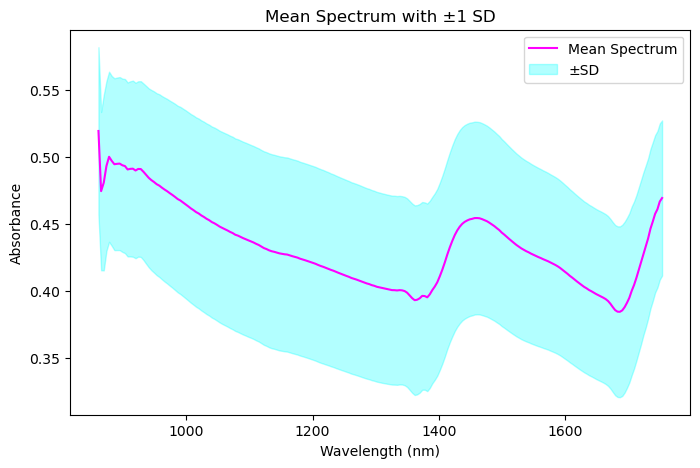
This research investigates the feasibility of classifying impurity levels in sugarcane leaf pellets. Samples were prepared by mixing sugarcane leaves with varying proportions of sand. NIR spectroscopy combined with linear discriminant analysis (LDA) was employed to categorize samples across discrete contamination tiers (5% to 25% sand content). Because an absolute 0% clean baseline was not evaluated, the framework is interpreted strictly as a system for grading impurity severity levels. Experimental results revealed that centering and 1st derivative preprocessing yielded the highest accuracy. These techniques effectively mitigated interference from light scattering and baseline shifts, while enhancing specific spectral features related to biomass chemical constituents, such as cellulose, lignin, and hemicellulose. The LDA model, optimized with preprocessing, achieved classification accuracy exceeding 97%, with minimal errors observed in samples containing low to moderate sand content. However, accuracy slightly declined when sand content exceeded 20% due to reflective interference from silica (SiO2). The findings confirm that selecting appropriate preprocessing methods is a critical factor for model performance. These laboratory-scale results demonstrate the strong potential of the method, serving as a foundational step toward developing future on-line monitoring pipelines for real-time soil contamination tracking.
Article Details

This work is licensed under a Creative Commons Attribution-NonCommercial-NoDerivatives 4.0 International License.
References
Department of Alternative Energy Development and Efficiency. Thailand's energy situation report [Internet]. 2022 [cited 20 Jan 2026]. Available from: https://pei.dede.go.th/dataset/energy-situation/resource/e67e2a97-4d90-4edb-af24-a5d069862d4a.
National Statistical Office. Explore basic agricultural data at the village level [Internet]. 2021 [cited 20 Jan 2026]. Available from: https://www.nso.go.th/nsoweb/index#gsc.tab=0.
Office of The Cane and Sugar Board. Report on the sugarcane production situation, 2024/2025 [Internet]. 2025 [cited 20 Jan 2026]. Available from: https://www.ocsb.go.th/.
Office of the Permanent Secretary, Ministry of Higher Education, Science, Research and Innovation. Annual Report 2018, Ministry of Science and Technology [Internet]. 2018 [cited 20 Jan 2026]. Available from: https://www.ops.go.th/th/data-store/94-annual-report/741-mostannualreport2018.
Feng X, Yu C, Shu Z, Liu X, Yan W, Zheng Q, Sheng K, He Yong. Rapid and non-destructive measurement of biofuel pellet quality indices based on two-dimensional near infrared spectroscopic imaging. Fuel. 2018;228:197-205.
Posom J, Saechua W, Sirisomboon P. Evaluation of pyrolysis characteristics of milled bamboo using near-infrared spectroscopy. Renewable Energy. 2017;103:653-65.
Xue J, Yang Z, Han L, Yuchen Liu, Yao Liu, Chengcheng Zhou. On-line measurement of proximates and lignocellulose components of corn stover using NIRS. Applied Energy. 2015;137:18-25.
Colette C. Fagan, Colm D. Everard, Kevin McDonnell. Prediction of moisture, calorific value, ash and carbon content of two dedicated bioenergy crops using near-infrared spectroscopy. Bioresource Technology. 2011;102(8):5200-6.
Gillespie GD, Everard CD, McDonnell KP. Prediction of biomass pellet quality indices using near infrared spectroscopy. Energy. 2015;80:582-8.
Posom J, Sirisomboon P. Evaluation of lower heating value and elemental composition of bamboo using near infrared spectroscopy. Energy. 2017;121:147-58.
Rinnan Å, van den Berg F, Engelsen SB. Review of the most common pre-processing techniques for near-infrared spectra. Trends in Analytical Chemistry. 2009;28(10),1201-22.
Stenberg B, Viscarra Rossel RA, Mouazen AM, Wetterlind J. Visible and near infrared spectroscopy in soil science. Advances in Agronomy. 2010;107,163-215.
