
Growth performance of green cos lettuce under differential light intensities in controlled vertical hydroponic cultivation
Article Sidebar
Main Article Content
Abstract
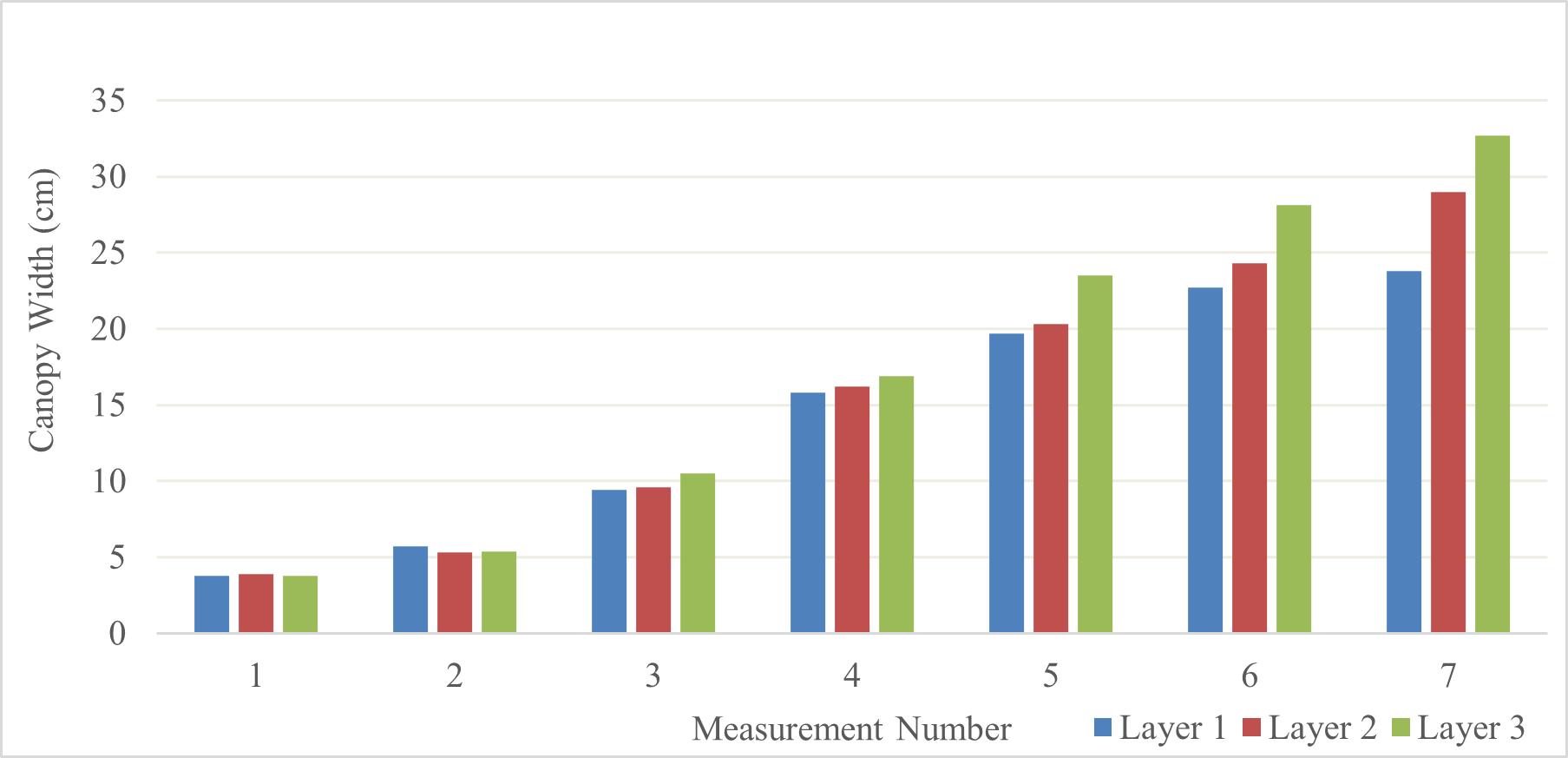
The increasing popularity of closed-system hydroponic cultivation has led to the need for optimizing environmental conditions to achieve uniform and high-quality crop production. One of the most important factors affecting plant growth is light intensity, which directly influences photosynthesis and nutrient accumulation. This study aimed to investigate the growth response of Green Cos lettuce (Caesar) under different light intensities in a controlled hydroponic environment and to record the growth parameters of the plants. The experimental procedure began with seed germination and seedling development, which took 28 days before transplanting into cultivation layers. The system consisted of three layers with identical environmental conditions, including nutrient solution pH, electrical conductivity (EC), air temperature, water temperature, relative humidity, and photoperiod, all monitored by sensors. The only difference among the layers was the number of LED grow lights used. Layer 1 was equipped with two lights, Layer 2 with three lights, and Layer 3 with four lights. Each light was an LED Grow Light Eco 18W (Flux PPF: PAR + PPF (400–800 nm) 27 µmol/s). Data was collected every five days from September 15, 2025, to October 15, 2025, for a total of 31 days, resulting in seven measurement intervals. Growth parameters recorded included leaf number, leaf size, plant height, and canopy width, as well as leaf color and appearance. The results showed that light intensity had a significant effect on the growth of Green Cos lettuce (Caesar). Plants grown in Layer 3, which received the highest light intensity, exhibited the best growth performance, with larger and longer leaves, uniform plant structure, and a healthy overall appearance. The average canopy width at maturity was 32.7 ± 1.98 cm for Layer 3, 29.0 ± 1.07 cm for Layer 2, and 23.8 ± 1.05 cm for Layer 1. The canopy width of plants in Layer 3 was 12.8% and 37.4% greater than those in Layers 2 and 1, respectively, while Layer 2 showed a 21.9% increase compared to Layer 1. The percentage increase of canopy width was calculated using the formula [Greater canopy width – Smaller canopy width) / Smaller canopy width] × 100. However, in all layers, the leaf characteristics are not very uniform; some leaves are curled and wrinkled, but most are complete. These findings indicate that optimizing light intensity plays a crucial role in enhancing the growth and quality of hydroponically grown Green Cos lettuce. The optimal light intensity for Green Cos (Caesar) in this study was 150 µmol/m²/s, achieved using four LED grow lights.
Article Details

This work is licensed under a Creative Commons Attribution-NonCommercial-NoDerivatives 4.0 International License.
References
Food and Agriculture Organization of the United (FAO). Growing without soil: hydroponics fundamentals, pros and cons [Internet]. 2024 [cited 2025 Nov 05]. Available from: https://www.fao.org/plant-production-protection/news-and-events/news/news-detail/growing-without-soil--hydroponics-fundamentals--pros-and-cons/en.
Resh HM. Hydroponic food production: A definitive guidebook for the advanced home gardener and the commercial hydroponic grower. 7th ed. CRC Press. 2013.
Jensen MH, Malter AJ. Protected horticulture: A guide to hydroponic methods. CRC Press. 1995.
Yang R, Yang H, Ji F, He D. Enhancing the photon yield of hydroponic lettuce through stage-wise optimization of the daily light integral in an LED plant factory. Agronomy. 2024;14(12):2949. https://doi.org/10.3390/agronomy14122949.
Pennisi G, Malorgio F, Incrocci L. Effects of light intensity and photoperiod on hydroponic lettuce growth. Acta Horticulturae. 2017;1153:155–62. https://doi.org/10.17660/ActaHortic.2017.1153.20.
Li T, Kubota C. Effects of supplemental light quality on growth and phytochemicals of hydroponically grown lettuce. Environmental and Experimental Botany. 2009;67(1):59–64. https://doi.org/10.1016/j.envexpbot.2009.04.007.
Boros IF, Székely G, Balázs L, Csambalik L, Sipos L. Effects of LED lighting environments on lettuce (Lactuca sativa) in hydroponics. Scientia Horticulturae. 2023;318:112766.
Nitu OA. Optimizing lettuce growth in nutrient film technique: Influence of light intensity. Agriculture. 2024;14(9):1896. https://doi.org/10.3390/agriculture14091896.
Su P, Ding S, Li C, Liu Q, Wang Y, Feng Q. Light intensity affects growth, photosynthesis and nutritional properties of Toona sinensis sprouts in plant factory. Photosynthesis Research. 2026;164(1):3. https://doi.org/10.1007/s11120-025-01192-z.
Hernández-Adasme C, Guevara MJ, Faicán-Benenaula MA, Neira R, Delgadillo D, Muñoz V, Salazar-Parra C, Sun B, Yang X, Escalona VH. Effect of light conditions on growth and antioxidant parameters of two hydroponically grown lettuce cultivars (Green and purple) in a vertical farm system. Horticulturae. 2025;11(2):220. https://doi.org/10.3390/horticulturae11020220.
Pinho S, Cammarisano L, Monsees H, Ramírez T, Kloas W, Körner O. (2024). Latitude-dependent implications of lighting regimes on lettuce physiology and resource utilisation in decoupled aquaponics systems. Environmental and Experimental Botany. 2024;220:105711. https://doi.org/10.1016/j.envexpbot.2024.105711.
