DIFFERENT WELDING CURRENT ON MECHANICAL AND ELECTROCHEMICAL BEHAVIOR OF FCAW ASTM A36 CABON STEEL JOINTS
Keywords:
ASTM A36 Carbon Steel, Corrosion Rates, Flux-Cored Arc Welding, Mechanical PropertiesAbstract
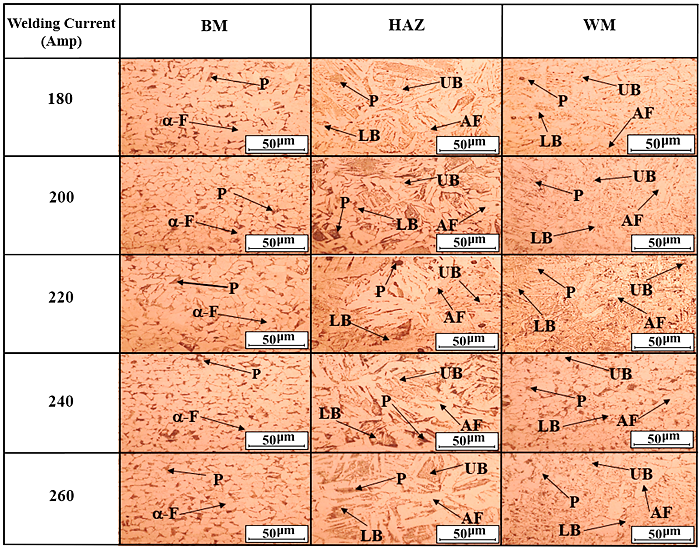
The effect of different welding current on microstructure, mechanical properties, and corrosion behavior of Flux-Cored Arc Welded (FCAW) ASTM A36 carbon steel joints is studied in the aim of work that used in the welding current like; 180A, 200A, 220A, 240A, and 260A corresponding to heat inputs of 1.242, 1.380, 1.518, 1.656 and 1.749 kJ/mm, respectively. The welding process was performed according to the Welding Procedure Specification (WPS) and the Procedure Qualification Record (PQR). Corrosion behaviour of the heat affected zones, weldment and base metal were determined by Tafel polarization curves. It was found that all welding currents, the heat affected zones had the highest corrosion rates which followed by the weldments then the base metal. The welding current at 220A caused the highest corrosion rate in comparison with other welding currents. However, the effect of different welding currents had been studied and measured on microstructures and hardnesses for all specimens after FCAW processes.
References
Ahn, J.H., Kim, I.T., Kainuma, S., and Lee, M.J. (2013). Residual shear strength of steel plate girder due to web local corrosion. J. Constr. Steel Res. 89: 198–212.
AWS Standard A5.20-95. (1995). Carbon Steel Electrodes for Flux Cored Arc Welding.
Badji, R., Bouabdallah, M., Bacroix, B., Kahloun, C., Belkessa, B., and Maza, H. (2008). Phase transformation and mechanical behavior in annealed 2205 duplex stainless steel welds. Mater. Charact. 59: 447–453.
Bakhtiari, R., and Ekrami, A. (2009). The effect of bainite morphology on the mechanical properties of a high bainite dual phase (HBDP) steel. Mater. Sci. Eng. A 525: 159–165.
Boumerzoug, Z., Derfouf1, C., and Baudin, T. (2010). Effect of Welding on Microstructure and Mechanical Properties of an Industrial Low Carbon Steel. J. Eng. 502-506.
Coronado, J.J., Caicedo, H.F., and Gomez, A.L. (2009). The effects of welding processes on abrasive wear resistance for hardfacing deposits. Tribol. Inter. 42: 745–749.
Daghash, S.M., and Ozbulut, O.E. (2017). Mechanical evaluation of corrosion-resistant steel plates for bridge girder fabrication. Struct. Congr. 494–505.
Dong, H., Hao, X., and Deng, D. (2014). Effect of welding heat input on microstructure and mechanical properties of HSLA steel joint. Metallogr. Microstruct. Anal. 138–146.
Eghlimi, A., Shamanian, M., Eskandarian, M., Zabolian, A., and Szpunar, J.A. (2015). Characterization of microstructure and texture across dissimilar super duplex/austenitic stainless steel weldment joint by super duplex filler metal. Mater. Charact., 106: 27–35.
Feng, JC., Wang, J., Sun. Q., Zhao, H., Wu, L., and Xu, P. (2017). Investigation on dynamic behaviorsof bubble evolution in underwater wet flux-cored arc welding. J Manuf Process., 28: 156–67.
Gao, W., Wang, D., Cheng, F., Di, X., Deng, C., and Xu, W. (2016). Microstructural and mechanical performance of underwater wet welded S355 steel. J. Mater. Process Tech., 238: 333 -340.
Geng, S., Sun, J., Guo, L., and Wang, H. (2015). Evolution of microstructure and corrosion behavior in 2205 duplex stainless steel GTA-welding joint. J. Manuf. Process., 19: 32–37.
Ghazvinlo, H.R. and Honarbakhsh, A. (2010). Effect of Gas-Shielded Flux Cored Arc Welding Parameters on Weld Width and Tensile Properties of Weld Metal in a Low Carbon Steel. Journal of Applied Science 10 (8): 658-663.
Gunasekaran, G., and Chauhan, L.R. (2004). Eco friendly inhibitor for corrosion inhibition of mild steel in phosphoric acid medium. Electrochim Acta., 49: 4387–4395.
Guo, N., Fu, Y., Wang, Y., Du, Y., Feng, J., and Deng, Z. (2017). Effects of welding velocity on metal transfer mode and weld morphology in underwater flux-cored wire welding. J. Mater. Process Technol., 239: 103–120.
Harris, P., and Smith, B.L. (1983). Factorial technique for weld quality prediction. Met. Construct., 15: 661–666.
Hu, J., Du, L.X., Wang, J.J., Xie, H., Gao, C.R., and Misra, R.D.K. (2013). Structure–mechanical property relationship in low carbon microalloyed steel plate processed using controlled rolling and two-continuous cooling. Materials Science and Engineering A 585:197-204.
Jayaweera, P., Lowe, D.M., Sanjurjo, A., Lau, K.H., and Jiang, L. (1996). Corrosion-resistant metallic coatings on low carbon steel. Surf. Coat. Technol., 86: 522–525.
Kannan, T., and Murugan, N. (2006). Effect of Flux Cored Arc Welding Process Parameters on Duplex Stainless Steel-Clad Quality. J. Mater. Process Tech., 176: 230-239.
Karadeniz, Erdal., Ozsarac, Ugur., and Yildiz, Ceyhan. (2007). The Effect of Process Parameters on Penetration in Gas Metal Arc Welding Processes. Mater. Des., 28: 649-656.
Koch, G., Varney, J., Thompson, N., Moghissi, O., Gould, M., and Payer, J. (2016). International measures of prevention, application. and economics of corrosion technologies study. NACE Int. IMPACT Rep.
Kumar, S., and Shahi, A. S. (2011). Effect of heat input on the microstructure and mechanical properties of gas tungsten arc welded AISI 304 stainless steel joints. Mater. Des., 32 : 3617–3623.
Kumar, R., Arya, H.K., and RK, S. (2014). Experimental determination of cooling rate and its effect on microhardness in submerged arc welding of mild steel plate (grade c-25 as per IS 1570). J. Mater. Sci. Eng. 1-4.
Lee, H., Kim, D., Jung, J., Pyoun, Y., and Shin, K. (2009). Influence of peening on the corrosion properties of AISI 304 stainless steel. Corros. Sci., 51: 2826–2830.
Li, L.H., Liu, D., Yan, Y.T., Guo, N., and Feng, J.C. (2016). Microstructural characteristics and mechanical properties of underwater wet flux-cored wire welded 316L stainless steel joints. J. Mater. Process Tech., 238 : 423–430.
Liou, H.Y., Hsieh, R.I., and Tsai, W.T. (2002). Microstructure and stress corrosion cracking in simulated heat-affected zones of duplex stainless steels. Corros. Sci. 44: 2841–2856.
Melchers, R.E. (2003). Probabilistic model for marine corrosion of steel for structural reliability assessment. J. Struct. Eng. 129: 1484–1493.
Merchant Samir, Y. (2015). Investigation on Effect of Heat Input on Cooling Rate and Mechanical Property (Hardness) Of Mild Steel Weld Joint by MMAW Process. J. Modern Eng. Res. 34-41.
Mirza, F.A., Macwan, A., Bhole, S.D., Chen, D.L., and Chen, X.G. (2017). Microstructure, tensile and fatigue properties of ultrasonic spot welded aluminium to galvanized high-strength-low-alloy and low-carbon steel sheets. Mater. Sci. Eng. A 690: 323–336.
Murti, V., Srinivas, P.D., Banadeki, G., and Raju, K.S. (1993). Effect of heat input on the metallurgical properties of HSLA steel in multi-pass MIG welding. J. Mater. Process Tech., 37: 723–9.
Murugan, N., and Parmar, R.S. (1994). Effects of MIG process parameters on the geometry of the bead in the automatic surfacing of stainless steel. J. Mater. Process. Technol., 41: 381–398.
Muthupandi, V., Srinivasan, P.B., Seshadri, S.K., and Sundaresan, S. (2003). Effect of weld metalchemistry and heat input on the structure and properties of duplex stainlesssteel welds. Mater Sci Eng A 358: 9–16.
Nowacki, J., and Rybicki, P. (2005). The influence of welding heat input on submerged arc welded duplex steel joints imperfections. J. Mater. Process Technol. 164: 1082–1088.
Patrick, W., Leech, X.S., and Nazmul, A.L. (2012). Comparison of abrasive wear of a complex high alloy hardfacing deposit and WC–Ni based metal matrix composite. Wear., 294: 295.
Priyantha, N., Jayaweera, P., Sanjurjo, Lau., A. Lu., K. F., and Krist, K. (2003). Corrosion-resistant metallic coatings for applications in highly aggressive environments. Surf. Coat. Technol. 163: 31–36.
Qin, G., Xu, S., Yao, D., and Zhang, Z. (2016). Study on the degradation of mechanical properties of corroded steel plates based on surface topography, J. Constr. Steel Res., 125: 205–217.
Sireesha, M., Albert, S.K., and Sundaresan, S. (2001). Microstructure and mechanical properties of weld fusion zones in modified 9Cr-1Mo steel. J. Mater. Eng. Perform., 10 (3): 320–330.
Sitthipong, S., Towatana, P., Sitticharoenchai, A., and Meengam, C. (2017). Abrasive wear behavior of surface hardfacing on propeller shafts AISI 4140 alloy steel. Mater. Today. Proc., 4 (2) : 1492–1499.
Srikarun, B., and Prapas, M. (2018). The effect of iron-based hardfacing with chromium powder addition onto low carbon steel. Mater. Today. Proc., 5: 9272–9280.
Trinet, Y., Nakarin, S., and Aphichart, R. (2016). The electrochemical investigation of the corrosion rates of welded pipe ASTM A106 Grade B. J. metal., 6: 207.
Townsend, H.E. (2001). Effects of alloying elements on the corrosion of steel in industrial atmospheres. Corros., 57: 497–501.
Varshney, A., Sangal, S., and Mondal, S. K. (2016). Super strong and highly ductile low alloy multiphase steels consisting of bainite, ferrite and retained austenite. Mater. Des., 95: 75-88.
Wan, M., Hasrizam,W.S., Syahida M.N., Mamat, N.S., and Jamian, S. (2015). Effect of welding heat input on microstructure and mechanical propertites at coarse grain heat affected zone of abs grade a steel. J. Eng. Appl. Sci. 9487-9495.
Welding, Brazing and Soldering. (1993). ASM Handbook Vol. 6. ASM International : 7–18.
Xiao, K., Dong, C., Li, X., and Wang, F. (2008). Corrosion products and formation mechanism during initial stage of atmospheric corrosion of carbon steel. J. Iron Steel Res. Int., 15: 42–48.
Xu, S., and Qiu, B. (2013). Experimental study on fatigue behavior of corroded steel, Mater. Sci. Eng. A 584: 163–169.
Zhang, Z.Y., Wang, Z.Y., Jiang, Y.M., Tan, H., Han, D., Guo, Y.J., and Li, J. (2012). Effect of post-weld heat treatment on microstructure evolution and pitting corrosion behavior of UNS S31803 duplex stainless-steel welds. Corros. Sci., 62: 42–50.