ADSORPTION OF RHODAMINE B DYE ON COMPOSITE PELLETS OBTAINED FROM PECTIN AND MONTMORILONITE CLAY
Keywords:
Adsorption, Rhodamine B, composite pellet, pectin, montmorillonite clayAbstract
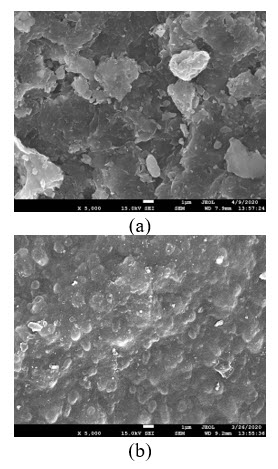
Montmorillonite (MMt) clay has exhibited excellent efficiency for the adsorption of cationic dyes. However, recovery of MMt clay powder after the adsorption from the liquid body is a difficult task. To overcome this limitation, the pelletizing of these powder particles with biopolymer is one of the potential alternatives. The composite pellet was prepared by immobilization of MMt particles inside the structure of the natural pectin pellet extracted from the watermelon peel (Citrullus lanatus). Then, the composite pellet and MMt were characterized comparatively using N2 adsorption-desorption isotherm at 77.4 K, Fourier Transform Infrared Spectroscopy (FTIR), and Field Emission Scanning Electron Microscopy (FESEM). The highest dye removal efficiency was 88.31%. The optimum condition was observed under a certain condition, which is the contact time of 180 min, the initial dye concentration of 250 mg/L, the initial pH of 2.0, and the temperature of 55°C. The adsorption isotherm followed the Freundlich equation revealing multilayer coverage. The kinetic data fit well with the pseudo-second order kinetic model exhibiting the chemical reaction involved. The pelletizing of MMT as the composite pellet has not only proven an effective adsorbent for the adsorption of Rhodamine B dye from wastewater, but also facilitated the recovery of the spent adsorbent.
References
Abbas, K. (2017). Adsorption removal of rhodamine B dye from aqueous solution using Rhamnus stone as low cost adsorbent. J. Al-Nahrain U., 20(1): 32.
Akpomie, K.G. and Dawodu, F.A. (2016). Acid-modified montmorillonite for sorption of heavy metals from automobile effluent. BENi-SUEF University J. Basic Appl., 5:1.
Al-Ghouti, M. and Al-Absi, R.S. (2020). Mechanistic understanding of the adsorption and thermodynamic aspects of cationic methylene blue dye onto cellulosic olive stones biomass from wastewater. Sci. Rep., 10:15928.
Ali, N.F., and El-Mohamedy, R.S.R. (2012). Microbial decolorization of textile waste water. J. Saudi. Chem. Soc., 16(2):117.
Bello, O.S., Adegoke, K.A., Sarumi, O.O., and Lameed, O.S. (2019). Functional locust bean pod (Parkia biglobosa) activated carbon for Rhodamine B dye removal, Heliyon, 5:e02323.
Birtalan, E., Rudat, B., Kolmel, D.K., Fritz, D., Vollrath, S.B.L., Schepers U., and Brase, S. (2011). Investigating rhodamine B-labeled peptoid: Scopes and limitations of its applications. Biopolym., 96(5):694.
Cychosz, K.A. and Thommes, M. (2018). Progress in the physisorption characterization of nanoporous gas storage materials”, Eng.,4(4):559.
De Lange, M.F, Vlugt, T.J.H, Gascon, J., and Kapteijin, F. (2014). Adsorptive characterization of porous solids: Error analysis guides the way. Microporous Mesoporous Mater., 200:199.
dos Santos, A.B., Cervantes, F.J., and van Lier, J.B. (2007). Review paper on current technologies for decolorization of textile wastewaters: Perspectives for anaerobic technology. Bioresour. Technol., 98(12):2,369.
Fishman, M.L., Coffin, D.R., Onwulata, C.I., and Konstance, R.P. (2004). Extrusion of pectin and glycerol with various combinations of orange albedo and starch. Carbohydr. Polym., 57(4):401.
Forgacs, E., Cesrhati, T., and Oros, G. (2004). Removal of synthetic dyes from wastewater: a review. Environ. Int., 30(7):953.
Freundlich, H.M.F. (1906). Over the adsorption in solution. J. Phy. Chem., 57:386.
Girish, C.R. and Murty, V.R. (2016). Mass transfer studies on adsorption of phenol from wastewater using Lantana camara, forest waste. Int. J. Chem. Eng., 2016(2):1.
Gisi, S.D., Lofrano, G., Grassi, M.T., and Notarnicola, M. (2016). Characteristics and adsorption capacities of low-cost sorbents for wastewater treatment: A review. SM&T, 9:10.
Hassaan, M.A., Nemr, A.E., and Madkour, F.F. (2017). Testing the advanced oxidation processes on the degradation of Direct Blue 86 dye in wastewater. Egypt. J. Aquat. Res., 43(1): 11.
Hastuti, B., Afifah, S.N., Mulyani, B., and Susilowati, E. (2020). Adsorption of methylene blue dyes using pectin membrane. Phys.: Conf. Ser.1503:012031.
Heidarinejad, Z., dehghani, M.H., Heidari, M., Javedan, G., Ali, I., and Sillanpaa, M. (2020). Methods for preapration and activation of activated carbon: a review. Environ. Chem. Lett., 18:393.
Ho, Y.S. and McKay, G. (1999). Pseudo-second order model for sorption processes. Process Biochem., 34:451.
Huang, P., Kazlauciunas, A., Menzel, R., and Lin, L. (2017). Determining the mechanism and efficiency of industrial dye adsorption through facile structural control of organo-montmorillonite adsorbents. ACS Appl. Mater. Interfaces., 31:26383.
Inyinbor, A.A., Adekoia, F.A., and Olatunji, G.A. (2015). Adsorption of rhodamine B dye from aqueous solution on Irvingia gabonensis biomass: Kinetics and thermodynamics studies. S. Afr. J. Chem., 68:115.
Junsongduang, A., Sirithip, K., Inta, A., and Nachai, R. (2017). Diversity and traditional knowledge of textile dyeing plants in northeastern Thailand. Econ. Bot., 71:241.
Katheresan, V., Kansedo, J., and Lau, S.Y. (2018). Efficiency of various recent wastewater dye removal methods:
A review. J. Environ. Chem. Eng., 6(4):4,676.
Kausar, A., Iqbal, M., Javed, A., and Aftab, K. (2018). Dyes adsorption using clay and modified clay: A review. J. Mol. Liq., 256:395.
Krupskaya, V.V., Zakusin, S.V., Tyupina, E.A., Dorzhieva, O.V., Zhukhlistov, A.P., Belousov, P.E., and Timofeeva, M.N. (2017). Experimental study of montmorillonite structure and transformation of its properties under treatment with inorganic acid solutions. Minerals., 49:1.
Lagergren, S. (1898). About the theory of so-called adsorption of soluble substances, Handlingar, 24(4):1.
Langmuir, I. (1918). The adsorption of gases on plane surfaces of glass, mica and platinum, J. Am. Chem., 40(9):1,361.
Lellis, B., Favaro-Polonio, C.Z., Pamphile, J.A., and Polonio, J.C. (2019). Effects of textile dyes on health and the environment and bioremediation potential of living organisms, Biotechnol. Res. Innov, 3(2):275.
Lichanporn, I., Nanthachai, N., Tanganurat, P., Singkhum, A., and Kromnongpai, P. (2020). Effect of Pectin from Watermelon Rind on Quality of Roselle (Hibiscus sabdariffa L.) Jam, RMUTT research J. Sci. Tech. 19(2):2,651.
Lini, F., Fukuda, L., Turbiani, F.R.B., and Garcia, P.S. (2014). Extraction of pectin from passion fruit peel (Passiflora edulis f. Flavicarpa) by microwave-induced heating, Food Hydrocoll., 38:186.
Mouzon, J., Bhuiyan, I.U., and Hedlund, J. (2016). The structure of montmorillonite gels reveals by sequential cryo-XHR-SEM imaging, J. Colloid Interface Sci., 465:58.
Namdaung, P. and Umpuch, C. (2019). Adsorption of reactive red 120 onto cationic surfactant intercalated montmorillonite clay. UBU Eng. J., 12(2):1.
Oyekanmi, A.A., Ahmad, A., Hossain, K., and Rafatullah, M. (2019). Adsorption of rhodamine B dye from aqueous solution onto acid treated banana peel: Response surface methodology, kinetics and isotherm studies. Plos One, 14(5):1.
Postai, D.L., Demarchi, C.A., Zanatta, F., Caroline, D., Melo, C., and Rodrigues, C.A. (2016). Adsorption of rhodamine B and methylene blue dyes using waste of seeds of Aleurites Moluccana, a low cost adsorbent. Alexandria Eng. J., 55(2):1,713.
Sabka, P., Radoslav, R., and Georgi, D. (2019). Physical properties of edible films with different composition. Bucharest, 20(171):152.
Saha, N.R., Sarkar, G., Roy, I., Rana, D., Bhattacharyya, A., Adhikari, A., Mukhopadhyay A., and Chattopadhyay D. (2015). Studies on methylcellulose/pectin/montmorillonite nanocomposite films and their application possibilities. Carbohydr. Polym.,136:1,218.
Samchetshabam, G., Hussan, A., and Choudhury, T.G. (2017). Impact of textile dyes waste on aquatic environments and its treatment. Environ. Ecol., 35(3C):2,349.
Sandarani, M. (2017). a review: different extraction techniques of pectin, sandarani. J. Phamacogn. Nat. Prod., 3(3):143.
Sukboonyasatit, D., Pornnikom, N., and Natyay, N. (2018). Chemical and physical properties of pectin from okra. Khon Kaen Agr., J.46:1,418.
Umpuch, C. and Sakaew, S. (2013). Adsorption characteristics of reactive black 5 onto chitosan-intercalated montmorillonite. Desalination Water Treat., 53(11):1.
Kuroda, J., Hara, H., Ueno, K., Charoentitirat, T., Maruoka, T., Miyazaki, T., Miyahigashi, A., and Lugli, S. (2017). Characterization of sufate mineral deposites in central Thailand. Island Arc., 26(2):e12175
Petkowicz, C.L.O. Vriesmann, L.C., and Williams, P.A. (2017). Pectins from food waste: extraction, characterization and properties of watermelon rind pectin. Food Hydrocolloids, 65:57-67.