EFFECT OF SUBSTRATE AND SPIN-COATING PARAMETERS ON STRUCTURES OF ZNO NANOROD AND PVDF FILM
Keywords:
Zinc Oxide, Nanostructure, PVDF, Thin film, NanogeneratorAbstract
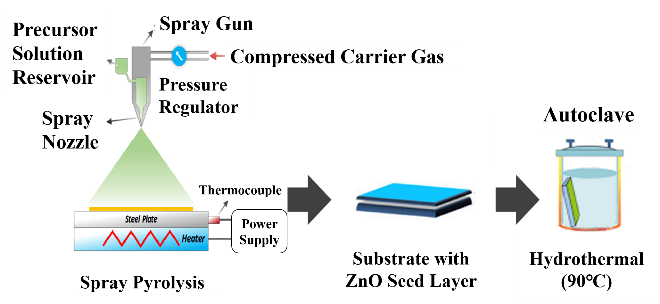
A piezoelectric nanogenerator is an energy harvesting system that converts small-scale mechanical energy into electrical energy. Zinc oxide nanorod structures have gained wide attention as a piezoelectric material for nanogenerator applications, because ZnO has good piezoelectric properties and can be fabricated at low cost. This work studied the morphology and structures of ZnO-PVDF composite films, fabricated using spray pyrolysis, hydrothermal and spin coating techniques. ZnO nanorods were grown using two steps: (1) growing seed layers on a metal substrate using a spray pyrolysis technique and (2) growing ZnO nanorods on the seed layers using a hydrothermal technique. Two different substrates, aluminium and copper foils, were used and the varying hydrothermal growth times were 12 and 14 h. The crystalline and morphological structures of the ZnO nanorods were characterized using X-ray diffraction and Scanning electron microscopy. Then, the ZnO nanorods were coated with poly (vinylidene fluoride) or PVDF using a spin-coating method with different spin speeds of 500 and 1,000 rpm. After spin-coating, the samples were treated with either air-cooling or heating (at 100°C) for 10 minutes. The phases and substituents of PVDF were analyzed using Fourier transform infrared spectroscopy (FTIR). The polar β phase of PVDF is of interest due to its piezoelectric property. The β percentage amount, calculated from the FTIR result, was maximized at 88% with ZnO nanorods and air-cooling.
References
Biswas, A., Henkel, K., Schmeiber, Dieter., and Mandal, D. (2017). Comparison of the thermal stability of the α, β and γ phases in poly (vinylidene fluoride) based on in situ thermal Fourier transform infrared spectroscopy. Phase Transitions., 90(12):1,205-1,213
Jalali, N. (2015). ZnO nanorods-based piezoelectric energy harvesters. London, 247p.
Jingjing, L., Sheng, C., Wentao, L., Rungfang, F., Shijian, T., Yinghui, Z., Liqin D., Bin Y., and Yingchun G. (2019). High performance piezoelectric nanogenerators based on electrospun ZnO nanorods/poly (vinylidene fluoride) composite membranes. J. Phys. Chem. C., 123(11):11,378-11,387.
Lanceros-Mendez, S., Mano, J.F., Costa A.M., and Hugo Schmidt, V. (2001). FTIR and DSC studies of mechanically deformed β-PVDF films. J. of Macromolecular Science, Part B., 40(3-4):517-527.
Lee, J.S., Shin, K.Y., Cheong, O.J., Kim, J.H., and Jang, J. (2015). Highly sensitive and multifunctional tactile sensor using free-standing ZnO/PDF thin film with graphene electrodes for pressure and temperature monitoring. Scientific Reports., 5:7,887.
Mahale, B., Bodas, D., and Gangal, S.A. (2017). Study of beta phase development in spin-coated PVDF thick films. Bulletin of Materials Science., 40(3):569-575.
Moonkang, C., Gonzalo, M., Sungmin, H., Jaewoong, K., Jonghoon, J., Chih-Yen, C., and Minbaek, L. (2017). Mechanical and electrical characterization of PVDF-ZnO hybrid structure for application to nanogenerator. Nano Energy., 33:462-468.
Nishiyama, T., Sumihara, T., Sasaki, Y., Sato, E., Yamato, M., and Horibe, H. (2016). Crystalline structure control of poly (vinylidene fluoride) films with the antisolvent addition method. Polymer J., 48:1,035-1,038.
Panda, K.P., Tambe, S.R., and Thite, A.G. (2020). Zinc oxide nanorod as effective reinforcing material for enhancing β phase crystal in poly (vinylidene fluoride) filaments. Journal of composite materials., 54(25):3,833-3,839.
Safaei, M., Sodano, H.A., and Anton, S.R. (2019). A review of energy harvesting using piezoelectric materials: state-of-the-art a decade later (2008-2018). Smart Materials and Structures., 28(11):3,001
Sripianem, W., Chuchuay, A., Kiatthanabumrung, P., Saengow, N., Na Wichean, T., Jongthammanurak, S., Jantaratana, P., Techapiesancharoenkij, R. (2018). Effect of aluminium doping concentration on microstructures, optical and electrical properties of ZnO thin films by spray pyrolysis technique. Materials Today: Proceedings., 2:9,519-9,524.
Sripianem, W., and Techapiesancharoenkij, R. (2018). Effect of Al and Ga codoping on the morphological, electronic, and optical properties of ZnO transparent conductive thin films prepared by spray pyrolysis technique. Turkish Journal of Phy., 42(6):688-698.