ANALYSIS OF PARTICLE FLOWS (PM1, PM5, PM10) IN FORCED VENTILATION SYSTEM USING CFD TECHNIQUE
Keywords:
Computational Fluid Dynamics (CFD), Discrete Phase Model (DPM) modelling, Particle tracking and movement, Forced ventilation systemAbstract
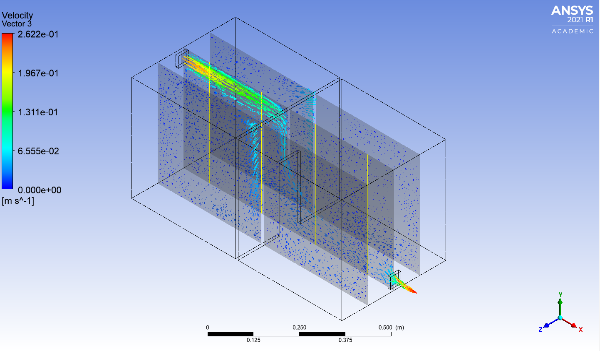
About 80% of the time, people living indoors face an unacceptable quantity of tiny particles that can affect respiration systems and lead to serious health issues. This research objective focuses on investigating forced ventilation systems and how the crucial parameters relating to the particle, including the size, inlet velocity, and room ventilating system, can influence the movement of harmful particles. The Computational Fluid Dynamics (CFD) technique was introduced to investigate a room model's air movements and compared with experimental data. Due to the turbulent flow, two different turbulence models (k-e and k-w SST) were involved and have been discussed when calculating the flow field, as in the Reynolds stress closures. The simulated velocity profiles were found in good agreement with experimental data. To obtain additional information on particle propagations, the Discrete Phase Model (DPM) was introduced. It was found that flow patterns can dominate particle motions in the considered ventilation systems dependent on the size and inlet velocity. Due to having different inlet velocities, the number of escaped particles and the residence times were found to represent different values for each particle size. As a result, the 1 μm particles could completely escape from the room within 13 min, but the larger 10 μm remained in the room for longer, finally escaping after 16 min. This DPM modeling technique will be further introduced to study such infected particles’ movements in commercial or public places. Modifications to enhance the ventilation system's efficiency in particle removal will be crucial in discussions.
References
Brusca, S., Famoso, F., Lanzafame, R., Mauro, S., Messina, M., and Strano, S. (2016). PM10 Dispersion Modeling by Means of CFD 3D and Eulerian-Lagrangian Models: Analysis and Comparison with Experiments. Energy Procedia., 101:329-336.
Chang, T.J., Kao, H.M., and Yam, R.S.W. (2013). Lagrangian modeling of the particle residence time in indoor environment. Building and Environment., 62:55-62.
Chen, F., Yu, S.C. M., and Lai, A.C.K. (2006). Modeling particle distribution and deposition in indoor environments with
a new drift-flux model. Atmospheric Environment., 40(2):357-367.
Chen, Q. (1995). Comparison of differentk-ε models for indoor air flow computations. Numerical Heat Transfer, Part B: Fundamentals., 28(3):353-369.
Deen, N.G., Van Sint Annaland, M., Van Der Hoef, M.A., and Kuipers, J.a.M. (2007). Review of discrete particle modeling of fluidized beds. Chemical Eng. Sci., 62(1-2):28-44.
Dickenson, J.A. and Sansalone, J.J. (2009). Discrete phase model representation of particulate matter (pm) for simulating |pm separation by hydrodynamic unit operations. Environmental Sci. and Technol., 43(21):8,220-8,226.
Gilani, S., Montazeri, H., and Blocken, B. (2016). CFD simulation of stratified indoor environment in displacement ventilation: Validation and sensitivity analysis. Building and Environment., 95:299-313.
Jurelionis, A., Gagytė, L., Prasauskas, T., Čiužas, D., Krugly, E., Šeduikytė, L., and Martuzevičius, D. (2015). The impact of the air distribution method in ventilated rooms on the aerosol particle dispersion and removal: The experimental approach. Energy and Buildings., 86:305-313.
Kao, H.M., Chang, T.J., Hsieh, Y.F., Wang, C.H., and Hsieh, C.I. (2009). Comparison of airflow and particulate matter transport in multi-room buildings for different natural ventilation patterns. Energy and Buildings., 41(9):966-974.
Lab, B. (2021) Particle Air Cleaning and Sick Building Syndrome Symptoms, See. Available from: https://iaqscience.lbl.gov/air-sick Accessed date: May 05, 2021.
Lai, A.C.K., Wang, K., and Chen, F.Z. (2008). Experimental and numerical study on particle distribution in a two-zone chamber. Atmos Environ (1994)., 42(8):1,717-1,726.
Launder, B.E. and Spalding, D.B. (1974). The numerical computation of turbulent flows. Computer Methods in Applied Mechanics and Engineering., 3(2):269-289.
Lu, W. and Howarth, A.T. (1996). Numerical Analysis of Indoor Aerosol Particle Deposition and Distribution in Two-Zone Ventilation System. Building and Environment., 31(1):41-50.
Mateus, N.M., Simões, G.N., Lúcio, C., and Da Graça, G.C. (2016). Comparison of measured and simulated performance of natural displacement ventilation systems for classrooms. Energy and Buildings., 133:185-196.
Menter, F.R. (1994). Two-equation eddy-viscosity turbulence models for engineering applications. AIAA J., 32(8):1,598-1,605.
Promtong, M. (2006). CFD study of flow in rubber smoking room and modification to improve uniformity of velocity and temperature distributions. Prince of Songkla University., 27(11):2,113-2,121.
Promtong, M. (2018). Development of mechanistic approach for wall heat flux partitioning in subcooled boiling flows. RMIT University., 174.
Promtong, M., Cheung, S., and Tu, J. (2016). Numerical modelling of subcooled boiling flow based on mechanistic approach: A validation study using wet steam (IAPWS) as working fluid properties. Lecture notes in engineering and computer science., 1,067-1,075.
Promtong, M., Cheung, S., Yeoh, G., Vahaji, S., and Tu, J. (2017). CFD study of subcooled boiling flow at elevated pressure using a mechanistic wall heat partitioning model. World Acad Sci. Eng. Technol. Int. J. Mech. Aerosp Ind Mechatron Manufh Eng., 10(4):175,748.
Promtong, M., Cheung, S., Yeoh, G., Vahaji, S., and Tu, J. (2018). CFD investigation of sub-cooled boiling flow using a mechanistic wall heat partitioning approach with Wet-Steam properties. The J. of Com. Multiphase Flows., 10(4):239-258.
Promtong, M., Kasemjirapatara, C., Srithep, P., Masoodi, Y., Namchanthra, S., Priyadumkol, J., and Suvanjumrat, C. (2020a). Investigation of aerodynamic performance of four potential airfoils for a formula sae car: a 2d validation study. In: The 34th Conference of the Mechanical Engineering Network of Thailand), 15-17 July 2020, Prachuap Khiri Khan, Thailand, p. 495-508.
Promtong, M., Khunsri, K., Teachapanitvittaya, K., Trakulkumlue, T., Watechagit, S., and Suvanjumrat, C. (2020b). Experimental and numerical investigations into the natural convection of hot gas in a vertical smoking oven: a validation study. In The 34th Conference of the Mechanical Engineering Network of Thailand.), 15-17 July 2020, Prachuap Khiri Khan, Thailand, p. 484-494.
Promtong, M., Kirirat, P., Taweekun, J., and Tekasakul, P. (2005) CFD and Experimental Study of the Temperature Distribution in a Present Rubber Smoking Room In Proceedings of The 19th Conference of Mechanical Engineering Network of Thailand.
Promtong, M. and Tekasakul, P. (2007). CFD study of flow in natural rubber smoking-room: I. Validation with the present smoking-room. Applied Thermal Engineering., 27(11-12):2,113-2,121.
Ren, J., Wang, Y., Liu, Q., and Liu, Y. (2021). Numerical Study of Three Ventilation Strategies in a prefabricated COVID-19 inpatient ward. Build Environ., 188:107,467.
Suvanjumrat, C. (2017). Comparison of Turbulence Models for Flow Past NACA0015 Airfoil Using OpenFOAM. Engineering J., 21(3):207-221.
Taheri, M., Zolfaghari, S.A., Afzalian, M., and Hassanzadeh, H. (2021a). The influence of air inlet angle in swirl diffusers of UFAD system on distribution and deposition of indoor particles. Building and Environment., 191.
Taheri, M., Zolfaghari, S.A., Hassanzadeh, H., and Salmanzadeh, M. (2021b). Numerical investigation of the effects of fan-coil airflow direction on distribution and deposition of indoor pollutant particles. J. of Building Eng., 33.
Tekasakul, P. and Promtong, M. (2008). Energy efficiency enhancement of natural rubber smoking process by flow improvement using a CFD technique. Applied Energy., 85(9):878-895.
Vuorinen, V., Aarnio, M., Alava, M., Alopaeus, V., Atanasova, N., Auvinen, M., Balasubramanian, N., Bordbar, H., Erasto, P., Grande, R., Hayward, N., Hellsten, A., Hostikka, S., Hokkanen, J., Kaario, O., Karvinen, A., Kivisto, I., Korhonen, M., Kosonen, R., Kuusela, J., Lestinen, S., Laurila, E., Nieminen, H.J., Peltonen, P., Pokki, J., Puisto, A., Raback, P., Salmenjoki, H., Sironen, T., and Osterberg, M. (2020). Modelling aerosol transport and virus exposure with numerical simulations in relation to SARS-CoV-2 transmission by inhalation indoors. Saf Sci., 130:104,866.
W.H.O. (2020) Coronavirus disease (COVID-19): How is it transmitted? World Health Organization [WHO], See. Available from: https: //www.who.int/news-room/q-a-detail/coronavirus-disease-covid-19-how-is-it-transmitted. Accessed date: May 05, 2021.
W.H.O. (2021) Air pollution. World Health Organization [WHO], See. Available from: https://www.who.int/health-topics/air-pollution#tab=tab_1. Accessed date: May 01, 2021.
Yuan, H.L., Kekina, P., Suvanjumrat, C., Agarwal, R.K., Tandon, P., and Wang, E.X. (2017). A Comparative Study on Turbulence Models for Simulation of Flow Past NACA 0015 Airfoil Using OpenFOAM. MATEC Web. of Conferences., p. 95.
Zahari, N.M., Zawawi, M.H., Sidek, L.M., Mohamad, D., Itam, Z., Ramli, M.Z., Syamsir, A., Abas, A., and Rashid, M. (2018) Introduction of discrete phase model (DPM) in fluid flow: A review. In: Green Design and Manufacture: Advanced And Emerging., 030(1):020,234.
Zhang, Z. and Chen, Q. (2006). Experimental measurements and numerical simulations of particle transport and distribution in ventilated rooms. Atmospheric Environment., 40(18):3,396-3,408.
Zhao, B., Yang, C., Yang, X., and Liu, S. (2008). Particle dispersion and deposition in ventilated rooms: Testing and evaluation of different Eulerian and Lagrangian models. Building and Environment., 43(4):388-397.
Zhao, B., Zhang, Y., Li, X., Yang, X., and Huang, D. (2004). Comparison of indoor aerosol particle concentration and deposition in different ventilated rooms by numerical method. Building and Environment., 39(1):1-8.
Zhao, W., Kilpeläinen, S., Kosonen, R., Jokisalo, J., Lestinen, S., and Mustakallio, P. (2021). Thermal environment and ventilation efficiency in a simulated office room with personalized micro-environment and fully mixed ventilation systems. Building and Environment., 188.