ANALYSIS ON FLOW CHARACTERISTICS OF COMBINATION AIR VALVE PROTOTYPE USING CFD TECHNIQUE: A 2D-VOF MODEL
Keywords:
Computational Fluid Dynamics (CFD), Volume of Fluid Method (VOF), Volumn tracking modelling, Combination air valve, Air releasing performancAbstract
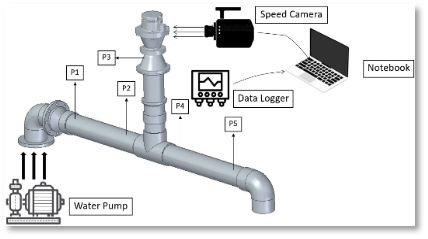
Due to vacuum and safety issues, combination air valves are necessarily introduced to evacuate the entrapped air before damaging piping system components. This research was aimed to introduce the Computational Fluid Dynamic (CFD) technique to investigate the flows in a combination air valve, especially while releasing the air under various operating conditions. A two-dimensional model was proposed to perform the simulation study to save the computing time. The boundary and conditions were derived from the actual experiment; specifically, the Volume of Fluids (VOF) method was employed to capture the interfacial motion of the air-water flows. The turbulent model, Realizable 𝑘-e, was adopted to calculate the Reynolds Stress term. As a result, the predicted transient pressures, and the calculated air release times of both the cases installing and not installing the SARC agreed with the experiments; the maximum differences were 8.8% and 16.4%, respectively. According to the simulation works, it was found that the crucial factors to consider to evaluate air valve performance are transient pressure and velocity fields in the air valve and the transient force acting on the ball valve. In future work, a more comprehensive study will be conducted to find the critical criteria for the combination air valve design, especially to enhance the air removal performance.
References
Aldeeb, A.A., Darby, R., and Arndt, S. (2014). The dynamic response of pressure relief valves in vapor or gas service. Part II: Experimental investigation. J. Loss Prev. Proc. Indust., 31:127-132.
Aniszewski, W., Ménard, T., and Marek, M. (2014). Volume of Fluid (VOF) type advection methods in two-phase flow:
A comparative study. Comp. Flu., 97:52-73.
Darby, R. (2013). The dynamic response of pressure relief valves in vapor or gas service, part I: Mathematical model. J. Loss Prev.Proc. Indust., 26(6):1,262-1,268.
Darby, R. and Aldeeb, A.A. (2014). The dynamic response of pressure relief valves in vapor or gas service. Part III: Model validation. J. Loss Prev.Proc. Indust., 31:133-141.
Davis, J.A. and Stewart, M. (2002). Predicting Globe Control Valve Performance-Part I: CFD Modeling. J. Fluids Eng., 124(3):772-777.
García-Todolí, S., Iglesias-Rey, P., Mora-Meliá, D., Martínez-Solano, F., and Fuertes-Miquel, V. (2018). Computational Determination of Air Valves Capacity Using CFD Tech. Water., 10(10).
Gardell, J. (2013). Benchmark of RELAP5 Check Valve Models against Experimental Data).
Hirt, C.W. and Nichols, B.D. (1981). Volume of fluid (VOF) method for the dynamics of free boundaries. J. Comp. Phys., 39(1):201-225.
Kim, N-S. and Jeong, Y-H. (2021). An investigation of pressure build-up effects due to check valve’s closing characteristics using dynamic mesh techniques of CFD. Ann. Nuclear Energy., p. 152.
Lai, Z., Karney, B., Yang, S., Wu, D., and Zhang, F. (2017). Transient performance of a dual disc check valve during the opening period. Ann. Nuclear Energy., 101:15-22.
Lai, Z., Li, Q., Karney, B., Yang, S., Wu, D., and Zhang, F. (2018). Numerical Simulation of a Check Valve Closure Induced by Pump Shutdown. J. Hyd. Eng., 144(12).
Launder, B.E. and Spalding, D.B. (1974). The numerical computation of turbulent flows. Computer Methods in Appl. Mech. Eng., 3(2):269-289.
Lee, N.H. (2005). Effect of Pressurization and Expulsion of Entrapped Air in Pipelines. J. Appl. Fluid Mech., 10(1):11-20.
Mcelhaney, K.L. (2000). An analysis of check valve performance characteristics based on valve design. Nuclear Eng. Design.
Menéndez-Blanco, A., Fernández Oro, J.M., and Meana-Fernández, A. (2019). Unsteady three-dimensional modeling of the Fluid-Structure Interaction in the check valves of diaphragm volumetric pumps. J. Fluid Struct., 90:432-449.
Menter, F.R. (1994). Two-equation eddy-viscosity turbulence models for engineering applications. AIAA J.., 32(8):1,598-1,605.
Pozos-Estrada, O. (2007). Investigation on the Effects of Entrained Air in Pipelines. In: Faculty of Civil and Environmental Engineering). Institut für Wasserbau der Universität Stuttgart
Pozos-Estrada, O. (2018). Investigation of the combined effect of air pockets and air bubbles on fluid transients. J. Hydro., 20(2):376-392.
Promtong, M., Cheung, S., and Tu, J. (2016). Numerical modelling of subcooled boiling flow based on mechanistic approach: A validation study using wet steam (IAPWS) as working fluid properties. Lecture notes in engineering and computer science.
Promtong, M., Khunsri, K., Teachapanitvittaya, K., Trakulkumlue, T., Watechagit, S., and Suvanjumrat, C. (2020). Experimental and numerical investigations into the natural convection of hot gas in a vertical smoking oven: a validation study. In: The 34th Conference of the Mechanical Engineering Network of Thailand., 15-17 July 2020, Prachuap Khiri Khan, Thailand, p. 484-494.
Promtong, M. and Tekasakul, P. (2007). CFD study of flow in natural rubber smoking-room: I. Validation with the present smoking-room. Appl. Thermal Eng., 27(11-12):2,113-2,121.
Suvanjumrat, C. (2017a). Comparison of Turbulence Models for Flow Past NACA0015 Airfoil Using OpenFOAM. Eng. J., 21(3):207-221.
Suvanjumrat, C. (2017b). Implementation and Validation of OpenFOAM for Thermal Convection of Airflow. Eng. J., 21(5):225-241.
Suvanjumrat, C. and Loksupspaiboon, K. (2020). Improvement of Thermal Distribution in the Rubber-Glove Former Conveyor Oven by OpenFOAM. Eng. J., 24(2):109-120.
Thorley, A.R.D. (1989). Check Valve Behavior Under Transient Flow Conditions: A State-of-the-Art Review. J. Fluids Eng., 11(2):178-183.
Tran, P.D. (2017). Pressure Transients Caused by Air-Valve Closure while Filling Pipelines. J. of Hydraulic Eng., 143(2).
Turesson, M. (2011). Dynamic simulation of check valve using CFD and evaluation of check valve model in RELAP5.
Valdés, J.R., Rodríguez, J.M., Monge, R., Peña, J.C., and Pütz, T. (2014). Numerical simulation and experimental validation of the cavitating flow through a ball check valve. Energy Conversion and Management, 78:776-786.
Valvemagazine (2017) Why Air Valves are Needed in Water Applications Valvemagazine (2018) Air Valves in Piping Systems.
Water and Wastesdigest (2016) How to deal with the dangers of entrapped air in liquid piping systems.
Wu, Y., Xu, Y., and Wang, C. (2015). Research on Air Valve of Water Supply Pipelines. Procedia Engineering., 119:884-891.
Yuan, H.L., Kekina, P., Suvanjumrat, C., Agarwal, R K., Tandon, P., and Wang, E.X. (2017). A Comparative Study on Turbulence Models for Simulation of Flow Past NACA 0015 Airfoil Using OpenFOAM. MATEC Web of Conferences. 95.
Zhou, F., Hicks, F., and Steffler, P. (2002a). Observations of Air-Water Interaction in a Rapidly Filling Horizontal Pipe. J. Hydraulic Engineering-asce - J HYDRAUL ENG-ASCE., 128.
Zhou, F., Hicks, F., and Steffler, P. (2002b). Transient Flow in a Rapidly Filling Horizontal Pipe Containing Trapped Air. J. of Hydraulic Eng., 128(6):625-634.
Zhou, L., Liu, D., and Karney, B. (2013). Investigation of Hydraulic Transients of Two Entrapped Air Pockets in a Water Pipeline. J. of Hydraulic Eng., 139(9):949-959.