WATER ABSORPTION KINETICS OF BLANCHED AND UNBLANCHED HYACINTH BEANS (LABLAB PURPUREUS)
Keywords:
activation energy, blanching, hyacinth beans, hydration, modelling, Peleg’s equationAbstract
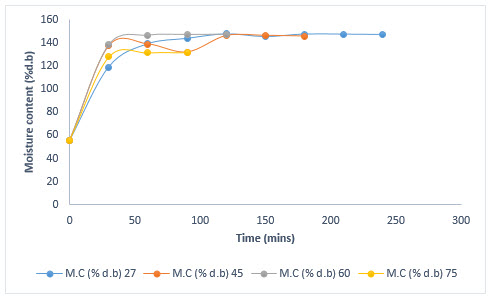
The suitability of Peleg’s equation in describing the water absorption kinetics of blanched and unblanched hyacinth beans seeds was studied at temperatures ranging between 27 and 750C. Blanched and unblanched hyacinth bean seeds were independently soaked at 27-75oC. Water absorbed during soaking was a function of the soaking temperature and time. Results revealed that lower time was required for the seeds to reach equilibrium moisture content when soaked at high temperatures. Blanching prior to soaking reduced the time to reach equilibrium moisture content. Peleg’s equation described the hydration process adequately for the seeds especially for the blanched. The coefficient of determination (R2) ranged between 48.4 to 99.6% for unblanched and 99.8 to 100% for the blanched beans. Temperature dependence of Peleg’s rate constant, k1 was described by the Arrhenius equation. Activation energy values (Ea) of the hydration process obtained were 9.92 kJ/mole for blanched and 11.31 kJ/mole for unblanched seeds.
References
Abu-Ghannam, N., and Mckenna, B. (1997). Hydration Kinetics of Kidney Beans. Journal of Food Science 62,520-523.
Agarry, S. E., Afolabi, T. J., and Akintunde, T. T. Y. (2014). Modelling the water absorption characteristics of different maize (Zea Mays L.) types during soaking. Journal of Food Processing Technology 5,326. doi:10.4172/2157-7110.1000326
AOAC (2016). Official Methods of Analysis, 20th ed. Association of Official Analytical Chemists, Washington D. C
Asoegwu, S. N., Ohanyere, S. O., Kanu, O. P., and Iwueke, C. N. (2006). Physical properties of African oil bean seed. Agric Eng International: the CIGR E-Journal, 8(5-6)
Asoiro, F. U., and Ani, A. O. (2011). Determination of some physical properties of African yam beans. Pacific Journal of Science and Technology 12(1), 374-380.
Eke, C. N. U., Asoegwu, S. N., and Nwandikom, G. I. (2007). Some physical properties of Jackbean seed (Canavalia ensiformis) Agric Eng International: the CIGR E-Journal (7-14)
Hossain, S., Ahmed, R., Bhowmick, S., Al Mamun A., and Hashimoto, M. (2016). Proximate composition and fatty acid analysis of Lablab purpureus (L.) legume seed: implicates to both protein and essential fatty acid supplementation. Springer Plus 5, 1899
Kashiri M., Kashaninejad, M., and Aghajani, N. (2010). Modelling water absorption of sorghum during soaking. Latin American Applied Research 40, 383-388
Kumar, M. M., Prasad, K., Chandra, T. S., and Debnath, S. (2016). Evaluation of physical properties and hydration kinetics of red lentil (Lens culinaris) at different processed levels and soaking temperatures. Journal of the Saudi Society of Agricultural Sciences doi.org/10.1016/jssas.2016.07.004
Miano, A. C., and Augusto, P. E. D. (2018). The hydration of grains: A critical review from description of phenomena to process improvements. Comprehensive Review of Food Science and Food Safety 17, 352-370
Mohsenin, N. N. (1986). Physical Properties of Plant and Animal Materials. Gordon and Breach Science Publishers, New York
Mpotokwane, S. N., Gaditlhatlhelwe, E., Sebaka, A., and Jideani, V. A. (2008). Physical properties of Bambara Groundnut from Botswana. Journal of Food Engineering 6, 89-105
Okpala, L. C., and Ekechi C. A. (2014). Rehydration characteristics of West African pepper (Piper guineense) leaves. Food Science and Nutrition 2(6), 664-668.
Okpala, L. C. (2010). Hydration kinetics and textural properties of pigeon pea (Cajanus cajan). Nigerian Food Journal 28(2), 349-356
Olabinjo, O. O., and Omomowo, O. O. (2019). Hydration kinetics of blanched and unblanched sword beans. International Journal of Horticulture, Agriculture and Food Science 3(5):243-253
Omobuwajo, T.O., Akande, E. A., and Sanni L. A. (1999). Selected physical, mechanical and aerodynamic properties of African breadfruit (Treculia africana) seeds. Journal of Food Engineering 40(4):241-244
Peleg, M. (1988). An Empirical Model for the Description of Moisture Sorption curves. Journal of Food Science 53, 1216-1219.
Sopade, P. A., and Obekpa, J. A. (1990). Modelling water absorption in soybean, cowpea and peanuts at three temperatures using Peleg’s equation. Journal of Food Science 55, 1084-1087.
Tabatabaeefar, A., Aghagoolzadeh, H., and Mobli, H. (2003). Design and development of an auxiliary chickpea second sieving and grading machine. Agricultural Engineering International: the CIGR Journal of Science Research and Development Manuscript FP 03 005
Taiwo, K. A., Akanbi, T., and Ajibo, O. O. (1994). Effect of soaking conditions on water absorption and texture of two cowpea varieties. Nigerian Food Journal 12, 11-18
Turhan, M., Sayar, S., and Gunasekarar, S. (2002). Application of Peleg Model to study water absorption in chickpea during soaking. Journal of Food Engineering 53(2), 153-159.
Urga, K., Fufa, H., Biratu, E., and Gebretsadik, M. (2006). Effects of Blanching and Soaking on some physical characteristics of Grass pea (Lathyrus sativa). African Journal of Food Agriculture and Nutrition 6(1), 1-17
Vasudeva, S., and Vishwanathan, K. H. (2010). Hydration behaviour of food grains and modelling their moisture pick up as per Peleg’s equation: Part II. Legumes. Journal of Food Science and Technology 47(1): 42-46