PHYSICAL AND THERMAL CHARACTERISTICS OF EXPANDED FOAM GLASSES USING CRUDE GLYCEROL AS A FOAMING AGENT
DOI:
https://doi.org/10.55766/sujst-2023-03-e0371Keywords:
Crude glycerol, Decomposition, Foam glass, MicrostructureAbstract
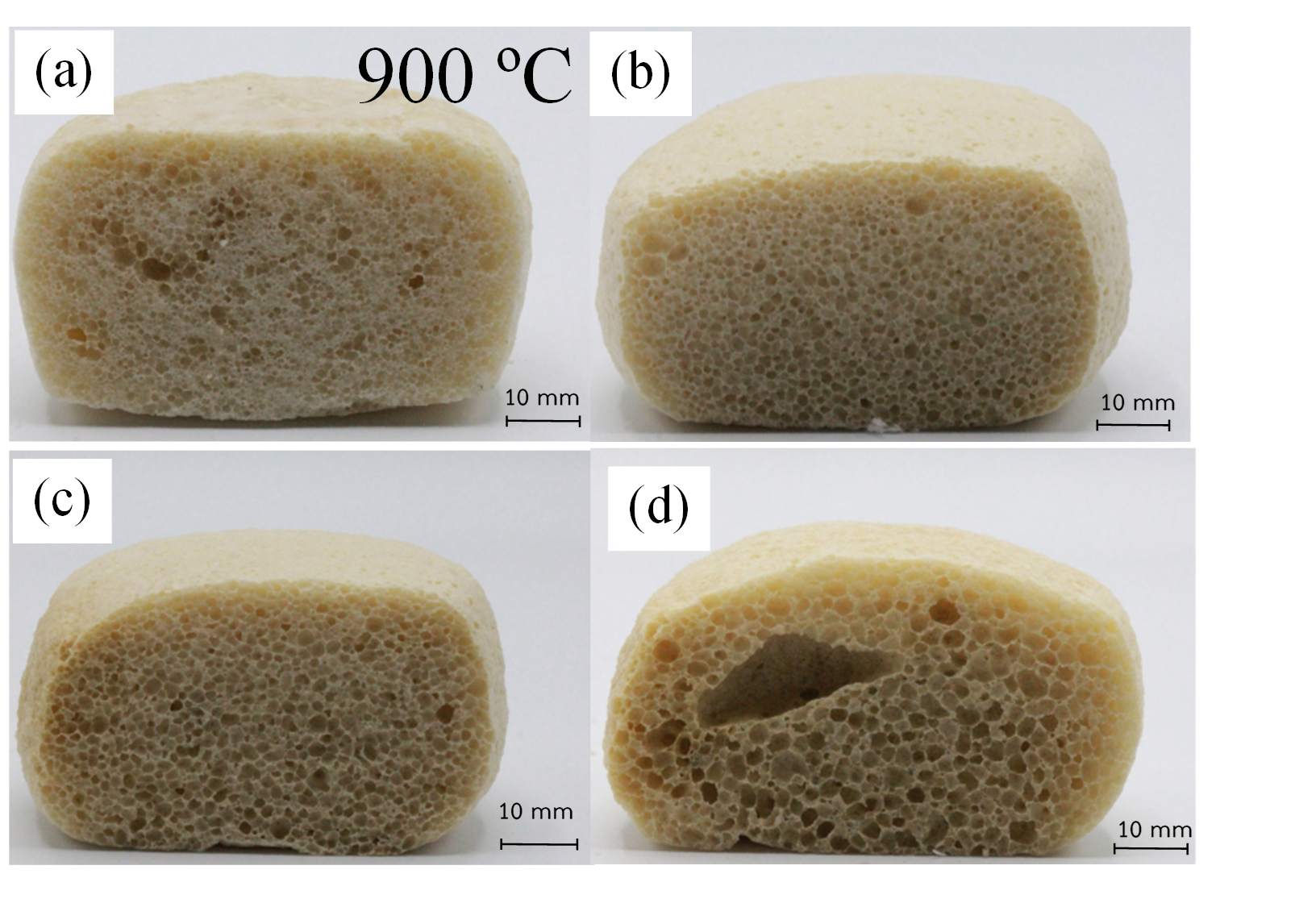
Expanded foam glasses were fabricated from a clear color soda-lime silicate glass. Crude glycerol was used as an effective foaming agent which promoted small closed cell pores. This research studied the effect of crude glycerol content on the expanding characteristics and thermal properties. The expanding behavior relied on the thermal decomposition mechanism of the foaming agent as well as the sintereing temperature. Expanded foam glasses fabricated at 850°C showed uniform pore size compared to those fabricated at other temperatures (800°C and 900°C). Pore size of the synthesized foam glasses generally increased with increasing firing temperature. The evidence of black color in some areas for samples fabricated at 800°C occurred due to incomplete combustion of crude glycerol within the bulk structure. Samples produced at 850°C and 900°C showed white color shading associated with complete combustion of carbonaceous compound. Foam glasses sintered at 900°C showed structural distortion due to glass melting during the foaming process. Large holes or gaps within the structures occured due to the sweeping and combining of gas bubbles during sintering.
References
Adhikary, S.K., Ashish, D.K. and Rudžionis, Ž. (2021) Expanded glass as light-weight aggregate in concrete – A review. Journal of Cleaner Production, 313(1): 127848
Alex, J., Dhanalakshmi, J. and Balraj, A. (2016). Experimental investigation on rice husk ash as cement replacement on concrete production. Construction and Building Materials, 127: 353-362
Bumanis, G., Bajare, D. and Korjakins, A. (2003). Mechanical and Thermal Properties of Lightweight Concrete Made from Expanded Glass. Journal of Sustainable Architecture and Civil Engineering, 2(3): 19-25.
Bumanis, G., Bajare, D. Locs, J. and Korjakins, A. (2013). Alkali-silica reactivity of foam glass granules in structure of lightweight concrete. Construction and building materials, 47: 274-281
Castro, S. and Brito, J. (2013). Evaluation of the durability of concrete made with crushed glass aggregates. Journal of Cleaner Production, 41: 7-14.
Chen, N.H., Zhang, S.H., Pan, X.Y., Zhou, S., Zhao, M. (2020). Foaming mechanism and optimal process conditions of foamed glass based on thermal analysis. Journal of Porous Materials, 27:621–626
Dou, B., Dupont, V., Williams, P.T., Chen, H., and Ding, Y. (2009). Thermogravimetric kinetics of crude glycerol. Bioresour. Technol., 100(9) : 2613.
Fernandes, H., Tulyaganov, D. and Ferreira, J. (2009). Preparation and characterization of foams from sheet glass and fly ash using carbonates as foaming agents. Ceramics International, 35(1): 229-235.
Hemings, E.B., Cavallotti, C., Cuoci, A., Faravelli, T. and Ranzi, E. (2012). A detailed kinetic study of pyrolysis and oxidation of glycerol (propane-1, 2, 3-triol). Combustion Science and Technology, 184(7-8): 1164-1178.
Hesky, D., Aneziris, C.G., Gross, U. and Horn, A. (2015). Water and waterglass mixtures for foam glass production. Ceramics International, 41(10): 12604-12613
Kidalova, L., Stevulova, N., Terpakova, E., Sicakova, A. (2012). Utilization of alternative materials in lightweight composites. Journal of Cleaner Production. 34: 116-119.
König, J., Petersen, R.R. and Yue, Y. (2016). Influence of the glass particle size on the foaming process and physical characteristics of foam glasses. Journal of Non-Crystalline Solids, 447: 190-197.
Petersen, R.R., König, J. and Yue, Y. (2017). The viscosity window of the silicate glass foam production. Journal of Non-Crystalline Solids, 456: 49-54.
Qu, Y.N., Xu, J., Su, Z.G., Ma, N., Zhang, X.Y., Xi, X.Q., and Yang, J.L. (2016). Lightweight and high-strength glass foams prepared by a novel green spheres hollowing technique. Ceramics International, 42(2): 2370-2377
Šeputytė-Jucikė, J. and Sinica, M. (2016). The effect of expanded glass and polystyrene waste on the properties of lightweight aggregate concrete. Engineering Structures and Technologies, 8(1):31-40.
Souza, M.T., Oliveira Maia, B.G., Teixeira, L.B., Oliveira, K.G., Teixeira, A. and Oliveira, A.P.N. (2017). Glass foams produced from glass bottles and eggshell wastes. Process Safety and Environmental Protection, 111: 60-64.
Wang, H., Chen, Z.W., Ji, R., Liu, L.L., Wang, X.D. (2018). Integrated utilization of high alumina fly ash for synthesis of foam glass ceramic. Ceram. Int. 44: 13681–13688
Wei, Y.L.,Cheng, S.H., Ou, K.T., Kuo, P.J., Chung, T.H. and Xie, X.Q. (2017). Effect of calcium compounds on lightweight aggregates prepared by firing a mixture of coal fly ash and waste glass. Ceramics International, 43(17): 15573-15579
Yu, R., Van Onna, D.V., Spiesz, P., Yu, Q.L., Brouwers, H.J.H. (2016). Development of Ultra-Lightweight Fibre Reinforced Concrete applying expanded waste glass. Journal of Cleaner Production, 112, Part 1: 690-701.
Zhang, Q., He, F., Qiao, Y., Mei, S.X., Jin, M.F. and Xie, J. (2016). Preparation of high strength glass ceramic foams from waste cathode ray tube and germanium tailings. Construction and Building Materials, 111: 105-110.
Zhu, M., Ji, R., Li, Z.M., Wang, H., Liu, L.L. and Zhang, Z. (2016). Preparation of glass ceramic foams for thermal insulation applications from coal fly ash and waste glass. Construction and Building Materials, 112: 398-405.