ADSORPTION OF DIBENZOXAZEPINE GAS ON TRANSITION METAL-DOPED SILICON CARBIDE NANOTUBES: A THEORETICAL INVESTIGATION
DOI:
https://doi.org/10.55766/sujst-2023-03-e0176Keywords:
CR gas, Dibenzoxazepine, DFT, Silicon carbie nanotube, SensorAbstract
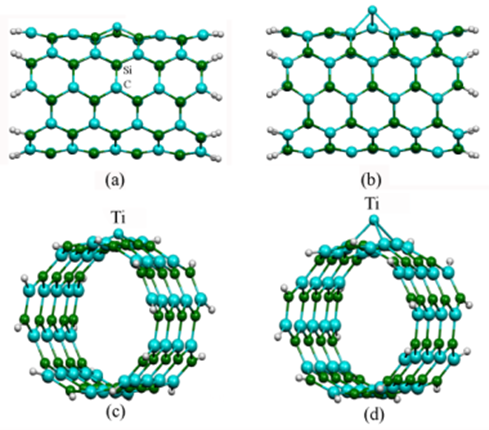
Dibenzoxazepine (CR) molecule is highly toxic gas, therefore, the development of highly sensitive materials for their adsorption and detection is desirable. Density functional theory (DFT) calculation was performed to study the adsorption behavior of CR gas on the pristine and transition metal (TM=Sc, Ti, Y, Zr, La, and Hf) –doped silicon carbide nanotubes (SiCNT) at both Si and C sites. The most stable adsorption configurations, adsorption distances, adsorption energies, charge transfers, energy gaps, orbital distributions, and density of states are obtained to understand the impacts of CR gas on the adsorption abilities and electronic properties of the pristine and TM–doped SiCNT surfaces. The results show that the pristine SiCNT exhibits low adsorption ability to CR gas. Conversely, the SiCNT doping with TM atom at Si and C sites enhances adsorption ability to CR gas. The strong adsorption of CR gas on TM–doped SiCNT surface is due to more favorable orbital interaction as well as shorter adsorption distance and larger charge transfer than pristine SiCNT. Moreover, the results reveal that the adsorption of CR gas significant changes in the electronic properties of TM–doped SiCNT. Therefore, the doping of TM atoms on SiCNT at both Si and C sites could enhance the adsorption ability and suitable for use as sensors for detecting CR gas.
References
Aleksandrov V.N., and Emelyanov V.I. (1990). Poisonous Substances. G.A. Sokolskiy, ed. Moscow.
Becke, A.D. (1998). Density–functional exchange–energy approximation with correct a symptotic behavior. Phys. Rev. A, 38:3098–3100.
Becke, A.D. (1993). Density–functional thermochemistry. III. The role of exact exchange. J. Chem. Phys., 98:5648–5652.
Demir, S., Fellah M.F. (2020). A DFT study on Pt doped (4,0) SWCNT: CO adsorption and sensing, Appl. Surf. Sci. 504:144141.
Esrafili, M.D., and Behzadi, H. (2013). A comparative study on carbon, boron–nitride, boron–phosphide and silicon–carbide nanotubes based on surface electrostatic potentials and average local ionization energies, J. Mol. Model., 19: 2375–2382.
Farmanzadeh, D., Ardehjani, N.A. (2018). Adsorption of O3, SO2 and NO2 molecules on the surface of pure and Fe–doped silicon carbide nanosheets: A computational study, Appl. Surf. Sci., 462:685–692.
Frisch, M.J., Trucks, G.W., Schlegel, H.B., Scuseria, G.E., Robb, M.A., Cheeseman, J.R., Scalmani, G., Barone, V.;Mennucci, B., Petersson, G.A., Nakatsuji, H., Caricato, M., Li, X., Hratchian, H.P., Izmaylov, A.F., Bloino, J., Zheng, G., Sonnenberg, J.L., Hada, M., Ehara, M., Toyota, K., Fukuda, R., Hasegawa, J., Ishida, M., Nakajima, T., Honda, Y., Kitao, O., Nakai, H., Vreven, T., Montgomery, J. A., Peralta, Jr., J.E., Ogliaro, F., Bearpark, M., Heyd, J.J., Brothers, E., Kudin, K.N., Staroverov, V.N., Kobayashi, R., Normand, J., Raghavachari, K., Rendell, A., Burant, J.C., Iyengar, S.S., Tomasi, J., Cossi, M., Rega, N., Millam, J.M., Klene, M., Knox, J.E., Cross, J.B., Bakken, V., Adamo, C., Jaramillo, J., Gomperts, R., Stratmann, R.E., Yazyev, O., Austin, A.J., Cammi, R., Pomelli, C., Ochterski, J.W., Martin, R.L., Morokuma, K., Zakrzewski, V.G., GVoth, .A., Salvador, P., Dannenberg, J.J., Dapprich, S., Daniels, A.D., Farkas, Ö., Foresman, J.B., Ortiz, J.V., Cioslowski, J., and Fox, D.J. (2009). GAUSSIAN 09, Revision A.02, GaussianInc, Wallingford CT.
Gecim, G., Ozekmekci, M. (2021). A density functional theory study of molecular H2S adsorption on (4,0) SWCNT doped with Ge, Ga and B, Surf. Sci., 711:121876.
Ghiassi, H., and Raissi, H. (2017). Doped–SiCNT as a promising sensor for detection of CS2 molecule, J. Sulphur Chem., 38:372–383.
Gogotsi, Y. (2006). Nanomaterials, Taylor & Francis Group, LLC, FL.
González Fá, A.J., Orazi, V., Jasen, P., Marchetti, J.M., López-Corral, I. (2020). Adsorption of carbonyl sulfide on Pt-doped vacancy-defected SWCNT: A DFT study, Appl. Surf. Sci., 525:146331.
Hay, P.J., and Wadt, W.R. (1985). Ab initio effective core potentials for molecular calculations. Potentials for the transition metal atoms Sc to Hg, J. Chem. Phys., 82: 270–283.
Gueriba, J.S., Padama, A.A.B., Villagracia, A.R., David, M., Arboleda Jr. N., and Kasai, H. (2017). Ab initio study on hydrogen interaction with calcium decorated silicon carbide nanotube, Int. J. Hydrog. Energy, 42:11452–11460.
Lin, W.Q., Li, F., Chen, G.H., Xiao, S.T., Wang, L.Y., and Wang, Q. (2020). A study on the adsorptions of SO2 on pristine and phosphorus–doped silicon carbide nanotubes as potential gas sensors, Ceram. Int., 46:25171–25188.
Lin, W.Q., Xiao, S.T., Li, H.B., Ouyang, Y.G., Wang, L.Y., Wang, Q., and Chen, G.H. (2021). Theoretical study of NO2 adsorption on SiCNT and P–doped SiCNT, Physica E Low Dimens. Syst. Nanostruct., 127:114519.
Liu, Y., Zhang, H., Zhang, Z., Jia, X., An, L. (2019). CO adsorption on Fe–doped vacancy–defected CNTs – A DFT study, Chem. Phys. Lett., 730:316–320.
Mahdavifar, Z., and Abbasi, N. (2014) The influence of Cu–doping on aluminum nitride, silicon carbide and boron nitride nanotubes’ ability to detect carbon dioxide; DFT study, Physica E Low Dimens. Syst. Nanostruct., 56:268–276.
Olajos, E.J., and Salem, H. (2001). Riot control agents: Pharmacology, toxicology, biochemistry and chemistry, J. Appl. Toxicol., 21:355–391.
Pearson, R.G. (1963). Hard and soft acids and bases, J. Am. Chem. Soc., 85(22):3533–3539.
Roohi, H., and Ardehjani, N.A. (2022). Adsorption performance of TM doped (TM = Fe, Ni, Cr and Zn) silicon carbide nanotubes towards formaldehyde: a DFT–M06–L study, Mol. Phys., 120 :.
Sangnikul, P., Tabtimsai, C., Rakrai, W., and Wanno, B. (2020). DFT investigation of toluene adsorption on silicon carbide nanosheet doping with transition metal for storage and sensor application, Suan Sunandha Sci. Tech., 7:14–21.
Sharafeldin, I.M., and Allam, N.K. (2017). DFT insights into the electronic properties and adsorption of NO2 on metal–doped carbon nanotubes for gas sensing applications, New J. Chem., 41:14936–14944.
Tabtimsai, C., Wanno, B., Utairueng, A., Promchamorn, P., Kumsuwan. U. (2019). First principles investigation of NH3 and NO2 adsorption on transition metal–doped single–walled carbon nanotubes, J. Electron. Mater., 48: 7226–7238.
Tabtimsai, C., Rakrai, W., Phalinyot, S., Wanno, B. (2020). Interaction investigation of single and multiple carbon monoxide molecules with Fe–, Ru–, and Os–doped single–walled carbon nanotubes by DFT study: applications to gas adsorption and detection nanomaterials, J. Mol. Model., 26:186.
Verma, R., Jaggi, N. (2022) Hydrogen adsorption on osmium and boron co–doped single walled carbon nanotubes for energy storage: A DFT study, Diam. Relat. Mater., 130:109452.
Wadt, W.R., and Hay, P.J. (1985). Ab initio effective core potentials for molecular calculations. Potentials for main group elements Na to Bi, J. Chem. Phys., 82:284–298.
Wright, S. (1998). An appraisal of technologies of political control. The STOA Programme, Directorate General for Research, European Parliament, Luxembourg.
Wu, R.Q., Yang, M., Lu, H.Y., Feng, Y.P., Huang, Z.G., and Wu, Q.Y. (2008). Silicon carbide nanotubes as potential gas sensors for CO and HCN detection, J. Phys. Chem. C, 112:15985–15989.
Zhao, D., Fan, X., Luo, Z., An, Y., Hu, Y. (2018). Enhanced gas–sensing performance of graphene by doping transition metal atoms: A first–principles study, Phys. Lett. A., 382:2965–2973.
Zhou, X., Zhao, C., Chen, C., Chen, J., Li, Y. (2020). DFT study on adsorption of formaldehyde on pure, Pd–doped, Si–doped single–walled carbon nanotube, Appl. Surf. Sci., 525:146595.