EXTREME LEARNING MACHINE AND CHAOTIC BASED SPHYRAENA CHRYSOTAENIA OPTIMIZATION ALGORITHMS FOR LOSS LESSENING AND POWER STABILITY MAGNIFICATION
DOI:
https://doi.org/10.55766/sujst-2023-03-e0123Keywords:
Optimal, Reactive, Transmission loss, Sphyraena Chrysotaenia Extreme Learning Machine, ChaoticAbstract
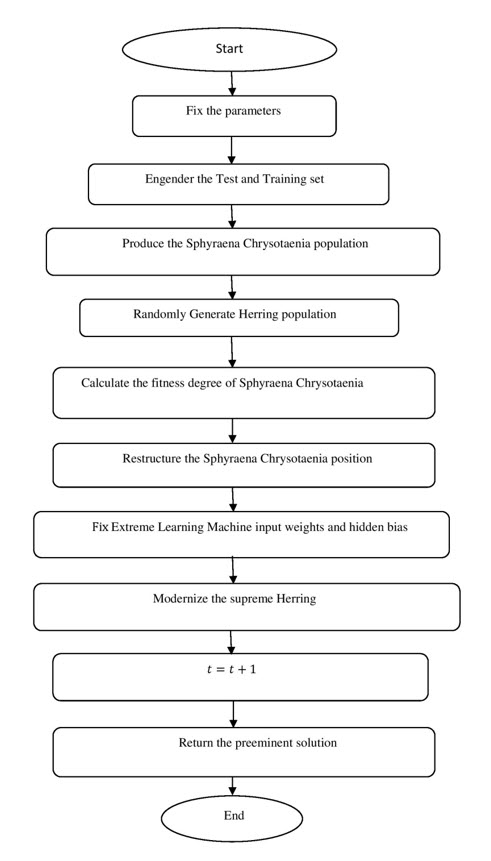
In this paper Extreme Learning Machine and Chaotic based Sphyraena Chrysotaenia Optimization Algorithms are applied for solving the Real Power loss lessening problem. Key objective of this work are Real power loss decreasing, power divergence restraining, and power constancy amplification. Extreme Learning machine and chaotic are integrated in the algorithm to obtain the better solutions. Candidate solutions in the projected Sphyraena Chrysotaenia optimization are Sphyraena Chrysotaenia and population in the inspection region is quixotically enthused. Spasmodically impressive solutions can be erroneous while restructuring the position of inspection agents and renewed positions may be inadequate one than the previous positions so magnificent selection is engaged. Domination comprises recurrence the self-effacing fitting solution to ensuing generation. In Extreme Learning Machine based Sphyraena Chrysotaenia Optimization Algorithm (ELMSC) initial phases of iteration, the Sphyraena Chrysotaenia Optimization Algorithm contestants are diversified in position and exponential standby generates unrestricted impulsive calculations which endow the rudiments to accommodate the entire revelation area. Compatibly, all over end stage of iterations, fundamentals are enclosed by Sphyraena Chrysotaenia Optimization Algorithm contestants and all an optimal condition with equivalent scheme. Chaotic sequences are combined into the Sphyraena Chrysotaenia Optimization Algorithm (CSCO). This amalgamation will augment the Exploration and Exploitation. Tinkerbell chaotic map fabricating tenets are employed. Proposed ELMSC and CSCO are corroborated in IEEE 30, 57, 118, 300, and 354 bus test systems. True power loss lessening, power divergence curtailing, and power constancy augmentation has been achieved. In future proposed ELMSC and CSCO can be applied to solve the others problems in Electrical engineering and also can be applied to resolve the problems in other engineering domains.
References
Ali Nasser Hussain, Ali Abdulabbas Abdullah and Omar Muhammed Neda, (2018),“Modified Particle Swarm Optimization for Solution of Reactive Power Dispatch”, Research Journal of Applied Sciences, Engineering and Technology 15(8): 316-327.
Ahmadnia, Sajjad & Tafehi, Ehsan & Dastgahian, Fatemeh. (2019). Optimal Placement and Sizing for Solar Farm with Economic Evaluation, Power Line Loss and Energy Consumption Reduction. IETE Journal of Research. 1-16. 10.1080/03772063.2019.1694450.
Azimi, Mohammad & Mohammadi-ivatloo, Behnam & Zare, Kazem & Abapour, Mehdi. (2015). Probabilistic Allocation of Thyristor-controlled Phase Shifting Transformer for Transient Stability Enhancement of Electric Power System. IETE Journal of Research. 61. 1-10. 10.1080/03772063.2015.1023743.
Bentouati, B., Khelifi, A., Shaheen, A.M. et al.(2021). An enhanced moth-swarm algorithm for efficient energy management based multi dimensions OPF problem. J Ambient Intell Human Comput 12:1, 9499–9519.
Bingane, M. F. Anjos, and S. Le Digabel, (2019). Tight-and-cheap conic relaxation for the optimal reactive power dispatch problem. IEEE Transactions on Power Systems. 34:6, 4684-4693.
Davoodi, E. Babaei, B. Mohammadi-Ivatloo, and M. Rasouli, (2019. A novel fast semidefinite programming-based approach for optimal reactive power dispatch. IEEE Transactions on Industrial Informatics. 16: 1, 288-298.
Dai, C., W. Chen, Y. Zhu and X. Zhang, 2009. Seeker optimization algorithm for optimal reactive power dispatch. IEEE T. Power Syst., 24(3):1218-1231.
Diab, H.; Abdelsalam, M.; Abdelbary, A. (2021). A Multi-Objective Optimal Power Flow Control of Electrical Transmission Networks Using Intelligent Meta-Heuristic Optimization Techniques. Sustainability. 13:1, 4979-1
Darvish Falehi, A. (2020). Optimal robust disturbance observer based sliding mode controller using multi-objective grasshopper optimization algorithm to enhance power system stability. J Ambient Intell Human Comput.11:1, 5045–5063.
Gonggui Chen, Lilan Liu, Yanyan Guo, Shanwai Huang, (2016). Multi-objective enhanced PSO algorithm for optimizing power losses and voltage deviation in power systems, COMPEL: The International Journal for Computation and Mathematics in Electrical and Electronic Engineering,. 35:1, 350-372.
Grudinin.(1998). Reactive power optimization using successive quadratic programming method. IEEE Transactions on Power System. 13:4, 1219–1225.
Illinois Center for a Smarter Electric Grid (ICSEG). Available online: https://icseg.iti.illinois.edu/ieee-30-bussystem/ (accessed on 25 February 2019).
Inoue. (2000). Application of chaos degree to some dynamical systems Chaos, Solutions Fractals, 11 :1, 1377-1385.
Jan., Chen, (1995). Application of the fast Newton-Raphson economic dispatch and reactive power/voltage dispatch by sensitivity factors to optimal power flow. IEEE Trans. Energy Convers. 10: 2, 293-301.
Juneja, Kapil. (2020). A Fuzzy-Controlled Differential Evolution Integrated Static Synchronous Series Compensator to Enhance Power System Stability. IETE Journal of Research. 1-16. 10.1080/03772063.2020.1795936.
Kien LC, Hien CT, Nguyen TT. (2021). Optimal Reactive Power Generation for Transmission Power Systems Considering Discrete Values of Capacitors and Tap Changers. Applied Sciences. 11(12):5378.
Kazmi, Syed Ali & Shahzad, Muhammad & Shin, Dong. (2017). Voltage Stability Index for Distribution Network connected in Loop Configuration. IETE Journal of Research. 63. 1-13. 10.1080/03772063.2016.1257376.
Khazali and M. Kalantar, (2011). Optimal reactive power dispatch based on harmony search algorithm. International Journal of Electrical Power & Energy Systems. 33:1, 684–692.
Khunkitti, S.; Siritaratiwat, A.; Premrudeepreechacharn, S. (2021) Multi-Objective Optimal Power Flow Problems Based on Slime Mould Algorithm. Sustainability. 13:1, 7448-1.
Kola Sampangi, Sambaiah & Jayabarathi, T.. (2020). Optimal Modeling and Allocation of Mixed Wind and Solar Generation Systems in Electric Distribution Networks. IETE Journal of Research. 1-13. 10.1080/03772063.2020.1787876.
Lakshmi Priya & S.T. Jaya Christa (2021) An Effective Hybridized GWO-BSA for Resolving Optimal Power Flow Problem with the Inclusion of Unified Power Flow Controller, IETE Journal of Research, DOI: 10.1080/03772063.2021.1942245
Lv, F.; Han, M. (2019). Hyperspectral image classification based on multiple reduced kernel extreme learning machine. Int. J. Mach. Learn. Cybern.10:1, 3397–3405.
Mandal and Roy.(2013). Optimal reactive power dispatch using quasi-oppositional teaching learning based optimization. International Journal of Electrical Power & Energy Systems. 15:1, 123–134.
Mei, R.N.S.; Sulaiman, M.H.; Mustaffa, Z.; Daniyal, H. (2017). Optimal reactive power dispatch solution by loss minimization using moth-flame optimization technique. Appl. Soft Comput. 59:1, 210–222
Masood, F.; Nor, N.B.M.; Nallagownden, P.; Elamvazuthi, I.; Saidur, R.; Alam, M.A.; Akhter, J.; Yusuf, M.; Mehmood, M.; Ali, M. A Review of Recent Developments and Applications of Compound Parabolic Concentrator-Based Hybrid Solar Photovoltaic/Thermal Collectors. Sustainability 2022, 14, 5529. https://doi.org/10.3390/su14095529
Menon, Praveen & Rani, B. & Kumar, Kailash & Gupta, Varun. (2021). An effective OS–DPLL design for reducing power dissipation in an IoT application. Journal of Ambient Intelligence and Humanized Computing. 10.1007/s12652-021-03016-z.
Mohamed Ebeed & Ayman Alhejji & Salah Kamel & Francisco Jurado, (2020). Solving the Optimal Reactive Power Dispatch Using Marine Predators Algorithm Considering the Uncertainties in Load and Wind-Solar Generation Systems. Energies. 13:17,1-19.
Mouassa, T. Bouktir, and A. Salhi, (2017). Ant lion optimizer for solving optimal reactive power dispatch problem in power system. Engineering Science and Technology. 20:3, 885–895.
Musarat, M.A.; Alaloul, W.S.; Rabbani, M.B.A.; Ali, M.; Altaf, M.; Fediuk, R.; Vatin, N.; Klyuev, S.; Bukhari, H.; Sadiq, A.; Rafiq, W.; Farooq, W. Kabul River Flow Prediction Using Automated ARIMA Forecasting: A Machine Learning Approach. Sustainability 2021, 13, 10720. https://doi.org/10.3390/su131910720
Nafees, A.; Javed, M.F.; Musarat, M.A.; Ali, M.; Aslam, F.; Vatin, N.I. FE Modelling and Analysis of Beam Column Joint Using Reactive Powder Concrete. Crystals 2021, 11, 1372. https://doi.org/10.3390/cryst11111372
Nagarajan, Karthik & a.k, Parvathy & Arul, R.. (2020). Multi-Objective Optimal Reactive Power Dispatch using Levy Interior Search Algorithm. International Journal on Electrical Engineering and Informatics. 12. 547-570. 10.15676/ijeei.2020.12.3.8.
Nuaekaew, K.; Artrit, P.; Pholdee, N.; Bureerat, S. (2017). Optimal reactive power dispatch problem using a two-archive multi-objective grey wolf optimizer. Expert Syst. Appl. 87:1, 79–89. .
Omelchenko, I.N. & Lyakhovich, Dmitry & Aleksandrov, A.A. & Vodchits, Angelina & Kunkov, N.V.. (2020). Development of a Design Algorithm for the Logistics System of Product Distribution of the Mechanical Engineering Enterprise. Herald of the Bauman Moscow State Technical University. Series Mechanical Engineering. 62-69. 10.18698/0236-3941-2020-3-62-69.
Omelchenko, Irina & Zakharov, Mikhail & Lyakhovich, Dmitry & Vodchits, Angelina. (2020). organization of logistic systems of scientific productions: scientific research work of the master's student and evaluation of its results. 10.18334/9785912923258.252-256.
Omelchenko, Irina & Lyakhovich, Dmitry & Alexandrov, Alexander & Vodchits, Angelina & Sturua, Kirill. (2020). Problems and organizational and technical solutions of processing management problems of material and technical resources in a design-oriented organization. 10.18334 / 9785912923258.257-260.
Pandya, S. and R. Roy, (2015). Particle swarm optimization based optimal reactive power dispatch. Proceeding of the IEEE International Conference on Electrical, Computer and Communication Technologies (ICECCT), pp: 1-5
Quintana, V.H., Santos-Nieto, M. (1989). Reactive-power dispatch by successive quadratic programming IEEE Trans. Energy Convers., 4 :3,425-435
Reddy. (2014). Faster evolutionary algorithm based optimal power flow using incremental variables”, Electrical Power and Energy Systems. 15:1, 198-210
Raghuwanshi, B.S.; Shukla, S. (2019). Class imbalance learning using UnderBagging based kernelized extreme learning machine. Neuro computing . 329:1,172–187..
Surender Reddy, (2017). “Optimal Reactive Power Scheduling Using Cuckoo Search Algorithm”, International Journal of Electrical and Computer Engineering. 7:5. 2349-2356.
Sahli, A. Hamouda, A. Bekrar, and D. Trentesaux, (2014). Hybrid PSO-tabu search for the optimal reactive power dispatch problem. in Proceedings of the IECON 2014-40th Annual Conference of the IEEE Industrial Electronics Society, Dallas, TX, USA, November 2014.
Subbaraj, P. and P.N. Rajnarayan, (2009). Optimal reactive power dispatch using self-adaptive real coded Genetic algorithm. Electr. Power Syst. Res., 79(2): 374-38.
Sridhar, N., Kowsalya, M. (2021). Enhancement of power management in micro grid system using adaptive ALO technique. J Ambient Intell Human Comput 12:1, 2163–2182
Suja, K.R. (2021). Mitigation of power quality issues in smart grid using levy flight based moth flame optimization algorithm. J Ambient Intell Human Comput. 12:1, 9209–9228
Sharma, S., Ghosh, S. (2020). FIS and hybrid ABC-PSO based optimal capacitor placement and sizing for radial distribution networks. J Ambient Intell Human Comput 11:1, 901–916.
Saravanan, C., Anbalagan, P. (2021). Multi objective dragonfly algorithm for congestion management in deregulated power systems. J Ambient Intell Human Comput 12:1, 7519–7528.
Saxena, Nitin Kumar, Kumar, Ashwani and Gupta, Varun.(2021). "Enhancement of system performance using STATCOM as dynamic compensator with squirrel cage induction generator (SCIG) based microgrid" International Journal of Emerging Electric Power Systems. 22:2, 177-189.
Souhil Mouassa, Tarek Bouktir, (2018). Multi-objective ant lion optimization algorithm to solve large-scale multi-objective optimal reactive power dispatch problem, COMPEL: The International Journal for Computation and Mathematics in Electrical and Electronic Engineering, 35:1, 350-372.
Tudose, Andrei & Picioroaga, Irina & Sidea, Dorian & Bulac, Constantin. (2021). Solving Single- and Multi-Objective Optimal Reactive Power Dispatch Problems Using an Improved Salp Swarm Algorithm. Energies. 14. 1222. 10.3390/en14051222.
The IEEE 57-Bus Test System [online], available at http://www.ee. washington.edu/research/pstca/pf57/pg_tca57bus.htm.
PSTCA, Power Systems Test Case Archive, University of Washington, Available: http://www.ee.washington.edu/research/pstca/, 2016
Polprasert, W. Ongsakul, and V. N. Dieu, (2016). Optimal reactive power dispatch using improved pseudo-gradient search particle swarm optimization. Electric Power Components and Systems. 44:5, 518–532.
Tran, T. V. Pham, L. H. Pham, N. T. Le, and T. T. Nguyen, (2019). Finding optimal reactive power dispatch solutions by using a novel improved stochastic fractal search optimization algorithm. Telecommunication Computing Electronics and Control. 17:5, 2517–2526.
Thanh Long Duong , Minh Quan Duong, Van-Duc Phan , Thang Trung Nguyen. (2020). Optimal Reactive Power Flow for Large-Scale Power Systems Using an Effective Metaheuristic Algorithm. Hindawi Journal of Electrical and Computer Engineering. 2020, Article ID 6382507,
The IEEE 118-Bus Test System [online], available at http://www.ee. washington.edu/research/pstca/pf118/pg_tca118bus.htm
Terra., Short, (1991). Security-constrained reactive power dispatch. IEEE Trans. Power Syst., 6:1, 109-117.
Vishnu, Mini, Sunil., (2020). An Improved Solution for Reactive Power Dispatch Problem Using Diversity-Enhanced Particle Swarm Optimization”. Energies. 13. 2862. 2-21.
Wang, J.; Mohammed, A.S.; Macioszek, E.; Ali, M.; Ulrikh, D.V.; Fang, Q. A Novel Combination of PCA and Machine Learning Techniques to Select the Most Important Factors for Predicting Tunnel Construction Performance. Buildings 2022, 12, 919. https://doi.org/10.3390/buildings12070919
Yu X, Feng Y, Gao Y, Jia Y, Mei S. (2021) Dual-Weighted Kernel Extreme Learning Machine for Hyperspectral Imagery Classification. Remote Sensing.; 13(3):508.
Zhu, J.Z., Xiong, X.F. (2003). Optimal reactive power control using modified interior point method. Electr. Power Syst. Res., 66:2,187-192.
Zou Q., Li A., He X., Wang X.. (2018). Optimal operation of cascade hydropower stations based on chaos cultural sine cosine algorithm. IOP Conference Series: Materials Science and Engineering, 366 :1, IOP Publishing
Zaidan, Majeed & Izadpanah Toos, Saber. (2021). Optimal Location of Static Var Compensator to Regulate Voltage in Power System. IETE Journal of Research. 10.1080/03772063.2021.1886877.
Zahir Sahli & Abdellatif Hamouda & Abdelghani Bekrar & Damien Trentesaux, (2018). Reactive Power Dispatch Optimization with Voltage Profile Improvement Using an Efficient Hybrid Algorithm. Energies. 11:8, 1-21,