DEVELOPMENT OF MODE CHOICE BEHAVIOR MODEL FOR INTER-REGIONAL PUBLIC TRANSPORT– A CASE STUDY OF INDIA
DOI:
https://doi.org/10.55766/sujst-2023-03-e0113Keywords:
Mode choice model, Interregional passenger trips, Multinomial logit model, Egress and ingress modes, Modal split analysisAbstract
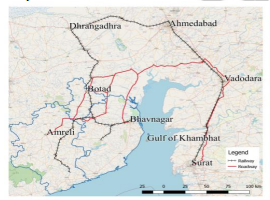
Mode choice behavior of the inter-regional public transport passengers is important for proficient planning and operation of transport systems in developing countries. It is the responsibility of the authority to satisfy the demand for long regional trips having a significant movement of passengers by providing efficient public transport services. Most of the studies for the mode choice behavior of the passengers have been done for the urban mass transport within the urban conglomerate. The study aims to improve knowledge of the factor affecting passengers' decisions on the mode of travel for inter-regional public transportation in India. The Multinomial Logit (MNL) model and Artificial Neural Network (ANN) models among Gujarat State Road Transport Corporation (GSRTC) buses, Railways, and privately operated buses were developed for the trips between Surat city and Bhavnagar region of Gujarat, India. The final ANN model reflects a difference of attributes has 90.52% mode prediction capability against 70.11% of the MNL model. The developed model gives the proper insight for improving the transportation facilities in the region. It is revealed that the improvement in the service level and egress parameters are more important to attract travelers. The sleeper seat availability, lesser travel cost, lesser egress distance, and availability of night journey have been found important during travelers' thinking process to select the traveling mode. There are 13.1% and 20.1% rises in the probability of choosing GSRTC bus and train mode, respectively, with the improvement in the service level. Moreover, the GSRTC bus should improve its connectivity.
References
Almasri, E. (2011). Factors Affecting Travel Choice of Shared Taxi versus Bus for Palestinian University Student Trips. International Review of Civil Engineering, 2(1):35-45.
Almasri, E., and Alraee, S. (2013). Factors Affecting Mode Choice of Work Trips in Developing Cities- Gaza as a Case Study. Journal of Transportation Technologies, Scientific Research, 3(4):247-259.
Al-Ahmadi, H. (2006). Development of intercity mode choice models for Saudi Arabia, J. King Saud Univ. Eng. Sci. 17(1):3–20
Arasan, T. and Vedagiri, P. (2011). Modeling Model Shift from Personal Vehicles to Bus on Introduction of Bus Priority Measure. Asian Transport Stud. 1(3): 288-302.
Ashalatha, R., Manju, V. S., and Zacharia, A. B. (2013). Mode Choice Behavior of Commuters in Thiruvananthapuram City. J. Transp. Eng. 139(5): 494-502. DOI:10.1061/(ASCE)TE.1943-5436.0000533.
Bardhan, R., Varghese, V., and Jana, A. (2015). Analyzing Regional Travel Patterns in India: Disaggregated Analysis of Social, Health and Pilgrimage Trips. J. East. Asia Soc. Transp. Studies 11.362–378.
Barus, L. S., Martell-Flores, H., Hadiwardoyo, S. P., and Batoz, J. L. (2016). Intercity mode choice modelling: Considering the intracity transport systems with application to the jakarta-bandung corridor. Int. J. Technol., 7(4):581–591, doi: 10.14716/ijtech.v7i4.2798.
Ben-Akiva, M., and Lerman, S. R. (1985). Discrete Choice Analysis: Theory and application to Travel Demand. The MIT Press, Cambridge, London. 384p.
Ben-Akiva, M. and Morikawa, T. (1990). Estimation of Switching Models from Revealed Preferences and Stated Intentions. Transp. Res. Part A Policy Pract. 24(6):485-490.
Bhat, C. R. (1995). A Heteroscedastic Extreme Value Model of Intercity Travel Mode Choice. Transp. Res. Part B. 29(6):471-483.
Cantarella, G. E. and de Luca, S. (2005). Multilayer feed forward networks for transportation mode choice analysis: An analysis and a comparison with random utility models. Transp. Res. Part C Emerg. Technol., 13(2):121-155, doi: 10.1016/j.trc.2005.04.002.
Domencich, T. A. and McFadden, D. (1975). Urban Travel Demand: A Behavioral Analysis. North-Holland, Amsterdam. 215p.
Dreiseitl, S., and Ohno-Machado, L. (2002). Logistic regression and artificial neural network classification models: a methodology review. J. Biomed. Inf. 35: 352-359.
Ghareib, A. (1996). Evaluation of Logit and Probit Models in Mode-Choice Situation. J. Transp. Eng. 122(4): 282-290.
Haire, A. R., and Machemehl, R. B. (2010). Regional and modal variability in effects of gasoline prices on U. S. transit ridership. Transp. Res. Rec.: Journal of the Transportation Research Board. 2144(1):20-27.
Hensher, D. A. and Greene, W. H. (2003). The Mixed Logit Model: The State of Practice and Warnings for the Unwary. Transportation (Amst)., 30:133-176.
Hensher, D. A., Rose, J. M., and Greene, W. H.(2005). Applied Choice Analysis A Primer. Cambridge University Press, Cambridge. 717p.
Hogg, R. V., Tanis, E. A., and Zimmerman, D. L. (2015). Probability and Statistical Inference. 9th ed. Pearson, NY. 1091p.
Horowitz, J. L. (1982). Evaluation of Usefulness of Two Standard Goodness-of-Fit Indicators for Comparing Non-Nested Random Utility Models. Transp. Res. Rec.: Journal of the Transportation Research Board. 874: 19-25.
Islam, M., Akter, S., Imran, M., Hossain, I., and Hassan, N. (2016). Festival Time Transportation Demand Modeling in Bangladesh. Int. J. Sci. Eng. Investig., 5(48)40-44.Available from: http://www.ijsei.com/papers/ijsei-54816-08.pdf
Jana, A. and Varghese, V. (2017). Analyzing mode choice for inter-regional travel in India. Proceedings of the World Conference on Transport Research-WCTR 2016; July 10-15, 2016; Shanghai, Transportation Research Procedia, Elsevier, p. 5220-5234.
Koppelman, F. S.,and Bhat, C.(2006). A Self Instructing Course in Mode Choice Modeling: Multinomial and Nested Logit Models. U.S. Department of Transportation Federal Transit Administration, U.S., p. 241.
Landinois, C. (1987). Supply Models for Intercity Passenger Transport: A review. Transport Reviews. 7(2):119-143.
Levy, P. S., and Lemeshow, S. (2008). Sampling of Populations: Methods and Applications. 4th ed., Wiley, 616p.
Manssour, A., Ahmed, M., and Riza, A. (2013). Modeling of Intercity Transport Mode Choice Behavior in Libya: a Binary Logit Model for Business Trips by Private Car and Intercity Bus. Aust. J. Basic Appl. Sci., 7(1):302-311.
Miller, E. J. (2004). The trouble with intercity travel demand models. Transp. Res. Rec.: Journal of the Transportation Research Board. 1895(1): 94-101.
Minal, C. and Sekhar, R. (2014). Mode Choice Analysis: the Data, the Models and Future Ahead. Int. J. Traffic Transp. Eng., 4(3):269–285. doi: 10.7708/ijtte.2014.4(3).03.
Miskeen, M. A., and Rahmat, R. A. (2011). Development of Disaggregate Mode Choice Models of Intercity Travel in Libya. Proceedings of the 6th IEEE Joint International Technology and Artificial Intelligence Conference; August 20-22, 2011, Chongqing, China, IEEE,p. 197-201
Miskeen, M. A., Alhodairi, A. M., and Rahmat, R. A. (2013). Modeling a Multinomial Logit Model of Intercity Travel Mode Choice Behavior for All Trips in Libya. International Journal of Civil Architectural, Structure and Construction Engineering, 7(9):308-317.
Ortuzar, J. D. and Willumsen, L. G. (2011). Modelling Transport. 4th Ed. Wiley, Chichester, UK, 586p.
Philip, M., Shreelatha, T., and Soosan, G. T. (2013). Modelling on Mode Choice Behavior of Rural Middle Class Residents - An Activity Based Approach. Int. j. emerg. technol. adv. eng., 3(7): 150-155.
Rajalakshmi, P. (2013). Mode Choice Modelling based on Work Trips- Artificial Neural Network Model. International Journal of Innovative Research in Science, Engineering and Technology, 2(1):360-369.
Sayed, T., and Razavi, A. (2000). Comparison of Neural and Conventional Approaches to Mode Choice Analysis. J. Comput. Civ. Eng. 14(1):23-30.
Sikdar, P. K., and Sekhar, R. (2005). Analysis of Artificial Neural Networks for Mode Choice Modeling. Proceeding of International Conference on Structural and Road Transportation Engineering (START 2005); January 3-5, 2005; Kharagpur, India.
Surat Municipal Corporation [SMC]. 2020. Surat Municipal Corporation, Surat: SMC. Available from: https://www.suratmunicipal.gov.in/TheCity/City/Stml13.Accessed date: January 25, 2020.
Subbarao, S. V., and Krishnarao, K. (2013). Analysis of Household Activity and Travel Behaviour: A case of Mumbai Metropolitan Region. Int. j. emerg. technol. adv. eng., 3(1):98-109.
Tamin, O. Z. (2000). Perencanaan dan Pemodelan Transportasi. Penerbit ITB. Indonesia. 1281p.
Train, K. (2002).Discrete Choice Methods and Simulation. Cambridge University Press, Cambridge. 378 p.
Walker, J. (2002). Mixed Logit (or Logit Kernel) Model: Dispelling Misconceptions of Identification., Transp. Res. Rec., 1805(1):86-98, doi: 10.3141/1805-11.
Yao, E., and Morikawa, T. (2005). A Study of an Integrated Intercity Travel Demand Model. Transp. Res. Part A., 39(4):367-381.
Zhao, S., Wu, N., and Wang, X. (2018). Impact of Feeder Accessibility on High-Speed Rail Share: Wuhan–Guangzhou Corridor, China. J. Urban Plann. Dev. 144(4):04018029-1-8.
Zhou, X, Du, H., Liu, Y., Huang, H., and Ran, B. (2017). Investigating the Intention of Rural Residents to Use Transit in Cixi, China. J. Urban Plann. Dev. 143(2): 05016017-1-8.
Zhao, X., Yan, X., Yu, A., and Van Hentenryck, P. (2020). Prediction and behavioral analysis of travel mode choice: A comparison of machine learning and logit models. Travel Behaviour and Society. 20:22–35.
Zhu, M., Li, X., and Li, J. (2010). Travel Mode Choice of Residents in Spring Festival based on Neural Network. Proceedings of the International Conference on Computational and Information Sciences; date;Chengdu, China, IEEE,p. 1118-1121.DOI: 10.1109/ICCIS.2010.277.