Musculoskeletal Disorders (MSDs) and Ergonomic Assessment of Working Posture in Wood-Cutting Operators
DOI:
https://doi.org/10.59796/jcst.V16N1.2026.157Keywords:
Body posture, MSDs, QEC, SMEs, Visual Analogue ScaleAbstract
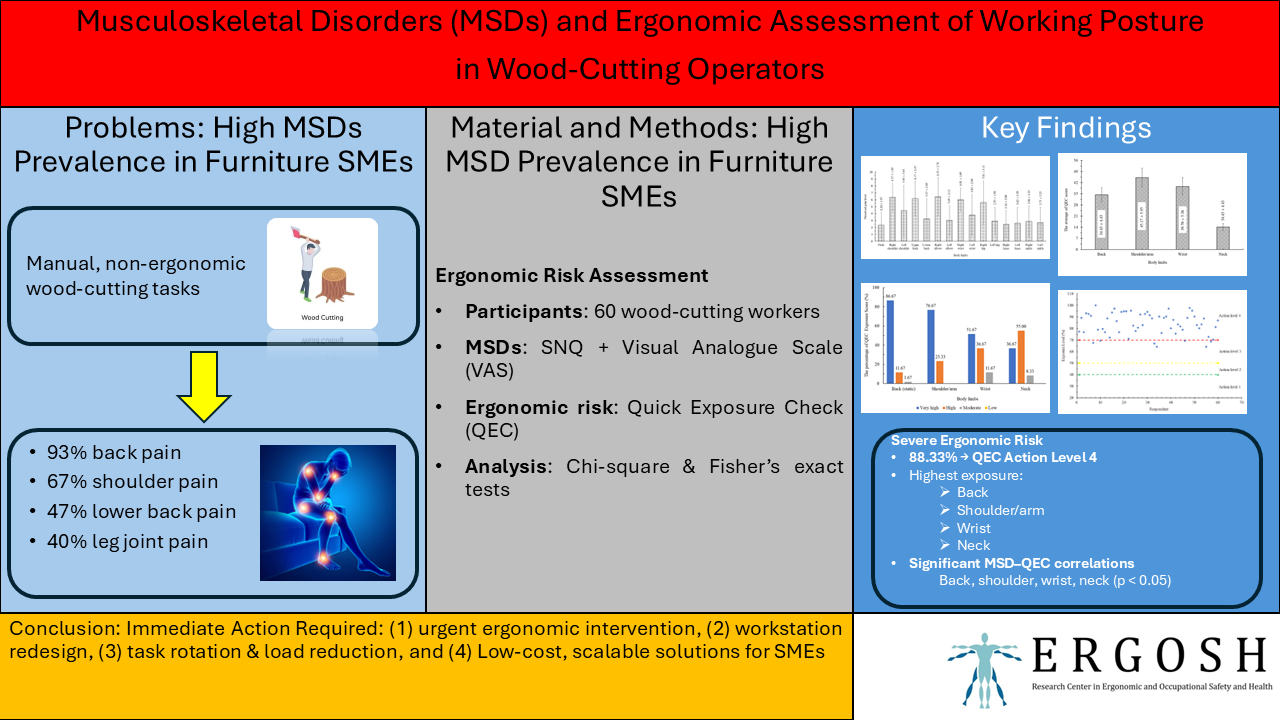
The industrial sector, particularly at the furniture SME center, relied heavily on human labor but lacked adequate infrastructure, leading to high rates of musculoskeletal disorders (MSDs) among workers. A preliminary study showed that 93% of workers experienced back pain, while significant percentages reported shoulder pain (67%), lower back pain (47%), leg joint pain (40%), and overall body aches (40%). These preliminary findings underscored the urgent need to assess the ergonomic risks specifically faced by wood-cutting workers. This study aimed to assess ergonomic risks for wood-cutting workers using the Quick Exposure Check (QEC) method and to examine the correlation between self-reported MSDs and ergonomic risk levels. A total of 60 workers from the wood-cutting workstation were surveyed. The independent variable was the workers' pain levels, measured using a modified SNQ-VAS questionnaire, while the dependent variable was the exposure level to injury risks in specific body parts, assessed using the QEC questionnaire. Chi-Square and Fisher's exact analyses were employed to explore the relationship between these variables. Results indicated that 88.33% of workers experienced ergonomic risks at action level 4, necessitating urgent intervention. Significant correlations were found, with MSDs in the upper and lower backs showing strong associations with QEC exposure levels (χ² = 3.965, p = 0.047 for the upper back; χ² = 4.044, p = 0.044 for the lower back). Similarly, correlations were significant for right shoulder and wrist MSDs in relation to QEC levels (χ² = 4.127, p = 0.042; χ² = 3.860, p = 0.049, respectively), as well as for neck MSDs correlated with neck exposure levels (χ² = 29.492, p = 0.033). These findings called for immediate ergonomic improvements to enhance the health and safety of workers at the SME Center.
References
Abdolalizadeh, M., & Jahanimoghadam, F. (2015). Musculoskeletal disorders in dental practitioners and ergonomic strategies. Anatomical Sciences Journal, 12(4), 161-166.
Adiratna, Y., Astono, S., Fertiaz, M., Subhan, S. C., & Prayitno, H. (2022). The Indonesian national occupational safety and health profile in 2022. Ministry of ManPower of Indonesia, 1-267.
Aladin, A., Dewata, E., Sari, Y., & Aryani, Y. A. (2021). The role of small and medium enterprises (SMES) and economic growth in Indonesia: the VECM analysis [Conference presentation]. 4th Forum in Research, Science, and Technology (FIRST-T3-20). Atlantis Press. https://doi.org/10.2991/ahsseh.k.210122.017
Bhatt, V., & Bhatia, R. (2023). An analysis of ergonomic risk factors associated with the wood block making craft of Pethapur, Gujarat, India. Journal of Visual and Performing Arts, 4(2), 684–700. https://doi.org/10.29121/shodhkosh.v4.i2.2023.605
Bostanpara, A., Hemmati, Z., & Varmazyar, S. (2024). Investigating the relationship between body structure status, work activity type, and the prevalence of musculoskeletal disorders among detergent industry workers. Work, 79(3), 1225-1235. https://doi.org/10.3233/wor-240118
Bulduk, E. Ö., Bulduk, S., Süren, T., & Ovalı, F. (2014). Assessing exposure to risk factors for work-related musculoskeletal disorders using Quick Exposure Check (QEC) in taxi drivers. International Journal of Industrial Ergonomics, 44(6), 817-820. https://doi.org/10.1016/j.ergon.2014.10.002
Chiasson, M. E., Imbeau, D., Major, J., Aubry, K., & Delisle, A. (2015). Influence of musculoskeletal pain on workers' ergonomic risk-factor assessments. Applied Ergonomics, 49, 1-7. https://doi.org/10.1016/j.apergo.2014.12.011
Chowdhury, S. K., Nimbarte, A. D., Hsiao, H., Gopalakrishnan, B., & Jaridi, M. (2018). A biomechanical shoulder strain index based on stabilizing demand of shoulder joint. Ergonomics, 61(12), 1657-1670. https://doi.org/10.1080/00140139.2018.1499967
Cohen, J. (2013). Statistical Power Analysis for the Behavioral Sciences (2nd ed.). New York, US: Routledge. https://doi.org/10.4324/9780203771587
Collins, J. D., & O'Sullivan, L. W. (2015). Musculoskeletal disorder prevalence and psychosocial risk exposures by age and gender in a cohort of office based employees in two academic institutions. International Journal of Industrial Ergonomics, 46, 85-97. https://doi.org/10.1016/j.ergon.2014.12.013
Das, B. (2020). Effects of awkward posture on work-related musculoskeletal disorders (WMSDs) among sawmill workers in India. Journal of Occupational Health and Epidemiology, 9(3), 158-166. https://doi.org/10.29252/johe.9.3.158
David, G., Woods, V., Li, G., & Buckle, P. (2008). The development of the Quick Exposure Check (QEC) for assessing exposure to risk factors for work-related musculoskeletal disorders. Applied Ergonomics, 39(1), 57-69. https://doi.org/10.1016/j.apergo.2007.03.002
De Sio, S., Traversini, V., Rinaldo, F., Colasanti, V., Buomprisco, G., Perri, R., ... & Guerra, F. (2018). Ergonomic risk and preventive measures of musculoskeletal disorders in the dentistry environment: An umbrella review. PeerJ, 6, Article e4154. https://doi.org/10.7717/peerj.4154
Drigny, J., Gauthier, A., Reboursière, E., Guermont, H., Gremeaux, V., & Edouard, P. (2020). Shoulder muscle imbalance as a risk for shoulder injury in elite adolescent swimmers: a prospective study. Journal of Human Kinetics, 75, 103-113. https://doi.org/10.2478/hukin-2020-0041
Ezugwu, U. A., Egba, E. N., Igweagu, P. C., Eneje, L. E., Orji, S., & Ugwu, U. C. (2020). Awareness of awkward posture and repetitive motion as ergonomic factors associated with musculoskeletal disorders by health promotion professionals. Global Journal of Health Science, 12(6), 128-134. https://doi.org/10.5539/gjhs.v12n6p128
Farooq, H. (2022). Prevalence of musculoskeletal disorders and ergonomic risk factors among firefighters [Master Thesis]. Chulalongkorn University, Thailand. https://doi.org/10.58837/CHULA.THE.2022.302
Faul, F., Erdfelder, E., Buchner, A., & Lang, A. G. (2009). Statistical power analyses using G* Power 3.1: Tests for correlation and regression analyses. Behavior Research Methods, 41(4), 1149-1160. https://doi.org/10.3758/BRM.41.4.1149
Genebra, C. V. D. S., Maciel, N. M., Bento, T. P. F., Simeão, S. F. A. P., & De Vitta, A. (2017). Prevalence and factors associated with neck pain: a population-based study. Brazilian Journal of Physical Therapy, 21(4), 274-280. https://doi.org/10.1016/j.bjpt.2017.05.005
Hawker, G. A., Mian, S., Kendzerska, T., & French, M. (2011). Measures of adult pain: Visual analog scale for pain (vas pain), numeric rating scale for pain (nrs pain), mcgill pain questionnaire (mpq), short‐form mcgill pain questionnaire (sf‐mpq), chronic pain grade scale (cpgs), short form‐36 bodily pain scale (sf‐36 bps), and measure of intermittent and constant osteoarthritis pain (icoap). Arthritis Care & Research, 63(S11), S240-S252. https://doi.org/10.1002/acr.20543
Hilmi, A. H., Hamid, A. R. A., & Ibrahim, W. A. R. A. W. (2024). Current trends and risk factors in low back pain: An ergonomic perspective on prevention and management. Malaysian Journal of Ergonomics (MJEr), 6(1), 105-118. https://doi.org/10.58915/mjer.v6.2024.1312
Hosseini, A., Choobineh, A., Razeghi, M., Pakshir, H. R., Ghaem, H., & Vojud, M. (2019). Ergonomic assessment of exposure to musculoskeletal disorders risk factors among dentists of Shiraz, Iran. Journal of Dentistry, 20(1), 53-60. https://doi.org/10.30476/DENTJODS.2019.44564
Ibrahim, N. A., Rahman, S. A. S. A., Ismail, S. H., & Abdullah, H. (2020). Musculoskeletal discomfort evaluation using Quick Exposure Check (QEC) among tower crane operators [Conference presentation]. IOP Conference Series: Materials Science and Engineering. IOP Publishing. https://doi.org/10.1088/1757-899X/834/1/012056
Jakobsen, M. D., Sundstrup, E., Brandt, M., Persson, R., & Andersen, L. L. (2018). Estimation of physical workload of the low-back based on exposure variation analysis during a full working day among male blue-collar workers. Cross-sectional workplace study. Applied Ergonomics, 70, 127-133. https://doi.org/10.1016/j.apergo.2018.02.019
Kamat, S. R., Zula, N. M., Rayme, N. S., Shamsuddin, S., & Husain, K. (2017). The ergonomics body posture on repetitive and heavy lifting activities of workers in aerospace manufacturing warehouse [Conference presentation]. IOP Conference Series: Materials Science and Engineering. IOP Publishing. https://doi.org/10.1088/1757-899X/210/1/012079
Karimi, A., Dianat, I., Barkhordari, A., Yusefzade, I., & Rohani-Rasaf, M. (2020). A multicomponent ergonomic intervention involving individual and organisational changes for improving musculoskeletal outcomes and exposure risks among dairy workers. Applied Ergonomics, 88, Article 103159. https://doi.org/10.1016/j.apergo.2020.103159
Krishnan, K. S., Raju, G., & Shawkataly, O. (2021). Prevalence of work-related musculoskeletal disorders: Psychological and physical risk factors. International Journal of Environmental Research and Public Health, 18(17), Article 9361. https://doi.org/10.3390/ijerph18179361
Kristanto, A., Nursanti, R., Bariyah, C., & Ma'ruf, F. (2022). The effects of the muddy surface environment on heart rate and pain perception in the lower extremity during the paddy planting activity. Engineering and Applied Science Research, 49(4), 574-580.
Kuorinka, I., Jonsson, B., Kilbom, A., Vinterberg, H., Biering-Sørensen, F., Andersson, G., & Jørgensen, K. (1987). Standardised Nordic questionnaires for the analysis of musculoskeletal symptoms. Applied Ergonomics, 18(3), 233-237. https://doi.org/10.1016/0003-6870(87)90010-X
Le, P., Weisenbach, C. A., Mills, E. H., Monforton, L., & Kinney, M. J. (2023). Exploring the interaction between head-supported mass, posture, and visual stress on neck muscle activation. Human Factors, 65(3), 365-381. https://doi.org/10.1177/00187208211019154
Lee, S. J., & Lee, J. H. (2017). Safe patient handling behaviors and lift use among hospital nurses: A cross-sectional study. International Journal of Nursing Studies, 74, 53-60. https://doi.org/10.1016/j.ijnurstu.2017.06.002
Luger, T., Maher, C. G., Rieger, M. A., & Steinhilber, B. (2019). Work‐break schedules for preventing musculoskeletal symptoms and disorders in healthy workers. Cochrane Database of Systematic Reviews, 7. https://doi.org/10.1002/14651858.CD012886.pub2
Mohamaddan, S., Rahman, M. A., Andrew_Munot, M., Tanjong, S. J., Deros, B. M., Dawal, S. M., & Case, K. (2021). Investigation of oil palm harvesting tools design and technique on work-related musculoskeletal disorders of the upper body. International Journal of Industrial Ergonomics, 86, Article 103226. https://doi.org/10.1016/j.ergon.2021.103226
Odebiyi, D. O., & Okafor, U. A. C. (2023). Musculoskeletal disorders, workplace ergonomics and injury prevention. Ergonomics-New Insights. IntechOpen. https://doi.org/10.5772/intechopen.106031
Pavlovic-Veselinovic, S., Hedge, A., & Veselinovic, M. (2016). An ergonomic expert system for risk assessment of work-related musculo-skeletal disorders. International Journal of Industrial Ergonomics, 53, 130-139. https://doi.org/10.1016/j.ergon.2015.11.008
Putsa, B., Jalayondeja, W., Mekhora, K., Bhuanantanondh, P., & Jalayondeja, C. (2022). Factors associated with reduced risk of musculoskeletal disorders among office workers: A cross-sectional study 2017 to 2020. BMC Public Health, 22(1), Article 1503. https://doi.org/10.1186/s12889-022-13940-0
Qu, X., Qu, C., Ma, T., Yin, P., Zhao, N., Xia, Y., & Qu, S. (2021). Effects of an industrial passive assistive exoskeleton on muscle activity, oxygen consumption and subjective responses during lifting tasks. Plos One, 16(1), Article e0245629. https://doi.org/10.1371/journal.pone.0245629
Seidel, D. H., Ditchen, D. M., Hoehne-Hückstädt, U. M., Rieger, M. A., & Steinhilber, B. (2019). Quantitative measures of physical risk factors associated with work-related musculoskeletal disorders of the elbow: A systematic review. International Journal of Environmental Research and Public Health, 16(1), Article 130. https://doi.org/10.3390/ijerph16010130
Shaikh, A. M., Mandal, B. B., & Mangalavalli, S. M. (2022). Causative and risk factors of musculoskeletal disorders among mine workers: A systematic review and meta-analysis. Safety Science, 155, Article 105868. https://doi.org/10.1016/j.ssci.2022.105868
Shandu, N. M., Mathunjwa, M. L., Shaw, I., & Shaw, B. S. (2023). Exercise Effects on Health-Related Quality of Life (HRQOL), muscular function, cardiorespiratory function, and body composition in smokers: A narrative review. International Journal of Environmental Research and Public Health, 20(19), Article 6813. https://doi.org/10.3390/ijerph20196813
Srivani, T., & Amsamani, S. (2025). Ergonomic interventions in Kalamkari block printing: Addressing challenges and preserving tradition. Ergonomics, 68(10), 1583-1605. https://doi.org/10.1080/00140139.2024.2427260
Thetkathuek, A., & Meepradit, P. (2018). Work-related musculoskeletal disorders among workers in an MDF furniture factory in eastern Thailand. International Journal of Occupational Safety and Ergonomics, 24(2), 207-217. https://doi.org/10.1080/10803548.2016.1257765
Tran, T. T., Taptagaporn, S., Dang, C. V., & Kaewdok, T. Ergonomic risk factor-related musculoskeletal disorders among wood furniture workers in Binh Duong Province, Vietnam. Asia-Pacific Journal of Science and Technology, 28(6), 1-10. https://doi.org/10.14456/apst.2023.91
World Bank. (2022). Indonesia Economic Prospects (IEP), June 2022: Financial Deepening for Stronger Growth and Sustainable Recovery [Text/HTML]. Retrieved from https://www.worldbank.org/en/country/indonesia/publication/indonesia-economic-prospects-iep-june-2022-financial-deepening-for-stronger-growth-and-sustainable-recovery
World Health Organization. (2021). Musculoskeletal health. Retrieved form https://www.who.int/news-room/fact-sheets/detail/musculoskeletal-conditions
Yoopat, P., Thoicharoen, P., Liammanee, W., Aribarg, T., Yongsiriwit, K., & Chaisiriprasert, P. (2024). Assessment of work-related stress utilizing the Find My Stress mobile application among university students and adult workers amidst the COVID-19 pandemic. Journal of Bodywork and Movement Therapies, 39, 415–422. https://doi.org/10.1016/j.jbmt.2024.02.016
Zare, M., Black, N., Sagot, J. C., Hunault, G., & Roquelaure, Y. (2020). Ergonomics interventions to reduce musculoskeletal risk factors in a truck manufacturing plant. International Journal of Industrial Ergonomics, 75, Article 102896. https://doi.org/10.1016/j.ergon.2019.102896
Downloads
Published
How to Cite
Issue
Section
License
Copyright (c) 2025 Journal of Current Science and Technology

This work is licensed under a Creative Commons Attribution-NonCommercial-NoDerivatives 4.0 International License.