A Study of Opinion and Satisfaction of Physical Therapists About the Prototype Exercise Machine for Lower Limb Strengthening in Children with Cerebral Palsy
DOI:
https://doi.org/10.59796/jcst.V16N2.2026.171Keywords:
satisfaction, children, exercise machine, lower limb strengthAbstract
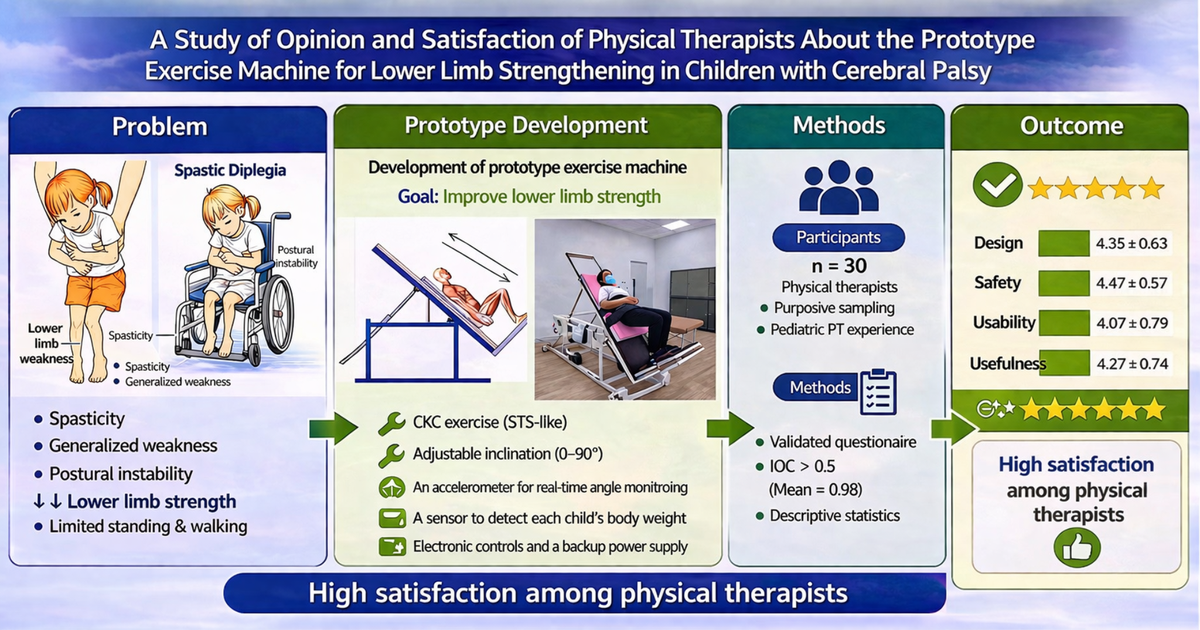
Children with spastic cerebral palsy commonly exhibit muscle spasticity, generalized weakness, and postural instability, with deficits in lower extremity strength markedly impairing their ability to perform functional activities such as standing and walking. In response to this clinical challenge, a prototype exercise machine was developed to enhance lower limb strength. However, the opinions and satisfaction of physical therapists regarding this machine constitute an important aspect that has not yet been systematically evaluated. Therefore, this study aimed to investigate their perspectives and satisfaction with the prototype. Thirty physical therapists were purposively recruited based on their clinical experience in pediatric physical therapy. Data were collected using a validated questionnaire, with an Index of Item-Objective Congruence (IOC) greater than 0.50 and a mean IOC of 0.98. Descriptive statistical analysis was conducted to examine participant demographics and satisfaction levels across various aspects. The mean satisfaction scores were as follows: design and structure (4.35 ± 0.63), safety (4.47 ± 0.57), usability (4.07 ± 0.79), and usefulness (4.27 ± 0.74). In conclusion, the equipment received high satisfaction ratings in all aspects. Further development is recommended in accordance with industry or medical device standards, along with additional studies involving a broader sample that includes both typically developing children and those with cerebral palsy.
References
Baruah, T. S., Goswami, P., Singha, R., & Dutta, A. (2016). A comparative study on effectiveness of open versus closed kinetic chain exercises to improve gait in spastic diplegic cerebral palsy. International Journal of Physiotherapy, 3(2), 193-196. https://doi.org/10.15621/ijphy/2016/v3i2/94886
Borkam, R., Donpunha, W., Peungsuwan, P., Chanavirut, R., Pratanaphon, S., & Malila, P. (2020). Effects of a lower extremity strength training program on range of motion in children with spastic cerebral palsy. Archives of Allied Health Sciences, 32(3), 39–49.
Chrif, F., Van Hedel, H. J., Vivian, M., Nef, T., & Hunt, K. J. (2022). Usability evaluation of an interactive leg press training robot for children with neuromuscular impairments. Technology and Health Care, 30(5), 1183-1197. https://doi.org/10.3233/THC-213629
Cumplido-Trasmonte, C., Barquín-Santos, E., Aneiros-Tarancón, F., Plaza-Flores, A., Espinosa-García, S., Fernández, R., & García-Armada, E. (2024). Usability and safety of the ATLAS 2030 robotic gait device in children with cerebral palsy and spinal muscular atrophy. Children, 11(12), Article 1500. https://doi.org/10.3390/children11121500
Howard, J. J., & Herzog, W. (2021). Skeletal muscle in cerebral palsy: From belly to myofibril. Frontiers in Neurology, 12, Article 620852. https://doi.org/10.3389/fneur.2021.620852
Klobucká, S., Klobucký, R., Valovičová, K., Šiarnik, P., & Kollár, B. (2023). Cost-effectiveness analysis of robot-assisted gait training in patients with bilateral spastic cerebral palsy. Cost Effectiveness and Resource Allocation, 21(1), Article 60. https://doi.org/10.1186/s12962-023-00475-3
Lauruschkus, K., Jarl, J., Fasth Gillstedt, K., & Tornberg, Å. B. (2022). Dynamic standing exercise in a novel assistive device compared with standard care for children with cerebral palsy who are non-ambulant, with regard to quality of life and cost-effectiveness. Disabilities, 2(1), 73-85. https://doi.org/10.3390/disabilities2010006
Lee, Y. S., Kim, W. B., & Park, J. W. (2014). The effect of exercise using a sliding rehabilitation machine on the gait function of children with cerebral palsy. Journal of Physical Therapy Science, 26(11), 1667-1669. https://doi.org/10.1589/jpts.26.1667
Liao, H. F., Liu, Y. C., Liu, W. Y., & Lin, Y. T. (2007). Effectiveness of loaded sit-to-stand resistance exercise for children with mild spastic diplegia: A randomized clinical trial. Archives of Physical Medicine and Rehabilitation, 88(1), 25-31. https://doi.org/10.1016/j.apmr.2006.10.006
McIntyre, S., Goldsmith, S., Webb, A., Ehlinger, V., Hollung, S. J., McConnell, K., ... & Global CP Prevalence Group*. (2022). Global prevalence of cerebral palsy: A systematic analysis. Developmental Medicine & Child Neurology, 64(12), 1494-1506. https://doi.org/10.1111/dmcn.15346
Money, A. G., Barnett, J., Kuljis, J., Craven, M. P., Martin, J. L., & Young, T. (2011). The role of the user within the medical device design and development process: Medical device manufacturers' perspectives. BMC Medical Informatics and Decision Making, 11(1), Article 15. https://doi.org/10.1186/1472-6947-11-15
Morton, J. F., Brownlee, M., & McFadyen, A. K. (2005). The effects of progressive resistance training for children with cerebral palsy. Clinical Rehabilitation, 19(3), 283-289. https://doi.org/10.1191/0269215505cr804oa
Özal, C., Türker, D., & Korkem, D. (2016). Strength training in people with cerebral palsy. In M. K. Gunel (Ed.), Cerebral Palsy—Current Steps (1st ed., pp. 103–126). https://doi.org/10.5772/64638
Park, J. W., & Kim, W. B. (2014). The effect of functional training using a sliding rehabilitation machine on the mobility of the ankle joint and balance in children with CP. Journal of Korean Society of Physical Medicine, 9(3), 293-299. https://doi.org/10.13066/kspm.2014.9.3.293
Paul, S., Nahar, A., Bhagawati, M., & Kunwar, A. J. (2022). A review on recent advances of cerebral palsy. Oxidative Medicine and Cellular Longevity, 2022(1), Article 2622310. https://doi.org/10.1155/2022/2622310
Pavão, S. L., dos Santos, A. N., Woollacott, M. H., & Rocha, N. A. C. F. (2013). Assessment of postural control in children with cerebral palsy: A review. Research in Developmental Disabilities, 34(5), 1367-1375. https://doi.org/10.1016/j.ridd.2013.01.034
Phonphotthanamat, W. (2022). A comparative study of verifying the content validity of a research instrument with the IOC, CVR and CVI. RSU Library Journal, 28(1), 169-192.
Raigoso, D., Céspedes, N., Cifuentes, C. A., Del-Ama, A. J., & Múnera, M. (2021). A survey on socially assistive robotics: Clinicians’ and patients’ perception of a social robot within gait rehabilitation therapies. Brain Sciences, 11(6), Article 738. https://doi.org/10.3390/brainsci11060738
Rana, M., Upadhyay, J., Rana, A., Durgapal, S., & Jantwal, A. (2017). A systematic review on etiology, epidemiology, and treatment of cerebral palsy. International Journal of Nutrition, Pharmacology, Neurological Diseases, 7(4), 76-83. https://doi.org/10.4103/ijnpnd.ijnpnd_26_17
Woudstra, K., Reuzel, R., Rovers, M., & Tummers, M. (2023). An overview of stakeholders, methods, topics, and challenges in participatory approaches used in the development of medical devices: A scoping review. International Journal of Health Policy and Management, 12, Article 6839. https://doi.org/10.34172/ijhpm.2022.6839
Downloads
Published
How to Cite
License
Copyright (c) 2026 Journal of Current Science and Technology

This work is licensed under a Creative Commons Attribution-NonCommercial-NoDerivatives 4.0 International License.