Weather Radar Utilization for Monitoring Volcanic Activity to Support Flight Safety: A Case Study of Mount Marapi Eruption, West Sumatra, 22 December 2023
DOI:
https://doi.org/10.59796/jcst.V16N1.2026.161Keywords:
weather radar, volcanic activity, eruption height, volcanic ash, flight safetyAbstract
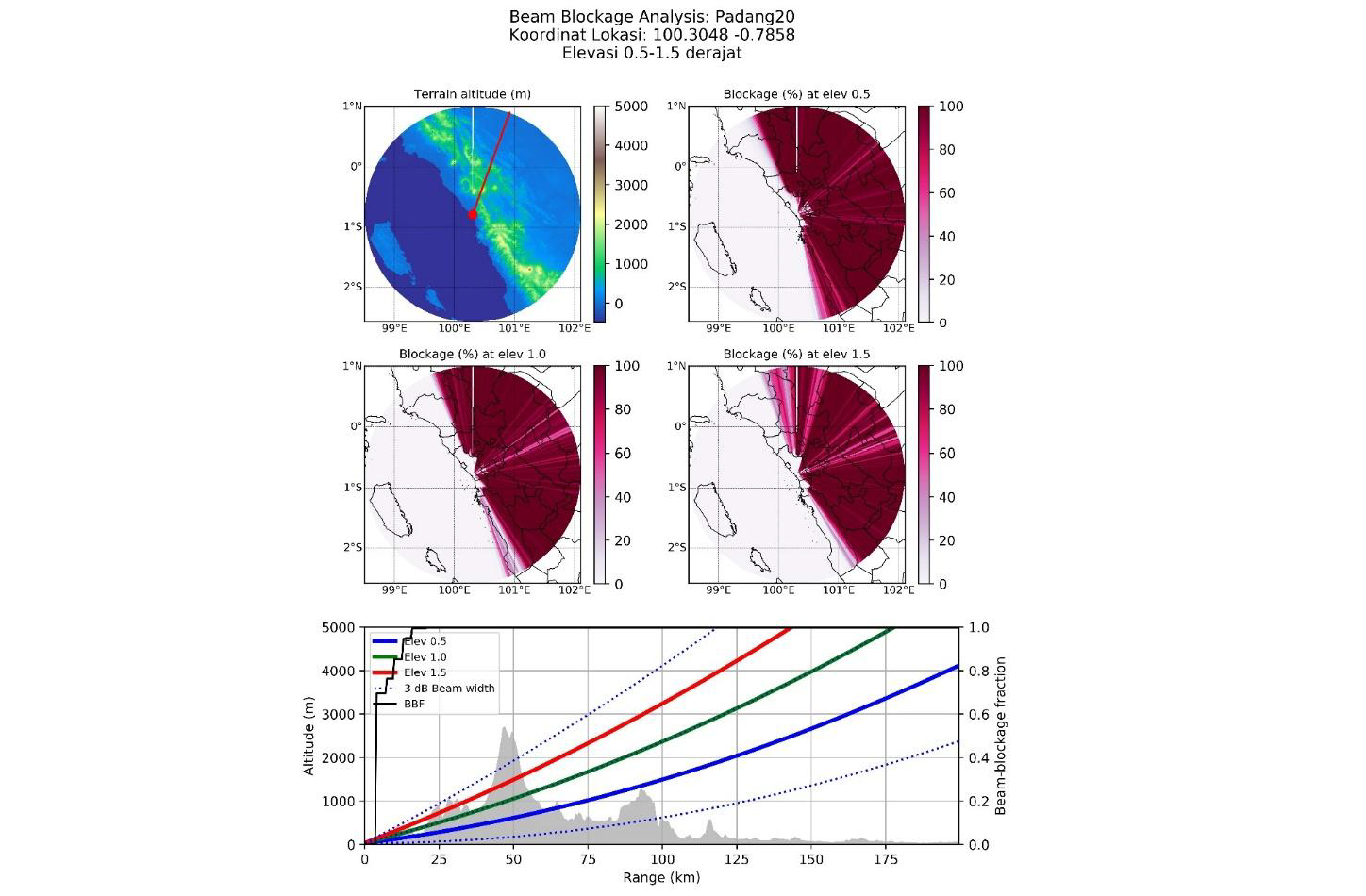
Volcanic ash can cause damage to aircraft engines and endanger flight safety. Weather radar has the potential to detect the height and direction of eruption cloud distribution, as well as the type of volcanic material. This research aims to close the technological gap in volcanic activity observation and eruption-height detection of volcanic eruptions using weather radar, based on a case study of the Mount Marapi eruption in West Sumatra on 22 December 2023. The method used in this research is to process radar data to produce weather radar products, specifically the CMAX (Column Maximum) product to determine the pattern of eruption activity and multi-VCUT (Vertical Cut) product to describe the eruption intensity, pattern characteristics, height, and distribution direction. The data used is the BMKG weather radar data from the Minangkabau Meteorological Station, West Sumatra. Before data processing, Clutter Identification and Radar Data Quality Control were carried out to reduce observation bias caused by ground-echo clutter.
The analysis results of the weather radar data show multiple episodes of continuous and sporadic eruption activity from Mount Marapi during a single day of observation. These results are more detailed than the VONA (Volcano Observatory Notice for Aviation) reports based on visual observations. This provides an opportunity to develop a volcanic ash early-warning system that improves the accuracy and effectiveness of volcanic activity observations and enhances flight safety.
References
Binetti, M. S., Campanale, C., Massarelli, C., & Uricchio, V. F. (2022). The use of weather radar data: Possibilities, challenges and advanced applications. Earth, 3(1), 157-171. https://doi.org/10.3390/earth3010012
Donnadieu, F. (2012). Volcanological applications of Doppler radars: A review and examples from a transportable pulse radar in L-band. INTECH Open Access Publisher.
Durant, A. J., Bonadonna, C., & Horwell, C. J. (2010). Atmospheric and environmental impacts of volcanic particulates. Elements, 6(4), 235-240. https://doi.org/10.2113/gselements.6.4.235
Falconi, M. T., & Marzano, F. S. (2019). Weather radar data processing and atmospheric applications: An overview of tools for monitoring clouds and detecting wind shear. IEEE Signal Processing Magazine, 36(4), 85-97. https://doi.org/10.1109/MSP.2019.2890934
Gabrielsen, H., Procter, J., Rainforth, H., Black, T., Harmsworth, G., & Pardo, N. (2017). Reflections from an indigenous community on volcanic event management, communications and resilience. Observing the Volcano World: Volcano Crisis Communication (pp. 463-479). Cham: Springer International Publishing.
Giammello, G., Firetto Carlino, M., & Coltelli, M. (2022). Automatic detection of the explosive activity of the Mt. Etna volcano through Doppler radar monitoring. Remote Sensing, 14(22), Article 5663. https://doi.org/10.3390/rs14225663
Hapsari, R. I., Iida, M., Muranishi, M., Ogawa, M., Syarifuddin, M., Iguchi, M., & Oishi, S. (2019). Ground observation of tephra particles: On the use of weather radar for estimating volcanic ash distribution. Journal of Disaster Research, 14(1), 151-159. https://doi.org/10.20965/jdr.2019.p0151
Hirtl, M., Arnold, D., Baro, R., Brenot, H., Coltelli, M., Eschbacher, K., ... & Zopp, R. (2020). A volcanic hazard demonstration exercise to assess and mitigate the impacts of volcanic ash clouds on civil and military aviation. Natural Hazards and Earth System Sciences Discussions, 20(6), 1719–1739. https://doi.org/10.5194/nhess-20-1719-2020
Maki, M., Kim, Y., Kobori, T., Hirano, K., Lee, D. I., & Iguchi, M. (2021a). Analyses of three-dimensional weather radar data from volcanic eruption clouds. Journal of Volcanology and Geothermal Research, 412, Article 107178. https://doi.org/10.1016/j.jvolgeores.2021.107178
Maki, M., Takaoka, R., & Iguchi, M. (2021b). Characteristics of particle size distributions of falling volcanic ash measured by optical disdrometers at the sakurajima volcano, Japan. Atmosphere, 12(5), Article 601. https://doi.org/10.3390/atmos12050601
Marzano, F. S. (2011). Remote sensing of volcanic ash cloud during explosive eruptions using ground-based weather RADAR data processing [In the Spotlight]. IEEE Signal Processing Magazine, 28(2), 128-126. https://doi.org/10.1109/MSP.2010.939846
Marzano, F. S., Barbieri, S., Picciotti, E., & Vulpiani, G. (2007). Microwave radar remote sensing of Plinian volcanic ash clouds for aviation hazard and civil protection applications [Conference presentation]. 2007 IEEE International Geoscience and Remote Sensing Symposium. IEEE, Barcelona, Spain. https://doi.org/10.1109/IGARSS.2007.4423658
Marzano, F. S., Lamantea, M., Montopoli, M., Di Fabio, S., & Picciotti, E. (2011). The Eyjafjöll explosive volcanic eruption from a microwave weather radar perspective. Atmospheric Chemistry and Physics, 11(18), 9503-9518. https://doi.org/10.5194/acp-11-9503-2011
Marzano, F. S., Mereu, L., Scollo, S., Donnadieu, F., & Bonadonna, C. (2019). Tephra mass eruption rate from ground-based X-band and L-band microwave radars during the November 23, 2013, Etna Paroxysm. IEEE Transactions on Geoscience and Remote Sensing, 58(5), 3314-3327. https://doi.org/10.1109/TGRS.2019.2953167
Marzano, F. S., Picciotti, E., Di Fabio, S., Montopoli, M., Mereu, L., Degruyter, W., ... & Ripepe, M. (2016). Near-real-time detection of tephra eruption onset and mass flow rate using microwave weather radar and infrasonic arrays. IEEE Transactions on Geoscience and Remote Sensing, 54(11), 6292-6306. https://doi.org/10.1109/TGRS.2016.2578282
Marzano, F. S., Picciotti, E., Montopoli, M., & Vulpiani, G. (2013). Inside volcanic clouds: Remote sensing of ash plumes using microwave weather radars. Bulletin of the American Meteorological Society, 94(10), 1567-1586. https://doi.org/10.1175/BAMS-D-11-00160.1
Montopoli, M., Cimini, D., Lamantea, M., Herzog, M., Graf, H. F., & Marzano, F. S. (2013). Microwave radiometric remote sensing of volcanic ash clouds from space: Model and data analysis. IEEE Transactions on Geoscience And Remote Sensing, 51(9), 4678-4691. https://doi.org/10.1109/TGRS.2013.2260343
Petersen, G. N. (2010). A short meteorological overview of the Eyjafjallajökull eruption 14 April–23 May 2010. Weather, 65(8), 203-207. https://doi.org/10.1002/wea.634
Prata, F. (2020). Detection and avoidance of atmospheric aviation hazards using infrared spectroscopic imaging. Remote Sensing, 12(14), Article 2309. https://doi.org/10.3390/rs12142309
Sokol, Z., Szturc, J., Orellana-Alvear, J., Popova, J., Jurczyk, A., & Célleri, R. (2021). The role of weather radar in rainfall estimation and its application in meteorological and hydrological modelling-A review. Remote Sensing, 13(3), Article 351. https://doi.org/10.3390/rs13030351
Supriyadi, A. A. (2023). Obstruction Zone Modeling at Halim Perdanakusuma Airport using Remote Sensing Data. International Journal of Remote Sensing and Earth Sciences, 20(1), 66-76. https://doi.org/10.30536/j.ijreses.2023.v20.a3883
Supriyadi, A. A., Rizky, F., Rahmawati, N., Rs, I. A., Manessa, M. D. M., & Gultom, R. A. (2019). Utilization of the Geography Information System to Support Business Enterprises Site Planning of Defense Industry. IOP Conference Series: Earth and Environmental Science, 313(1), Article 012020. https://doi.org/10.1088/1755-1315/313/1/012020
Syarifuddin, M., Jenkins, S. F., Hapsari, R. I., Yang, Q., Taisne, B., Aji, A. B., ... & Legono, D. (2021). Real-time tephra detection and dispersal forecasting by a ground-based weather radar. Remote Sensing, 13(24), Article 5174. https://doi.org/10.3390/rs13245174
Takebayashi, M., Onishi, M., & Iguchi, M. (2021). Large volcanic eruptions and their influence on air transport: The case of Japan. Journal of Air Transport Management, 97, Article 102136. https://doi.org/10.1016/j.jairtraman.2021.102136
Vidal, L., Nesbitt, S. W., Salio, P., Farias, C., Nicora, M. G., Osores, M. S., ... & Marzano, F. S. (2017). C-band dual-polarization radar observations of a massive volcanic eruption in South America. IEEE Journal of Selected Topics in Applied Earth Observations and Remote Sensing, 10(3), 960-974. https://doi.org/10.1109/JSTARS.2016.2640227
Webley, P., & Mastin, L. (2009). Improved prediction and tracking of volcanic ash clouds. Journal of Volcanology and Geothermal Research, 186(1-2), 1-9. https://doi.org/10.1016/j.jvolgeores.2008.10.022
Downloads
Published
How to Cite
Issue
Section
Categories
License
Copyright (c) 2025 Journal of Current Science and Technology

This work is licensed under a Creative Commons Attribution-NonCommercial-NoDerivatives 4.0 International License.