Development of a Functional Goat Milk Yogurt Fortified with Canine-Derived Probiotics: Physicochemical Properties, Gastrointestinal Survival, and Palatability in Dogs
DOI:
https://doi.org/10.59796/jcst.V16N4.2026.226Keywords:
canine probiotics, Agrilactobacillus fermenti, Limosilactobacillus fermentum, Pediococcus pentosaceus, goat milk yogurt, simulated gastrointestinal survivalAbstract
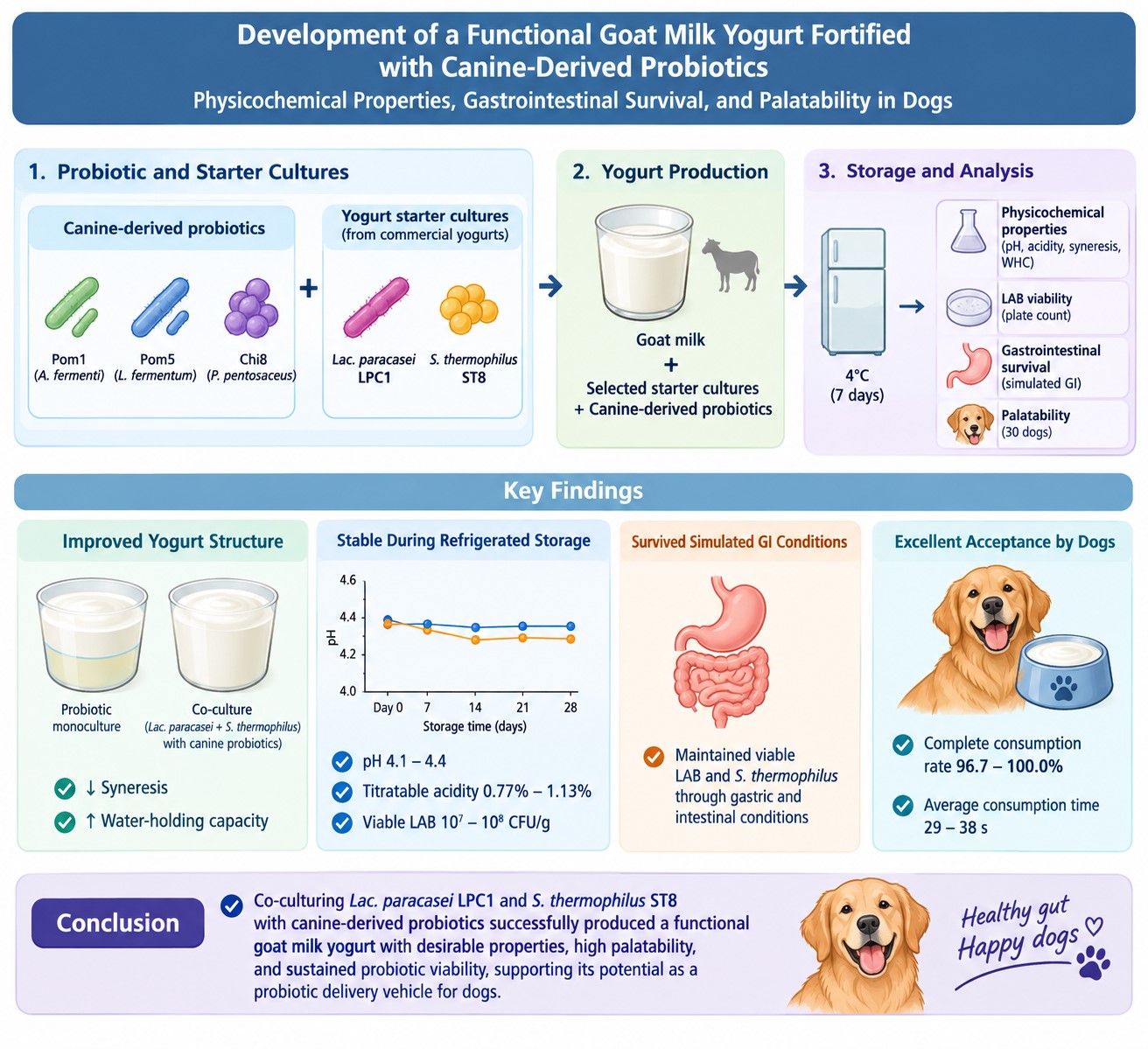
Dog yogurt products have gained increasing popularity among pet owners because of their nutritional value and their potential as vehicles for delivering probiotics to companion animals. This study aimed to develop a host-specific probiotic goat milk yogurt for dogs by combining canine-derived probiotic strains with selected yogurt starter cultures isolated from commercial yogurts. Six lactic acid bacteria (LAB) isolates were obtained from ten commercial yogurt products and identified as Lacticaseibacillus paracasei subsp. paracasei, Limosilactobacillus fermentum, and Streptococcus salivarius subsp. thermophilus using the API 50 CHL system. Among the isolates, Lacticaseibacillus (Lac.) paracasei LPC1 and Streptococcus (S.) thermophilus ST8 were selected as starter cultures based on their technological properties. Functional goat milk yogurts were produced by co-culturing the selected starter cultures with canine-derived probiotics, namely Agrilactobacillus fermenti Pom1, Limosilactobacillus fermentum Pom5, Pediococcus pentosaceus Chi8, or their cocktail. Compared with probiotic monocultures, the incorporation of Lac. paracasei LPC1 and S. thermophilus ST8 significantly improved yogurt structure by reducing syneresis and increasing the water-holding capacity. During 7 days of storage at 4°C, all formulations maintained stable physicochemical properties, with pH values ranging from 4.1 to 4.4 and titratable acidity from 0.77% to 1.13%. Viable LAB populations remained within 107–108 CFU/g throughout storage. Simulated gastrointestinal assays showed that substantial populations of viable LAB and S. thermophilus survived exposure to gastric and intestinal conditions, indicating a protective effect of the yogurt matrix. Palatability testing in 30 dogs demonstrated excellent acceptance of all formulations, with complete consumption rates of 96.7–100.0% and average consumption times of 28–38 s. Overall, co-culturing Lac. paracasei LPC1 and S. thermophilus ST8 with canine-derived probiotics successfully produced a functional goat milk yogurt with desirable physicochemical properties, high palatability, and sustained LAB viability during refrigerated storage, supporting its potential as a probiotic delivery vehicle for dogs.
References
Da Silva, N., Taniwaki, M. H., Junqueira, V. C., Silveira, N., Okazaki, M. M., & Gomes, R. A. R. (2018). Microbiological examination methods of food and water: A laboratory manual (2nd ed.). New York, US: CRC Press.
Dan, T., Hu, H., Tian, J., He, B., Tai, J., & He, Y. (2023). Influence of different ratios of Lactobacillus delbrueckii subsp. bulgaricus and Streptococcus thermophilus on fermentation characteristics of yogurt. Molecules, 28(5), Article 2123. https://doi.org/10.3390/molecules28052123
Dave, R. I., & Shah, N. P. (1997). Viability of yoghurt and probiotic bacteria in yoghurts made from commercial starter cultures. International Dairy Journal, 7(1), 31-41. https://doi.org/10.1016/S0958-6946(96)00046-5
El Kahlout, K. E., El Quqa, I. M., El Hindi, M. W., & El Bashiti, T. A. (2018). Isolation, biochemical characterization and DNA identification of yogurt starters Streptococcus thermophilus & Lactobacillus delbrueckii ssp. Bulgaricus in Gaza strip. Advances in Microbiology, 8(12), 1005-1020. https://doi.org/10.4236/aim.2018.812068
Foongsawat, N., Sunthornthummas, S., Nantavisai, K., Surachat, K., Rangsiruji, A., Sarawaneeyaruk, S., ... & Pringsulaka, O. (2023a). Isolation, characterization, and comparative genomics of the novel potential probiotics from canine feces. Food Science of Animal Resources, 43(4), Article 685. https://doi.org/10.5851/kosfa.2023.e28
Foongsawat, N., Sunthornthummas, S., Rangsiruji, A., Sarawaneeyaruk, S., Insian, K., & Pringsulaka, O. (2023b). In vitro survival of microencapsulated canine-specific probiotics under simulated gastrointestinal tract conditions and during storage. Journal of Current Science and Technology, 13(3), 584–594. https://doi.org/10.59796/jcst.V13N3.2023.1121
Grześkowiak, Ł., Endo, A., Beasley, S., & Salminen, S. (2015). Microbiota and probiotics in canine and feline welfare. Anaerobe, 34, 14-23. https://doi.org/10.1016/j.anaerobe.2015.04.002
Han, S., Lu, Y., Xie, J., Fei, Y., Zheng, G., Wang, Z., ... & Li, L. (2021). Probiotic gastrointestinal transit and colonization after oral administration: A long journey. Frontiers in Cellular and Infection Microbiology, 11, Article 609722. https://doi.org/10.3389/fcimb.2021.609722
Jiang, Z., Yang, M., Su, W., Mei, L., Li, Y., Guo, Y., ... & Wang, Y. (2024). Probiotics in piglet: From gut health to pathogen defense mechanisms. Frontiers in Immunology, 15, Article 1468873. https://doi.org/10.3389/fimmu.2024.1468873
Latif, A., Shehzad, A., Niazi, S., Zahid, A., Ashraf, W., Iqbal, M. W., ... & Korma, S. A. (2023). Probiotics: Mechanism of action, health benefits and their application in food industries. Frontiers in Microbiology, 14, Article 1216674. https://doi.org/10.3389/fmicb.2023.1216674
Lee, W. J., & Lucey, J. A. (2010). Formation and physical properties of yogurt. Asian-Australasian Journal of Animal Sciences, 23(9), 1127-1136. https://doi.org/10.5713/ajas.2010.r.05
Lima, M. J. R., Teixeira-Lemos, E., Oliveira, J., Teixeira-Lemos, L. P., Monteiro, A. M., & Costa, J. M. (2018). Nutritional and health profile of goat products: Focus on health benefits of goat milk. Goat Science, 189-232. https://doi.org/10.5772/intechopen.70321
Liu, A., Liu, Q., Bu, Y., Hao, H., Liu, T., Gong, P., ... & Yi, H. (2022). Aroma classification and characterization of Lactobacillus delbrueckii subsp. bulgaricus fermented milk. Food Chemistry: X, 15, Article 100385. https://doi.org/10.1016/j.fochx.2022.100385
Lone, A., Mottawea, W., Ait Chait, Y., & Hammami, R. (2021). Dual inhibition of Salmonella enterica and Clostridium perfringens by new probiotic candidates isolated from chicken intestinal mucosa. Microorganisms, 9(1), Article 166. https://doi.org/10.3390/microorganisms9010166
Luana, N., Rossana, C., Curiel, J. A., Kaisa, P., Marco, G., & Rizzello, C. G. (2014). Manufacture and characterization of a yogurt-like beverage made with oat flakes fermented by selected lactic acid bacteria. International Journal of Food Microbiology, 185, 17-26. https://doi.org/10.1016/j.ijfoodmicro.2014.05.004
Lucey, J. A. (2002). Formation and physical properties of milk protein gels. Journal of Dairy Science, 85(2), 281-294. https://doi.org/10.3168/jds.S0022-0302(02)74078-2
Nayik, G. A., Jagdale, Y. D., Gaikwad, S. A., Devkatte, A. N., Dar, A. H., & Ansari, M. J. (2022). Nutritional profile, processing and potential products: A comparative review of goat milk. Dairy, 3(3), 622-647. https://doi.org/10.3390/dairy3030044
Oladipo, I. C., Atolagbe, O. O., & Adetiba, T. M. (2014). Nutritional evaluation and microbiological analysis of yoghurt produced from full cream milk, tiger-nut milk, skimmed milk and fresh cow milk. Pensee, 76(4), 30-38.
Papadimitriou, K., Alegría, Á., Bron, P. A., De Angelis, M., Gobbetti, M., Kleerebezem, M., ... & Kok, J. (2016). Stress physiology of lactic acid bacteria. Microbiology and Molecular Biology Reviews, 80(3), 837-890. https://doi.org/10.1128/mmbr.00076-15
Park, Y. W., Juárez, M., Ramos, M. G. F. W., & Haenlein, G. F. W. (2007). Physico-chemical characteristics of goat and sheep milk. Small Ruminant Research, 68(1-2), 88-113. https://doi.org/10.1016/j.smallrumres.2006.09.013
Paszczyk, B., Czarnowska-Kujawska, M., Klepacka, J., & Tońska, E. (2023). Health-promoting ingredients in goat’s milk and fermented goat’s milk drinks. Animals, 13(5), Article 907. https://doi.org/10.3390/ani13050907
Pilla, R., & Suchodolski, J. S. (2020). The role of the canine gut microbiome and metabolome in health and gastrointestinal disease. Frontiers in Veterinary Science, 6, Article 502799. https://doi.org/10.3389/fvets.2019.00498
Pringsulaka, O., Thawornwiriyanan, K., Tulathon, C., Sunthornthummas, S., Sarawaneeyaruk, S., Rangsiruji, A., Sudyoung, N., & Suwannachart, C. (2025). Survivability of microencapsulated probiotic bacteria in a sodium alginate–goat milk–β-glucan matrix under freeze-drying conditions for dog supplements. Journal of Current Science and Technology, 15(4), Article 141. https://doi.org/10.59796/jcst.V15N4.2025.1411
Ranadheera, C. S., Evans, C. A., Adams, M. C., & Baines, S. K. (2012). Probiotic viability and physico-chemical and sensory properties of plain and stirred fruit yogurts made from goat’s milk. Food Chemistry, 135(3), 1411-1418. https://doi.org/10.1016/j.foodchem.2012.06.025
Rashwan, A. K., Karim, N., Xu, Y., Cui, H., Fang, J., Cheng, K., ... & Chen, W. (2022). Chemical composition, quality attributes and antioxidant activity of stirred-type yogurt enriched with Melastoma dodecandrum Lour fruit powder. Food & Function, 13(3), 1579-1592. https://doi.org/10.1039/D1FO03448K
Schillinger, U., & Lücke, F. K. (1987). Identification of lactobacilli from meat and meat products. Food Microbiology, 4(3), 199-208. https://doi.org/10.1016/0740-0020(87)90002-5
Schmitz, S., & Suchodolski, J. (2016). Understanding the canine intestinal microbiota and its modification by pro‐, pre‐and synbiotics–what is the evidence?. Veterinary Medicine and Science, 2(2), 71-94. https://doi.org/10.1002/vms3.17
Sodini, I., Remeuf, F., Haddad, S., & Corrieu, G. (2004). The relative effect of milk base, starter, and process on yogurt texture: A review. Critical Reviews in Food Science and Nutrition, 44(2), 113-137. https://doi.org/10.1080/10408690490424793
Sunthornthummas, S., Foogsawat, N., Chonghan, Y., Ubonban, P., Surachat, K., Sarawaneeyaruk, S., ... & Pringsulaka, O. (2025). Exploring the Probiotic Potential of Agrilactobacillus fermenti from a canine feces: Functional and genomic insights beyond fermented vegetable applications. Journal of Agriculture and Food Research, 23, Article 102185. https://doi.org/10.1016/j.jafr.2025.102185
Vareltzis, P., Adamopoulos, K., Stavrakakis, E., Stefanakis, A., & Goula, A. M. (2016). Approaches to minimise yoghurt syneresis in simulated tzatziki sauce preparation. International Journal of Dairy Technology, 69(2), 191-199. https://doi.org/10.1111/1471-0307.12238
Wijesekara, A., Weerasingha, V., Jayarathna, S., & Priyashantha, H. (2022). Quality parameters of natural phenolics and its impact on physicochemical, microbiological, and sensory quality attributes of probiotic stirred yogurt during the storage. Food Chemistry: X, 14, Article 100332. https://doi.org/10.1016/j.fochx.2022.100332
Downloads
Published
How to Cite
Issue
Section
License
Copyright (c) 2026 Journal of Current Science and Technology

This work is licensed under a Creative Commons Attribution-NonCommercial-NoDerivatives 4.0 International License.