Prevalence and Multidimensional Determinants of Mild Cognitive Impairment among Urban-Dwelling Older Adults in Pathum Thani, Thailand: A Cross-Sectional Study
DOI:
https://doi.org/10.59796/jcst.V16N4.2026.215Keywords:
cognitive dysfunction, aged, prevalence, urban health, cross-sectional studies, risk factors, depression, ThailandAbstract
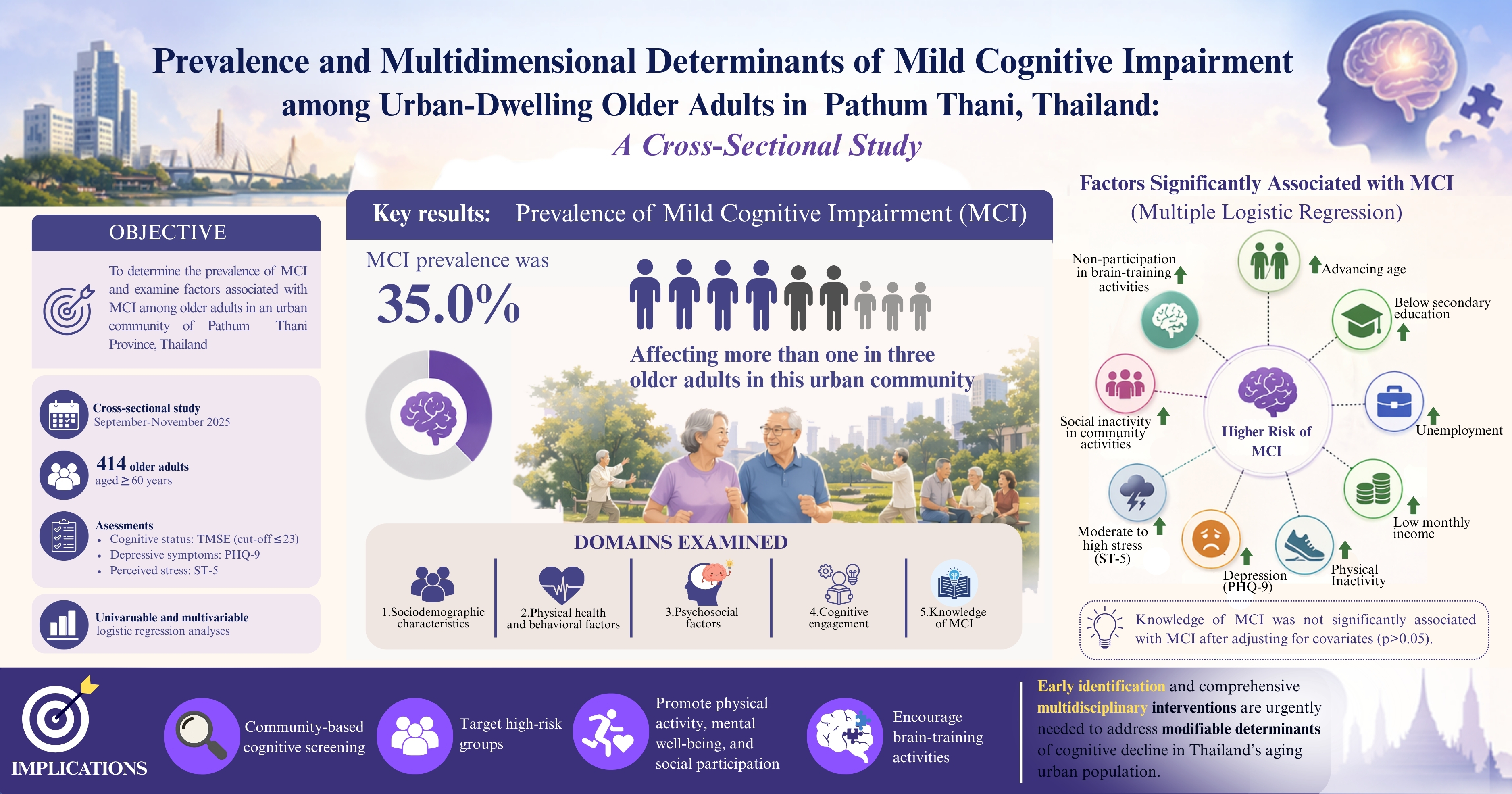
Mild cognitive impairment (MCI) is a stage of cognitive decline beyond normal aging that has not progressed to dementia and is increasingly recognized as a major public health concern worldwide. However, population-based evidence on MCI in urban Thailand remains limited. This cross-sectional study assessed the prevalence of MCI and its multidimensional determinants among older adults in an urban community in Pathum Thani, Thailand. A total of 414 adults aged 60 years or older were recruited using multistage sampling between September and November 2025. Cognitive status was assessed using the Thai Mental State Examination (TMSE; cutoff ≤23, indicating MCI), while depressive symptoms and perceived stress were evaluated using the PHQ-9 and ST-5, respectively. Associations were examined using univariable and multivariable logistic regression analyses. The prevalence of MCI was 35.0%, affecting more than one-third of the participants. Multivariable analysis identified nine factors significantly associated with MCI: older age, lower educational attainment, unemployment, low income, physical inactivity, depression, elevated stress, limited social participation, and lack of engagement in brain-training activities (p < 0.05). Knowledge of MCI was not significantly associated with MCI after adjustment (p > 0.05). These findings highlight the multifactorial nature of MCI in urban settings and emphasize the need for targeted, community-based screening and integrated health-promotion strategies that address modifiable risk factors in Thailand’s rapidly aging population.
References
Alzheimer’s Association. (2024). 2024 Alzheimer’s disease facts and figures. Alzheimer’s & Dementia, 20(5), 3708-3821. https://doi.org/10.1002/alz.13809
Auampradit, N., Vapattanawong, P., Punpuing, S., Sunpuwan, M., & Jirapramukpitak, T. (2019). A longitudinal study of changes in cognition among older Thais: Studying from the Kanchanaburi demographic surveillance system. Gerontology and Geriatric Medicine, 5, Article 2333721419862885. https://doi.org/10.1177/2333721419862885
Biessels, G. J., & Despa, F. (2018). Cognitive decline and dementia in diabetes mellitus: Mechanisms and clinical implications. Nature Reviews Endocrinology, 14(10), 591-604. https://doi.org/10.1038/s41574-018-0048-7
Bloom, B. S., Engelhart, M. D., Furst, E. J., Hill, W. H., & Krathwohl, D. R. (1956). Taxonomy of educational objectives: The classification of educational goals. Handbook 1: Cognitive domain. New York, US: Longman.
Cai, X. Y., Qian, G. P., Wang, F., Zhang, M. Y., Da, Y. J., & Liang, J. H. (2023). Association between sedentary behavior and risk of cognitive decline or mild cognitive impairment among the elderly: A systematic review and meta-analysis. Frontiers in Neuroscience, 17, Article 1221990. https://doi.org/10.3389/fnins.2023.1221990
Chuang, Y. F., Liu, Y. C., Tseng, H. Y., Lin, P. X., Li, C. Y., Shih, M. H., ... & Chiu, Y. L. (2021). Urban-rural differences in the prevalence and correlates of mild cognitive impairment in community-dwelling older adults in Taiwan: The EMCIT study. Journal of the Formosan Medical Association, 120(9), 1749-1757. https://doi.org/10.1016/j.jfma.2021.03.005
Chung, W., & Kim, R. (2020). Differential risk of cognitive impairment across paid and unpaid occupations in the middle-age population: Evidence from the Korean Longitudinal Study of Aging, 2006–2016. International Journal of Environmental Research and Public Health, 17(9), Article 3124. https://doi.org/10.3390/ijerph17093124
Ciesielska, N., Sokołowski, R., Mazur, E., Podhorecka, M., Polak-Szabela, A., & Kędziora-Kornatowska, K. (2016). Is the Montreal Cognitive Assessment (MoCA) test better suited than the Mini-Mental State Examination (MMSE) in mild cognitive impairment (MCI) detection among people aged over 60? Meta-analysis. Psychiatria Polska, 50(5), 1039-1052. https://doi.org/10.12740/PP/45368
Cochran, W. G. (1977). Sampling techniques (3rd ed.). New York, US: John Wiley & Sons.
Dahlgren, G., & Whitehead, M. (1991). Policies and strategies to promote social equity in health: Background document to WHO—Strategy paper for Europe (Arbetsrapport 2007:14). Institute for Futures Studies. Retrieved from https://ideas.repec.org/p/hhs/ifswps/2007_014.html
Department of Mental Health. (2009). ST-5 stress assessment. Retrieved from https://dmh.go.th/test/
Department of Older Persons, Ministry of Social Development and Human Security. (2025). Situation of the Thai Older Persons. Retrieved from https://www.dop.go.th/download/statistics/th1768287262-2583_1.pdf
Diwakar, R., Chakravarthy, B. S., Peter, R. M., Palanisamy, K., & Anantharaman, V. V. (2025). Prevalence of cognitive impairment and its determinants among older adults in Urban South India–A cross-sectional study. Nigerian Postgraduate Medical Journal, 32(4), 376-382. https://doi.org/10.4103/npmj.npmj_148_25
Dong, J., Yu, S., Qin, Y., Jin, X., Xing, Y., & Wang, H. (2026). Knowledge and health beliefs about dementia prevention among Chinese older adults: A qualitative study. Qualitative Health Research, 36(4-5), 405-427. https://doi.org/10.1177/10497323251324127
Engel, G. L. (1977). The need for a new medical model: A challenge for biomedicine. Science, 196(4286), 129-136. https://doi.org/10.1126/science.847460
Fowler, N. R., Partrick, K. A., Taylor, J., Hornbecker, M., Kelleher, K., Boustani, M., ... & Willis, D. R. (2025). Implementing early detection of cognitive impairment in primary care to improve care for older adults. Journal of Internal Medicine, 298(1), 31-45. https://doi.org/10.1111/joim.20098
Griffiths, J. (2020). Prevalence and factors associated with mild cognitive impairment among older adults in rural communities of northern Thailand [Doctoral dissertation], Chiang Mai University, Thailand.
Hamdan, M., Zidan, S., Abualhaija, R., Vanoh, D., Mouamer, A., Taqatqa, H., ... & Badrasawi, M. (2025). Factors associated with mild cognitive impairment among Palestinian community-dwelling older adults: A cross-sectional study. Cogent Psychology, 12(1), Article 2478715. https://doi.org/10.1080/23311908.2025.2478715
Ismail, Z., Elbayoumi, H., Fischer, C. E., Hogan, D. B., Millikin, C. P., Schweizer, T., ... & Fiest, K. M. (2017). Prevalence of depression in patients with mild cognitive impairment: A systematic review and meta-analysis. JAMA Psychiatry, 74(1), 58-67. https://doi.org/10.1001/jamapsychiatry.2016.3162
James, K. A., Stromin, J. I., Steenkamp, N., & Combrinck, M. I. (2023). Understanding the relationships between physiological and psychosocial stress, cortisol and cognition. Frontiers in Endocrinology, 14, Article 1085950. https://doi.org/10.3389/fendo.2023.1085950
Kitro, A., Panumasvivat, J., Sirikul, W., Wijitraphan, T., Promkutkao, T., & Sapbamrer, R. (2024). Associations between frailty and mild cognitive impairment in older adults: Evidence from rural Chiang Mai Province. PLoS One, 19(4), Article e0300264. https://doi.org/10.1371/journal.pone.0300264
Koyanagi, A., Oh, H., Vancampfort, D., Carvalho, A. F., Veronese, N., Stubbs, B., & Lara, E. (2019). Perceived stress and mild cognitive impairment among 32,715 community-dwelling older adults across six low-and middle-income countries. Gerontology, 65(2), 155-163. https://doi.org/10.1159/000492177
Kroenke, K., Spitzer, R. L., & Williams, J. B. (2001). The PHQ‐9: Validity of a brief depression severity measure. Journal of General Internal Medicine, 16(9), 606-613. https://doi.org/10.1046/j.1525-1497.2001.016009606.x
Kunrit, P., Tanthanapanyakorn, P., Khantikulanon, N., Mungkhunthod, S., Praserttai, C., Rungrungrueang, S., & Phonmamuang, W. (2025). Effectiveness of a brain exercise program using game-based cognitive enhancement to reduce mild cognitive impairment among older adults in Pathum Thani Province, Thailand: A quasi-experimental study. Osong Public Health and Research Perspectives, 16(1), 59-71. https://doi.org/10.24171/j.phrp.2024.0267
Livingston, G., Huntley, J., Liu, K. Y., Costafreda, S. G., Selbæk, G., Alladi, S., ... & Mukadam, N. (2024). Dementia prevention, intervention, and care: 2024 report of the Lancet standing Commission. The Lancet, 404(10452), 572-628. https://doi.org/10.1016/S0140-6736(24)01296-0
Lotrakul, M., Sumrithe, S., & Saipanish, R. (2008). Reliability and validity of the Thai version of the PHQ-9. BMC Psychiatry, 8(1), Article 46. https://doi.org/10.1186/1471-244X-8-46
Mahoney, F., & Barthel, D. (1965). Functional evaluation: The Barthel Index. Maryland State Medical Journal, 14, 61-65.
Mon, S. L., Tiraphat, S., & Jayasvasti, I. (2017). Factors associated with mild cognitive impairment among the community-dwelling elderly in the urban area of Kyauk Tan Township, Myanmar. Journal of Public Health and Development, 15(1), 63-79.
Muhammad, T., Srivastava, S., & Sekher, T. V. (2022). Assessing socioeconomic inequalities in cognitive impairment among older adults: A study based on a cross-sectional survey in India. BMC Geriatrics, 22(1), Article 389. https://doi.org/10.1186/s12877-022-03076-6
Nanthakwang, N., Siviroj, P., Matanasarawoot, A., Sapbamrer, R., Lerttrakarnnon, P., & Awiphan, R. (2020). Prevalence and associated factors of cognitive impairment and poor sleep quality among community-dwelling older adults in Northern Thailand. The Open Public Health Journal, 13, 815-822. https://doi.org/10.2174/1874944502013010815
National Statistical Office. (2023). Survey of the older persons in Thailand. Retrieved from https://www.nso.go.th/nsoweb/nso/survey_detail/iM?set_lang=en
Nutbeam, D. (2000). Health literacy as a public health goal: a challenge for contemporary health education and communication strategies into the 21st century. Health promotion international, 15(3), 259-267. https://doi.org/10.1093/heapro/15.3.259
Pender, N. J., Murdaugh, C. L., & Parsons, M. A. (2015). Health promotion in nursing practice (7th ed.). New Jersey, US: Pearson Education, Inc.
Petersen, R. C. (2004). Mild cognitive impairment as a diagnostic entity. Journal of Internal Medicine, 256(3), 183-194. https://doi.org/10.1111/j.1365-2796.2004.01388.x
Phanasathit, M., Nimnuan, C., & Lohsoonthorn, V. (2022). The effects of cognitive training in healthy community residing thai elderly: A randomized controlled trial. Psychology Research and Behavior Management, 15, 3709-3720. https://doi.org/10.2147/PRBM.S383526
Pinyopornpanish, K., Buawangpong, N., Soontornpun, A., Thaikla, K., Pateekhum, C., Nantsupawat, N., ... & Angkurawaranon, C. (2024). A household survey of the prevalence of subjective cognitive decline and mild cognitive impairment among urban community-dwelling adults aged 30 to 65. Scientific Reports, 14(1), Article 7783. https://doi.org/10.1038/s41598-024-58150-3
Piyaphattanuschai, T., & Chuaktong, S. (2025). The effect of the resilience quotient program with social support among the elderly with chronic non-communicable diseases. Journal of Current Science and Technology, 15(4), Article 130. https://doi.org/10.59796/jcst.V15N4.2025.130
Rajesh, J., Ramasubramanian, R., & Santhanam, R. S. (2020). A Cross-sectional study on prevalence of cognitive impairment and its associated factors among the elderly in an urban area of Chennai, India. International Journal of Community Medicine and Public Health, 7(12), 5126-5133. https://doi.org/10.18203/2394-6040.ijcmph20205196
Reamrimmadun, Y., Jaidee, W., Wattanaburanon, A., & Rojpaisarnkit, K. (2025). Effectiveness of a web-based application on health literacy, self-efficacy, self-care, and glycemic control in elderly patients with type 2 diabetes: A randomized controlled trial. Journal of Current Science and Technology, 15(1), Article 83. https://doi.org/10.59796/jcst.V15N1.2025.83
Smith, L., Shin, J. I., Sánchez, G. F. L., Oh, H., Kostev, K., Jacob, L., ... & Koyanagi, A. (2022). Social participation and mild cognitive impairment in low-and middle-income countries. Preventive Medicine, 164, Article 107230. https://doi.org/10.1016/j.ypmed.2022.107230
Srisupornkornkool, K., Veerapan, O., Thwon, K., Supain, B., Ponriangpon, A., Boonyarom, O., & Somthavil, S. (2022). Prevalence and factors related to mild cognitive impairment in older adults at Muang District, Phitsanulok Province. Journal of Health Science of Thailand, 31(1), 14-26.
Takase, M., Sugiura, K., Nakamoto, I., Watanabe, S., & Murayama, H. (2024). The association between employment and cognitive function in older adults: A systematic review. Geriatrics & Gerontology International, 24(12), 1283-1291. https://doi.org/10.1111/ggi.15017
Tiraphat, S., & Aekplakorn, W. (2018). Comparison of prevalence and risk factors associated with cognitive impairment between rural and urban elderly in Thailand. Journal of the Medical Association of Thailand, 101(3), 331-337.
Train the Brain Forum Committee. (1993). Thai mental state examination (TMSE). Siriraj Hospital Gazette, 45(6), 359-374.
United Nations. (2023). World social report 2023: Leaving no one behind in an ageing world. Retrieved from https://www.un.org/development/desa/dspd/world-social-report/2023-2.html
Von Elm, E., Altman, D. G., Egger, M., Pocock, S. J., Gøtzsche, P. C., & Vandenbroucke, J. P. (2007). The Strengthening the Reporting of Observational Studies in Epidemiology (STROBE) statement: Guidelines for reporting observational studies. The Lancet, 370(9596), 1453-1457. https://doi.org/10.1016/S0140-6736(07)61602-X
Wang, Y., Li, M., Haughton, D., & Kazis, L. E. (2024). Transition of mild cognitive impairment to Alzheimer’s disease: Medications as modifiable risk factors. PLoS One, 19(8), Article e0306270. https://doi.org/10.1371/journal.pone.0306270
World Health Organization (WHO). (2022). Ageing and health. Retrieved from https://www.who.int/news-room/fact-sheets/detail/ageing-and-health
Xue, J., Li, J., Liang, J., & Chen, S. (2018). The prevalence of mild cognitive impairment in China: A systematic review. Aging and Disease, 9(4), 706-715. https://doi.org/10.14336/AD.2017.0928
Zhang, W., Zhang, J., & Gao, N. (2025). Social isolation and cognitive decline in older adults: A longitudinal study across 24 countries. BMC Geriatrics, 25(1), Article 775. https://doi.org/10.1186/s12877-025-06430-6
Downloads
Published
How to Cite
Issue
Section
Categories
License
Copyright (c) 2026 Journal of Current Science and Technology

This work is licensed under a Creative Commons Attribution-NonCommercial-NoDerivatives 4.0 International License.