Enhancing Wear Resistance and Interfacial Properties of Hardfaced AISI 1050 Steel Utilizing an Austenitic Buffer Layer
DOI:
https://doi.org/10.59796/jcst.V16N4.2026.216Keywords:
abrasive wear, aisi 1050, austenitic buffer, carbon diffusion, hardfacing, microstructure, smawAbstract
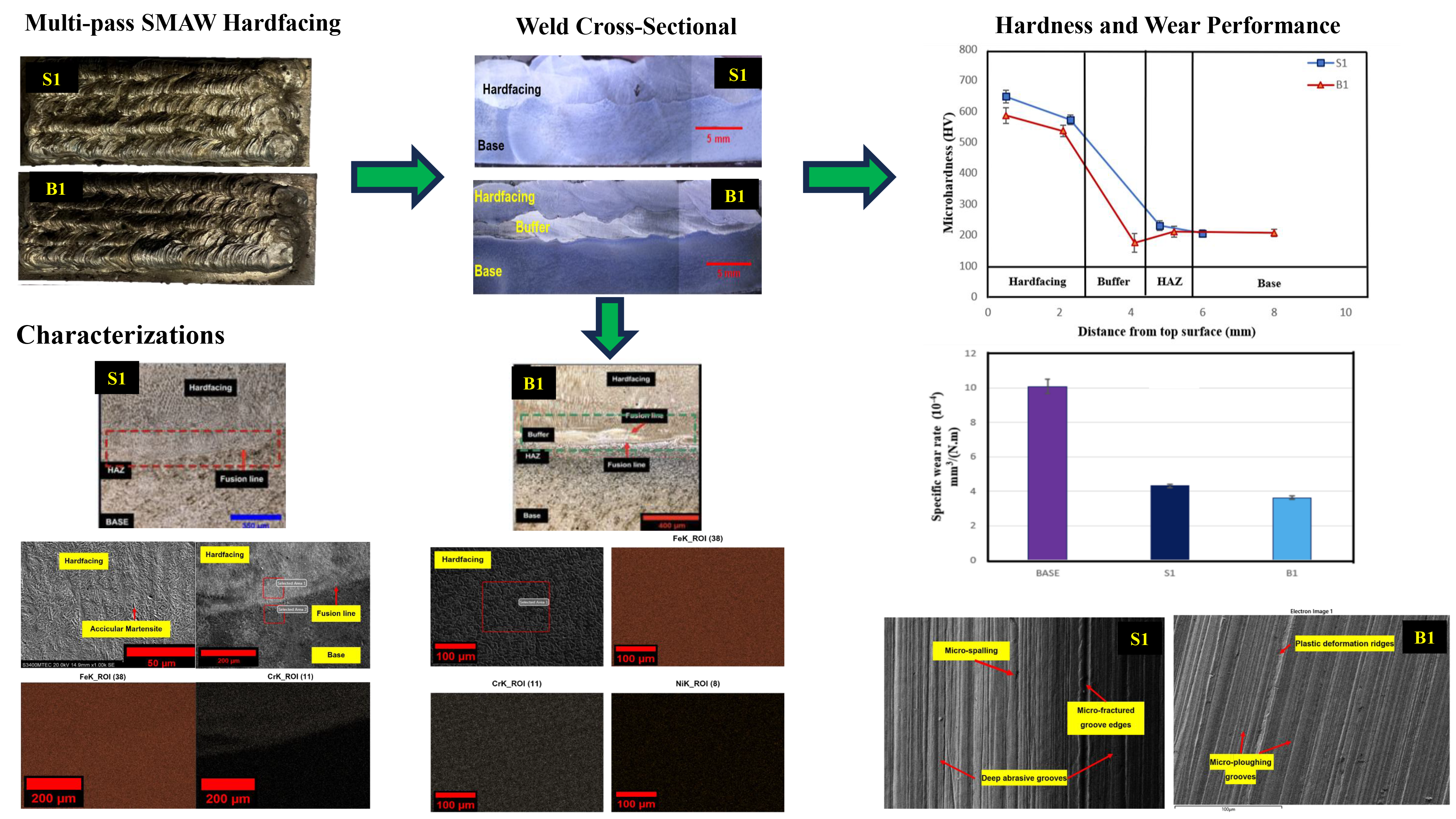
The performance of hardfaced carbon steels is strongly influenced by interfacial integrity and microstructural evolution during welding. This study investigated the effects of an austenitic E309L-16 buffer layer on the microstructure, hardness distribution, and abrasive wear resistance of SMAW-hardfaced AISI 1050 steel. A functionally graded hardfacing architecture incorporating the buffer layer was developed to improve metallurgical compatibility and interfacial stability. Two conditions were examined: direct hardfacing (S1) and buffer-assisted hardfacing (B1). Optical microscopy (OM), scanning electron microscopy coupled with energy-dispersive X-ray spectroscopy (SEM-EDS), microhardness measurements, and ASTM G65 abrasion testing were conducted. The results showed that direct hardfacing promoted carbon redistribution toward the interface, resulting in a brittle interfacial region and an abrupt hardness transition. In contrast, the E309L-16 buffer layer moderated carbon redistribution, eliminated the interfacial white band, and promoted a more homogeneous microstructure with a gradual hardness profile. The B1 specimen predominantly exhibited lath martensite and demonstrated superior wear resistance despite its slightly lower peak hardness (586 HV compared with 647 HV for S1). The specific wear rate decreased from (10.08 ± 0.43) × 10⁻⁴ mm³/N·m for the base metal to (4.30 ± 0.10) × 10⁻⁴ mm³/N·m for S1 and further to (3.62 ± 0.11) × 10⁻⁴ mm³/N·m for B1. These findings demonstrate that interfacial engineering using an austenitic buffer layer can improve wear resistance and provide practical guidance for designing durable multilayer hardfacing systems.
References
Allou, D., Ould Brahim, I., Cheniti, B., Fides, M., Hvizdos, P., Miroud, D., & Ziouche, A. (2021). Effect of post weld heat treatment on microstructure and mechanical behaviors of weld overlay Inconel 182 on 4130 steel substrate using SMAW process. Metallography, Microstructure, and Analysis, 10(5), 567-578. https://doi.org/10.1007/s13632-021-00773-3
Anusha, K., Routara, B. C., & Guha, S. (2023). A review on high-velocity oxy-fuel (HVOF) coating technique. Journal of The Institution of Engineers (India): Series D, 104(2), 831-848. https://doi.org/10.1007/s40033-022-00434-x
ASM Handbook Committee. (1990). Properties and selection: Irons, steels, and high-performance alloys. Ohio, US: ASM international. https://doi.org/10.31399/asm.hb.v01.a0001035
ASTM International. (2017). Standard test method for measuring abrasion using the dry sand/rubber wheel apparatus. Retrieved from https://doi.org/10.1520/G0065-16
ASTM International. (2022). Standard test method for microindentation hardness of materials. Retrieved form https://doi.org/10.1520/E0384-22
Balos, S., Zlatanović, D. L., Janjatović, P., Pećanac, M., Erić Cekić, O., Rosić, M., & Stopić, S. (2025). Microstructure, hardness, and wear behavior of layers obtained by electric arc hardfacing processes. Materials, 18(2), Article 299. https://doi.org/10.3390/ma18020299
Chaichawalit, A., Kaewvilai, A., & Nilsonthi, T. (2025). TIG-cladding of carbon steel reinforced with carbide particles: Microstructural characteristics and wear resistance evaluation. Welding in the World, 70(2), 387-405. https://doi.org/10.1007/s40194-025-02190-4
Dubourg, L., Ursescu, D., Hlawka, F., & Cornet, A. (2005). Laser cladding of MMC coatings on aluminium substrate: Influence of composition and microstructure on mechanical properties. Wear, 258(11-12), 1745-1754. https://doi.org/10.1016/j.wear.2004.12.010
Equbal, M. I., Alam, P., Ohdar, R., Anand, K. A., & Alam, M. S. (2016). Effect of cooling rate on the microstructure and mechanical properties of medium carbon Steel. International Journal of Metallurgical Engineering, 5(2), 21-24.
Gupta, A., Singh, J., & Chhibber, R. (2024). Dissimilar welding of austenitic and ferritic steels using nickel and stainless-steel filler: Associated issues. Proceedings of the Institution of Mechanical Engineers, Part E: Journal of Process Mechanical Engineering, 238(5), 2524-2544. https://doi.org/10.1177/09544089231159776
Hasanah, N., Mokhtar, A., & Zulfika, D. N. (2025). Evaluation on microstructure and hardness of heat treated AISI 1050. JTTM: Jurnal Terapan Teknik Mesin, 6(1), 109-114. https://doi.org/10.37373/jttm.v6i1.1545
Hellier, C. J. (2013). Handbook of nondestructive evaluation (2nd ed.). Ohio, US: McGraw Hill.
Holmberg, K., & Matthews, A. (2009). Coatings tribology: Properties, mechanisms, techniques and applications in surface engineering. Oxford, UK: Elsevier.
Jeong, Y. E., Shin, G. Y., & Shim, D. S. (2021). Effect of P21 buffer layer on interfacial bonding characteristics of high carbon tool steel hardfaced through directed energy deposition. Journal of Manufacturing Processes, 68(A), 1596-1614. https://doi.org/10.1016/j.jmapro.2021.07.002
Kou, S. (2021). Welding metallurgy (3rd ed.). New Jersey, US: John Wiley & Sons.
Krauss, G. (2015). Steels: Processing, structure, and performance (2nd ed.). Ohio, US: ASM International. https://doi.org/10.31399/asm.tb.spsp2.9781627082655
Lippold, J. C. (2014). Welding metallurgy and weldability. New Jersey, US: John Wiley & Sons.
Makhdoom, M. A., Ahmed, F., Channa, I. A., Inam, A., Riaz, F., Siyal, S. H., ... & Alhazaa, A. (2022). Effect of multiple thermal cycles on the microstructure and mechanical properties of AISI 1045 weldments. ACS Omega, 7(46), 42313–42319. https://doi.org/10.1021/acsomega.2c05249
Mvola, B., Kah, P., & Martikainen, J. (2014). Dissimilar ferrous metal welding using advanced gas metal arc welding processes. Reviews on Advanced Materials Science, 38(2), 125-137.
Ning, Y., Qiu, Z., Wu, B., Pan, Z., & Li, H. (2025). Hardfacing of metals: A review of consumables, properties and strengthening processes. Journal of Materials Research and Technology, 36, 6330-6349. https://doi.org/10.1016/j.jmrt.2025.04.221
Srisuwan, N., Kumsri, N., Yingsamphancharoen, T., & Kaewvilai, A. (2019). Hardfacing welded ASTM A572-based, high-strength, low-alloy steel: Welding, characterization, and surface properties related to the wear resistance. Metals, 9(2), Article 244. https://doi.org/10.3390/met9020244
Tandon, D., Li, H., Pan, Z., Yu, D., & Pang, W. (2023). A review on hardfacing, process variables, challenges, and future works. Metals, 13(9), Article 1512. https://doi.org/10.3390/met13091512
Testa, V., Morelli, S., Bolelli, G., Benedetti, B., Puddu, P., Sassatelli, P., & Lusvarghi, L. (2020). Alternative metallic matrices for WC-based HVOF coatings. Surface and Coatings Technology, 402, Article 126308. https://doi.org/10.1016/j.surfcoat.2020.126308
Tippayasam, C., Taengwa, C., Palomas, J., Siripongsakul, T., Thaweechai, T., & Kaewvilai, A. (2023). Effects of flux-cored arc welding technology on microstructure and wear resistance of Fe-Cr-C hardfacing alloy. Materials Today Communications, 35, Article 105569. https://doi.org/10.1016/j.mtcomm.2023.105569
Downloads
Published
How to Cite
Issue
Section
Categories
License
Copyright (c) 2026 Journal of Current Science and Technology

This work is licensed under a Creative Commons Attribution-NonCommercial-NoDerivatives 4.0 International License.