Association between Praziquantel Treatment and Cholangiocarcinoma in Khon Kaen, Thailand: A Retrospective Cohort Study
DOI:
https://doi.org/10.59796/jcst.V16N4.2026.222Keywords:
cholangiocarcinoma, Opisthorchis viverrini, praziquantelAbstract
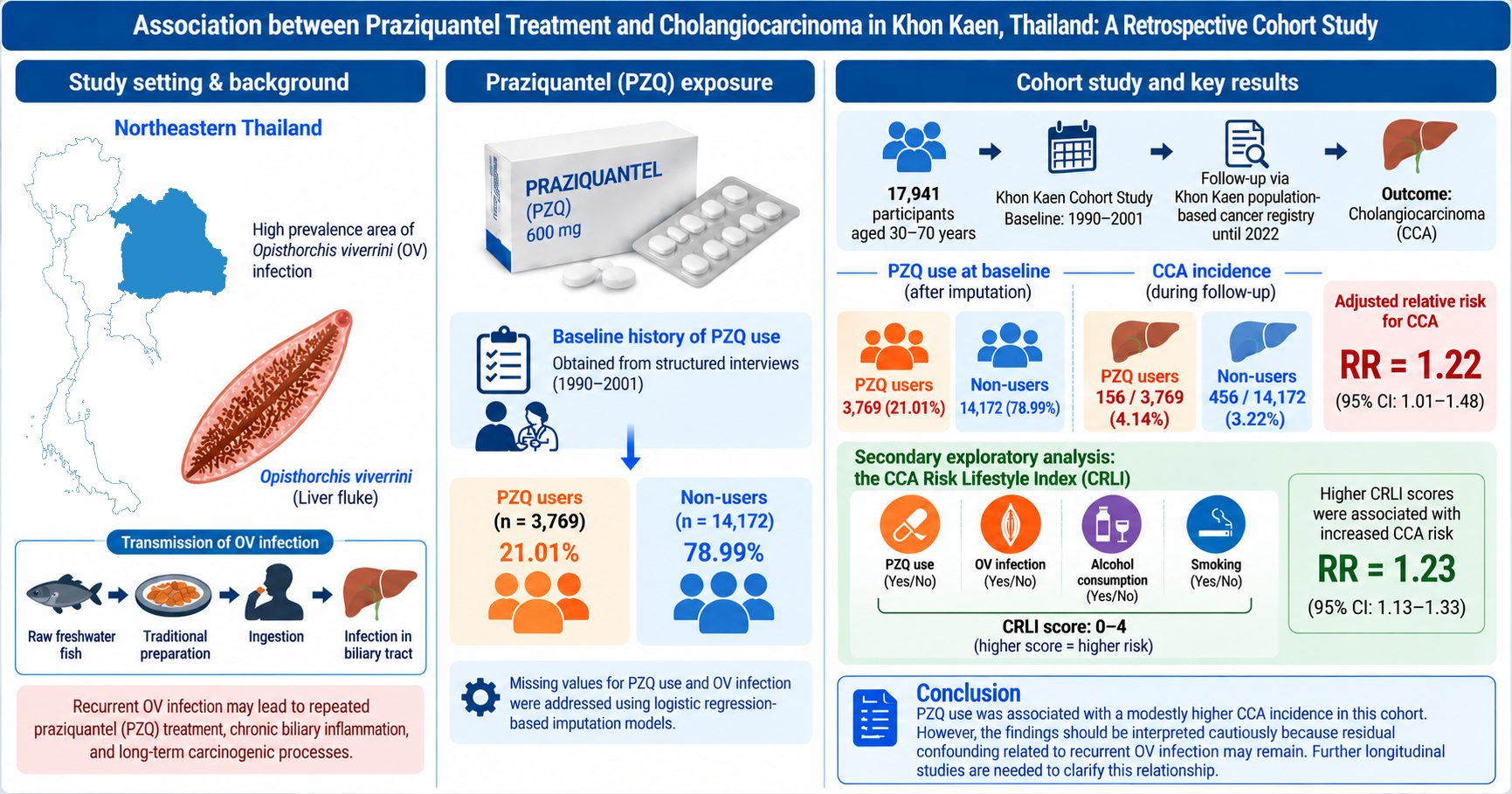
Cholangiocarcinoma (CCA) is highly prevalent in northeastern Thailand, where Opisthorchis viverrini (OV) infection is endemic. Recurrent infection may lead to repeated praziquantel (PZQ) treatment, chronic biliary inflammation, and long-term carcinogenic processes. However, population-based longitudinal evidence regarding the association between PZQ use and CCA remains limited. Therefore, this study aimed to estimate the association between PZQ use and CCA incidence in a population-based cohort. This retrospective cohort study used data from the Khon Kaen Cohort Study conducted between 1990 and 2001. A total of 17,941 participants aged 30–70 years were followed through linkage with the Khon Kaen Population-Based Cancer Registry until 2022. Participants were classified by baseline history of PZQ use, obtained from structured interviews. Missing values for PZQ use and OV infection were addressed using logistic regression-based imputation models. Generalized linear models were used to estimate relative risks (RRs) and 95% confidence intervals (CIs). As a secondary exploratory analysis, the CCA Risk Lifestyle Index (CRLI), constructed from four factors, namely PZQ use, OV infection, alcohol consumption, and smoking (range 0–4), was evaluated separately. Among participants, 3,769 (21.01%) reported PZQ use. CCA occurred in 156 PZQ users (4.14%) and 456 non-users (3.22%). PZQ use was associated with a modestly increased risk of CCA (adjusted RR = 1.22, 95% CI: 1.01–1.48). Higher CRLI scores were associated with increased CCA risk (RR = 1.23, 95% CI: 1.13–1.33). PZQ use was associated with higher CCA incidence in this cohort. However, the findings should be interpreted cautiously because residual confounding related to recurrent OV infection may remain. Further longitudinal studies are needed to clarify this relationship.
References
Bureau of Epidemiology (2010). Thailand annual epidemiological surveillance report 2009. Nonthaburi, Thailand: Bureau of Epidemiology.
Cho, I. R., Yi, S. W., Choi, J. S., & Yi, J. J. (2022). Comparison of risk factors for cholangiocarcinoma and hepatocellular carcinoma: A prospective cohort study in Korean adults. Cancers, 14(7), Article 1709. https://doi.org/10.3390/cancers14071709
Curado, M. P., Edwards, B., Shin, H. R., Storm, H., Ferlay, J., Heanue, M., & Boyle, P. (2007). Cancer incidence in five continents, Volume IX. Lyon Cedex, France: IARC Press, International Agency for Research on Cancer
Dechakhamphu, S., Yongvanit, P., Nair, J., Pinlaor, S., Sitthithaworn, P., & Bartsch, H. (2008). High excretion of etheno adducts in liver fluke–infected patients: Protection by praziquantel against DNA damage. Cancer Epidemiology Biomarkers & Prevention, 17(7), 1658-1664. https://doi.org/10.1158/1055-9965.EPI-08-0191
Ervik, M., Lam, F., Laversanne, M., Colombet, M., Ferlay, J., Miranda-Filho, A., & Bray, F. (2024). Global cancer observatory: Cancer over time. Retrieved from https://www.researchgate.net/publication/391727087_Global_Cancer_Observatory_Cancer_Over_Time
Fedorova, O. S., Kovshirina, A. E., Kovshirina, Y. V., Hattendorf, J., Onishchenko, S. V., Katanakhova, L. L., ... & Odermatt, P. (2023). Opisthorchis felineus infection is a risk factor for cholangiocarcinoma in Western Siberia: A hospital-based case-control study. Clinical Infectious Diseases, 76(3), e1392-e1398. https://doi.org/10.1093/cid/ciac497
Giri, B. R., & Roy, B. (2016). Praziquantel induced oxidative stress and apoptosis-like cell death in Raillietina echinobothrida. Acta Tropica, 159, 50-57. https://doi.org/10.1016/j.actatropica.2016.03.022
Kamsa-ard, S., Kamsa-ard, S., Luvira, V., Suwanrungruang, K., Vatanasapt, P., & Wiangnon, S. (2018). Risk factors for cholangiocarcinoma in Thailand: A systematic review and meta-analysis. Asian Pacific Journal of Cancer Prevention, 19(3), 605-614. https://doi.org/10.22034/APJCP.2018.19.3.605
Kamsa-ard, S., Luvira, V., Pugkhem, A., Luvira, V., Thinkhamrop, B., Suwanrungruang, K., & Bhudhisawasdi, V. (2015). Association between praziquantel treatment and cholangiocarcinoma: A hospital-based matched case–control study. BMC Cancer, 15(1), Article 776. https://doi.org/10.1186/s12885-015-1788-6
Khuntikao, N. (2005). Current concept in management of cholangiocarcinoma. Srinagarind Medical Journal, 20(3), 143-149.
Lee, B. S., Park, E. C., Park, S. W., Nam, C. M., & Roh, J. (2015). Hepatitis B virus infection, diabetes mellitus, and their synergism for cholangiocarcinoma development: A case-control study in Korea. World Journal of Gastroenterology, 21(2), 502-510. https://doi.org/10.3748/wjg.v21.i2.502
Luvira, V., Kamsa-ard, S., Kamsa-ard, S., Luvira, V., Srisuk, T., Pugkhem, A., ... & Bhudhisawasdi, V. (2018). Association between repeated praziquantel treatment and papillary, and intrahepatic cholangiocarcinoma. Annals of Hepatology, 17(5), 802-809. https://doi.org/10.5604/01.3001.0012.3140
Peng, Y. C., Lin, C. L., Hsu, W. Y., Chow, W. K., Lee, S. W., Yeh, H. Z., ... & Kao, C. H. (2018). Association between cholangiocarcinoma and proton pump inhibitors use: A nested case-control study. Frontiers in Pharmacology, 9, Article 718. https://doi.org/10.3389/fphar.2018.00718
Petrick, J. L., Campbell, P. T., Koshiol, J., Thistle, J. E., Andreotti, G., Beane-Freeman, L. E., ... & McGlynn, K. A. (2018). Tobacco, alcohol use and risk of hepatocellular carcinoma and intrahepatic cholangiocarcinoma: The Liver Cancer Pooling Project. British Journal of Cancer, 118(7), 1005-1012. https://doi.org/10.1038/s41416-018-0007-z
Petrick, J. L., Yang, B., Altekruse, S. F., Van Dyke, A. L., Koshiol, J., Graubard, B. I., & McGlynn, K. A. (2017). Risk factors for intrahepatic and extrahepatic cholangiocarcinoma in the United States: A population-based study in SEER-Medicare. PLoS One, 12(10), Article e0186643. https://doi.org/10.1371/journal.pone.0186643
.Pinlaor, S., Ma, N., Hiraku, Y., Yongvanit, P., Semba, R., Oikawa, S., ... & Kawanishi, S. (2004). Repeated infection with Opisthorchis viverrini induces accumulation of 8-nitroguanine and 8-oxo-7, 8-dihydro-2′-deoxyguanine in the bile duct of hamsters via inducible nitric oxide synthase. Carcinogenesis, 25(8), 1535-1542. https://doi.org/10.1093/carcin/bgh157
Pinlaor, S., Prakobwong, S., Hiraku, Y., Kaewsamut, B., Dechakhamphu, S., Boonmars, T., ... & Kawanishi, S. (2008). Oxidative and nitrative stress in Opisthorchis viverrini–infected hamsters: An indirect effect after praziquantel treatment. The American Journal of Tropical Medicine and Hygiene, 78(4), 564-573. https://doi.org/10.4269/ajtmh.2008.78.564
Pupacdi, B., Loffredo, C. A., Budhu, A., Rabibhadana, S., Bhudhisawasdi, V., Pairojkul, C., ... & TIGER‐LC Consortium. (2024). The landscape of etiological patterns of hepatocellular carcinoma and intrahepatic cholangiocarcinoma in Thailand. International Journal of Cancer, 155(8), 1387-1399. https://doi.org/10.1002/ijc.35034
Rojanamatin, J., Ukranum, W., Supaattagorn, P., Chiawiriyabunya, I., Wongsena, M., Chaiwerawattana, A., Ploawhutanont, P., Chitapanarux, I., Vatanasapt, P., Greater, S. L., Sangrajrang, S., & Buasom, R. (Eds.). (2021). Cancer in Thailand: Vol. X, 2016–2018. National Cancer Institute. Retrieved from chrome-extension://efaidnbmnnnibpcajpcglclefindmkaj/https://nci.go.th/files/cancer_stat/1771381927_file.pdf
Rosner, B. (2000). Fundamentals of biostatistics (5th ed.). California, US: Duxbury Press.
Saengsawang, P., Promthet, S., & Bradshaw, P. (2016). Reinfection by Opisthorchis viverrini after treatment with praziquantel. Asian Pacific Journal of Cancer Prevention, 17(2), 857-62. https://doi.org/10.7314/APJCP.2016.17.2.857
Shin, H. R., Oh, J. K., Masuyer, E., Curado, M. P., Bouvard, V., Fang, Y. Y., ... & Hong, S. T. (2010). Epidemiology of cholangiocarcinoma: An update focusing on risk factors. Cancer Science, 101(3), 579-585. https://doi.org/10.1111/j.1349-7006.2009.01458.x
Songserm, N., Woradet, S., Sripa, B., & Ali, A. (2020). Sustainable prevention of cholangiocarcinoma through community participation in a high-incidence area in Thailand. Asian Pacific Journal of Cancer Prevention, 21(3), 777-782. https://doi.org/10.31557/APJCP.2020.21.3.777
Sripa, B., Yongvanit, P., & Pairojkul, C. (2005). Etiology and pathogenesis of cholangiocarcinoma: Introduction to the association with liver fluke infection. Srinagarind Medical Journal, 20(3), 122-134.
Steele, J. A., Richter, C. H., Echaubard, P., Saenna, P., Stout, V., Sithithaworn, P., & Wilcox, B. A. (2018). Thinking beyond Opisthorchis viverrini for risk of cholangiocarcinoma in the lower Mekong region: A systematic review and meta-analysis. Infectious Diseases of Poverty, 7(1), Article 44. https://doi.org/10.1186/s40249-018-0434-3
Thinkhamrop, K., Khuntikao, N., Laohasiriwong, W., Chupanit, P., Kelly, M., & Suwannatrai, A. T. (2021). Association of comorbidity between Opisthorchis viverrini infection and diabetes mellitus in the development of cholangiocarcinoma among a high-risk population, northeastern Thailand. PLoS Neglected Tropical Diseases, 15(9), Article e0009741. https://doi.org/10.1371/journal.pntd.0009741
Watanapa, P. (2002). Literature review on Opisthorchis-associated cholangiocarcinoma. Faculty of Medicine Siriraj Hospital, Mahidol University. Retrieved from https://doi.nrct.go.th/ListDoi/listDetail?Resolve_DOI=10.14457/MU.res.2002.7
Wirasorn, K., Klarod, K., Hongsprabhas, P., & Boonsiri, P. (2014). Oxidative stress, antioxidant and cancer. Srinagarind Medical Journal, 29(2), 207–219.
Xiong, J., Lu, X., Xu, W., Bai, Y., Huang, H., Bian, J., ... & Zhao, H. (2018). Metabolic syndrome and the risk of cholangiocarcinoma: A hospital-based case–control study in China. Cancer Management and Research, 10, 3849-3855. https://doi.org/10.2147/CMAR.S175628
Zhang, Y. B., Pan, X. F., Chen, J., Cao, A., Zhang, Y. G., Xia, L., ... & Pan, A. (2020). Combined lifestyle factors, incident cancer, and cancer mortality: A systematic review and meta-analysis of prospective cohort studies. British Journal of Cancer, 122(7), 1085-1093. https://doi.org/10.1038/s41416-020-0741-x
Downloads
Published
How to Cite
License
Copyright (c) 2026 Journal of Current Science and Technology

This work is licensed under a Creative Commons Attribution-NonCommercial-NoDerivatives 4.0 International License.