Energy-Efficient Scheduling and Control of Aluminum Melting Processes Using Genetic Algorithms and Reinforcement Learning
DOI:
https://doi.org/10.59796/jcst.V16N3.2026.205Keywords:
aluminum melting, deep Q-network, energy-aware scheduling, genetic algorithm, reinforcement learning, temperature control, industrial process control, thermal process optimizationAbstract
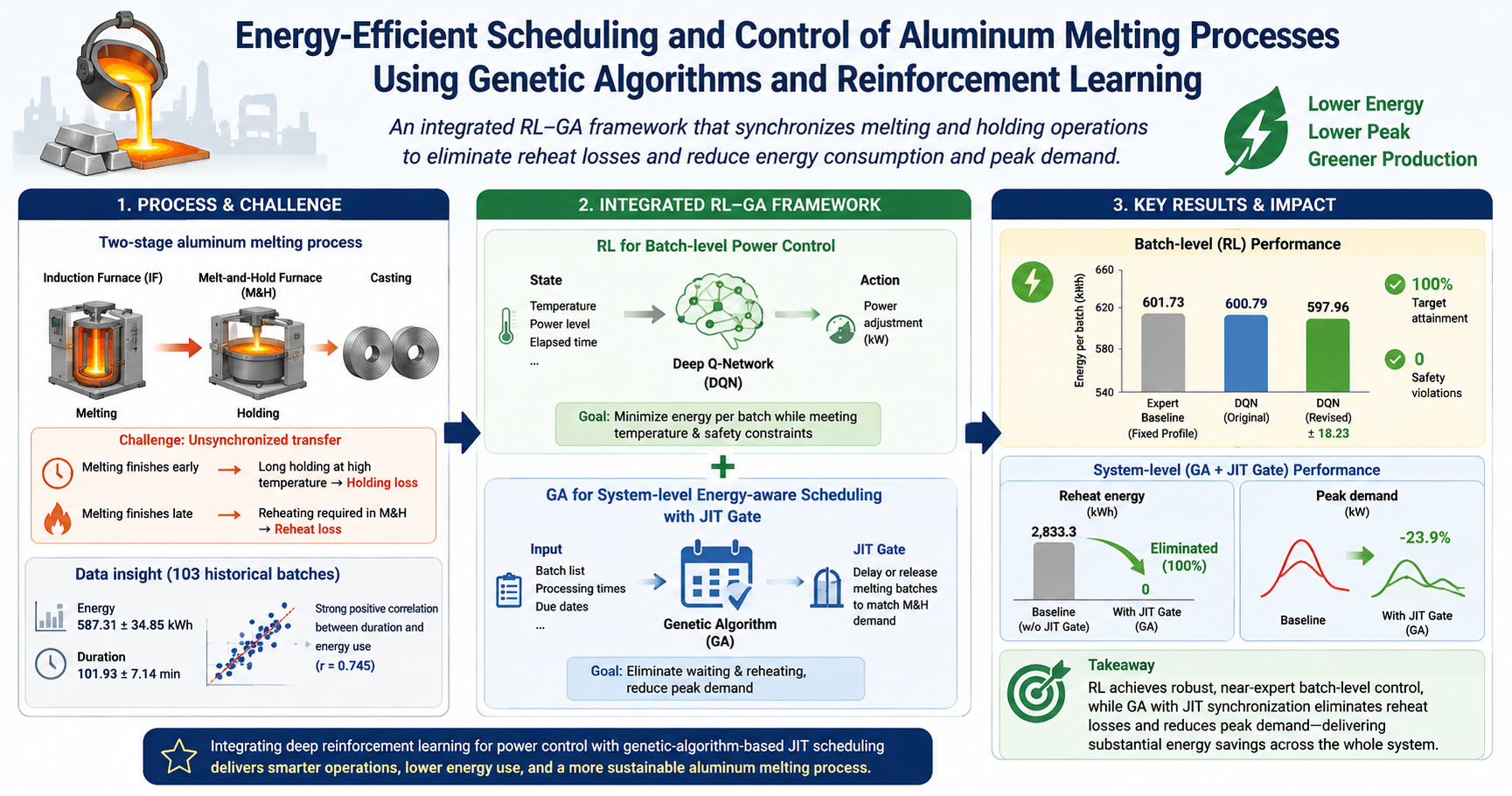
Manufacturing is a primary driver of global energy consumption, necessitating advanced production strategies to maintain industrial competitiveness. This study explores opportunities for thermal optimization within an industrial aluminum melting process in Thailand. While traditional manual furnace regulation and heuristic scheduling provide operational stability, the inherent complexity of multi-stage processes presents opportunities to further minimize holding and reheat losses through automated synchronization. However, existing studies typically address batch-level thermal control and system-level scheduling separately, and few explicitly target the holding and reheat losses caused by unsynchronized transfer between induction and melt-and-hold stages. To address this gap, we propose an integrated framework that combines deep reinforcement learning (RL) for batch-level power control with a genetic algorithm (GA) for system-level energy-aware scheduling. The RL component uses a deep Q-network (DQN) to learn an expert-guided power-control policy, while the GA incorporates a just-in-time (JIT) Gate, a synchronization mechanism that delays or releases melting batches to align induction-furnace output with downstream melt-and-hold (M&H) demand. Under repeated mixed-start evaluation, the revised RL controller achieved 597.96 ± 18.23 kWh per batch, slightly improving upon the original DQN result (600.79 ± 19.96 kWh) and the fixed expert-profile baseline (601.73 kWh), while preserving 100% target attainment and zero executed safety violations. At the system level, the GA-based scheduler eliminated reheat energy from 2,833.3 kWh to 0 kWh and reduced peak demand by 23.9%. These results indicate that RL provides robust, near-expert batch-level control, while GA-based JIT synchronization delivers the major energy-saving benefit at the production-system level.
References
Ahmad Khan, S., Rehman, A. U., Arshad, A., Malik, F. H., & Ayadi, W. (2026). Metaheuristic optimizer-based segregated load scheduling approach for household energy consumption management. Eng, 7(2), Article 65. https://doi.org/10.3390/eng7020065
Braga, C. A. P., & da Fonseca Netto, J. V. (2016). A dynamic state observer to control the energy consumption in aluminium production cells. Systems Science & Control Engineering, 4(1), 307-319. https://doi.org/10.1080/21642583.2016.1238325
Chen, L., Cao, L. L., Wen, Y. M., Chen, H., & Jiang, S. L. (2023). A knowledge-based NSGA-II algorithm for multi-objective hot rolling production scheduling under flexible time-of-use electricity pricing. Journal of Manufacturing Systems, 69, 255-270. https://doi.org/10.1016/j.jmsy.2023.06.009
Cui, W., & Yuan, B. (2024). A hybrid genetic algorithm based on reinforcement learning for the energy-aware production scheduling in the photovoltaic glass industry. Computers & Operations Research, 163, Article 106521. https://doi.org/10.1016/j.cor.2023.106521
Dai, J., Liu, H., Zhang, Y., Shi, H., & Ling, P. (2025). An optimization design of energy consumption for aluminum smelting based on a multi-objective artificial vulture algorithm. Metals, 15(2), Article 105. https://doi.org/10.3390/met15020105
Fernandes, J. M. R. C., Homayouni, S. M., & Fontes, D. B. M. M. (2022). Energy-efficient scheduling in job shop manufacturing systems: A literature review. Sustainability, 14(10), Article 6264. https://doi.org/10.3390/su14106264
Gao, K., Huang, Y., Sadollah, A., & Wang, L. (2020). A review of energy-efficient scheduling in intelligent production systems. Complex & Intelligent Systems, 6(2), 237-249. https://doi.org/10.1007/s40747-019-00122-6
Li, C., Chang, Q., & Fan, H. T. (2024). Multi-agent reinforcement learning for integrated manufacturing system-process control. Journal of Manufacturing Systems, 76, 585-598. https://doi.org/10.1016/j.jmsy.2024.08.021
Loffredo, A., May, M. C., & Matta, A. (2023). Reinforcement learning for energy-efficient control of multi-stage production lines with parallel machine workstations [Conference presentation]. Italian Manufacturing Association Conference: XVI AITeM, Naples, Italy. https://doi.org/10.21741/9781644902714-51
Lu, R., Li, Y. C., Li, Y., Jiang, J., & Ding, Y. (2020). Multi-agent deep reinforcement learning based demand response for discrete manufacturing systems energy management. Applied Energy, 276, Article 115473. https://doi.org/10.1016/j.apenergy.2020.115473
Modrak, V., Sudhakarapandian, R., Balamurugan, A., & Soltysova, Z. (2024). A review on reinforcement learning in production scheduling: An inferential perspective. Algorithms, 17(8), Article 343. https://doi.org/10.3390/a17080343
Nayak, A., Fang, K., & Lee, S. (2017). Demand response in flow shop with job due dates using genetic algorithm approach. Smart and Sustainable Manufacturing Systems, 1(1), 100-120. https://doi.org/10.1520/SSMS20160006
Park, J. S., Ng, H. Y., Chua, T. J., Ng, Y. T., & Kim, J. W. (2021). Unified genetic algorithm approach for solving flexible job-shop scheduling problem. Applied Sciences, 11(14), Article 6454. https://doi.org/10.3390/app11146454
Salido, M. A., Escamilla, J., Giret, A., & Barber, F. (2016). A genetic algorithm for energy-efficiency in job-shop scheduling. The International Journal of Advanced Manufacturing Technology, 85(5), 1303-1314. https://doi.org/10.1007/s00170-015-7987-0
Wong, C. J., Bao, J., Skyllas-Kazacos, M., Welch, B., Mahmoud, M., Arkhipov, A., & Ahli, N. (2023). Studies on power modulation of aluminum smelting cells based on a discretized mass and thermal dynamic model. Metallurgical and Materials Transactions B, 54(2), 562-577. https://doi.org/10.1007/s11663-022-02709-w
Downloads
Published
How to Cite
Issue
Section
Categories
- Industrial engineering > Systems Modeling and Simulation
- Industrial engineering > Production and Operations Management
- Industrial engineering > Operations Research
- Computing (Computer Science; Computer Engineering) > Artificial Intelligence (AI)
- Computing (Computer Science; Computer Engineering) > Machine Learning and Intelligent Systems
License
Copyright (c) 2026 Journal of Current Science and Technology

This work is licensed under a Creative Commons Attribution-NonCommercial-NoDerivatives 4.0 International License.