Suspension Control Strategies for High-Speed Trains: A Comprehensive Review and Future Perspectives
DOI:
https://doi.org/10.59796/jcst.V16N3.2026.206Keywords:
adaptive and hybrid controllers, high-speed train suspension, intelligent control strategies, semi-active and active suspension, vibration suppression, reinforcement learning, magnetorheological damperAbstract
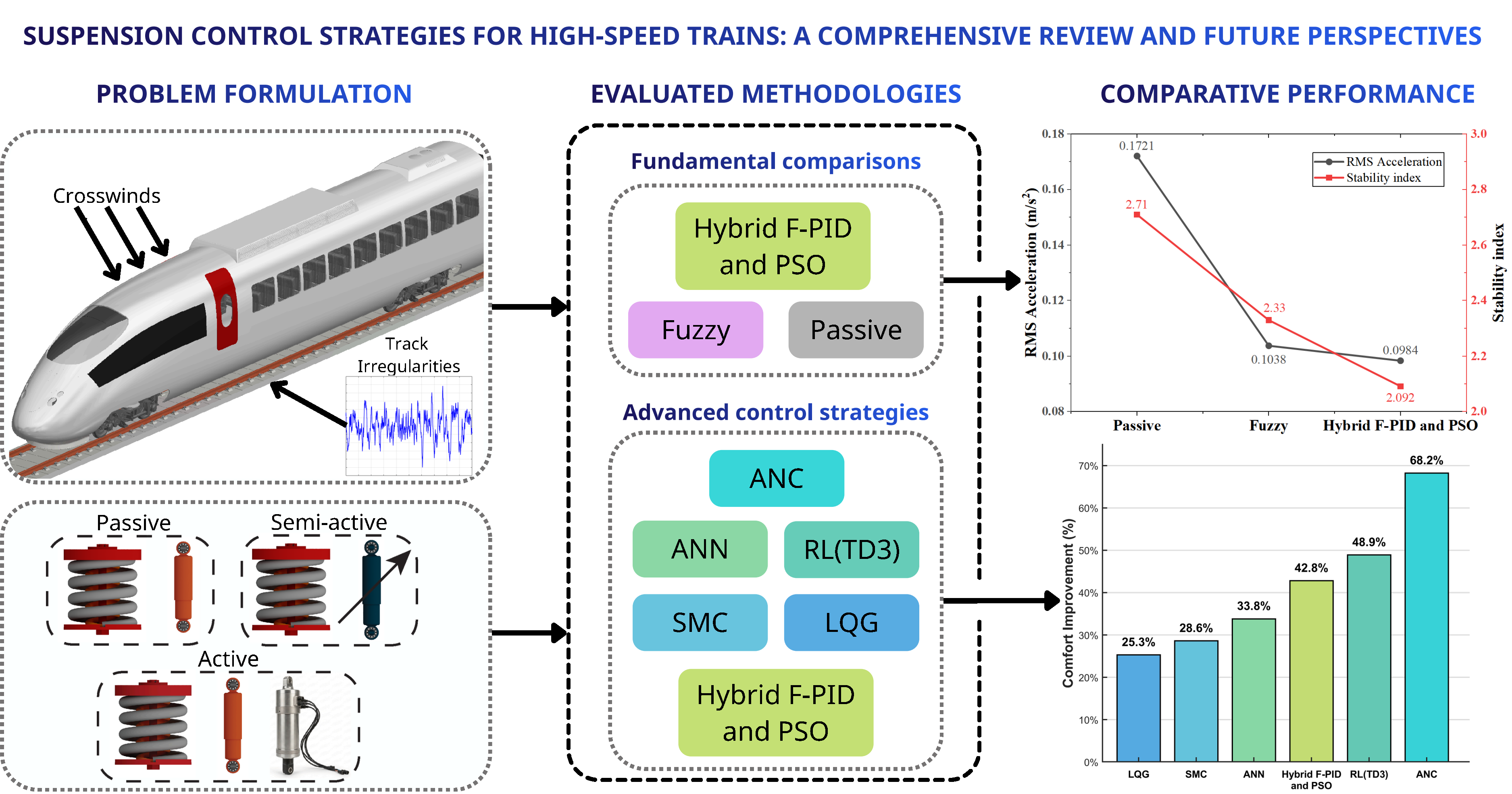
The suspension system plays a crucial role in ensuring the smoothness, stability, and safety of high-speed trains. This paper provides a comprehensive overview of the development of passive, semi-active, and active suspension systems. Advanced intelligent control architectures, such as Proportional Integral Derivative (PID), Linear Quadratic Regulator/Gaussian (LQR/LQG), and Sliding Mode Control (SMC), are compared with modern approaches, specifically fuzzy logic control frameworks based on Particle Swarm Optimization (PSO), Adaptive Neural Networks (ANN), and Adaptive Nonlinear Control (ANC). The paper evaluates the advantages and disadvantages of each strategy by considering five core criteria: passenger comfort, vibration suppression capability, disturbance rejection, adaptability, and implementation complexity. The synthesis of results indicates that intelligent and adaptive controllers provide significant quantitative enhancements; for instance, a PSO-optimized hybrid Fuzzy-PID controller achieves a 42.8% reduction in root-mean-square (RMS) acceleration. Most notably, the ANC strategy attains the highest improvement, enhancing ride comfort by up to 68.2% compared with passive systems. Finally, future research directions are outlined, emphasizing the necessity of high-fidelity multi-physics modeling and the development of computationally optimized, data-efficient reinforcement learning frameworks directly integrated into fault-tolerant control loops.
References
Akgul, T., & Unluturk, A. (2023). Comparison of PSO-LQR and PSO-PID controller performances on a real quarter vehicle suspension [Conference presentation]. 2023 Innovations in intelligent systems and applications conference (ASYU). IEEE., Sivas, Turkiye. https://doi.org/10.1109/ASYU58738.2023.10296830
Alehashem, S. S., Ni, Y. Q., & Liu, X. Z. (2021). A full-scale experimental investigation on ride comfort and rolling motion of high-speed train equipped with MR dampers. IEEE access, 9, 118113-118123. https://doi.org/10.1109/ACCESS.2021.3106953
Bruni, S., & Resta, F. (2001). Active control of railway vehicles to avoid hunting instability [Conference presentation]. 2001 IEEE/ASME International Conference on Advanced Intelligent Mechatronics. Proceedings (Cat. No. 01TH8556). IEEE, Como, Italy. https://doi.org/10.1109/AIM.2001.936459
Chen, Y. H. (2009). Constraint-following servo control design for mechanical systems. Journal of Vibration and Control, 15(3), 369-389. https://doi.org/10.1177/1077546307086895
Dang, X.-K., Do, V.-D., Nguyen, N.-T., & Ly, S. (2025). Integrating model predictive control with deep learning for sway reduction in ship-to-shore crane operations. EAI Endorsed Transactions on Transportation Systems and Ocean Engineering, 1(1), Article 1.
Deng, M., Sun, D., Zhan, L., Xu, X., & Zou, J. (2024). Advancing active suspension control with TD3-PSC: Integrating physical safety constraints into deep reinforcement learning. IEEE Access, 12, 115628-115641. https://doi.org/10.1109/ACCESS.2024.3445663
Dridi, I., Hamza, A., & Ben Yahia, N. (2023). A new approach to controlling an active suspension system based on reinforcement learning. Advances in Mechanical Engineering, 15(6), Article 16878132231180480. https://doi.org/10.1177/16878132231180480
Feng, X., & Jing, X. (2019). Human body inspired vibration isolation: Beneficial nonlinear stiffness, nonlinear damping & nonlinear inertia. Mechanical Systems and Signal Processing, 117, 786-812. https://doi.org/10.1016/j.ymssp.2018.08.040
Ferhath, A. A., & Kasi, K. (2025). Prediction of damping force in magnetorheological dampers using long short-term memory (LSTM) neural networks. Iranian Journal of Science and Technology, Transactions of Mechanical Engineering, 49, 2387–2405. https://doi.org/10.1007/s40997-025-00897-9
Fu, B., Giossi, R. L., Persson, R., Stichel, S., Bruni, S., & Goodall, R. (2020). Active suspension in railway vehicles: A literature survey. Railway Engineering Science, 28(1), 3-35. https://doi.org/10.1007/s40534-020-00207-w
Gao, Z. Y., Tian, B., Wu, D. P., & Chang, Y. S. (2021). Study on semi-active control of running stability in the high-speed train under unsteady aerodynamic loads and track excitation. Vehicle System Dynamics, 59(1), 101-114. https://doi.org/10.1080/00423114.2019.1662924
Goodall, R. (1997). Active railway suspensions: Implementation status and technological trends. Vehicle System Dynamics, 28(2-3), 87-117. https://doi.org/10.1080/00423119708969351
Gutiérrez-Moizant, R., Valdez, A. R., Boada, M. J. L., Boada, B. L., & Ramírez-Berasategui, M. (2025). Reliability analysis of vehicle semi-active suspension systems under parameter uncertainties in magnetorheological dampers. Results in Engineering, 27, Article 106301. https://doi.org/10.1016/j.rineng.2025.106301
Han, J., Hayashi, Y., Jia, P., & Yuan, Q. (2012). Economic effect of high-speed rail: Empirical analysis of Shinkansen’s impact on industrial location. Journal of Transportation Engineering, 138(12), 1551–1557. https://doi.org/10.1061/(ASCE)TE.1943-5436.0000467
He, J., Liu, Z., & Zhang, C. (2020). Sliding mode control of lateral semi-active suspension of high-speed train. Journal of Advanced Computational Intelligence and Intelligent Informatics, 24(7), 925–933. https://doi.org/10.20965/jaciii.2020.p0925
Hua, Y., Zhu, S., & Shi, X. (2022). High-performance semiactive secondary suspension of high-speed trains using negative stiffness and magnetorheological dampers. Vehicle System Dynamics, 60(7), 2290-2311. https://doi.org/10.1080/00423114.2021.1899251
Huang, D., Chen, C., Huang, T., Zhao, D., & Tang, Q. (2020). An active repetitive learning control method for lateral suspension systems of high-speed trains. IEEE Transactions on Neural Networks and Learning Systems, 31(10), 4094-4103. https://doi.org/10.1109/TNNLS.2019.2952175
Jiang, J. Z., Matamoros-Sanchez, A. Z., Zolotas, A., Goodall, R. M., & Smith, M. C. (2015). Passive suspensions for ride quality improvement of two-axle railway vehicles. Proceedings of the Institution of Mechanical Engineers, Part F: Journal of Rail and Rapid Transit, 229(3), 315–329. https://doi.org/10.1177/0954409713511592
Jianjun, M., Zhongjun, W., Ruxun, X., & Decang, L. (2021). Research on active suspension control of high-speed train based on fuzzy compound strategy. Journal of System Simulation, 33(7), 1554–1564. https://doi.org/10.16182/j.issn1004731x.joss.20-0191
Jin, X. (2020). A measurement and evaluation method for wheel–rail contact forces and axle stresses of high-speed train. Measurement, 149, Article 106983. https://doi.org/10.1016/j.measurement.2019.106983
Kimball, J. B., DeBoer, B., & Bubbar, K. (2024). Adaptive control and reinforcement learning for vehicle suspension control: A review. Annual Reviews in Control, 58, Article 100974. https://doi.org/10.1016/j.arcontrol.2024.100974
Koç, M. A. (2020). Dynamic response and fuzzy control of half-car high-speed train and bridge interaction. Academic Perspective Procedia, 3(1), 519–529. https://doi.org/10.33793/acperpro.03.01.100
Leblebici, A. S., & Türkay, S. (2018). An H∞ and skyhook controller design for a high speed railway vehicle. IFAC-PapersOnLine, 51(9), 156-161. https://doi.org/10.1016/j.ifacol.2018.07.026
Li, D.-Y., Song, Y.-D., & Cai, W.-C. (2015). Neuro-adaptive fault-tolerant approach for active suspension control of high-speed trains. IEEE Transactions on Intelligent Transportation Systems, 16(5), 2446–2456. https://doi.org/10.1109/TITS.2015.2409296
Li, X., Zhu, M., Zhang, B., Wang, X., Liu, Z., & Han, L. (2024). A review of artificial intelligence applications in high-speed railway systems. High-speed Railway, 2(1), 11-16. https://doi.org/10.1016/j.hspr.2024.01.002
Liu, H., Li, C., & Yang, X. (2024). Overview of the balanced suspension patents. Recent Patents on Engineering, 18(8), 1–16. https://doi.org/10.2174/1872212118666230915103451
Metin, M., & Guclu, R. (2011). Active vibration control with comparative algorithms of half rail vehicle model under various track irregularities. Journal of Vibration and Control, 17(10), 1525–1539. https://doi.org/10.1177/1077546310381099
Montenegro, P. A., Carvalho, H., Ortega, M., Millanes, F., Goicolea, J. M., Zhai, W., & Calçada, R. (2022a). Impact of the train-track-bridge system characteristics in the runnability of high-speed trains against crosswinds Part I: Running safety. Journal of Wind Engineering and Industrial Aerodynamics, 224, Article 104974. https://doi.org/10.1016/j.jweia.2022.104974
Montenegro, P. A., Ribeiro, D., Ortega, M., Millanes, F., Goicolea, J. M., Zhai, W., & Calçada, R. (2022b). Impact of the train-track-bridge system characteristics in the runnability of high-speed trains against crosswinds Part II: Riding comfort. Journal of Wind Engineering and Industrial Aerodynamics, 224, Article 104987. https://doi.org/10.1016/j.jweia.2022.104987
Mou, R., & Chen, C. (2024). Reinforcement learning control of lateral vibration of high-speed train carbody. Journal of Physics: Conference Series, 2902(1), Article 012040. https://doi.org/10.1088/1742-6596/2902/1/012040
Nguyen, H. C., Sone, A., Iba, D., & Masuda, A. (2008). Design of passive suspension system of railway vehicles via control theory. Journal of System Design and Dynamics, 2(2), 518-527. https://doi.org/10.1299/jsdd.2.518
Peng, J., Hu, Y., Zhang, Q., Zhou, H., Hua, T., & Cheng, C. (2022). Adaptive neural network control for active suspension systems with asymmetric time-varying output constraints [Conference presentation]. 2022 37th Youth Academic Annual Conference of Chinese Association of Automation (YAC), IEEE, Beijing, China. https://doi.org/10.1109/YAC57282.2022.10023813
Qin, W., Shangguan, W. B., Yin, H., Chen, Y. H., & Huang, J. (2021). Constraint-following control design for active suspension systems. Mechanical Systems and Signal Processing, 154, Article 107578. https://doi.org/10.1016/j.ymssp.2020.107578
Qin, Y., Rath, J. J., Hu, C., Sentouh, C., & Wang, R. (2019). Adaptive nonlinear active suspension control based on a robust road classifier with a modified super-twisting algorithm. Nonlinear Dynamics, 97(4), 2425–2442. https://doi.org/10.1007/s11071-019-05138-8
Qiu, Z., Han, S., Na, J., & Wang, C. (2021). Vertical Suspension Optimization for a High‐Speed Train with PSO Intelligent Method. Computational Intelligence and Neuroscience, 2021(1), Article 1526792. https://doi.org/10.1155/2021/1526792
Sharma, S. K., & Kumar, A. (2018). Ride comfort of a higher speed rail vehicle using a magnetorheological suspension system. Proceedings of the Institution of Mechanical Engineers, Part K: Journal of Multi-Body Dynamics, 232(1), 32-48. https://doi.org/10.1177/1464419317706873
Shiao, Y., & Huynh, T. L. (2024). A new hybrid control strategy for improving ride comfort on lateral suspension system of railway vehicle. Journal of Low Frequency Noise, Vibration and Active Control, 43(4), 1842-1859. https://doi.org/10.1177/14613484241254762
Shieh, N. C., Lin, C. L., Lin, Y. C., & Liang, K. Z. (2005). Optimal design for passive suspension of a light rail vehicle using constrained multiobjective evolutionary search. Journal of Sound and Vibration, 285(1-2), 407-424. https://doi.org/10.1016/j.jsv.2004.08.014
Singh, P., & Prasad, M. P. R. (2019). Stability control of high speed train using robust pid controller [Conference presentation]. 2019 3rd International conference on Electronics, Communication and Aerospace Technology (ICECA), IEEE, Coimbatore, India. https://doi.org/10.1109/ICECA.2019.8822105
Singh, S., & Kumar, A. (2022). Modelling and analysis of a passenger train for enhancing the ride performance using MR-based semi-active suspension. Journal of Vibration Engineering & Technologies, 10(5), 1737-1751. https://doi.org/10.1007/s42417-022-00479-y
Soliman, A. M. A., & Kaldas, M. M. S. (2021). Semi-active suspension systems from research to mass-market a review. Journal of Low Frequency Noise, Vibration and Active Control, 40(2), 1005-1023. https://doi.org/10.1177/1461348419876392
Stichel, S., Persson, R., & Giossi, R. (2023). Improving rail vehicle dynamic performance with active suspension. High-speed Railway, 1(1), 23-30. https://doi.org/10.1016/j.hspr.2022.12.002
Sun, J., & Zhao, K. (2020). Adaptive neural network sliding mode control for active suspension systems with electrohydraulic actuator dynamics. International Journal of Advanced Robotic Systems, 17(4), Article 1729881420941986. https://doi.org/10.1177/1729881420941986
Sun, Y., Zhou, J., Gong, D., & Ji, Y. (2022). Study on multi-degree of freedom dynamic vibration absorber of the car-body of high-speed trains. Mechanical Sciences, 13(1), 239-256. https://doi.org/10.5194/ms-13-239-2022
Tang, H. H., & Ahmad, N. S. (2025). Enhanced fuzzy logic control for active suspension systems via hybrid water wave and particle swarm optimization. International Journal of Control, Automation and Systems, 23(2), 560-571. https://doi.org/10.1007/s12555-024-0513-0
Tell, S., Andersson, A., Najafi, A., Spencer Jr, B. F., & Karoumi, R. (2022). Real-time hybrid testing for efficiency assessment of magnetorheological dampers to mitigate train-induced vibrations in bridges. International Journal of Rail Transportation, 10(4), 436-455. https://doi.org/10.1080/23248378.2021.1954560
Tran, T. D., Do, V. D., Dang, X. K., & Mai, B. L. (2022). Improving the control performance of jacking system of Jack-up rig using self-adaptive fuzzy controller based on particle swarm optimization. In International Conference on Industrial Networks and Intelligent Systems. Springer. https://doi.org/10.1007/978-3-031-08878-0_13
Tran, T. T. H., et al. (2024). Application of a sliding mode control solution to control the active suspension system equipped with hydraulic actuator. In B. T. Long et al. (Eds.), Proceedings of the 3rd Annual International Conference on Material, Machines and Methods for Sustainable Development (MMMS2022). Lecture Notes in Mechanical Engineering. Springer. https://doi.org/10.1007/978-3-031-39090-6_58
Umar, A. M., Lazi, M. K. A. M., Hassan, S. A., Hashim, H. I. C., & Zhang, Y. (2025). A bibliometric analysis of railway safety research: Thematic evolution, current status, and future research directions. Journal of Traffic and Transportation Engineering (English Edition), 12(1), 1-11. https://doi.org/10.1016/j.jtte.2024.07.001
Valášek, M., Kortüm, W., Šika, Z., Magdolen, L., & Vaculın, O. (1998). Development of semi-active road-friendly truck suspensions. Control Engineering Practice, 6(6), 735-744. https://doi.org/10.1016/S0967-0661(98)00079-3
Wang, D. (2022). Adaptive control for the nonlinear suspension systems with stochastic disturbances and unknown time delay. Systems Science & Control Engineering, 10(1), 208-217. https://doi.org/10.1080/21642583.2021.1949403
Wang, J. F., Lin, C. C., & Chen, B. L. (2003). Vibration suppression for high-speed railway bridges using tuned mass dampers. International Journal of Solids and structures, 40(2), 465-491. https://doi.org/10.1016/S0020-7683(02)00589-9
Wijaya, A. A., Yakub, F., Abdullah, S. S., Aljazzar, S., & Kamal, M. A. S. (2024). Adaptive estimation and control of nonlinear suspension systems with natural logarithm sliding mode control. IEEE Access, 12, 60896-60907. https://doi.org/10.1109/ACCESS.2024.3393970
Wu, Y., Liu, S., Wu, D., & Wang, W. (2023). Multibody system dynamics modelling and simulation of a high-speed train for its suspension optimization. Vibroengineering Procedia, 50, 70-76. https://doi.org/10.21595/vp.2023.23289
Xin, L., Xu, L., Zhang, J., Pei, M., Mao, J., & Wang, D. (2026). Research on characterization methods for track irregularities. Railway Engineering Science, 34(1), 25-39. https://doi.org/10.1007/s40534-024-00367-z
Yang, L. P., Zhu, Q., & Ni, J. (2020). Ride quality improvement for high-speed railway based on D-type iteration learning control [Conference presentation]. 2020 IEEE 9th Data Driven Control and Learning Systems Conference (DDCLS), IEEE, Liuzhou, China. https://doi.org/10.1109/DDCLS49620.2020.9275212
Ye, Y., Huang, P., & Zhang, Y. (2022). Deep learning-based fault diagnostic network of high-speed train secondary suspension systems for immunity to track irregularities and wheel wear. Railway Engineering Science, 30(1), 96-116. https://doi.org/10.1007/s40534-021-00252-z
Zhai, W. (2020). Vehicle–track coupled dynamics: Theory and applications. Singapore: Springer. https://doi.org/10.1007/978-981-32-9283-3
Zhai, W., & Sun, X. (1994). A detailed model for investigating vertical interaction between railway vehicle and track. Vehicle System Dynamics, 23(sup1), 603-615. https://doi.org/10.1080/00423119308969544
Zhang, C., Kordestani, H., & Shadabfar, M. (2023). A combined review of vibration control strategies for high-speed trains and railway infrastructures: Challenges and solutions. Journal of Low Frequency Noise, Vibration and Active Control, 42(1), 272-291. https://doi.org/10.1177/14613484221128682
Zhang, H., Ling, L., & Zhai, W. (2024). Adaptive nonlinear damping control of active secondary suspension for hunting stability of high-speed trains. Applied Mathematical Modelling, 133, 79-107. https://doi.org/10.1016/j.apm.2024.05.015
Zhang, Z. Y., Shang, D., & Su, S. (2026). Digital twin in railway industry: A bibliometric analysis and systematic review. Digital Twin, 3(1), Article 2533858. https://doi.org/10.1080/27525783.2025.2533858
Zhang, Z., Zhang, J., Yin, H., Zhang, B., & Jing, X. (2022). Bio-inspired structure reference model oriented robust full vehicle active suspension system control via constraint-following. Mechanical Systems and Signal Processing, 179, Article 109368. https://doi.org/10.1016/j.ymssp.2022.109368
Zhao, Q., Lu, Y., Zhu, L., Li, S., Wang, H., Ma, Y., & Xu, J. (2026). Study on adaptive extended LQR control for suspension based on road recognition with experimental validation. International Journal of Automotive Technology, 1-21. https://doi.org/10.1007/s12239-026-00440-y
Zhu, Q., Ding, J. J., & Yang, M. L. (2018). LQG control based lateral active secondary and primary suspensions of high‐speed train for ride quality and hunting stability. IET Control Theory & Applications, 12(10), 1497-1504. https://doi.org/10.1049/iet-cta.2017.0529
Zhu, Q., Li, L., Chen, C. J., Liu, C. Z., & Hu, G. D. (2017). A low-cost lateral active suspension system of the high-speed train for ride quality based on the resonant control method. IEEE Transactions on Industrial Electronics, 65(5), 4187-4196. https://doi.org/10.1109/TIE.2017.2767547
Downloads
Published
How to Cite
Issue
Section
Categories
License
Copyright (c) 2026 Journal of Current Science and Technology

This work is licensed under a Creative Commons Attribution-NonCommercial-NoDerivatives 4.0 International License.