Work Fatigue and Associated Factors among Wood-Cutting Workers: An Ergonomic Assessment Using the Fatigue Assessment Scale
DOI:
https://doi.org/10.59796/jcst.V16N4.2026.217Keywords:
ergonomics, Fatigue Assessment Scale (FAS), heart rate, occupational health, work fatigue, wood-cutting industryAbstract
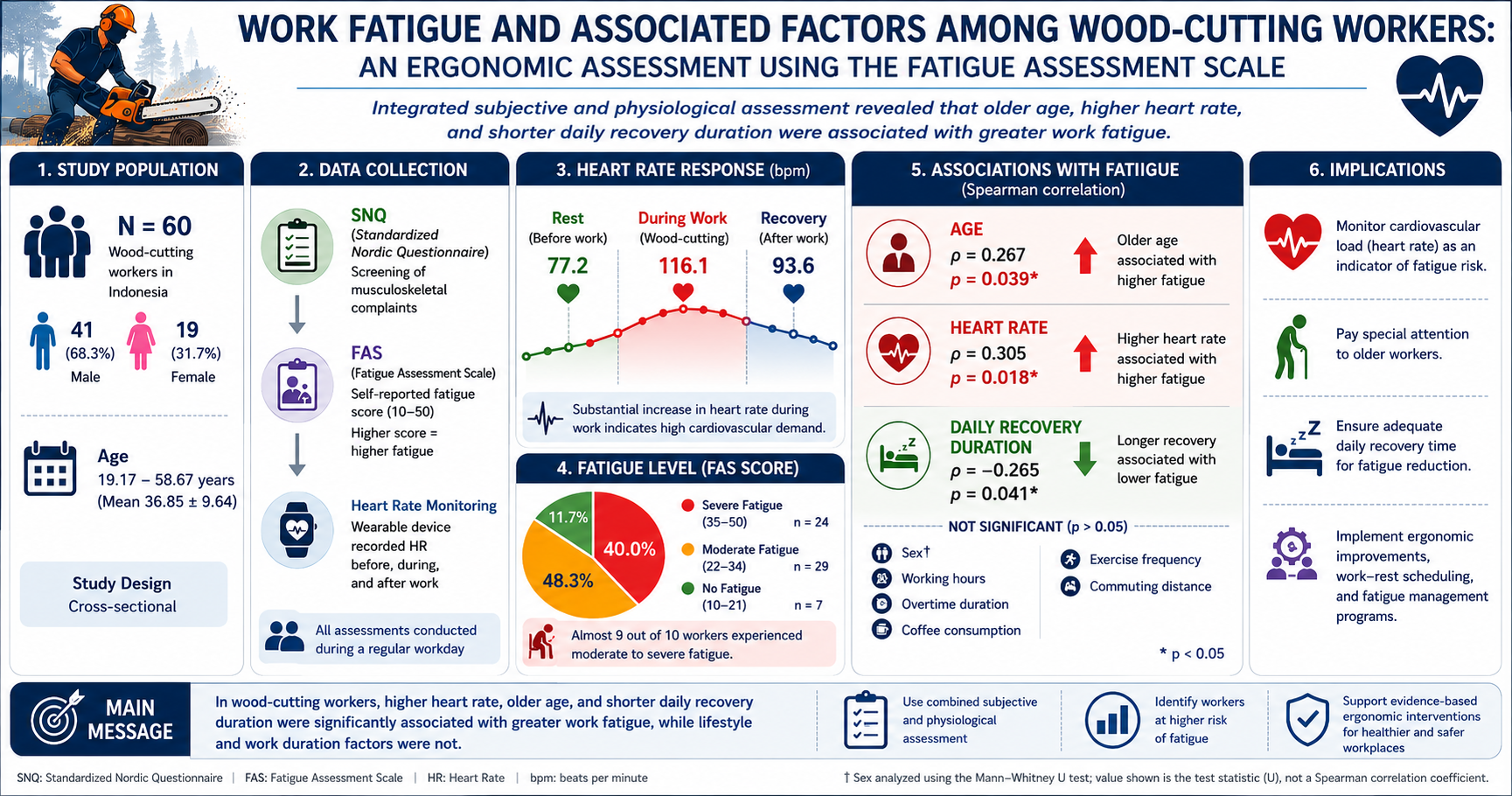
Work fatigue is a common occupational health problem in labor-intensive industries, particularly among wood-cutting workers exposed to repetitive physical demands and prolonged standing. However, studies integrating subjective fatigue assessment and physiological monitoring in woodworking settings remain limited. Therefore, this study aimed to examine the relationship between individual characteristics and work fatigue among wood-cutting workers in Indonesia. A total of 60 participants, comprising 41 males and 19 females aged 19.17–58.67 years, were included in this cross-sectional study. Data were collected using the Standardized Nordic Questionnaire (SNQ) to screen for musculoskeletal complaints; the Fatigue Assessment Scale (FAS) was applied to measure fatigue levels; and a wearable heart rate monitor recorded physiological responses before, during, and after work. Spearman correlation analysis examined associations between individual characteristics (age, working hours, daily recovery duration, overtime, coffee consumption, exercise frequency, commuting distance, and heart rate) and fatigue scores. The results showed that 40.00%, 48.33%, and 11.67% of workers experienced severe, moderate, and no fatigue, respectively. Significant correlations were found between fatigue levels and age (ρ = 0.267, p = 0.039), daily recovery duration (ρ = –0.265, p = 0.041), and heart rate (ρ = 0.305, p = 0.018). Heart rate showed the strongest association with fatigue, suggesting that cardiovascular strain may be associated with perceived fatigue during wood-cutting activities. Other variables, including working hours, overtime duration, coffee consumption, exercise frequency, and commuting distance, were not significantly associated with fatigue. These findings indicated that physiological workload, worker age, and insufficient recovery periods were important factors associated with work fatigue among wood-cutting workers. The study supported the use of combined subjective and physiological approaches for ergonomic fatigue assessment and workplace fatigue management.
References
Aitken, B., & MacMahon, C. (2019). Shared demands between cognitive and physical tasks may drive negative effects of fatigue: A focused review. Frontiers in Sports and Active Living, 1, Article 45. https://doi.org/10.3389/fspor.2019.00045
Albulescu, P., Macsinga, I., Rusu, A., Sulea, C., Bodnaru, A., & Tulbure, B. T. (2022). "Give me a break!" A systematic review and meta-analysis on the efficacy of micro-breaks for increasing well-being and performance. PLoS One, 17(8), Article e0272460. https://doi.org/10.1371/journal.pone.0272460
Billones, R., Liwang, J. K., Butler, K., Graves, L., & Saligan, L. N. (2021). Dissecting the fatigue experience: A scoping review of fatigue definitions, dimensions, and measures in non-oncologic medical conditions. Brain, Behavior, & Immunity-Health, 15, Article 100266. https://doi.org/10.1016/j.bbih.2021.100266
Coleman Wood, K. A., Lowndes, B. R., Buus, R. J., & Hallbeck, M. S. (2018). Evidence-based intraoperative microbreak activities for reducing musculoskeletal injuries in the operating room. Work, 60(4), 649-659. https://doi.org/10.3233/WOR-182772
Costa, G., & Sartori, S. (2007). Ageing, working hours and work ability. Ergonomics, 50(11), 1914-1930. https://doi.org/10.1080/00140130701676054
Darbandy, M. T., Rostamnezhad, M., Hussain, S., Khosravi, A., Nahavandi, S., & Sani, Z. A. (2020). A new approach to detect the physical fatigue utilizing heart rate signals. Research in Cardiovascular Medicine, 9(1), 23-27. https://doi.org/10.4103/rcm.rcm_8_20
Das, D., Kumar, A., & Sharma, M. (2020). A systematic review of work-related musculoskeletal disorders among handicraft workers. International Journal of Occupational Safety and Ergonomics, 26(1), 55-70. https://doi.org/10.1080/10803548.2018.1458487
Dias, M., Silva, L., Folgado, D., Nunes, M. L., Cepeda, C., Cheetham, M., & Gamboa, H. (2023). Cardiovascular load assessment in the workplace: A systematic review. International Journal of Industrial Ergonomics, 96, Article 103476. https://doi.org/10.1016/j.ergon.2023.103476
Ding, Y., Cao, Y., Duffy, V. G., & Zhang, X. (2020). It is time to have rest: How do break types affect muscular activity and perceived discomfort during prolonged sitting work. Safety and Health at Work, 11(2), 207-214. https://doi.org/10.1016/j.shaw.2020.03.008
Greggi, C., Visconti, V. V., Albanese, M., Gasperini, B., Chiavoghilefu, A., Prezioso, C., ... & Tarantino, U. (2024). Work-related musculoskeletal disorders: A systematic review and meta-analysis. Journal of Clinical Medicine, 13(13), Article 3964. https://doi.org/10.3390/jcm13133964
Horisberger, A., Courvoisier, D., & Ribi, C. (2019). The fatigue assessment scale as a simple and reliable tool in systemic lupus erythematosus: A cross-sectional study. Arthritis Research & Therapy, 21(1), Article 80. https://doi.org/10.1186/s13075-019-1864-4
Kristanto, A., Malkab, A. M. K., Ma’ruf, F., & Bariyah, C. (2025). Analysis of the prevalence and risk factors for malalignment of the lower limbs in rice farmers in Indonesia. Journal of Current Science and Technology, 15(2), Article 96. https://doi.org/10.59796/jcst.V15N2.2025.96
Luger, T., Maher, C. G., Rieger, M. A., & Steinhilber, B. (2019). Work‐break schedules for preventing musculoskeletal symptoms and disorders in healthy workers. Cochrane Database of Systematic Reviews, 7, Article CD012886. https://doi.org/10.1002/14651858.CD012886.pub2
Martinez, K. B., Nazarahari, M., & Rouhani, H. (2023). Breaking the fatigue cycle: Investigating the effect of work-rest schedules on muscle fatigue in material handling jobs. Sensors, 23(24), Article 9670. https://doi.org/10.3390/s23249670
Mehta, R. K. (2016). Integrating physical and cognitive ergonomics. IIE Transactions on Occupational Ergonomics and Human Factors, 4(2-3), 83-87. https://doi.org/10.1080/21577323.2016.1207475
Michielsen, H. J., De Vries, J., & Van Heck, G. L. (2003). Psychometric qualities of a brief self-rated fatigue measure: The fatigue assessment scale. Journal of Psychosomatic Research, 54(4), 345-352. https://doi.org/10.1016/S0022-3999(02)00392-6
Moshawrab, M., Adda, M., Bouzouane, A., Ibrahim, H., & Raad, A. (2022). Smart wearables for the detection of occupational physical fatigue: A literature review. Sensors, 22(19), Article 7472. https://doi.org/10.3390/s22197472
Ni, Z., Sun, F., & Li, Y. (2022). Heart rate variability-based subjective physical fatigue assessment. Sensors, 22(9), Article 3199. https://doi.org/10.3390/s22093199
Nurjaman, N. A. P., Novalesi, Y., Pasaribu, Y. M., & Vidyarini, E. (2025). Musculoskeletal complaints among itinerant tailors in Lenteng Agung, Jakarta. International Journal of Innovation in Enterprise System, 9(2), 91-99. https://doi.org/10.25124/ijies.v9i02.8988
Radwan, A., Barnes, L., DeResh, R., Englund, C., & Gribanoff, S. (2022). Effects of active microbreaks on the physical and mental well-being of office workers: A systematic review. Cogent Engineering, 9(1), Article 2026206. https://doi.org/10.1080/23311916.2022.2026206
Rahman, I. A., Mohamad, N., Rohani, J. M., & Zein, R. M. (2018). The impact of work rest scheduling for prolonged standing activity. Industrial Health, 56(6), 492-499. https://doi.org/10.2486/indhealth.2018-0043
Ramdan, I. M., Duma, K., & Setyowati, D. L. (2019). Reliability and validity test of the Indonesian version of the Nordic Musculoskeletal Questionnaire (NMQ) to Measure Musculoskeletal Disorders (MSD) in traditional women weavers. Global Medical & Health Communication, 7(2), 123-130. https://doi.org/10.29313/gmhc.v7i2.4132
Reimers, A. K., Knapp, G., & Reimers, C. D. (2018). Effects of exercise on the resting heart rate: A systematic review and meta-analysis of interventional studies. Journal of Clinical Medicine, 7(12), Article 503. https://doi.org/10.3390/jcm7120503
Simon, S., Dully, J., Dindorf, C., Bartaguiz, E., Becker, S., & Fröhlich, M. (2024). Impact of fatigue on ergonomic risk scores and foot kinetics: A field study employing inertial and in-shoe plantar pressure measurement devices. Sensors, 24(4), Article 1175. https://doi.org/10.3390/s24041175
Soranso, D. R., Minette, L. J., Marçal, M., Marins, J. C. B., Schettino, S., Lima, R. C. A., & Oliveira, M. (2022). Thermography in ergonomic assessment: A study of wood processing industry workers. PeerJ, 10, Article e13973. https://doi.org/10.7717/peerj.13973
Techera, U., Hallowell, M., Stambaugh, N., & Littlejohn, R. (2016). Causes and consequences of occupational fatigue: Meta-analysis and systems model. Journal of Occupational and Environmental Medicine, 58(10), 961-973. https://doi.org/10.1097/JOM.0000000000000837
Tran, T. T., Taptagaporn, S., Dang, C. V., & Kaewdok, T. (2023). Ergonomic risk factor-related musculoskeletal disorders among wood furniture workers in Binh Duong Province, Vietnam. Asia-Pacific Journal of Science and Technology, 28(6), Article APST-28-06-05. https://doi.org/10.14456/apst.2023.91
Tsao, L., Kim, S., Ma, L., & Nussbaum, M. A. (2021). An exploratory study comparing three work/rest schedules during simulated repetitive precision work. Ergonomics, 64(12), 1579-1594. https://doi.org/10.1080/00140139.2021.1950844
Umer, W., Yu, Y., Antwi-Afari, M. F., Jue, L., Siddiqui, M. K., & Li, H. (2022). Heart rate variability based physical exertion monitoring for manual material handling tasks. International Journal of Industrial Ergonomics, 89, Article 103301. https://doi.org/10.1016/j.ergon.2022.103301
Whitehead, L. (2009). The measurement of fatigue in chronic illness: A systematic review of unidimensional and multidimensional fatigue measures. Journal of Pain and Symptom Management, 37(1), 107-128. https://doi.org/10.1016/j.jpainsymman.2007.08.019
Xing, X., Zhong, B., Luo, H., Rose, T., Li, J., & Antwi-Afari, M. F. (2020). Effects of physical fatigue on the induction of mental fatigue of construction workers: A pilot study based on a neurophysiological approach. Automation in Construction, 120, Article 103381. https://doi.org/10.1016/j.autcon.2020.103381
Xu, S., & Hall, N. G. (2021). Fatigue, personnel scheduling and operations: Review and research opportunities. European Journal of Operational Research, 295(3), 807-822. https://doi.org/10.1016/j.ejor.2021.03.036
Zinoubi, B., Zbidi, S., Vandewalle, H., Chamari, K., & Driss, T. (2018). Relationships between rating of perceived exertion, heart rate and blood lactate during continuous and alternated-intensity cycling exercises. Biology of Sport, 35(1), 29-37. https://doi.org/10.5114/biolsport.2018.70749
Downloads
Published
How to Cite
Issue
Section
Categories
License
Copyright (c) 2026 Journal of Current Science and Technology

This work is licensed under a Creative Commons Attribution-NonCommercial-NoDerivatives 4.0 International License.