Multidrug Resistant Staphylococci from Environments of Sub-District Health Promoting-Hospitals in Chiang Rai, Thailand
DOI:
https://doi.org/10.59796/jcst.V16N4.2026.210Keywords:
antibiotic susceptibility, hospital environments, multidrug resistance, resistance genes, staphylococci, sub-district health promoting-hospitalsAbstract
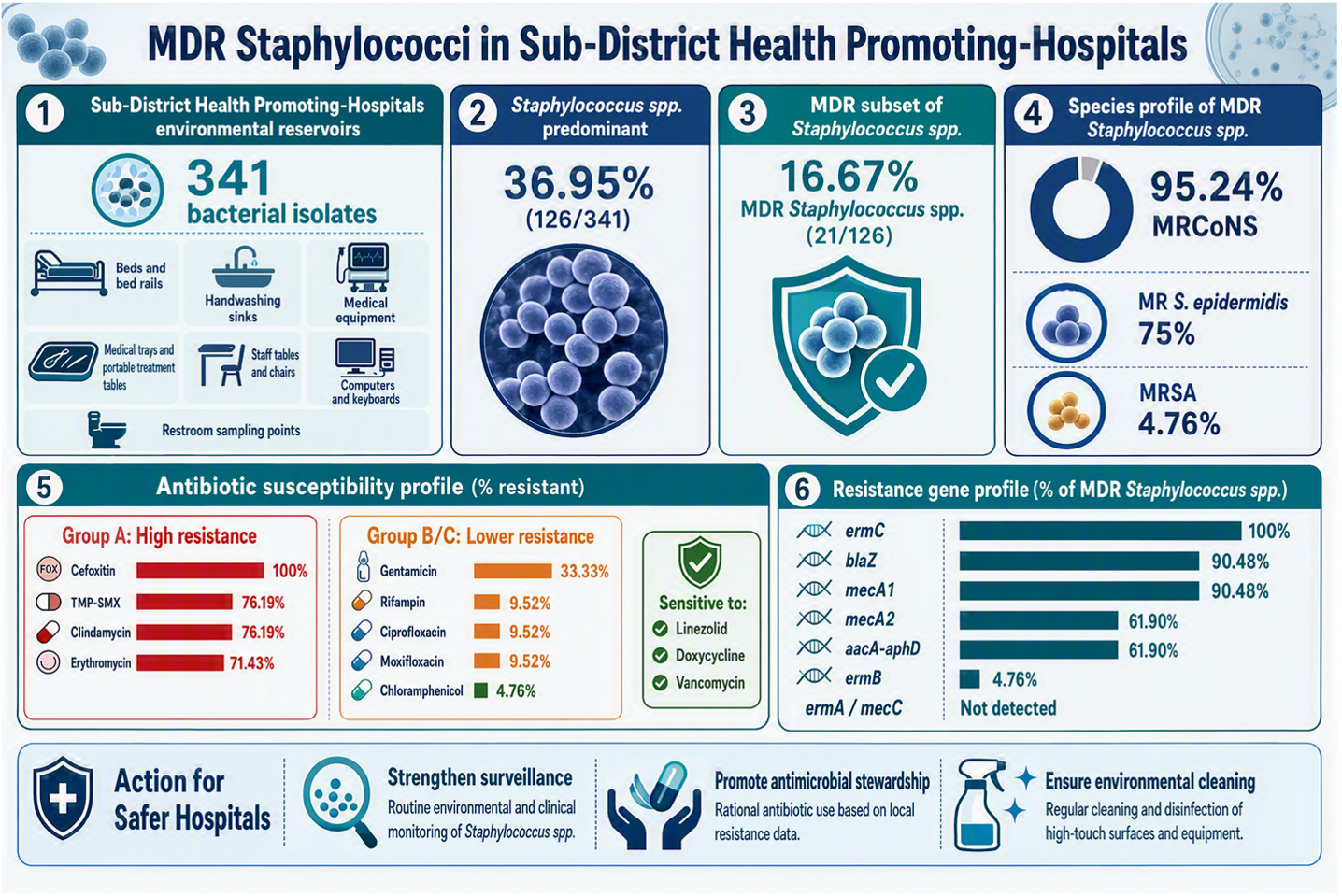
The presence of multidrug resistant (MDR) bacteria in hospital environments poses a major challenge for infection control, given their role as environmental reservoirs. Staphylococcus spp. were the predominant bacteria, accounting for 36.95% of all isolates (126/341), of which 16.67% (21/126) exhibited MDR phenotypes. Accordingly, the present study comprehensively evaluated these 21 MDR isolates to determine their extended antibiotic susceptibility profiles and associated resistance genes. Antibiotic susceptibility was assessed using the disk diffusion method against 12 antibiotics classified into Groups A, B, and C. Polymerase chain reaction was used to detect eight resistance genes: blaZ, mecA1, mecA2, mecC, ermA, ermB, ermC, and aacA-aphD. In group A, all isolates showed resistance to cefoxitin, and high resistance to trimethoprim-sulfamethoxazole, clindamycin (both at 76.19%), and erythromycin (71.43%). The majority (95.24%) of bacteria were methicillin-resistant coagulase-negative staphylococci (MRCoNS), primarily methicillin-resistant Staphylococcus epidermidis (75%) and a small proportion of methicillin-resistant Staphylococcus aureus (4.76%). Most isolates remained sensitive to group B and C antibiotics, such as linezolid, doxycycline, and vancomycin, with limited resistance to rifampin (9.52%), gentamicin (33.33%), ciprofloxacin and moxifloxacin (9.52% each), and chloramphenicol (4.76%). MDR staphylococci isolates showed a high prevalence of diverse resistance genes. Notably, the blaZ and mecA1 genes were common (each found in 90.48% of isolates), whereas ermA and mecC genes were not detected. The ermC gene was present in all isolates while ermB was rare (4.76%). The mecA2 and aacA-aphD genes were detected only in MRCoNS, each occurring in 61.90% of isolates. These findings reveal distinctive local resistance profiles in resource-limited sub-district health promoting-hospitals and underscore the need for continuous surveillance, targeted antimicrobial stewardship, and rigorous environmental cleaning protocols to control MDR staphylococci in these healthcare settings.
References
Águila-Arcos, S., Álvarez-Rodríguez, I., Garaiyurrebaso, O., Garbisu, C., Grohmann, E., & Alkorta, I. (2017). Biofilm-forming clinical Staphylococcus isolates harbor horizontal transfer and antibiotic resistance genes. Frontiers in Microbiology, 8, Article 2018. https://doi.org/10.3389/fmicb.2017.02018
Akter, S., Sabuj, A. A. M., Haque, Z. F., Kafi, M. A., Rahman, M. T., & Saha, S. (2020). Detection of antibiotic-resistant bacteria and their resistance genes from houseflies. Veterinary World, 13(2), 266–274. https://doi.org/10.14202/vetworld.2020.266-274
Alfeky, A. A. E., Tawfick, M. M., Ashour, M. S., & El-Moghazy, A. N. A. (2022). High prevalence of multi-drug resistant methicillin-resistant Staphylococcus aureus in tertiary Egyptian hospitals. The Journal of Infection in Developing Countries, 16(05), 795-806. https://doi.org/10.3855/jidc.15833
Ballhausen, B., Kriegeskorte, A., Schleimer, N., Peters, G., & Becker, K. (2014). The mecA homolog mecC confers resistance against β-lactams in Staphylococcus aureus irrespective of the genetic strain background. Antimicrobial Agents and Chemotherapy, 58(7), 3791-3798. https://doi.org/10.1128/aac.02731-13
Bauer, A. W., Kirby, W. M., Sherris, J. C., & Turck, M. (1966). Antibiotic susceptibility testing by a standardized single disk method. American Journal of Clinical Pathology, 45(4_ts), 493-496. https://doi.org/10.1093/ajcp/45.4_ts.493
Boonsilp, S., Sikora, J., Rupprom, K., Acılıoğlu, S., Homkaew, A., Nutalai, D., ... & Wongsuk, T. (2023). Molecular characterization and antibiotic resistance of Staphylococcus aureus isolated from clinical specimens in an urban university hospital in Bangkok, Thailand. Acta Microbiologica et Immunologica Hungarica, 70(1), 61-72. https://doi.org/10.1556/030.2023.01942
Bouphan, P., Apipalakul, C., & Ngang, T. K. (2015). Factors affecting public health performance evaluation of sub-district health promoting hospital directors. Procedia-Social and Behavioral Sciences, 185, 128-132. https://doi.org/10.1016/j.sbspro.2015.03.421
Broekema, N. M., Van, T. T., Monson, T. A., Marshall, S. A., & Warshauer, D. M. (2009). Comparison of cefoxitin and oxacillin disk diffusion methods for detection of mecA-mediated resistance in Staphylococcus aureus in a large-scale study. Journal of Clinical Microbiology, 47(1), 217-219. https://doi.org/10.1128/jcm.01506-08
Chansareewittaya, K., & Krajangcharoensakul, S. (2021). Existence of bacterial contamination on inanimate surfaces and equipment in sub-district health-promoting hospitals in Chiang Rai, Thailand. Journal of Current Science and Technology, 11(3), 355-366. https://doi.org/10.14456/jcst.2021.36
Chansareewittaya, K., & Krajangcharoensakul, S. (2022). The occurrence of antibiotic resistant bacteria contamination in sub-district health-promoting hospitals in Chiang Rai, Thailand. Journal of Health Science and Medical Research, 40(4), 459-473. https://doi.org/10.31584/jhsmr.2021857
Chaoui, L., Mhand, R., Mellouki, F., & Rhallabi, N. (2019). Contamination of the Surfaces of a Health Care Environment by Multidrug‐Resistant (MDR) Bacteria. International Journal of Microbiology, 2019(1), Article 3236526. https://doi.org/10.1155/2019/3236526
Charles, A. J., Majigo, M., Makupa, J. E., Kibwana, U., Mwazyunga, Z., Mwandigha, A. M., ... & Joachim, A. (2024). Occurrence of virulence genes icaADBC and antibiotic resistance genes blaZ, mecA, and aac (6’)-Ie-aph (2’’)-Ia in coagulase-negative staphylococci isolates from neonates with sepsis at a regional referral hospital in Dar es Salaam, Tanzania. Bulletin of the National Research Centre, 48(1), Article 115. https://doi.org/10.1186/s42269-024-01271-6
Chikkaraddi, U., Nandihal, N. W., & Smitha, N. R. (2022). Clinico-bacteriological profile and antibiogram of Staphylococcus epidermidis with special emphasis on Methicillin resistance and hospital acquired infections in a tertiary care center south India. Indian Journal of Microbiology Research, 9(1), 34-40. https://doi.org/10.18231/j.ijmr.2022.006
Chopjitt, P., Tangthong, P., Kongkaem, J., Wonkyai, P., Charoenwattanamaneechai, A., Khankhum, S., ... & Sunthamala, N. (2025). Molecular characterization and genotype of multi-drug resistant Staphylococcus epidermidis in nasal carriage of young population, Mahasarakham, Thailand. Biomolecules and Biomedicine, 25(2), 461–471. https://doi.org/10.17305/bb.2024.11116
Clinical and Laboratory Standards Institute (CLSI). (2020). Performance standards for antimicrobial susceptibility testing. (30th ed.). CLSI supplement M100. Wayne, US: Clinical and Laboratory Standards Institute.
Contractor, S. S., Kulkarni, R. D., & Arakera, S. B. (2025). Prevalence, antibiotic susceptibility pattern and the detection of mecA gene among Staphylococcus spp. isolates from a tertiary care hospital in North Karnataka. Indian Journal of Microbiology, 65(2), 1019-1027. https://doi.org/10.1007/s12088-024-01403-6
Côrtes, M. F., André, C., Martins Simões, P., Corvec, S., Caillon, J., Tristan, A., ... & Laurent, F. (2022). Persistence of a multidrug-resistant worldwide-disseminated methicillin-resistant Staphylococcus epidermidis clone harbouring the cfr linezolid resistance gene in a French hospital with evidence of interspecies transfer to several Staphylococcus aureus lineages. Journal of Antimicrobial Chemotherapy, 77(7), 1838-1846. https://doi.org/10.1093/jac/dkac119
Deekshit, V. K., & Srikumar, S. (2022). ‘To be, or not to be’-The dilemma of ‘silent’antimicrobial resistance genes in bacteria. Journal of Applied Microbiology, 133(5), 2902-2914. https://doi.org/10.1111/jam.15738
Domingues, C. P. F., Rebelo, J. S., Dionisio, F., & Nogueira, T. (2026). Clinical and environmental plasmids: Antibiotic resistance, virulence, mobility, and ESKAPEE pathogens. Antibiotics, 15(1), Article 29. https://doi.org/10.3390/antibiotics15010029
Facciolà, A., Pellicano, G. F., Visalli, G., Paolucci, I. A., Venanzi Rullo, E., Ceccarelli, M., ... & La Fauci, V. (2019). The role of the hospital environment in the healthcare-associated infections: A general review of the literature. European Review for Medical & Pharmacological Sciences, 23(3), 1266-1278. https://doi.org/10.26355/eurrev_201902_17020
Fasihi, Y., Saffari, F., Kandehkar Ghahraman, M. R., & Kalantar-Neyestanaki, D. (2017). Molecular detection of macrolide and lincosamide-resistance genes in clinical methicillin-resistant Staphylococcus aureus isolates from Kerman, Iran. Archives of Pediatric Infectious Diseases, 5(1), Article e37761. https://doi.org/10.5812/pedinfect.37761
Firesbhat, A., Tigabu, A., Tegene, B., & Gelaw, B. (2021). Bacterial profile of high-touch surfaces, leftover drugs and antiseptics together with their antimicrobial susceptibility patterns at University of Gondar Comprehensive Specialized Hospital, Northwest Ethiopia. BMC Microbiology, 21(1), Article 309. https://doi.org/10.1186/s12866-021-02378-w
Gan, T., Shu, G., Fu, H., Yan, Q., Zhang, W., Tang, H., ... & Lin, J. (2021). Antimicrobial resistance and genotyping of Staphylococcus aureus obtained from food animals in Sichuan Province, China. BMC Veterinary Research, 17(1), Article 177. https://doi.org/10.1186/s12917-021-02884-z
Kime, L., Randall, C. P., Banda, F. I., Coll, F., Wright, J., Richardson, J., ... & O’Neill, A. J. (2019). Transient silencing of antibiotic resistance by mutation represents a significant potential source of unanticipated therapeutic failure. MBio, 10(5), Article e01755-19. https://doi.org/10.1128/mbio.01755-19
Kitreerawutiwong, N., Jordan, S., & Hughes, D. (2017). Facility type and primary care performance in sub-district health promotion hospitals in Northern Thailand. PLoS One, 12(3), Article e0174055. https://doi.org/10.1371/journal.pone.0174055
Lade, H., & Kim, J. S. (2023). Molecular determinants of β-lactam resistance in methicillin-resistant Staphylococcus aureus (MRSA): An updated review. Antibiotics, 12(9), Article 1362. https://doi.org/10.3390/antibiotics12091362
Ledwoch, K., Dancer, S. J., Otter, J. A., Kerr, K., Roposte, D., Rushton, L., ... & Maillard, J. Y. (2018). Beware biofilm! Dry biofilms containing bacterial pathogens on multiple healthcare surfaces; A multi-centre study. Journal of Hospital Infection, 100(3), e47-e56. https://doi.org/10.1016/j.jhin.2018.06.028
Ledwoch, K., Dancer, S. J., Otter, J. A., Kerr, K., Roposte, D., & Maillard, J. Y. (2021). How dirty is your QWERTY? The risk of healthcare pathogen transmission from computer keyboards. Journal of Hospital Infection, 112, 31-36. https://doi.org/10.1016/j.jhin.2021.02.021
Loncaric, I., Kuebber-Heiss, A., Posautz, A., Ruppitsch, W., Lepuschitz, S., Schauer, B., ... & Spergser, J. (2019). Characterization of mecC gene-carrying coagulase-negative Staphylococcus spp. isolated from various animals. Veterinary Microbiology, 230, 138-144. https://doi.org/10.1016/j.vetmic.2019.02.014
Mahdi Al-Buhilal, J. A., Saad, M., & AL-Rubaey, N. K. F. (2021). Molecular detection of ermA, ermB and ermC genes among methicillin resistant Staphylococcus aureus isolated from patients with ocular infections. Biochemical & Cellular Archives, 21, 1443-1448. https://connectjournals.com/03896.2021.21.1443
Mazloumi, M. J., Akbari, R., & Yousefi, S. (2021). Detection of inducible clindamycin resistance genes (ermA, ermB, and ermC) in Staphylococcus aureus and Staphylococcus epidermidis. Microbiology and Biotechnology Letters, 49(3), 449-457. https://doi.org/10.48022/mbl.2103.03011
Miklasińska-Majdanik, M. (2021). Mechanisms of resistance to macrolide antibiotics among Staphylococcus aureus. Antibiotics, 10(11), Article 1406. https://doi.org/10.3390/antibiotics10111406
Mustafa, H. A., & Ali, S. M. (2025). Prevalence and molecular characterization of methicillin-resistant Staphylococcus aureus (MRSA) in acute and chronic sinusitis. Molecular Biology Reports, 52(1), Article 882. https://doi.org/10.1007/s11033-025-10994-2
Otto, M. (2013). Coagulase‐negative staphylococci as reservoirs of genes facilitating MRSA infection: Staphylococcal commensal species such as Staphylococcus epidermidis are being recognized as important sources of genes promoting MRSA colonization and virulence. Bioessays, 35(1), 4-11. https://doi.org/10.1002/bies.201200112
Partridge, S. R., Kwong, S. M., Firth, N., & Jensen, S. O. (2018). Mobile genetic elements associated with antimicrobial resistance. Clinical Microbiology Reviews, 31(4), Article e00088-17. https://doi.org/10.1128/cmr.00088-17
Perumal, N., Murugesan, S., & Krishnan, P. (2016). Distribution of genes encoding aminoglycoside-modifying enzymes among clinical isolates of methicillin-resistant staphylococci. Indian Journal of Medical Microbiology, 34(3), 350-352. https://doi.org/10.4103/0255-0857.188339
Pietrocola, G., Campoccia, D., Motta, C., Montanaro, L., Arciola, C. R., & Speziale, P. (2022). Colonization and infection of indwelling medical devices by Staphylococcus aureus with an emphasis on orthopedic implants. International Journal of Molecular Sciences, 23(11), Article 5958. https://doi.org/10.3390/ijms23115958
Prommachote, W., Deeudom, M., Koonyosying, P., Srichomphoo, P., Somnabut, R., Khamnoi, P., ... & Srichairatanakool, S. (2025). Drug susceptibility, siderophore production, and genome analysis of Staphylococcus aureus clinical isolates from a university hospital in Chiang Mai, Thailand. Antibiotics, 14(5), Article 521. https://doi.org/10.3390/antibiotics14050521
Qv, M., Dai, D., Wu, Q., Wang, W., Li, L., & Zhu, L. (2025). Metagenomic insight into the horizontal transfer mechanism of fluoroquinolone antibiotic resistance genes mediated by mobile genetic element in microalgae-bacteria consortia. Journal of Environmental Management, 380, Article 124946. https://doi.org/10.1016/j.jenvman.2025.124946
Rimi, S. S., Ashraf, M. N., Sigma, S. H., Ahammed, M. T., Siddique, M. P., Zinnah, M. A., ... & Islam, M. S. (2024). Biofilm formation, agr typing and antibiotic resistance pattern in methicillin-resistant Staphylococcus aureus isolated from hospital environments. PLoS One, 19(8), Article e0308282. https://doi.org/10.1371/journal.pone.0308282
Rogers, K. L., Fey, P. D., & Rupp, M. E. (2009). Coagulase-negative staphylococcal infections. Infectious Disease Clinics of North America,23(1), 73-98. https://doi.org/10.1016/j.idc.2008.10.001
Rohana, H., Hager-Cohen, A., Azrad, M., & Peretz, A. (2023). Trend of changes in chloramphenicol resistance during the years 2017–2020: A retrospective report from Israel. Antibiotics, 12(2), Article 196. https://doi.org/10.3390/antibiotics12020196
Rybak, B., Werbowy, O., Debowski, K., Plotka, M., & Kocot, A. M. (2025). Coagulase-negative staphylococci determined as blood culture contamination have high virulence characteristic including transfer of antibiotic resistance determinants to Staphylococcus aureus and Escherichia coli. International Journal of Molecular Sciences, 26(9), Article 4424. https://doi.org/10.3390/ijms26094424
Sabzehali, F., Goudarzi, M., Goudarzi, H., & Azimi, H. (2017). Distribution of aminoglycoside resistance genes in coagulase-negative Staphylococci isolated from hospitalized patients. Archives of Pediatric Infectious Diseases, 5(3), Article e57297. http://doi.org/10.5812/pedinfect.57297
Salmanov, A., Shchehlov, D., Artyomenko, V., Svyrydiuk, O., Maliarchuk, R., Bortnik, I., ... & Loskutov, O. (2023). Nosocomial transmission of multi-drug-resistant organisms in Ukrainian hospitals: Results of a multi-centre study (2019–2021). Journal of Hospital Infection, 132, 104-115. https://doi.org/10.1016/j.jhin.2022.12.008
Sassi, A., Basher, N. S., Kirat, H., Meradji, S., Ibrahim, N. A., Idres, T., & Touati, A. (2025). The role of the environment (Water, Air, Soil) in the emergence and dissemination of antimicrobial resistance: A one health perspective. Antibiotics, 14(8), Article 764. https://doi.org/10.3390/antibiotics14080764
Schinas, G., Polyzou, E., Spernovasilis, N., Gogos, C., Dimopoulos, G., & Akinosoglou, K. (2023). Preventing multidrug-resistant bacterial transmission in the intensive care unit with a comprehensive approach: A policymaking manual. Antibiotics, 12(8), Article 1255. https://doi.org/10.3390/antibiotics12081255
Senobar Tahaei, S. A., Stájer, A., Barrak, I., Ostorházi, E., Szabó, D., & Gajdács, M. (2021). Correlation between biofilm-formation and the antibiotic resistant phenotype in Staphylococcus aureus isolates: A laboratory-based study in Hungary and a review of the literature. Infection and Drug Resistance, 14, 1155-1168. https://doi.org/10.2147/IDR.S303992
Socohou, A., Sina, H., Degbey, C., Nanoukon, C., Chabi-Sika, K., Ahouandjinou, H., ... & Baba-Moussa, L. (2020). Antibiotics resistance and biofilm formation capacity of Staphylococcus spp. strains isolated from surfaces and medicotechnical materials. International Journal of Microbiology, 2020(1), Article 6512106. https://doi.org/10.1155/2020/6512106
Thai National Institute of Health, Department of Medical Sciences, Thailand Ministry of Public Health. (2014). Laboratory manual for bacteriology laboratories at regional and general hospitals (1st ed.). Bankok, Thailand: Thana Press.
Tribuddharat, C., Pummangura, C., Srifuengfung, M., Pipobwatthana, P., Thuncharoon, H., Rodjun, V., ... & Srifuengfung, S. (2022). Prevalence and antimicrobial susceptibility of methicillinresistant Staphylococcus aureus clones: A study at Taksin Hospital, Bangkok, Thailand. ScienceAsia, 48, 159-164. http://doi.org/10.2306/scienceasia1513-1874.2022.022
Waitayangkoon, P., Thongkam, A., Benjamungkalarak, T., Rachayon, M., Thongthaisin, A., Chatsuwan, T., ... & Chiewchengchol, D. (2020). Hospital epidemiology and antimicrobial susceptibility of isolated methicillin-resistant Staphylococcus aureus: A one-year retrospective study at a tertiary care center in Thailand. Pathogens and Global Health, 114(4), 212-217. https://doi.org/10.1080/20477724.2020.1755550
Wassanarungroj, P., Nobthai, P., Ruekit, S., Srijan, A., Sukhchat, P., Serichantalergs, O., ... & Lertsethtakarn, P. (2025). Molecular characterization of clinical isolates of methicillin-resistant Staphylococcus aureus from Chonburi, Thailand. Pathogens, 14(5), Article 406. https://doi.org/10.3390/pathogens14050406
Wolska-Gębarzewska, M., Międzobrodzki, J., & Kosecka-Strojek, M. (2024). Current types of staphylococcal cassette chromosome mec (SCC mec) in clinically relevant coagulase-negative staphylococcal (CoNS) species. Critical Reviews in MiCrobiology, 50(6), 1020-1036. https://doi.org/10.1080/1040841X.2023.2274841
Downloads
Published
How to Cite
License
Copyright (c) 2026 Journal of Current Science and Technology

This work is licensed under a Creative Commons Attribution-NonCommercial-NoDerivatives 4.0 International License.