Utilization of Waste Silicone Sealant and Aluminium Scraps as Additives in Fly Ash–Based Geopolymer for Lightweight Construction Blocks
DOI:
https://doi.org/10.59796/jcst.V16N4.2026.209Keywords:
geopolymer, fly ash, lightweight materials, aluminium scraps, silicone sealant, post-consumer recyclingAbstract
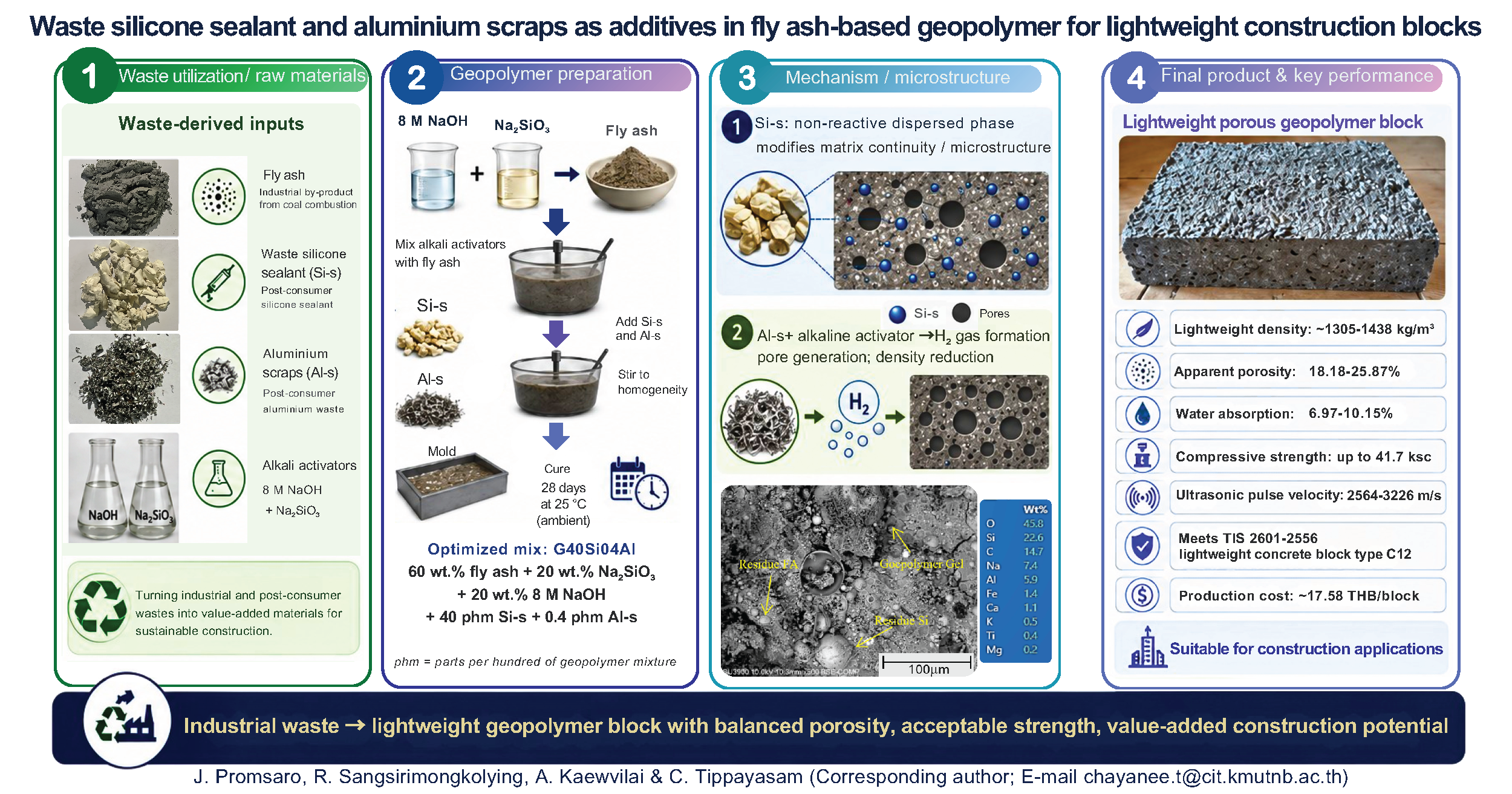
This study presents a pathway for using waste silicone sealant (Si-s) and aluminium scraps (Al-s) to produce lightweight geopolymer materials. Fly ash, sodium hydroxide, and sodium silicate were used as the starting materials for geopolymerization. Ground Si-s and Al-s were added to the mixtures, which were then cured for 28 days under ambient conditions (25°C). The structural composition and morphology were analyzed using Fourier-transform infrared spectroscopy (FTIR), X-ray diffraction (XRD), and scanning electron microscopy equipped with energy-dispersive X-ray spectroscopy (SEM–EDS). The results showed that Si-s acted as a dispersed additive in the geopolymer matrix and affected the reaction, possibly because its acidity neutralized the alkaline solution. It also increased the crystallite size to 51.68 nm, compared with 20.25 nm for the control geopolymer. The addition of Al-s produced a porous structure and reduced the crystallite size to 14.94 nm because it reacted with the alkaline solution, generating an exothermic reaction and hydrogen gas. The physical and mechanical properties, including density, apparent porosity, water absorption, compressive strength, and ultrasonic pulse velocity, were evaluated. The proportions of Al-s and Si-s were expressed as parts per hundred mixtures (phm), with the mixture comprising fly ash, NaOH, and Na₂SiO₃ used in the geopolymerization process. The addition of 0.4–0.6 phm Al-s and 40 phm Si-s resulted in geopolymers with densities of 1,292–1,438 kg/m³, apparent porosities of 18.18%–25.87%, and water absorption values of 6.97%–10.15%. The compressive strength ranged from 13.25 to 41.91 ksc, depending on the Si-s content. These geopolymers exhibited physical properties and compressive strengths that complied with the requirements for Type C12 lightweight concrete blocks specified in Thai Industrial Standard TIS 2601-2556. Therefore, waste Si-s and Al-s can be effectively recycled to produce lightweight geopolymer materials with properties suitable for construction applications.
References
Abdollahnejad, Z., Pacheco-Torgal, F., Félix, T., Tahri, W., & Aguiar, J. B. (2015). Mix design, properties and cost analysis of fly ash-based geopolymer foam. Construction and Building Materials, 80, 18-30. https://doi.org/10.1016/j.conbuildmat.2015.01.063
Aliabdo, A. A., Abd Elmoaty, M., & Salem, H. A. (2016). Effect of water addition, plasticizer and alkaline solution constitution on fly ash based geopolymer concrete performance. Construction and Building Materials, 121, 694-703. https://doi.org/10.1016/j.conbuildmat.2016.06.062
Allen, K. W., Hutchinson, A. R., & Pagliuca, A. (1994). A study of the curing of sealants used in building construction. International Journal of Adhesion and Adhesives, 14(2), 117-122. https://doi.org/10.1016/0143-7496(94)90006-X
Amran, Y. M., Alyousef, R., Alabduljabbar, H., & El-Zeadani, M. (2020). Clean production and properties of geopolymer concrete; A review. Journal of Cleaner Production, 251, Article 119679. https://doi.org/10.1016/j.jclepro.2019.119679
Bajare, D., Korjakins, A., & Kazjonovs, J. (2011). Application of aluminium dross and glass waste for production of expanded clay aggregate [Conference presentation]. Civil Engineering’11 The 3rd International Scientific Conference Proceedings. Jelgava, Latvia.
Barbarey, M. S., Seleman, M. M. E. S., El Kheshen, A. A., & Zawrah, M. F. (2024). Utilization of ladle furnace slag for fabrication of geopolymer: Its application as catalyst for biodiesel production. Construction and Building Materials, 411, Article 134226. https://doi.org/10.1016/j.conbuildmat.2023.134226
Bazarkhankyzy, A., Aibuldinov, Y., Iskakova, Z., Kurpińska, M., Abdelgader, H. S., Avudaiappan, S., ... & Murali, G. (2026). Influence of coir and flax fiber lengths on fracture toughness of fly ash, slag, and silica fume-based geopolymer concrete. Scientific Reports, 16(1), Article 5596. https://doi.org/10.1038/s41598-026-35731-y
Behera, A., Pratap, B., Kumar, P., Rout, M. D., & Sembeta, R. Y. (2025). Prediction of rapid chloride permeability using silica fume, fly ash, GGBS and micro fibers based geopolymer concrete. Scientific Reports, 16(1), Article 959. https://doi.org/10.1038/s41598-025-30430-6
Bekturganova, N. Y., & Kolesnikova, I. V. (2025). Effect of polymer additives on improvement of concrete properties. Advances in Polymer Technology, 2025(1), Article 6235216. https://doi.org/10.1155/adv/6235216
Bogas, J. A., Gomes, M. G., & Gomes, A. (2013). Compressive strength evaluation of structural lightweight concrete by non-destructive ultrasonic pulse velocity method. Ultrasonics, 53(5), 962-972. https://doi.org/10.1016/j.ultras.2012.12.012
Chaichawalit, A., Kaewvilai, A., & Nilsonthi, T. (2026). TIG-cladding of carbon steel reinforced with carbide particles: Microstructural characteristics and wear resistance evaluation. Welding in the World, 70(2), 387-405. https://doi.org/10.1007/s40194-025-02190-4
Chindaprasirt, P., & Rattanasak, U. (2017). Characterization of the high-calcium fly ash geopolymer mortar with hot-weather curing systems for sustainable application. Advanced Powder Technology, 28(9), 2317-2324. https://doi.org/10.1016/j.apt.2017.06.013
Chokkha, S., Ayawanna, J., Poowancum, A., Singlaem, T., & Mitsomwang, P. (2024). Fabrication of porous geopolymers utilizing aluminum wastes as foaming agent. Journal of Metals, Materials and Minerals, 34(2), Article 1966. https://doi.org/10.55713/jmmm.v34i2.1966
Coleman, E. A. (2011). 23 - plastics additives. applied plastics engineering handbook (pp.419-428). New York, US: William Andrew. https://doi.org/10.1016/B978-1-4377-3514-7.10023-6
De Buyl, F. (2001). Silicone sealants and structural adhesives. International Journal of Adhesion and Adhesives, 21(5), 411-422. https://doi.org/10.1016/S0143-7496(01)00018-5
Delihowski, J., & Izak, P. (2026). Rheological characterisation of clay-cement sealing suspensions with fractionated coal fly ashes. Scientific Reports, 16(1), Article 2856. https://doi.org/10.1038/s41598-025-30793-w
Engelmann, M., Giese-Hinz, J., & Tasche, S. (2026). Short-fiber-reinforced structural silicone for facades: Potential & performance. International Journal of Adhesion and Adhesives, 147, Article 104220. https://doi.org/10.1016/j.ijadhadh.2025.104220
Freidin, C. (2007). Cementless pressed blocks from waste products of coal-firing power station. Construction and Building Materials, 21(1), 12-18. https://doi.org/10.1016/j.conbuildmat.2005.08.002
Gou, Y., Xu, C., Liu, L., Cai, H., Li, J., Zhang, Q., ... & Li, Y. (2026). One-step recovery of high-purity aluminum from waste AlSi alloy via pulsed ultrasound-promoted electrolysis in ionic liquids with low energy consumption. Separation and Purification Technology, 391, Article 137071. https://doi.org/10.1016/j.seppur.2026.137071
Hou, D., Luo, C., Du, Z., Li, X., Wu, F., & Zhang, L. (2026). Calcium-based pellets prepared by coal fly ash and cement Co-supporting method for CO2 capture. Fuel, 412, Article 138185. https://doi.org/10.1016/j.fuel.2025.138185
Kaewvilai, A., Kittisayarm, P., Thaweechai, T., Heness, G., Leonelli, C., Chaysuwan, D., & Tippayasam, C. (2025). Heat-resistant geopolymer derived from metakaolin–fly ash blend with bagasse ash addition: An innovative curved backing for steel pipe welding. Journal of the Australian Ceramic Society. https://doi.org/10.1007/s41779-025-01334-5
Kaki, A., Velpula, M., Madathil, N., Kumar, K. U., Kisannagar, R. R., Jung, I., & Rajaboina, R. K. (2026). Upcycling expired silicone sealants into high‐performance triboelectric nanogenerators for sustainable energy harvesting and smart infrastructure safety systems. Energy Technology, 14(2), Article e202502152. https://doi.org/10.1002/ente.202502152
Keawpapasson, P., Tippayasam, C., Ruangjan, S., Thavorniti, P., Panyathanmaporn, T., Fontaine, A., ... & Chaysuwan, D. (2014). Metakaolin-based porous geopolymer with aluminium powder. Key Engineering Materials, 608, 132-138. https://doi.org/10.4028/www.scientific.net/KEM.608.132
Kittisayarm, P., Tippayasam, C., Kaewvilai, A., Thongma, K., Leonelli, C., Thanachayanont, C., ... & Chaysuwan, D. (2026). Performance of refractoriness geopolymer with alumina additive for ceramic weld backing applications. Next Materials, 11, Article 101926. https://doi.org/10.1016/j.nxmate.2026.101926
Kittisayarm, P., Tippayasam, C., Leonelli, C., Thanachayanont, C., Wannagon, A., Heness, G., & Chaysuwan, D. (2024). Effective function of activated bagasse ash for high early strength geopolymer. Journal of the Australian Ceramic Society, 60(4), 1071-1083. https://doi.org/10.1007/s41779-024-01008-8
Komnitsas, K., & Zaharaki, D. (2007). Geopolymerisation: A review and prospects for the minerals industry. Minerals Engineering, 20(14), 1261-1277. https://doi.org/10.1016/j.mineng.2007.07.011
Koushki, P., Kwok, T. H., Hof, L., & Wuthrich, R. (2020). Reinforcing silicone with hemp fiber for additive manufacturing. Composites Science and Technology, 194, Article 108139. https://doi.org/10.1016/j.compscitech.2020.108139
Kujawa, W., Tarach, I., Olewnik-Kruszkowska, E., & Rudawska, A. (2022). Effect of polymer additives on the microstructure and mechanical properties of self-leveling rubberised concrete. Materials, 15(1), Article 249. https://doi.org/10.3390/ma15010249
Makul, N., Fediuk, R., Amran, M., Al-Akwaa, M. S., Pralat, K., Nemova, D., ... & Sulman, M. (2021). Utilization of biomass to ash: An overview of the potential resources for alternative energy. Materials, 14(21), Article 6482. https://doi.org/10.3390/ma14216482
Mandal, A. K., Verma, H. R., & Sinha, O. P. (2017). Utilization of aluminum plant's waste for production of insulation bricks. Journal of Cleaner Production, 162, 949-957. https://doi.org/10.1016/j.jclepro.2017.06.080
Masoule, M. S. T., Bahrami, N., Karimzadeh, M., Mohasanati, B., Shoaei, P., Ameri, F., & Ozbakkaloglu, T. (2022). Lightweight geopolymer concrete: A critical review on the feasibility, mixture design, durability properties, and microstructure. Ceramics International, 48(8), 10347-10371. https://doi.org/10.1016/j.ceramint.2022.01.298
Mihailova, I., Uzunov, I., & Mehandjiev, D. (2021). Waste copper slag/aluminium dross-based geopolymer. Journal of Chemical Technology and Metallurgy, 56(3), 653-659.
Palomas, J., Siripongsakul, T., Tippayasam, C., Pattanaphiboon, N., Thaweechai, T., & Kaewvilai, A. (2026). Flux-Cored Arc welding with immediate post-heating of hardfacing Fe-Cr-C alloy welded on structural steel. Journal of Materials Engineering and Performance, 35(11), 10797-10815. https://doi.org/10.1007/s11665-025-12445-2
Parthiban, K., & Mohan, K. S. R. (2017). Influence of recycled concrete aggregates on the engineering and durability properties of alkali activated slag concrete. Construction and Building Materials, 133, 65-72. https://doi.org/10.1016/j.conbuildmat.2016.12.050
Plaichum, S., Kaewvilai, A., Pantongsuk, T., Chaysuwan, D., & Tippayasam, C. (2020). A novel ceramic backing strip from metakaolin-based geopolymer with gas flow holes for welding application. Key Engineering Materials, 856, 309-316. https://doi.org/10.4028/www.scientific.net/KEM.856.309
Posi, P., Teerachanwit, C., Tanutong, C., Limkamoltip, S., Lertnimoolchai, S., Sata, V., & Chindaprasirt, P. (2013). Lightweight geopolymer concrete containing aggregate from recycle lightweight block. Materials & Design (1980-2015), 52, 580-586. https://doi.org/10.1016/j.matdes.2013.06.001
Promsaro, J., Sangsirimongkolying, R., Kaewvilai, A., & Tippayasam, C. (2023). Study on the property of lightweight geopolymer produced from fly ash mixed aluminium foil scrap [Conference presentation]. The Conference of Industrial Engineering Network (IE NETWORK 2023). Chonburi Thailand. https://eng.src.ku.ac.th/ienet2023/proceedings.html
Puksisuwan, P., Laoratanakul, P., & Cherdhirunkorn, B. (2017). Utilization of aluminium dross as a main raw material for synthesis of geopolymer. Journal of Metals, Materials and Minerals, 27(2), 35-42.
Rattanasak, U., & Chindaprasirt, P. (2009). Influence of NaOH solution on the synthesis of fly ash geopolymer. Minerals Engineering, 22(12), 1073-1078. https://doi.org/10.1016/j.mineng.2009.03.022
Rattanasak, U., Pankhet, K., & Chindaprasirt, P. (2011). Effect of chemical admixtures on properties of high-calcium fly ash geopolymer. International Journal of Minerals, Metallurgy, and Materials, 18(3), 364-369. https://doi.org/10.1007/s12613-011-0448-3
Sangngern, S., Sahasithiwat, S., Kaewvilai, A., Koonsaeng, N., & Laobuthee, A. (2011). Preparation of chemical vapor sensing materials from composites of esterified poly (vinyl alcohol) and carbon black. Sensors and Actuators B: Chemical, 156(2), 961-968. https://doi.org/10.1016/j.snb.2011.03.014
Thai Industrial Standards Institute. (2013). Industrial product standards for aerated lightweight concrete blocks. In TIS 2601-2556 (pp. 1–9). Ministry of Industry, Thailand. [in thai]. Retrieved from https://www.tisi.go.th/data/service/tisistandard/2601-2556.pdf
Thaweechai, T., & Kaewvilai, A. (2019). Benzoxazine grafted poly (γ-glutamic acid) functional material: Synthesis, characterization and photophysical properties. Materials Chemistry and Physics, 227, 117-122. https://doi.org/10.1016/j.matchemphys.2019.01.069
Thonglor, T., & Charoeythornkhajhornchai, P. (2022). Recycle ability of post-consumer recycled plastic (PCR) from the chlorine tank. Trends in Sciences, 19(8), Article 3459. https://doi.org/10.48048/tis.2022.3459
Tippayasam, C., & Kaewvilai, A. (2020). Steel-reinforced polyethylene pipe: Extrusion welding, investigation, and mechanical testing. Welding Journal, 99(2), 52s-58s. https://doi.org/10.29391/2020.99.005
Tippayasam, C., Boonsalee, S., Sajjavanich, S., Ponzoni, C., Kamseu, E., & Chaysuwan, D. (2010). Geopolymer development by powders of metakaolin and wastes in Thailand. Advances in Science and Technology, 69, 63-68. https://doi.org/10.4028/www.scientific.net/AST.69.63
Tippayasam, C., Sutikulsombat, S., Paramee, J., Leonelli, C., & Chaysuwan, D. (2018). Development of geopolymer mortar from metakaolin blended with agricultural and industrial wastes. Key Engineering Materials, 766, 305-310. https://doi.org/10.4028/www.scientific.net/KEM.766.305
Yoshimura, H. N., Abreu, A. P., Molisani, A. L., De Camargo, A. C., Portela, J. C. S., & Narita, N. E. (2008). Evaluation of aluminum dross waste as raw material for refractories. Ceramics International, 34(3), 581-591. https://doi.org/10.1016/j.ceramint.2006.12.007
Downloads
Published
How to Cite
Issue
Section
Categories
License
Copyright (c) 2026 Journal of Current Science and Technology

This work is licensed under a Creative Commons Attribution-NonCommercial-NoDerivatives 4.0 International License.