Computational Design Optimization of Internal Ramp Geometry in Side-Port Embryo Transfer Catheters to Minimize Fluid Recirculation and Shear Stress
DOI:
https://doi.org/10.59796/jcst.V16N4.2026.218Keywords:
catheter, catheter hydrodynamics, computational fluid dynamics, embryo transfer, in vitro fertilization, wall shear stressAbstract
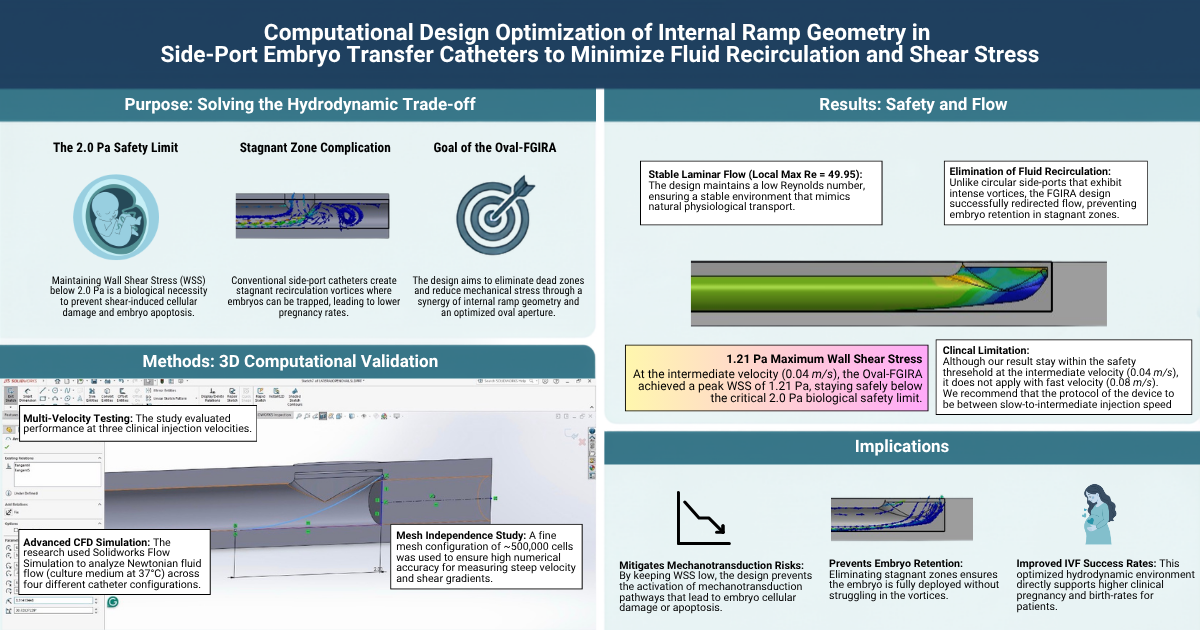
The success of in vitro fertilization (IVF) relies heavily on non-traumatic embryo delivery. While end-opening catheters provide direct flow, they pose a risk of endometrial injury and embryo displacement due to high-velocity jetting, whereas conventional side-port designs minimize trauma but inherently suffer from fluid stagnation and elevated shear stress. This study aims to resolve this critical hydrodynamic trade-off by proposing a novel 'Flow-Guiding Internal Ramp Architecture' (FGIRA) integrated with an oval lateral aperture to eliminate dead zones while maintaining safe, low-velocity expulsion. Three-dimensional computational fluid dynamics (CFD) simulations were conducted using SolidWorks Flow Simulation based on the finite volume method to solve the Navier–Stokes equations. The study modeled the fluid as a Newtonian standard culture medium at 310.15 K, utilizing a mesh refinement strategy optimized for grid independence to comparatively analyze the hydrodynamic performance of four catheter configurations, focusing on velocity distribution, vorticity, and Wall Shear Stress (WSS). The results demonstrated that the Oval-FGIRA design successfully eliminated fluid recirculation and achieved a maximum WSS of 1.21 Pa within the 0.04 m/s injection speed regime. This value falls well within the physiological safety threshold (< 2 Pa), supported by a stable laminar flow regime (Maximum Local Reynolds Number = 49.95). In conclusion, unlike traditional side-port designs that merely redirect flow at the cost of high shear stress, the Oval-FGIRA establishes a breakthrough. By simultaneously eliminating fluid stagnation and dampening mechanical forces, the synergy between the internal ramp and oval aperture creates a superior hydrodynamic environment that minimizes mechanotransduction-induced cellular damage, offering a paradigm shift in catheter geometry to improve clinical pregnancy rates. However, at the injection velocity of 0.08 m/s, maximum wall shear stress exceeded the safety threshold at 2.10 Pa. Consequently, clinical implementation of the Oval-FGIRA is recommended for slow-to-immediate injection protocols.
References
Brown, J., Buckingham, K., Buckett, W., & Abou‐Setta, A. M. (2016). Ultrasound versus' clinical touch' for catheter guidance during embryo transfer in women. Cochrane Database of Systematic Reviews, 3. Article CD006107. https://doi.org/10.1002/14651858.CD006107.pub4
Celik, I. B., Ghia, U., Roache, P. J., & Freitas, C. J. (2008). Procedure for estimation and reporting of uncertainty due to discretization in CFD applications. Journal of Fluids Engineering-Transactions of the ASME, 130(7), Article 078001. https://doi.org/10.1115/1.2960953
D’Angelo, A., Panayotidis, C., Alteri, A., Mcheik, S., & Veleva, Z. (2022). Evidence and consensus on technical aspects of embryo transfer. Human Reproduction Open, 2022(4), Article hoac038. https://doi.org/10.1093/hropen/hoac038
Edwards, R. G., Steptoe, P. C., & Purdy, J. M. (1980). Establishing full‐term human pregnancies using cleaving embryos grown in vitro. BJOG: An International Journal of Obstetrics & Gynaecology, 87(9), 737-756. https://doi.org/10.1111/j.1471-0528.1980.tb04610.x
Espina, J. A., Cordeiro, M. H., Milivojevic, M., Pajić-Lijaković, I., & Barriga, E. H. (2023). Response of cells and tissues to shear stress. Journal of Cell Science, 136(18), Article jcs260985. https://doi.org/10.1242/jcs.260985
Fontes, P. K., Milazzotto, M. P., & Ferraz, M. D. A. M. M. (2025). Mimicking the oviductal fluid viscosity improves the quality of in vitro–produced bovine embryos. Biology of Reproduction, 113(6), 1364-1374. https://doi.org/10.1093/biolre/ioaf202
Grygoruk, C., Mrugacz, G., Kolodziejczyk, M., Gagan, J., Ratomski, K., & Grusza, M. (2013). Shear stress during embryo transfer. Progress in Health Sciences, 3(2), 7-10.
Guerrero-Alvarado, M. D. Á., Tejeda-Alejandre, R., Vázquez-Lepe, E., Plascencia-Martínez, D. F., Castillo-Ortega, M. M., Encinas-Encinas, J. C., & García-López, E. (2026). Micro injection molding parameters impact on thermoplastic polyurethane (TPU)'s mechanical properties. The International Journal of Advanced Manufacturing Technology, 142, 6037–6056. https://doi.org/10.1007/s00170-025-17292-y
IVF Co. (n.d.). Embryo Transfer Catheter. Retrieved from https://ivfco.co/Catalogue/Transteb%20echotip.pdf
Leftwich, M. C., & Baumer, A. C. (2024). The fluid mechanics of female reproduction: A review of the biofluid mechanics of pregnancy and delivery. Annual Review of Fluid Mechanics, 56(1), 171-188. https://doi.org/10.1146/annurev-fluid-121021-033738
Lin, S., He, X., Wang, Y., Chen, Y., & Lin, A. (2024). Emerging role of lncRNAs as mechanical signaling molecules in mechanotransduction and their association with Hippo-YAP signaling: A review. Journal of Zhejiang University-SCIENCE B, 25(4), 280-292. https://doi.org/10.1631/jzus.B2300497
Mains, L., & Van Voorhis, B. J. (2010). Optimizing the technique of embryo transfer. Fertility and Sterility, 94(3), 785-790. https://doi.org/10.1016/j.fertnstert.2010.03.030
Mrugacz, G., Grygoruk, C., Kolodziejczyk, M., Gagan, J., Ratomski, K., & Grusza, M. (2013). Fluid velocity during embryo transfer. Progress in Health Sciences, 3(2), 17-20.
Munson, B. R., Okiishi, T. H., Huebsch, W. W., & Rothmayer, A. P. (2013). Fluid mechanics. Singapore: Wiley.
Nakamura, Y., Kikuchi, F., & Ezaki, K. (2024). Impact of injection speed of embryo transfer on pregnancy rate. Journal of Mammalian Ova Research, 41(2), 87-94.
Owen, D. G., de Oliveira, D. C., Qian, S., Green, N. C., Shepherd, D. E., & Espino, D. M. (2020). Impact of side-hole geometry on the performance of hemodialysis catheter tips: A computational fluid dynamics assessment. PLoS One, 15(8), Article e0236946. https://doi.org/10.1371/journal.pone.0236946
Schoolcraft, W. B., Surrey, E. S., & Gardner, D. K. (2001). Embryo transfer: Techniques and variables affecting success. Fertility and Sterility, 76(5), 863-870. https://doi.org/10.1016/S0015-0282(01)02731-5
Shi, C., Sun, T. C., Meng, S. H., Wang, P., Liang, R., Duan, S. N., Han, H. J., Liu, Y. N., Shen, H., & Chen, X. (2022). Embryo density and its neutrality in day-3 embryo development: A retrospective cohort study. International Journal of Endocrinology, 2022, Article 6368678. https://doi.org/10.1155/2022/6368678
United Nations. (2015). Transforming our world: The 2030 agenda for sustainable development (A/RES/70/1). https://sdgs.un.org/2030agenda
Xu, J., Yin, M. N., Chen, Z. H., Yang, L., Ye, D. S., & Sun, L. (2020). Embryo retention significantly decreases clinical pregnancy rate and live birth rate: A matched retrospective cohort study. Fertility and Sterility, 114(4), 787-791. https://doi.org/10.1016/j.fertnstert.2020.04.043
Yang, Y., Li, Y., Liu, C., Zhou, J., Li, T., Xiong, Y., & Zhang, L. (2022). Hemodynamic analysis of the geometric features of side holes based on GDK catheter. Journal of Functional Biomaterials, 13(4), Article 236. https://doi.org/10.3390/jfb13040236
Downloads
Published
How to Cite
Issue
Section
Categories
License
Copyright (c) 2026 Journal of Current Science and Technology

This work is licensed under a Creative Commons Attribution-NonCommercial-NoDerivatives 4.0 International License.