Carbon-Based Electrodes from Agricultural Waste: Comparison of Textural and Electrical Properties
DOI:
https://doi.org/10.59796/jcst.V16N4.2026.212Keywords:
activated carbon, apricot stone, electric double-layer capacitor, electrical properties, electrodes, palmyra palm, textural propertiesAbstract
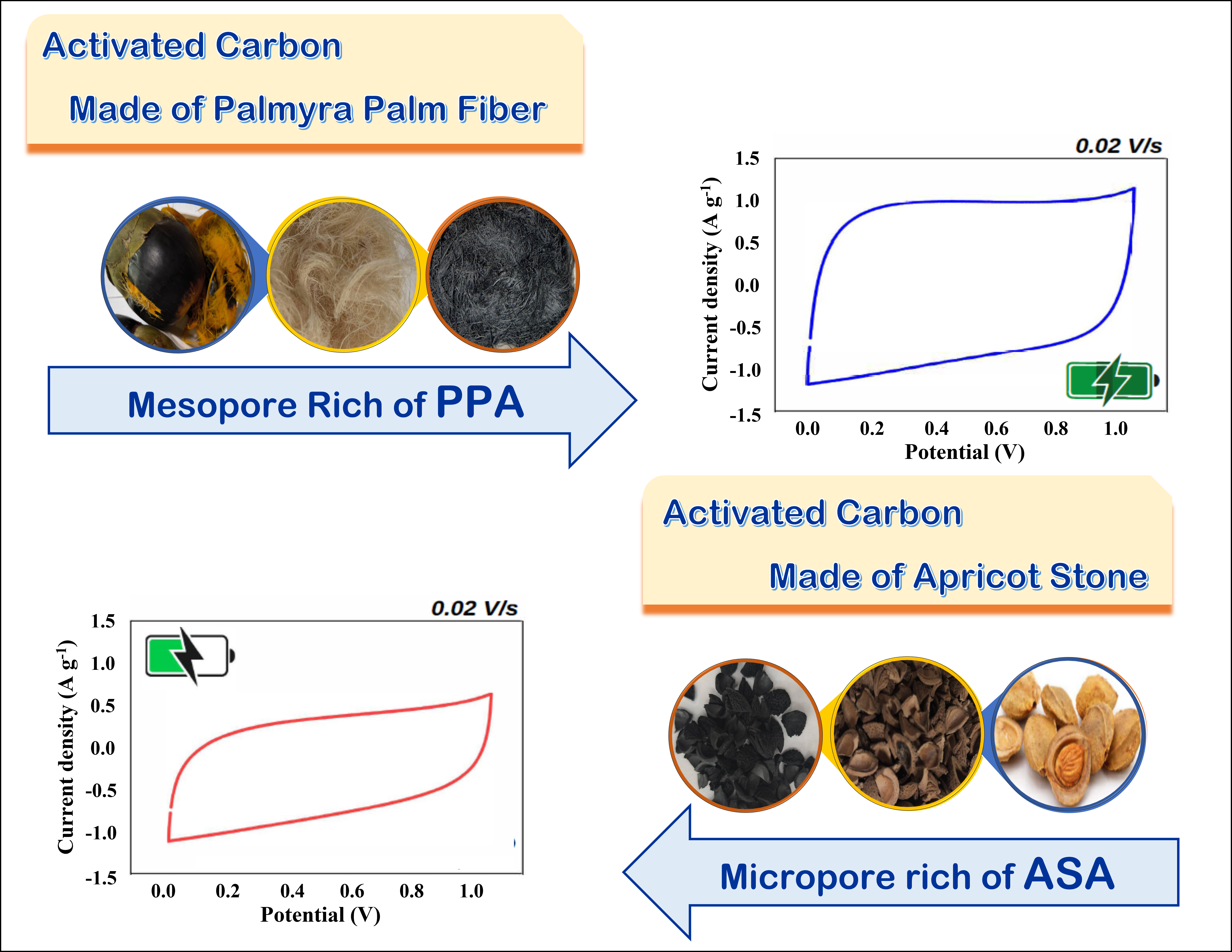
Activated carbon-based electrodes were successfully derived from agri-food residues, namely palmyra palm fibers and apricot stone shells, via activation with potassium hydroxide at 750°C. Palmyra palm fiber activated carbon (PPA) and apricot stone shell activated carbon (ASA) were prepared, while commercial activated carbon (CAC) was used as received. All samples were characterized and electrically evaluated in a comparative study. Characterization results confirmed that ASA and PPA were successfully converted into carbonaceous materials. Scanning electron microscopy revealed a sponge-like porous structure in the PPA sample, whereas one-dimensional channel-like pores were observed in the ASA, and a smooth surface with randomly distributed cracks was observed in the CAC sample. Interestingly, the surface area of the activated carbon electrodes alone did not determine the specific capacitance. Although ASA possessed the highest surface area (1372.9 m2 g⁻1), it exhibited the lowest specific capacitance of 30.5 F g⁻1 at 0.5 A g⁻1. In contrast, PPA demonstrated the lowest surface area (502.5 m2 g⁻1) but delivered the highest specific capacitance of 47.6 F g-1 at the same current density. Textural-electrical performance correlation analysis revealed that mesopore content (2-50 nm) has a greater impact on electrical capacitance than the overall specific surface area. Moreover, all carbon electrodes displayed quasi-rectangular cyclic voltammograms, consistent with the characteristic behavior of EDLCs. The PPA-based electrode exhibited excellent rate capability, retaining approximately 88% of its initial capacitance as the current density increased from 0.5 to 5.0 A g⁻1, indicating its strong potential for practical EDLC applications.
References
Ampong, D. N., Lin, W., de Souza, F. M., Bharti, V. K., Agyemang, F. O., Andrews, A., ... & Gupta, R. K. (2024). Utilization of shea butter waste-derived hierarchical activated carbon for high-performance supercapacitor applications. Bioresource Technology, 406, Article 131039. https://doi.org/10.1016/j.biortech.2024.131039
Brodawka, E., Balys, M. R., & Jagiello, J. (2022). Carbon materials porosity analysis using DFT models for potential application in the recovery of methane from its low-concentration mixtures. Chemical Engineering Journal, 436, Article 135259. https://doi.org/10.1016/j.cej.2022.135259
Byatarayappa, G., Srilakshmi, R., Tejashree, V., Venkatesh, K., Nagaraju, N., & Nagaraju, K. (2023). A comparative study on electrochemical performance of KOH activated carbons derived from different biomass sources-Musa acuminata stem, Pongamia pinnata seed oil extract cake, cajanus cajan stem and Asclepias syriaca floss. Heliyon, 9(4), Article e15399. https://doi.org/10.1016/j.heliyon.2023.e15399
Chaiammart, N., Taechamahaphan, A., Chakartnarodom, P., Prakaypan, W., Ishizaki, T., Eiad-Ua, A., & Panomsuwan, G. (2026). Valorization of macadamia nut shell waste into activated carbons for electrochemical supercapacitor electrodes. ACS Omega, 11(8), 13036–13051. https://doi.org/10.1021/acsomega.5c06396
Chitpreecha, S., Veerasamy, U. S., Punyawudho, K., Chaichana, C., Sekine, C., & Mona, Y. (2026). Effect of chemical activation agents on properties of durian peel-derived activated carbon for high-energy supercapacitor applications. Biomass and Bioenergy, 210, Article 109031. https://doi.org/10.1016/j.biombioe.2026.109031
Dan, N. H., & Le Luu, T. (2026). Excellent energy efficiency and pseudocapacitive adsorption in superior microporous electrodes derived from macadamia seed shells. Journal of Environmental Management, 404, Article 129361. https://doi.org/10.1016/j.jenvman.2026.129361
Das, A., & Sarma, A. K. (2025). Unlocking the potential applications of bamboo, as an energy resource and bamboo-based activated carbon: A comprehensive review. BioEnergy Research, 18(1), Article 77. https://doi.org/10.1007/s12155-025-10874-4
Echaroj, S., Asavatesanupap, C., Keanthong, T., Chanthee, S., Limcharoen, W., Manjai, K., ... & Santikunaporn, M. (2025). Investigation of CO2 adsorption on modified bimetallic activated carbon derived from apricot stones. ACS Omega, 10(10), 10004-10016. https://doi.org/10.1021/acsomega.4c08014
Fasakin, O., Dangbegnon, J. K., Momodu, D. Y., Madito, M. J., Oyedotun, K. O., Eleruja, M. A., & Manyala, N. (2018). Synthesis and characterization of porous carbon derived from activated banana peels with hierarchical porosity for improved electrochemical performance. Electrochimica Acta, 262, 187-196. https://doi.org/10.1016/j.electacta.2018.01.028
Fasakin, O., Oyedotun, K. O., Mirghni, A. A., Sylla, N. F., Mahmoud, B. A., & Manyala, N. (2024). Synthesis and characterization of activated carbon derived from agricultural waste (cocoa pod husks) as potential electrode for symmetric supercapacitor. Materials Today Sustainability, 28, Article 101028. https://doi.org/10.1016/j.mtsust.2024.101028
Gamby, J., Taberna, P. L., Simon, P., Fauvarque, J. F., & Chesneau, M. (2001). Studies and characterisations of various activated carbons used for carbon/carbon supercapacitors. Journal of Power Sources, 101(1), 109-116. https://doi.org/10.1016/S0378-7753(01)00707-8
Gandla, D., Wu, X., Zhang, F., Wu, C., & Tan, D. Q. (2021). High-performance and high-voltage supercapacitors based on N-doped mesoporous activated carbon derived from dragon fruit peels. ACS Omega, 6(11), 7615–7625. https://doi.org/10.1021/acsomega.0c06171
Gong, Z., Guo, Y., Chen, X., Xiao, J., Wang, T., & Chai, B. (2025). Tangerine peel-derived nitrogen doped porous carbon as electrode material for high-performance supercapacitors. International Journal of Electrochemical Science, 20(8), Article 101081. https://doi.org/10.1016/j.ijoes.2025.101081
He, X., Ling, P., Yu, M., Wang, X., Zhang, X., & Zheng, M. (2013). Rice husk-derived porous carbons with high capacitance by ZnCl2 activation for supercapacitors. Electrochimica Acta, 105, 635-641. https://doi.org/10.1016/j.electacta.2013.05.050
Kang, Z., Xu, D., Zhao, L., & Liu, D. (2024). Boosting supercapacitor performance with high-specific surface area porous carbon derived from sugarcane bagasse. Journal of Energy Storage, 104, Article 114718. https://doi.org/10.1016/j.est.2024.114718
Liang, K., Chen, Y., Wang, S., Wang, D., Wang, W., Jia, S., ... & Chen, Z. (2023). Peanut shell waste derived porous carbon for high-performance supercapacitors. Journal of Energy Storage, 70, Article 107947. https://doi.org/10.1016/j.est.2023.107947
Liu, L., Qin, X., & Zhang, R. (2025). Advanced carbon electrodes for supercapacitors: Design strategies, performance optimization, and practical applications. Smart Materials and Devices, 1(2), 202504-202504. https://doi.org/10.70401/smd.2025.0008
Márquez-Montesino, F., Portales-Martínez, B., Martínez-dlCruz, L., Vega-Moreno, J., Velasco-Arias, D., & Lemus-Santana, A. A. (2023). Electrodes with excellent capacitance: Influence of micro-mesoporosity in derived bituminous carbon. Journal of Energy Storage, 73, Article 108934. https://doi.org/10.1016/j.est.2023.108934
Onyilmaz, E., Onal, Y., & Oz, E. (2025). Structural characterization and electrochemical performance of apricot kernel-based activated carbons for supercapacitors. ACS Omega, 10(31), 34254–34265. https://doi.org/10.1021/acsomega.5c00919
Pandolfo, A. G., & Hollenkamp, A. F. (2006). Carbon properties and their role in supercapacitors. Journal of Power Sources, 157(1), 11-27. https://doi.org/10.1016/j.jpowsour.2006.02.065
Phan, T. N., Gong, M. K., Thangavel, R., Lee, Y. S., & Ko, C. H. (2019). Enhanced electrochemical performance for EDLC using ordered mesoporous carbons (CMK-3 and CMK-8): Role of mesopores and mesopore structures. Journal of Alloys and Compounds, 780, 90-97. https://doi.org/10.1016/j.jallcom.2018.11.348
Shiraishi, S., Urita, K., Nishihara, H., & Kondo, T. (2024). Extraordinary capacitance and stability of carbon electrode for electrochemical capacitors. Electrochemistry, 92(7), Article 074001. https://doi.org/10.5796/electrochemistry.24-70036
Song, H., Qu, Q., Yang, Z., Zhang, Y., Qiu, L., Zhao, Y., ... & Yang, X. (2025). Supercapacitor performance of activated carbon from Eucommia Ulmoides Oliver wood optimized by the activation method. ACS Omega, 10(15), 15368–15380. https://doi.org/10.1021/acsomega.4c11529
Sumangala Devi, N., & Vivekanandhan, S. (2024). Effect of carbonization temperatures on the synthesis of biocarbon from Borassus flabellifer fruit fiber for capacitive energy storage. Applied Research, 3(5), Article e202400005. https://doi.org/10.1002/appl.202400005
Sun, L., Gong, Y., Li, D., & Pan, C. (2022). Biomass-derived porous carbon materials: Synthesis, designing, and applications for supercapacitors. Green Chemistry, 24(10), 3864-3894. https://doi.org/10.1039/d2gc00099g
Thommes, M., Kaneko, K., Neimark, A. V., Olivier, J. P., Rodriguez-Reinoso, F., Rouquerol, J., & Sing, K. S. (2015). Physisorption of gases, with special reference to the evaluation of surface area and pore size distribution (IUPAC Technical Report). Pure and Applied Chemistry, 87(9-10), 1051-1069. https://doi.org/10.1515/pac-2014-1117
Torrarit, P., Poompradub, S., Mohammadifar, M., Pattananuwat, P., Jayaraman, T., Jeong, Y., ... & Kasemchainan, J. (2025). Highly porous activated carbon from betel palm shells as the prospective electrode for high-performance supercapacitors. Materials Science for Energy Technologies, 8, 143-153. https://doi.org/10.1016/j.mset.2025.03.001
Verma, S., Padha, B., Mahajan, P., & Arya, S. (2022). Effect of electrolyte on the performance of supercapacitors. Electrochemical Society Transactions, 107(1), 10821-10829. https://doi.org/10.1149/10701.10821ecst
Wang, C., Bai, L., Zhao, F., & Bai, L. (2022). Activated carbon fibers derived from natural cattail fibers for supercapacitors. Carbon Letters, 32(3), 907-915. https://doi.org/10.1007/s42823-022-00329-7
Wang, L., Wu, J., Ma, H., Han, G., Yang, D., Chen, Y., & Zhou, J. (2021). H3PO4-assisted synthesis of apricot shell lignin-based activated carbon for capacitors: Understanding the pore structure/electrochemical performance relationship. Energy & Fuels, 35(9), 8303-8312. https://doi.org/10.1021/acs.energyfuels.1c00169
Yang, I., Kim, S. G., Kwon, S. H., Lee, J. H., Kim, M. S., & Jung, J. C. (2016). Pore size-controlled carbon aerogels for EDLC electrodes in organic electrolytes. Current Applied Physics, 16(6), 665-672. https://doi.org/10.1016/j.cap.2016.03.019
Yang, J., Peng, J., Lei, Y., Tang, Y., Liu, P., Zeng, J., ... & Wang, X. (2024). Activated carbon derived from the agricultural waste camellia seed shell for high-performance supercapacitors. ACS Applied Energy Materials, 7(2), 469-478. https://doi.org/10.1021/acsaem.3c02391
Yu, P., Liang, Y., Dong, H., Hu, H., Liu, S., Peng, L., ... & Liu, Y. (2018). Rational synthesis of highly porous carbon from waste bagasse for advanced supercapacitor application. ACS Sustainable Chemistry & Engineering, 6(11), 15325-15332. https://doi.org/10.1021/acssuschemeng.8b03763
Zhang, J., & Xie, Y. L. (2025). Hierarchical porous hollow of carbon spheres with high surface area for high performance supercapacitor electrode materials. Scientific Reports, 15(1), Article 15125. https://doi.org/10.1038/s41598-025-00043-0
Zhang, L. L., & Zhao, X. S. (2009). Carbon-based materials as supercapacitor electrodes. Chemical Society Reviews, 38(9), 2520-2531. https://doi.org/10.1039/b813846j
Zhao, Y., Mu, J., Wang, Y., Liu, Y., Wang, H., & Song, H. (2023). Preparation of hierarchical porous carbon through one-step KOH activation of coconut shell biomass for high-performance supercapacitor. Journal of Materials Science: Materials in Electronics, 34(6), Article 527. https://doi.org/10.1007/s10854-023-09885-8
Zhu, Z., Jiang, H., Guo, S., Cheng, Q., Hu, Y., & Li, C. (2015). Dual tuning of biomass-derived hierarchical carbon nanostructures for supercapacitors: The role of balanced meso/microporosity and graphene. Scientific Reports, 5(1), Article 15936. https://doi.org/10.1038/srep15936
Zhu, Z., Tang, S., Yuan, J., Qin, X., Deng, Y., Qu, R., & Haarberg, G. M. (2016). Effects of various binders on supercapacitor performances. International Journal of Electrochemical Science, 11(10), 8270-8279. https://doi.org/10.20964/2016.10.04
Downloads
Published
How to Cite
Issue
Section
Categories
License
Copyright (c) 2026 Journal of Current Science and Technology

This work is licensed under a Creative Commons Attribution-NonCommercial-NoDerivatives 4.0 International License.