Prevalence of Myopia and Its Association with Indoor and Outdoor Sport Participation among University Student Athletes in Thailand
DOI:
https://doi.org/10.59796/jcst.V16N3.2026.194Keywords:
myopia prevalence, university athletes, sport vision, indoor sports, outdoor sports, family history, sleep duration, refractive errorAbstract
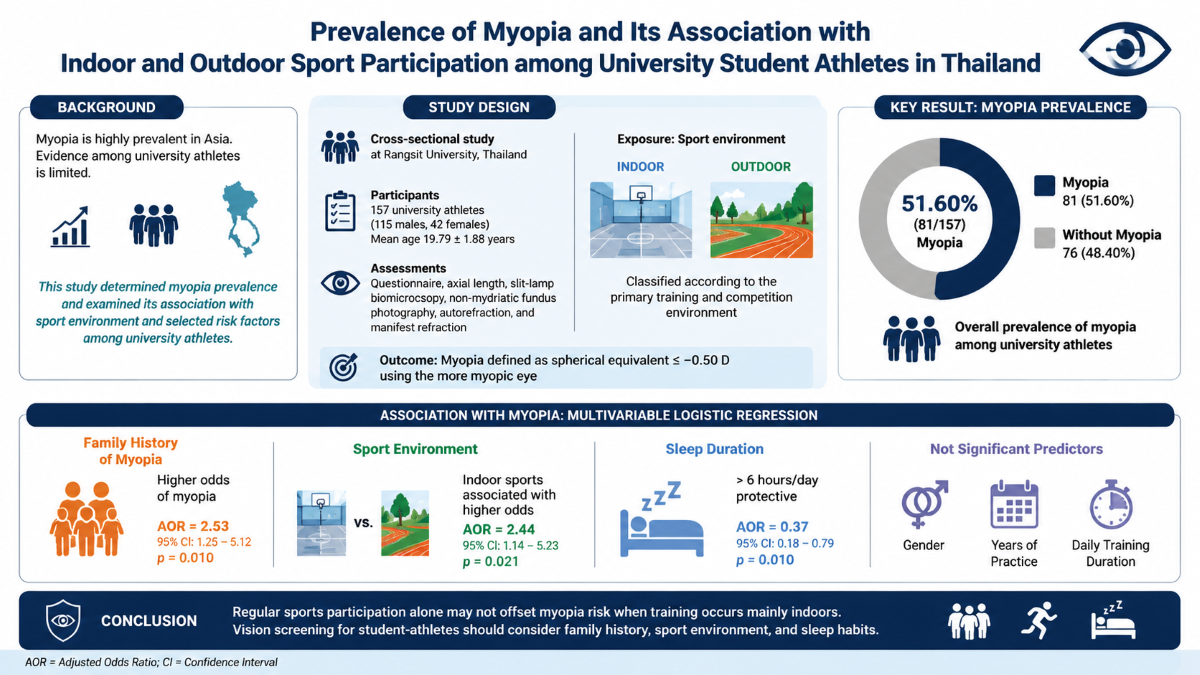
Myopia is a growing public health problem in East and Southeast Asia, but evidence among university athletes remains limited. This cross-sectional study determined the prevalence of myopia among amateur university athletes at Rangsit University, Thailand, and examined associations with sport environment and selected risk factors. A total of 157 athletes (115 males, 42 females; mean age 19.79 ± 1.88 years) completed a demographic questionnaire and underwent axial length measurement, slit-lamp biomicroscopy, non-mydriatic fundus photography, autorefraction, and manifest refraction. Myopia was defined as a spherical equivalent ≤ −0.50 D using the more myopic eye. Sports were classified as indoor or outdoor according to the primary training and competition environment. Multivariable logistic regression was used to assess associations with family history of myopia, sport environment, sleep duration, years of athletic practice, daily training duration, and gender. Overall myopia prevalence was 51.60% (81/157). A positive family history was associated with higher odds of myopia (AOR = 2.53; 95% CI: 1.25–5.12; p = 0.010). After adjustment, indoor sport participation was associated with higher odds compared with outdoor sport participation (AOR = 2.44; 95% CI: 1.14–5.23; p = 0.021). Sleeping >6 hours per day was protective (AOR = 0.37; 95% CI: 0.18–0.79; p = 0.010). Gender, years of practice, and daily training duration were not significant predictors. These findings suggest that regular sports participation alone may not offset myopia risk when training occurs mainly indoors. Vision screening for student-athletes should consider family history, sport environment, and sleep habits.
References
Ayaki, M., Torii, H., Tsubota, K., & Negishi, K. (2016). Decreased sleep quality in high myopia children. Scientific Reports, 6(1), Article 33902. https://doi.org/10.1038/srep33902
Buscemi, A., Mondelli, F., Biagini, I., Gueli, S., D’Agostino, A., & Coco, M. (2024). Role of sport vision in performance: Systematic review. Journal of Functional Morphology and Kinesiology, 9(2), Article 92. https://doi.org/10.3390/jfmk9020092
Chakraborty, R., Ostrin, L. A., Nickla, D. L., Iuvone, P. M., Pardue, M. T., & Stone, R. A. (2018). Circadian rhythms, refractive development, and myopia. Ophthalmic and Physiological Optics, 38(3), 217-245. https://doi.org/10.1111/opo.12453
Czepita, D., Żejmo, M., & Mojsa, A. (2007). Prevalence of myopia and hyperopia in a population of Polish schoolchildren. Ophthalmic and Physiological Optics, 27(1), 60-65. https://doi.org/10.1111/j.1475-1313.2006.00419.x
Czepita, M., Czepita, D., & Lubiński, W. (2017). The influence of environmental factors on the prevalence of myopia in Poland. Journal of Ophthalmology, 2017(1), Article 5983406. https://doi.org/10.1155/2017/5983406
Dirani, M., Tong, L., Gazzard, G., Zhang, X., Chia, A., Young, T. L., ... & Saw, S. M. (2009). Outdoor activity and myopia in Singapore teenage children. British Journal of Ophthalmology, 93(8), 997-1000. https://doi.org/10.1136/bjo.2008.150979
Flitcroft, D. I., He, M., Jonas, J. B., Jong, M., Naidoo, K., Ohno-Matsui, K., ... & Yannuzzi, L. (2019). IMI defining and classifying myopia: A proposed set of standards for clinical and epidemiologic studies. Investigative Ophthalmology & Visual Science, 60(3), M20-M30. https://doi.org/10.1167/iovs.18-25957
Goh, P. P., Abqariyah, Y., Pokharel, G. P., & Ellwein, L. B. (2005). Refractive error and visual impairment in school-age children in Gombak District, Malaysia. Ophthalmology, 112(4), 678-685. https://doi.org/10.1016/j.ophtha.2004.10.048
Ha, A., Lee, Y. J., Lee, M., Shim, S. R., & Kim, Y. K. (2025). Digital screen time and myopia: a systematic review and dose-response meta-analysis. JAMA Network Open, 8(2), Article e2460026. https://doi.org/10.1001/jamanetworkopen.2024.60026
Hammond, C. J., Snieder, H., Gilbert, C. E., & Spector, T. D. (2001). Genes and environment in refractive error: The twin eye study. Investigative Ophthalmology & Visual Science, 42(6), 1232-1236.
He, M., Xiang, F., Zeng, Y., Mai, J., Chen, Q., Zhang, J., ... & Morgan, I. G. (2015). Effect of time spent outdoors at school on the development of myopia among children in China: A randomized clinical trial. JAMA, 314(11), 1142-1148. https://doi.org/10.1001/jama.2015.10803
Hirshkowitz, M., Whiton, K., Albert, S. M., Alessi, C., Bruni, O., DonCarlos, L., ... & Hillard, P. J. A. (2015). National Sleep Foundation’s sleep time duration recommendations: Methodology and results summary. Sleep Health, 1(1), 40-43. https://doi.org/10.1016/j.sleh.2014.12.010
Holden, B. A., Fricke, T. R., Wilson, D. A., Jong, M., Naidoo, K. S., Sankaridurg, P., ... & Resnikoff, S. (2016). Global prevalence of myopia and high myopia and temporal trends from 2000 through 2050. Ophthalmology, 123(5), 1036-1042. https://doi.org/10.1016/j.ophtha.2016.01.006
Jacobs, D. S., Afshari, N. A., Bishop, R. J., Keenan, J. D., Lee, J., Shen, T. T., Vitale, S., & American Academy of Ophthalmology Preferred Practice Pattern Refractive Management/Intervention Panel. (2023). Refractive errors preferred practice pattern®. Ophthalmology, 130(3), P1-P60. https://doi.org/10.1016/j.ophtha.2022.10.031
Jaradaroonchay, M., Parsuraphun, P., Vincent, J., & Jenchitr, W. (2024). Refractive error of the elderly presenting to a University Eye Clinic. Journal of Current Science and Technology, 14(2), Article 39. https://doi.org/10.59796/jcst.V14N2.2024.39
Jee, D., Morgan, I. G., & Kim, E. C. (2016). Inverse relationship between sleep duration and myopia. Acta Ophthalmologica, 94(3), e204-e210. https://doi.org/10.1111/aos.12776
Jenchitr, W., & Jaradaroonchay, M. (2021). The relationship of refractive error and glaucoma in a University Eye Clinic. Journal of Current Science and Technology, 11(3), 432-441. https://doi.org/10.14456/jcst.2022.2
Jin, E., Lee, C. E., Li, H., Tham, Y. C., & Chen, D. Z. (2024). Association between sleep and myopia in children and adolescents: A systematic review and meta-analysis. Graefe's Archive for Clinical and Experimental Ophthalmology, 262(7), 2027-2038. https://doi.org/10.1007/s00417-023-06338-0
Jones, L. A., Sinnott, L. T., Mutti, D. O., Mitchell, G. L., Moeschberger, M. L., & Zadnik, K. (2007). Parental history of myopia, sports and outdoor activities, and future myopia. Investigative Ophthalmology & Visual Science, 48(8), 3524-3532. https://doi.org/10.1167/iovs.06-1118
Lanca, C., Teo, A., Vivagandan, A., Htoon, H. M., Najjar, R. P., Spiegel, D. P., ... & Saw, S. M. (2019). The effects of different outdoor environments, sunglasses and hats on light levels: Implications for myopia prevention. Translational Vision Science & Technology, 8(4), Article 7. https://doi.org/10.1167/tvst.8.4.7
Liang, J., Pu, Y., Chen, J., Liu, M., Ouyang, B., Jin, Z., ... & Chen, Y. (2025). Global prevalence, trend and projection of myopia in children and adolescents from 1990 to 2050: A comprehensive systematic review and meta-analysis. British Journal of Ophthalmology, 109(3), 362-371. https://doi.org/10.1136/bjo-2024-325427
Limwattanayingyong, J., Amornpetchsathaporn, A., Chainakul, M., Grzybowski, A., & Ruamviboonsuk, P. (2022). The association between environmental and social factors and myopia: A review of evidence from COVID-19 pandemic. Frontiers in Public Health, 10, Article 918182. https://doi.org/10.3389/fpubh.2022.918182
Mann, D. T., Williams, A. M., Ward, P., & Janelle, C. M. (2007). Perceptual-cognitive expertise in sport: A meta-analysis. Journal of Sport and Exercise Psychology, 29(4), 457-478. https://doi.org/10.1123/jsep.29.4.457
Morgan, I. G. (2024). Is there an impending epidemic of myopia in Southeast Asia? An appraisal of the evidence. Asia-Pacific Journal of Ophthalmology, 13(6), Article 100113. https://doi.org/10.1016/j.apjo.2024.100113
Morgan, I. G., Wu, P. C., Ostrin, L. A., Tideman, J. W. L., Yam, J. C., Lan, W., ... & Guggenheim, J. A. (2021). IMI risk factors for myopia. Investigative Ophthalmology & Visual Science, 62(5), Article 3. https://doi.org/10.1167/iovs.62.5.3
Muralidharan, A. R., Lança, C., Biswas, S., Barathi, V. A., Wan Yu Shermaine, L., Seang-Mei, S., ... & Najjar, R. P. (2021). Light and myopia: From epidemiological studies to neurobiological mechanisms. Therapeutic Advances in Ophthalmology, 13, 1-45. https://doi.org/10.1177/25158414211059246
Nickla, D. L., & Wallman, J. (2010). The multifunctional choroid. Progress in Retinal and Eye Research, 29(2), 144-168. https://doi.org/10.1016/j.preteyeres.2009.12.002
Paudel, P., Ramson, P., Naduvilath, T., Wilson, D., Phuong, H. T., Ho, S. M., & Giap, N. V. (2014). Prevalence of vision impairment and refractive error in school children in Ba Ria–Vung Tau province, Vietnam. Clinical & Experimental Ophthalmology, 42(3), 217-226. https://doi.org/10.1111/ceo.12273
Poovichayasumlit, C., & Khewnoparatana, A. (2024). Prevalence of myopia and pseudomyopia and their risk factors in medical and nursing students at Navamindradhiraj University. Journal of the Medical Association of Thailand, 107(12), 994-1001. https://doi.org/10.35755/jmedassocthai.2024.12.994-1001-01054
Rose, K. A., Morgan, I. G., Ip, J., Kifley, A., Huynh, S., Smith, W., & Mitchell, P. (2008). Outdoor activity reduces the prevalence of myopia in children. Ophthalmology, 115(8), 1279-1285. https://doi.org/10.1016/j.ophtha.2007.12.019
Tedja, M. S., Haarman, A. E., Meester-Smoor, M. A., Kaprio, J., Mackey, D. A., Guggenheim, J. A., ... & CREAM Consortium. (2019). IMI–myopia genetics report. Investigative Ophthalmology & Visual Science, 60(3), M89-M105. https://doi.org/10.1167/Iovs.18-25965
Wu, H. M., Seet, B., Yap, E. P. H., Saw, S. M., Lim, T. H., & Chia, K. S. (2001). Does education explain ethnic differences in myopia prevalence? A population-based study of young adult males in Singapore. Optometry and Vision Science, 78(4), 234-239. https://doi.org/10.1002/j.1538-9235.2001.tb01245.x
Wu, P. C., Tsai, C. L., Hu, C. H., & Yang, Y. H. (2010). Effects of outdoor activities on myopia among rural school children in Taiwan. Ophthalmic Epidemiology, 17(5), 338-342. https://doi.org/10.3109/09286586.2010.508347
Xiong, S., Sankaridurg, P., Naduvilath, T., Zang, J., Zou, H., Zhu, J., ... & Xu, X. (2017). Time spent in outdoor activities in relation to myopia prevention and control: A meta‐analysis and systematic review. Acta Ophthalmologica, 95(6), 551-566. https://doi.org/10.1111/aos.13403
Zeri, F., Pitzalis, S., Di Vizio, A., Ruffinatto, T., Egizi, F., Di Russo, F., ... & Naroo, S. A. (2018). Refractive error and vision correction in a general sports‐playing population. Clinical and Experimental Optometry, 101(2), 225-236. https://doi.org/10.1111/cxo.12626
Zhang, M., Sun, Z., Zhu, X., Zhang, H., Zhu, Y., & Yan, H. (2022). Sports and myopia: An investigation on the prevalence and risk factors of myopia in young sports-related groups in Tianjin, China. Investigative Ophthalmology & Visual Science, 63(6), Article 27. https://doi.org/10.1167/iovs.63.6.27
Zhang, N., Han, G., & Hao, R. (2026). The role of circadian rhythms in the pathogenesis of myopia. Frontiers in Physiology, 17, Article 1797489. https://doi.org/10.3389/fphys.2026.1797489
Zhou, X., Pardue, M. T., Iuvone, P. M., & Qu, J. (2017). Dopamine signaling and myopia development: What are the key challenges. Progress in Retinal and Eye Research, 61, 60-71. https://doi.org/10.1016/j.preteyeres.2017.06.003
Zimmerman, A. B., Lust, K. L., & Bullimore, M. A. (2011). Visual acuity and contrast sensitivity testing for sports vision. Eye & Contact Lens, 37(3), 153-159. https://doi.org/10.1097/ICL.0b013e31820d12f4
Downloads
Published
How to Cite
License
Copyright (c) 2026 Journal of Current Science and Technology

This work is licensed under a Creative Commons Attribution-NonCommercial-NoDerivatives 4.0 International License.