DDoS Detection Framework Using Machine Learning Optimized by Bayesian and PSO Techniques
DOI:
https://doi.org/10.59796/jcst.V16N3.2026.204Keywords:
DDoS detection framework, feature selection, hyperparameter optimization, machine learning, XGBoostAbstract
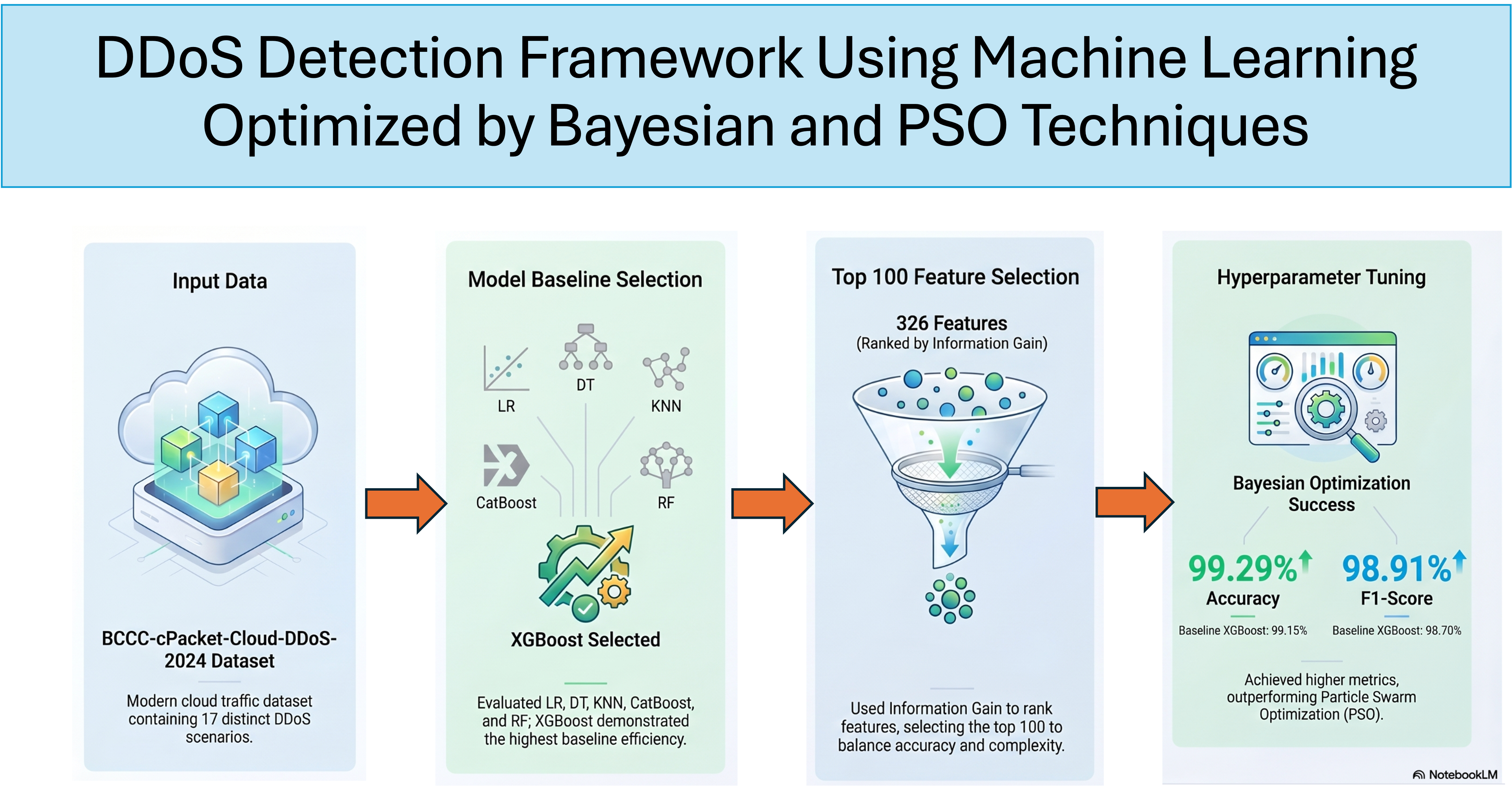
This paper presents a distributed denial of service (DDoS) detection framework using machine learning techniques enhanced with hyperparameter optimization for network traffic classification and evaluated on the BCCC-cPacket-Cloud-DDoS-2024 dataset. The framework includes data preprocessing with normalization and class imbalance handling via the synthetic minority over-sampling technique. A critical contribution of this study is the rigorous analysis of the trade-off between detection accuracy and model complexity. Unlike arbitrary feature selection methods, we empirically determined the optimal feature set using information gain, identifying that the top 100 features represent the saturation point that balances high accuracy with minimal overhead. Model performance was further improved through hyperparameter optimization using particle swarm optimization and Bayesian algorithms. The extreme gradient boosting (XGBoost) model optimized using Bayesian optimization and the top 100 features achieved the highest performance, with an accuracy of 99.29% and an F1-score of 98.91%. As a result, the proposed framework improves detection performance while reducing model complexity by selecting an optimal feature set to improve model stability and efficiency.
References
Ahmad, I., Imran, M., Qayyum, A., Ramzan, M. S., & Alassafi, M. O. (2023). An optimized hybrid deep intrusion detection model (HD-IDM) for enhancing network security. Mathematics, 11(21), Article 4501. https://doi.org/10.3390/math11214501
Al-Shareeda, M. A., Manickam, S., & Saare, M. A. (2023). DDoS attacks detection using machine learning and deep learning techniques: analysis and comparison. Bulletin of Electrical Engineering and Informatics, 12(2), 930-939. https://doi.org/10.11591/eei.v12i2.4466
Awan, M. J., Farooq, U., Babar, H. M. A., Yasin, A., Nobanee, H., Hussain, M., ... & Zain, A. M. (2021). Real-time DDoS attack detection system using big data approach. Sustainability, 13(19), Article 10743. https://doi.org/10.3390/su131910743
Becerra-Suarez, F. L., Fernández-Roman, I., & Forero, M. G. (2024). Improvement of distributed denial of service attack detection through machine learning and data processing. Mathematics, 12(9), Article 1294. https://doi.org/10.3390/math12091294
Bhattacharya, S., S, S. R. K., Maddikunta, P. K. R., Kaluri, R., Singh, S., Gadekallu, T. R., Alazab, M., & Tariq, U. (2020). A novel PCA-firefly based XGBoost classification model for intrusion detection in networks using GPU. Electronics, 9(2), Article 219. https://doi.org/10.3390/electronics9020219
Breiman, L. (2001). Random forests. Machine Learning, 45(1), 5-32. https://doi.org/10.1023/A:1010933404324
Breiman, L., Friedman, J., Olshen, R. A., & Stone, C. J. (2017). Classification and regression trees. New York, US: Chapman and Hall/CRC. https://doi.org/10.1201/9781315139470
Chawla, N. V., Bowyer, K. W., Hall, L. O., & Kegelmeyer, W. P. (2002). SMOTE: Synthetic minority over-sampling technique. Journal of Artificial Intelligence Research, 16, 321-357. https://doi.org/10.1613/jair.953
Chen, S. R., Chen, S. J., & Hsieh, W. B. (2025). Enhancing machine learning-based DDoS detection through hyperparameter optimization. Electronics, 14(16), Article 3319. https://doi.org/10.3390/electronics14163319
Chen, T., & Guestrin, C. (2016). Xgboost: A scalable tree boosting system [Conference presentation]. Proceedings of the 22nd ACM Sigkdd International Conference on Knowledge Discovery and Data Mining, New York, US. https://doi.org/10.1145/2939672.2939785
Cil, A. E., Yildiz, K., & Buldu, A. (2021). Detection of DDoS attacks with feed forward based deep neural network model. Expert Systems with Applications, 169, Article 114520. https://doi.org/10.1016/j.eswa.2020.114520
Cover, T., & Hart, P. (1967). Nearest neighbor pattern classification. IEEE Transactions on Information Theory, 13(1), 21-27. https://doi.org/10.1109/TIT.1967.1053964
Cox, D. R. (1958). The regression analysis of binary sequences. Journal of the Royal Statistical Society Series B: Statistical Methodology, 20(2), 215-232. https://doi.org/10.1111/j.2517-6161.1958.tb00292.x
Dasari, S., & Kaluri, R. (2024). An effective classification of DDoS attacks in a distributed network by adopting hierarchical machine learning and hyperparameters optimization techniques. IEEE Access, 12, 10834-10845. https://doi.org/10.1109/ACCESS.2024.3352281
Indrasiri, P. L., Lee, E., Rupapara, V., Rustam, F., & Ashraf, I. (2022). Malicious traffic detection in IoT and local networks using stacked ensemble classifier. Computers, Materials and Continua, 71(1), 489-515. https://doi.org/10.32604/cmc.2022.019636
Kennedy, J., & Eberhart, R. (1995). Particle swarm optimization [Conference presentation]. Proceedings of ICNN'95-International Conference on Neural Networks, Perth, WA, Australia. https://doi.org/10.1109/ICNN.1995.488968
Liu, Z., Wang, Y., Feng, F., Liu, Y., Li, Z., & Shan, Y. (2023). A DDoS detection method based on feature engineering and machine learning in software-defined networks. Sensors, 23(13), Article 6176. https://doi.org/10.3390/s23136176
Mohmand, M. I., Hussain, H., Khan, A. A., Ullah, U., Zakarya, M., Ahmed, A., ... & Haleem, M. (2022). A machine learning-based classification and prediction technique for DDoS attacks. IEEE Access, 10, 21443-21454. https://doi.org/10.1109/ACCESS.2022.3152577
Krishna, S. G., & Sahu, K. K. (2015). Normalization: A preprocessing stage. International Advanced Research Journal in Science, Engineering and Technology, 2(3), 20–22. https://doi.org/10.17148/IARJSET.2015.2305
Prokhorenkova, L., Gusev, G., Vorobev, A., Dorogush, A. V., & Gulin, A. (2018). CatBoost: Unbiased boosting with categorical features. Advances in Neural Information Processing Systems, 31. https://proceedings.neurips.cc/paper_files/paper/2018/file/14491b756b3a51daac41c24863285549-Paper.pdf
Rai, M., & Mandoria, H. L. (2019). Network Intrusion Detection: A comparative study using state-of-the-art machine learning methods [Conference presentation]. 2019 international conference on issues and challenges in intelligent computing techniques (ICICT). IEEE, Ghaziabad, India. https://doi.org/10.1109/ICICT46931.2019.8977679
Sadhwani, S., Manibalan, B., Muthalagu, R., & Pawar, P. (2023). A lightweight model for DDoS attack detection using machine learning techniques. Applied Sciences, 13(17), Article 9937. https://doi.org/10.3390/app13179937
Saghezchi, F. B., Mantas, G., Violas, M. A., de Oliveira Duarte, A. M., & Rodriguez, J. (2022). Machine learning for DDoS attack detection in industry 4.0 CPPSs. Electronics, 11(4), Article 602. https://doi.org/10.3390/electronics11040602
Saini, P. S., Behal, S., & Bhatia, S. (2020). Detection of DDoS attacks using machine learning algorithms [Conference presentation]. 2020 7th International Conference on Computing for Sustainable Global Development (INDIACom), IEEE, New Delhi, India. https://doi.org/10.23919/INDIACom49435.2020.9083716
Sanchez, O. R., Repetto, M., Carrega, A., & Bolla, R. (2021). Evaluating ML-based DDoS detection with grid search hyperparameter optimization [Conference presentation]. 2021 IEEE 7th International Conference on Network Softwarization (NetSoft), IEEE, Tokyo, Japan. https://doi.org/10.1109/NetSoft51509.2021.9492633
Santos, R., Souza, D., Santo, W., Ribeiro, A., & Moreno, E. (2020). Machine learning algorithms to detect DDoS attacks in SDN. Concurrency and Computation: Practice and Experience, 32(16), Article e5402. https://doi.org/10.1002/cpe.5402
Sathaporn, P., Krungseanmuang, W., Chaowalittawin, V., Benjangkaprasert, C., & Purahong, B. (2025). DDoS detection using a hybrid CNN–RNN model enhanced with multi-head attention for cloud infrastructure. Applied Sciences, 15(21), Article 11567. https://doi.org/10.3390/app152111567
Shafi, M., Lashkari, A. H., Rodriguez, V., & Nevo, R. (2024). Toward generating a new cloud-based distributed denial of service (DDoS) dataset and cloud intrusion traffic characterization. Information, 15(4), Article 195. https://doi.org/10.3390/info15040195
Sharafaldin, I., Lashkari, A. H., & Ghorbani, A. A. (2018). Toward generating a new intrusion detection dataset and intrusion traffic characterization [Conference presentation]. Proceedings of the 4th International Conference on Information Systems Security and Privacy (ICISSP), Madeira, Portugal. https://doi.org/10.5220/0006639801080116
Sharafaldin, I., Lashkari, A. H., Hakak, S., & Ghorbani, A. A. (2019). Developing realistic distributed denial of service (DDoS) attack dataset and taxonomy [Conference presentation]. 2019 international carnahan conference on security technology (ICCST), IEEE, Chennai, India. https://doi.org/10.1109/CCST.2019.8888419
Snoek, J., Larochelle, H., & Adams, R. P. (2012). Practical bayesian optimization of machine learning algorithms. Advances in Neural Information Processing Systems, 25. https://proceedings.neurips.cc/paper_files/paper/2012/hash/05311655a15b75fab86956663e1819cd-Abstract.html
Vinayakumar, R., Alazab, M., Soman, K. P., Poornachandran, P., Al-Nemrat, A., & Venkatraman, S. (2019). Deep learning approach for intelligent intrusion detection system. IEEE Access, 7, 41525-41550. https://doi.org/10.1109/ACCESS.2019.2895334
Yoachimik, O., & Pacheco, J. (2025). Hyper-volumetric DDoS attacks skyrocket: Cloudflare’s 2025 Q2 DDoS threat report. Retrieved from https://blog.cloudflare.com/ddos-threat-report-for-2025-q2/
Downloads
Published
How to Cite
Issue
Section
Categories
License
Copyright (c) 2026 Journal of Current Science and Technology

This work is licensed under a Creative Commons Attribution-NonCommercial-NoDerivatives 4.0 International License.