Relationship between Family Violence and Psychological Stress Among Thai Young People: A Mixed-Methods Study in Pathum Thani Province
DOI:
https://doi.org/10.59796/jcst.V16N3.2026.198Keywords:
family violence, psychological stress, young people, mental health, interparental conflict, mixed-methods researchAbstract
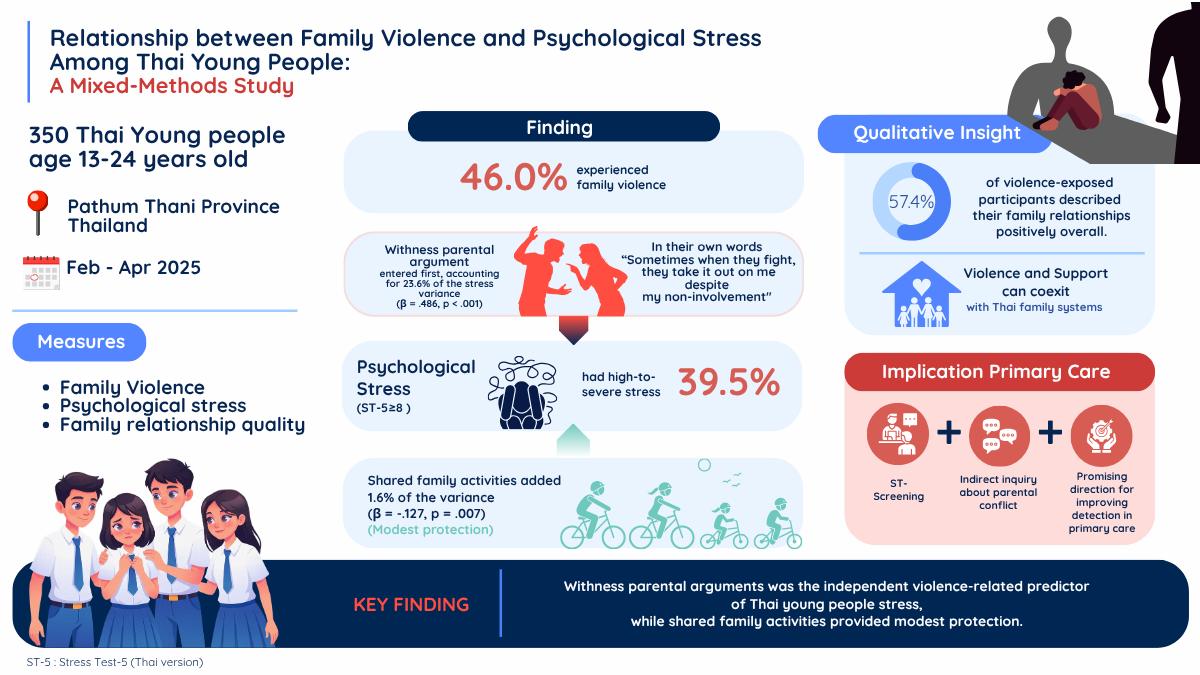
Family violence among young people remains a significant public health concern, yet primary care screening remains inconsistent in Thailand. To understand which specific types of violence most strongly predict adolescent stress and why these problems remain hidden during healthcare visits, we enrolled 350 young people aged 13 – 24 years from Pathum Thani Province between February and April 2025. Participants completed surveys measuring six types of violence, psychological stress using the ST-5 instrument, and family relationship quality. The 138 participants scoring ST-5 ≥ 8 subsequently completed in-depth interviews. Associations were analyzed using Pearson correlations and stepwise regression, and interview transcripts were then coded thematically.
Of the 365 young people approached, 350 participated, yielding a response rate of 95.9%. Violence exposure affected 46% of participants, while 39.5% demonstrated high-to-severe stress levels. Stepwise regression revealed that witnessing parental arguments was the only violence-related predictor independently associated with stress, accounting for 23.6% of the variance (β = .486, p < .001). Shared family activities provided modest protection (β = -.127, p = .007), increasing the total explained variance to 25.2%. Paradoxically, 57.1% of violence-exposed participants described their family relationships positively overall, reflecting the coexistence of violence and support within Thai family systems. Based on these findings, brief ST-5 screening combined with culturally adapted indirect inquiry about parental conflict may represent a promising direction for improving the detection in primary care settings, although prospective evaluation is required. Clinicians must recognize that violence and support can coexist within Thai families, requiring interventions that validate young people’s distress while preserving essential family bonds.
References
Braun, V., & Clarke, V. (2006). Using thematic analysis in psychology. Qualitative Research in Psychology, 3(2), 77-101. https://doi.org/10.1191/1478088706qp063oa
Bronfenbrenner, U. (1979). The ecology of human development: Experiments by nature and design. London, UK: Harvard University Press.
Chao, R. K. (1994). Beyond parental control and authoritarian parenting style: Understanding Chinese parenting through the cultural notion of training. Child Development, 65(4), 1111-1119. https://doi.org/10.1111/j.1467-8624.1994.tb00806.x
Cohen, J. (1988). Statistical power analysis for the behavioral sciences (2nd ed.). New Jersey, US: Lawrence Erlbaum Associates.
Cohen, S., Kamarck, T., & Mermelstein, R. (1983). A global measure of perceived stress. Journal of Health and Social Behavior, 24(4), 385-396. https://doi.org/10.2307/2136404
Davies, P. T., & Cummings, E. M. (1994). Marital conflict and child adjustment: An emotional security hypothesis. Psychological Bulletin, 116(3), 387-411. https://doi.org/10.1037/0033-2909.116.3.387
Department of Mental Health, Ministry of Public Health, Thailand. (2016). Department of mental health screening test for stress 5 (ST-5). Retrieved from https://dmh.go.th/test
Diamond, G. M., Diamond, G. S., Levy, S., Closs, C., Ladipo, T., & Siqueland, L. (2012). Attachment-based family therapy for suicidal lesbian, gay, and bisexual adolescents: A treatment development study and open trial with preliminary findings. Psychotherapy, 49(1), 62-71. https://doi.org/10.1037/a0026247
Fang, X., Fry, D. A., Ji, K., Finkelhor, D., Chen, J., Lannen, P., & Dunne, M. P. (2015). The burden of child maltreatment in China: A systematic review. Bulletin of the World Health Organization, 93, 176-185C. https://doi.org/10.2471/BLT.14.140970
Goldberg, D. P. (1972). The detection of psychiatric illness by questionnaire. Oxford, UK: Oxford University Press.
Hagan, J. F., Shaw, J. S., & Duncan, P. M. (Eds.). (2017). Bright Futures: Guidelines for health supervision of infants, children, and adolescents (4th ed.). Washington, DC, US: American Academy of Pediatrics.
Harold, G. T., Acquah, D., Sellers, R., & Chowdry, H. (2016). What works to enhance inter-parental relationships and improve outcomes for children. London, UK: Early Intervention Foundation.
Hillis, S., Mercy, J., Amobi, A., & Kress, H. (2016). Global prevalence of past-year violence against children: A systematic review and minimum estimates. Pediatrics, 137(3), Article e20154079. https://doi.org/10.1542/peds.2015-4079
Junla, D., & Yotanyamaneewong, S. (2024). Cultural values, parenting and child adjustment in Thailand. International Journal of Psychology, 59(4), 559-567. https://doi.org/10.1002/ijop.13111
Kaewjanta, N., Kabkumba, C., Rungreangkulkij, S., & Rice, S. (2024). Psychometric evaluation of the Thai Male Depression Risk Scale (MDRS-TH): psychometric properties of MDRS Thai version. Journal of Current Science and Technology, 14(2), Article 44. https://doi.org/10.59796/jcst.V14N2.2024.44
Miller, E., & McCaw, B. (2019). Intimate partner violence. New England Journal of Medicine, 380(9), 850-857. https://doi.org/10.1056/NEJMra1807166
Napa, W., Neelapaichit, N., Kongsakon, R., Chotivitayataragorn, S., & Udomsubpayakul, U. (2023). Impacts of COVID-19 on family violence in Thailand: Prevalence and influencing factors. BMC Women's Health, 23(1), Article 294. https://doi.org/10.1186/s12905-023-02440-x
Noiprasert, S., Buttagat, V., Sittiprapaporn, P., Sivaphongthongchai, A., & Hongsing, P. (2024). Effects of acupuncture on autonomic nervous system parameters and salivary cortisol level among mental stress university students: A pilot randomized controlled trial. Journal of Current Science and Technology, 14(2), Article 25. https://doi.org/10.59796/jcst.V14N2.2024.25
Norman, R. E., Byambaa, M., De, R., Butchart, A., Scott, J., & Vos, T. (2012). The long-term health consequences of child physical abuse, emotional abuse, and neglect: A systematic review and meta-analysis. PLoS Medicine, 9(11), Article e1001349. https://doi.org/10.1371/journal.pmed.1001349
Peltzer, K., & Pengpid, S. (2015). Depressive symptoms and social demographic, stress and health risk behaviour among university students in 26 low-, middle-and high-income countries. International Journal of Psychiatry in Clinical Practice, 19(4), 259-265. https://doi.org/10.3109/13651501.2015.1082598
Ruangkanchanasetr, S., Plitponkarnpim, A., Hetrakul, P., & Kongsakon, R. (2005). Youth risk behavior survey: Bangkok, Thailand. Journal of Adolescent Health, 36(3), 227-235. https://doi.org/10.1016/j.jadohealth.2004.01.013
Straus, M. A., Hamby, S. L., Boney-McCoy, S. U., & Sugarman, D. B. (1996). The revised conflict tactics scales (CTS2) development and preliminary psychometric data. Journal of Family Issues, 17(3), 283-316. https://doi.org/10.1177/019251396017003001
Substance Abuse and Mental Health Services Administration. (2014). SAMHSA's concept of trauma and guidance for a trauma-informed approach (HHS Publication No. SMA 14-4884). Author. Retrieved from https://www.nctsn.org/sites/default/files/resources/resource-guide/samhsa_trauma.pdf
Thackeray, J. D., Hibbard, R., Dowd, M. D., & Committee on Child Abuse and Neglect, and the Committee on Injury, Violence, and Poison Prevention. (2010). Intimate partner violence: the role of the pediatrician. Pediatrics, 125(5), 1094-1100. https://doi.org/10.1542/peds.2010-0451
Thombs, B. D., Ziegelstein, R. C., Roseman, M., Kloda, L. A., & Ioannidis, J. P. (2014). There are no randomized controlled trials that support the United States Preventive Services Task Force guideline on screening for depression in primary care: a systematic review. BMC Medicine, 12(1), Article 13. https://doi.org/10.1186/1741-7015-12-13
UNICEF. (2022a). Alarming poor mental health trend among children and adolescents in Thailand requires urgent investment in services. Retrieved from https://www.unicef.org/thailand/press-releases/alarming-poor-mental-health-trend-among-children-and-adolescents-thailand-requires
UNICEF. (2022b). Strengthening mental health and psychosocial support systems and services for children and adolescents in East Asia and Pacific Region: Thailand country report 2022. Retrieved from https://www.unicef.org/eap/media/11806/file/ Thailand%20Country%20Rport.pdf
Wang, M., Sun, S., Liu, X., Yang, Y., Liu, C., Huang, A., & Liu, S. (2024). Interparental conflict and early adolescent depressive symptoms: parent-child triangulation as the mediator and grandparent support as the moderator. Journal of Youth and Adolescence, 53(1), 186-199. https://doi.org/10.1007/s10964-023-01923-2
World Health Organization. (2021). Mental health of adolescents. Retrieved from https://www.who.int/news-room/fact-sheets/detail/adolescent-mental-health
World Health Organization. (2022). Global school-based student health survey (GSHS): Thailand 2021 fact sheet. Retrieved from https://cdn.who.int/media/docs/default-source/ncds/2021-thailand-gshs-fact-sheet.pdf
Downloads
Published
How to Cite
License
Copyright (c) 2026 Journal of Current Science and Technology

This work is licensed under a Creative Commons Attribution-NonCommercial-NoDerivatives 4.0 International License.