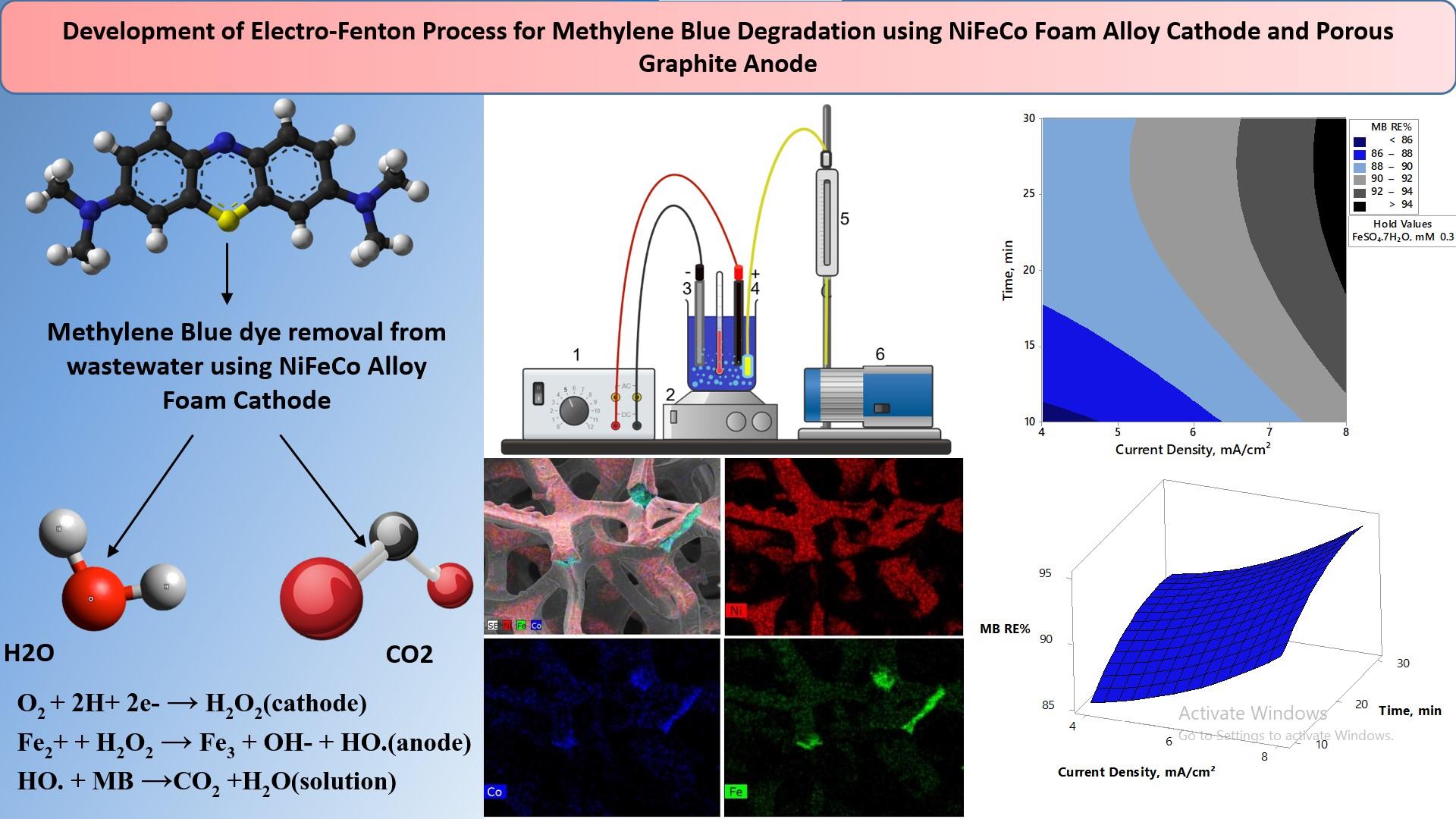
Development of Electro-Fenton Process for Methylene Blue Degradation using NiFeCo Foam Alloy Cathode and Porous Graphite Anode
DOI:
https://doi.org/10.59796/jcst.V16N3.2026.202Keywords:
foam alloy, analysis of variance, methylene blue, electro-Fenton, hydroxyl radical, RSMAbstract
The low efficiency of electro-Fenton (EF) technology in generating hydrogen peroxide (H2O2) is one of the most frequently encountered obstacles. Thus, the search for high-performance electrodes and reactors is necessary to increase system efficiency. In this study, porous graphite served as the control group to increase oxygen mass transfer in the reactor, while foam alloy was used as the cathode for producing in situ H2O2. X-Ray diffraction analyzer (XRD) and scanning electron microscope (SEM) were utilized to investigate the microstructure of the electrodes. Response surface methodology (RSM) was used to examine the various operational parameters affecting the reduction of methylene blue (MB) dye. A FeSO4.7H2O concentration of 0.5 mM, a current density of 8 mA/cm2, and a reaction time of 30 min were the optimal conditions for the electro-Fenton technique. Under these conditions, the MB removal efficiency (RE%) was 97.73%, and the energy consumption was 11.76 kWh/kg MB. The two most important factors controlling dye reduction in the electro-Fenton process are the FeSO4.7H2O concentration and the current density, which contributed 68.33% and 15.44%, respectively, in this model. The coefficient of multiple correlation (R2) was 99.59%, which demonstrated the statistical significance of the regression analysis. Therefore, the foam alloy electrode represents a new and viable strategy for contaminant degradation in the electro-Fenton process.
References
Abbas, R. N., & Abbas, A. S. (2022). Kinetics and energetic parameters study of phenol removal from aqueous solution by electro-fenton advanced oxidation using modified electrodes with PbO2 and graphene. Iraqi Journal of Chemical and Petroleum Engineering, 23(2), 1-8. https://doi.org/10.31699/IJCPE.2022.2.1
Abbas, Z. I., & Abbas, A. S. (2019). Oxidative degradation of phenolic wastewater by electro-fenton process using MnO2-graphite electrode. Journal of Environmental Chemical Engineering, 7(3), Article 103108. https://doi.org/10.1016/j.jece.2019.103108
Abbas, Z., & Abbar, A. H. (2020). Application of response surface methodology for optimization of phenol removal from simulated wastewater using rotating tubular packed bed electrochemical reactor. Egyptian Journal of Chemistry, 63(10), 3925-3936. https://doi.org/10.21608/ejchem.2020.26727.2547
Ali, B. H., Baghdadi, M., & Torabian, A. (2021). Application of nickel foam as an effective electrode for the electrochemical treatment of liquid hazardous wastes of COD analysis containing mercury, silver, and chromium (VI). Environmental Technology & Innovation, 23, Article 101617. https://doi.org/10.1016/j.eti.2021.101617
Benjumea-Hoyos, C. A., Giraldo Restrepo, S., & Gutiérrez Monsalve, J. (2024). Electro-Fenton method for dye removal of agro-industrial wastewater from flower production. Advances in Environmental Technology, 10(2), 118-130. https://doi.org/10.22104/aet.2024.6395.1750
Chai, C., Xu, H., Zhao, C., Guo, H., Li, N., Lin, X., & Xu, W. (2022). Effect of carbonization temperature of carbon felt on removal of methylene blue: Carbon felt as the cathode of Electro-Fenton system. In Journal of Physics: Conference Series, 2174(1), Article 012034. https://doi.org/10.1088/1742-6596/2174/1/012034
Demirel, C., Kabutey, A., Herák, D., Sedlaček, A., Mizera, Č., & Dajbych, O. (2022). Using Box–Behnken design coupled with response surface methodology for optimizing rapeseed oil expression parameters under heating and freezing conditions. Processes, 10(3), Article 490. https://doi.org/10.3390/pr10030490
Deng, F., Olvera-Vargas, H., Zhou, M., Qiu, S., Sirés, I., & Brillas, E. (2023). Critical review on the mechanisms of Fe2+ regeneration in the electro-Fenton process: Fundamentals and boosting strategies. Chemical Reviews, 123(8), 4635-4662. https://doi.org/10.1021/acs.chemrev.2c00684
Fahim, A. S., & Abbar, A. H. (2020). Treatment of petroleum refinery wastewater by electro-Fenton process using porous graphite electrodes. Egyptian Journal of Chemistry, 63(12), 4805-4819. https://doi.org/10.21608/ejchem.2020.28148.2592
Faraj, H., Jamrah, A., Al-Omari, S., & Al-Zghoul, T. M. (2024). Optimization of an electrocoagulation-assisted adsorption treatment system for dairy wastewater. Case Studies in Chemical and Environmental Engineering, 9, Article 100574. https://doi.org/10.1016/j.cscee.2023.100574
Fayazi, M., & Ghanei-Motlagh, M. (2020). Electrochemical mineralization of methylene blue dye using electro-Fenton oxidation catalyzed by a novel sepiolite/pyrite nanocomposite. International Journal of Environmental Science and Technology, 17(11), 4541-4548. https://doi.org/10.1007/s13762-020-02749-2
Ghjair, A., & Abbar, A. (2022). Removal of chemical oxygen demand (COD) from hospital wastewater by electro fenton process using graphite–graphite electrochemical system. Al-Qadisiyah Journal for Engineering Sciences, 15(1), 23-31. https://doi.org/10.30772/qjes.v15i1.809
Gopalakrishnan, G., Jeyakumar, R. B., & Somanathan, A. (2023). Challenges and emerging trends in advanced oxidation technologies and integration of advanced oxidation processes with biological processes for wastewater treatment. Sustainability, 15(5), Article 4235. https://doi.org/10.3390/su15054235
Hameed, Z. M., & Salman, R. H. (2024). Elimination of methyl orange dye with three dimensional electro-Fenton and sono-electro-Fenton systems utilizing copper foam and activated carbon. Ecological Engineering & Environmental Technology, 25(10), 44-59. https://doi.org/10.12912/27197050/191199
Hameed, Z. M., & Salman, R. H. (2025). Optimizing methyl orange degradation via electro-fenton with copper foam cathode: A comparative approach using iron waste vs. iron salts and exploring catalyst and cathode durability. Applied Science and Engineering Progress, 18(4), 7728-7728. https://doi.org/10.14416/j.asep.2025.05.002
Hasnaoui, A., Chikhi, M., Balaska, F., Seraghni, W., Boussemghoune, M., & Dizge, N. (2024). Electrocoagulation employing recycled aluminum electrodes for methylene blue remediation. Desalination and Water Treatment, 319, Article 100453. https://doi.org/10.1016/j.dwt.2024.100453
Ho, S. (2022). Low-cost adsorbents for the removal of phenol/phenolics, pesticides, and dyes from wastewater systems: A review. Water, 14(20), Article 3203. https://doi.org/10.3390/w14203203
Hsieh, T. H., Wang, Y. Z., & Ho, K. S. (2022). Cobalt-based cathode catalysts for oxygen-reduction reaction in an anion exchange membrane fuel cell. Membranes, 12(7), Article 699. https://doi.org/10.3390/membranes12070699
Hu, X., Tian, X., Lin, Y. W., & Wang, Z. (2019). Nickel foam and stainless steel mesh as electrocatalysts for hydrogen evolution reaction, oxygen evolution reaction and overall water splitting in alkaline media. RSC Advances, 9(54), 31563-31571. https://doi.org/10.1039/C9RA07258F
Islam, M. M., Aidid, A. R., Mohshin, J. N., Mondal, H., Ganguli, S., & Chakraborty, A. K. (2025). A critical review on textile dye-containing wastewater: Ecotoxicity, health risks, and remediation strategies for environmental safety. Cleaner Chemical Engineering, 11, Article 100165. https://doi.org/10.1016/j.clce.2025.100165
Jankovic, A., Chaudhary, G., & Goia, F. (2021). Designing the design of experiments (DOE) An investigation on the influence of different factorial designs on the characterization of complex systems. Energy and Buildings, 250, Article 111298. https://doi.org/10.1016/j.enbuild.2021.111298
Karnjanakom, S., Maneechakr, P., Kurnia, I., Bayu, A., Farobie, O., Samart, C., Kongparakul, S., & Guan, G. (2024). Sustainable upgrading of crude glycerol via ultrasound-reinforced bio-refinery process with oxygen–nitrogen subsistence: Co-application of reusable heterogeneous catalyst. Energy Conversion and Management, 310, Article 118477. https://doi.org/10.1016/j.enconman.2024.118477
Khan, Z. U. H., Gul, N. S., Sabahat, S., Sun, J., Tahir, K., Shah, N. S., ... & Wu, J. (2023). Removal of organic pollutants through hydroxyl radical-based advanced oxidation processes. Ecotoxicology and Environmental Safety, 267, Article 115564. https://doi.org/10.1016/j.ecoenv.2023.115564
Khezri, S. H., Yazdani, A., Khordad, R., & Ravan, B. A. (2013). Preparation of pure cobalt nanoparticles by electric arc discharge method in ethylene glycol. Modern Physics Letters B, 27(09), Article 1350057. https://doi.org/10.1142/S0217984913500577
Kim, D. H., Yu, B. Y., Cha, P. R., Yoon, W. Y., Byun, J. Y., & Kim, S. H. (2012). A study on FeCrAl foam as effective catalyst support under thermal and mechanical stresses. Surface and Coatings Technology, 209, 169-176. https://doi.org/10.1016/j.surfcoat.2012.08.017
Le, S. T., Dung, T. N., Huong, T. T., Dien, N. T., & Uyen, D. P. (2021). Study on some parameters affecting the degradation of methylene blue in water by electro-fenton using Ti/PbO2 anode. Vietnam Journal of Science and Technology, 59(5), 609-622. https://doi.org/10.15625/2525-2518/59/5/15932
Li, H., Ma, R., Chen, F., Wang, D., Zhang, H., & Lu, C. (2023). Constructing interconnected microporous structures in carbon by homogeneous activation as a sustainable electrode material for high-performance supercapacitors. Molecules, 28(19), Article 6851. https://doi.org/10.3390/molecules28196851
Li, J., Song, D., Du, K., Wang, Z., & Zhao, C. (2019). Performance of graphite felt as a cathode and anode in the electro-Fenton process. RSC Advances, 9(66), 38345-38354. https://doi.org/10.1039/C9RA07525A
Majed, A. A., & Abbar, A. H. (2025). A review on induced electro-fenton process for wastewater treatment. IOP Conference Series: Earth and Environmental Science, 1507(1), Article 012045. https://doi.org/10.1088/1755-1315/1507/1/012045
Manjunatha, M., Reddy, G. S., Mallikarjunaiah, K. J., Damle, R., & Ramesh, K. P. (2019). Determination of phase composition of cobalt nanoparticles using 59Co internal field nuclear magnetic resonance. Journal of Superconductivity and Novel Magnetism, 32(10), 3201-3209. https://doi.org/10.1007/s10948-019-5083-7
Minnalkodi Senguttuvan, K. R., Sellappa, K., & Kuppusamy, S. (2024). Performance evaluation of the electro-fenton process for distillery wastewater treatment. Sustainability, 16(15), Article 6512. https://doi.org/10.3390/su16156512
Mohammed, S. J., M-Ridha, M. J., Abed, K. M., & Elgharbawy, A. A. (2023a). Removal of levofloxacin and ciprofloxacin from aqueous solutions and an economic evaluation using the electrocoagulation process. International Journal of Environmental Analytical Chemistry, 103(16), 3801-3819. https://doi.org/10.1080/03067319.2021.1913733
Mohammed, S. J., MRidha, M. J., Ali, Q. A., Abed, K. M., & Ahmadzadeh, S. (2023b). Reliable treatment approach for levofloxacin and ciprofloxacin removal from aqueous medium: process modelling, kinetic and isotherm studies. Desalination and Water Treatment, 307, 50-62. https://doi.org/10.5004/dwt.2023.29776
Nair, K. M., Kumaravel, V., & Pillai, S. C. (2021). Carbonaceous cathode materials for electro-Fenton technology: Mechanism, kinetics, recent advances, opportunities and challenges. Chemosphere, 269, Article 129325. https://doi.org/10.1016/j.chemosphere.2020.129325
Ni, C., Fan, Z., Deng, N., & Huang, X. (2024). Inhibiting joule heating to enhance the hydrogen peroxide electrosynthesis efficiency at industrial level current density. ACS Applied Energy Materials, 7(8), 3116-3124. https://doi.org/10.1021/acsaem.3c03109
Nuhma, M. J., Mohsen, O. A., Abed, K. M., Zageer, K. F., Wasmi, B. A., & Hassan, A. A. (2025). Electro-fenton oxidation for degradation of direct red organic pollutants using stainless steel and iron electrodes. The Eurasia Proceedings of Science, Technology, Engineering and Mathematics, 37, 1124-1134. https://doi.org/10.55549/epstem.1376
Periyasamy, A. P. (2024). Recent advances in the remediation of textile-dye-containing wastewater: Prioritizing human health and sustainable wastewater treatment. Sustainability, 16(2), Article 495. https://doi.org/10.3390/su16020495
Ratchawet, A., Joradol, A., Sookyang, J., Bueruean, C., & Doungjit, S. (2025). Kinetics and isotherms study of methylene blue dye adsorption on water hyacinth stem powder adsorbent. Engineering Access, 12(1), 63–75. https://ph02.tci-thaijo.org/index.php/mijet/article/view/255637
Saleem, A. G., & Al-Jubouri, S. M. (2024). Separation performance of cationic and anionic dyes from water using polyvinylidene fluoride-based ultrafiltration membrane incorporating polyethylene glycol. Desalination and Water Treatment, 319, Article 100546. https://doi.org/10.1016/j.dwt.2024.100546
Salman, R. H., Khudhair, E. M., Abed, K. M., & Abbas, A. S. (2024). Removal of E133 brilliant blue dye from artificial wastewater by electrocoagulation using cans waste as electrodes. Environmental Progress & Sustainable Energy, 43(2), Article e14292. https://doi.org/10.1002/ep.14292
Teng, X., Li, J., Wang, Z., Wei, Z., Chen, C., Du, K., ... & Li, Y. (2020). Performance and mechanism of methylene blue degradation by an electrochemical process. RSC Advances, 10(41), 24712-24720. https://doi.org/10.1039/D0RA03963B
Thwaini, H. H., & Salman, R. H. (2023a). Modification of electro-fenton process with granular activated carbon for phenol degradation–optimization by response surface methodology. Journal of Ecological Engineering, 24(9), 92-104. https://doi.org/10.12911/22998993/168411
Thwaini, H. H., & Salman, R. H. (2023b). Phenol removal by electro-Fenton process using a 3D electrode with iron foam as particles and carbon fibre modified with graphene. Journal of Electrochemical Science and Engineering, 13(3), 537-551. https://doi.org/10.5599/jese.1806
Uddin, J., Idrees, M., Ahmed, H., Batool, S., Rahman, T. U., Mehmood, S., ... & Musharraf, S. G. (2024). Biodegradation and decolorization of methylene blue, reactive Black-5, and toluidine blue-O from an aqueous solution using the polyphenol oxidase enzyme. Frontiers in Sustainable Food Systems, 7, Article 1320855. https://doi.org/10.3389/fsufs.2023.1320855
Üner, O., Geçgel, Ü., & Bayrak, Y. (2016). Adsorption of methylene blue by an efficient activated carbon prepared from Citrullus lanatus rind: Kinetic, isotherm, thermodynamic, and mechanism analysis. Water, Air, & Soil Pollution, 227(7), Article 247. https://doi.org/10.1007/s11270-016-2949-1
Wang, X., Zhao, J., Song, C., Shi, X., & Du, H. (2022). An eco-friendly iron cathode electro-fenton system coupled with a pH-regulation electrolysis cell for p-nitrophenol degradation. Frontiers in Chemistry, 9, Article 837761. https://doi.org/10.3389/fchem.2021.837761
Wetchakun, K., & Wetchakun, N. (2022). Influences of operational parameters on methylene blue degradation in the suspension photoreactor using Aeroxide® P25/TiO₂ as a photocatalyst. Science & Technology Asia, 27(3), 37–54. https://doi.org/10.14456/scitechasia.2022.44
Yang, X., Liu, J., Bagnall, N. R., Heuts, J. P., Worrell, B., Waldron, C., & Haddleton, D. M. (2025). Assessing Cobalt (II/III) complex purity using XRD and its impact on effectiveness of catalytic chain transfer polymerization. Macromolecules, 58(6), 3188-3198. https://doi.org/10.1021/acs.macromol.5c00049
Yin, J., Zhang, H., Luo, M., Zhao, J., Zhou, X., Wang, F., ... & Lai, B. (2025). Electro-Fenton process for wastewater treatment: From selective H2O2 generation to efficient •OH conversion. Chemical Engineering Journal, 507, Article 160709. https://doi.org/10.1016/j.cej.2025.160709
Zhang, H., Yang, Y., Ren, D., Wang, L., & He, X. (2021). Graphite as anode materials: Fundamental mechanism, recent progress and advances. Energy Storage Materials, 36, 147-170. https://doi.org/10.1016/j.ensm.2020.12.027
Zhu, Y., Qiu, S., Deng, F., Ma, F., Li, G., & Zheng, Y. (2020). Three-dimensional nickel foam electrode for efficient electro-Fenton in a novel reactor. Environmental technology, 41(6), 730-740. https://doi.org/10.1080/09593330.2018.1509890
Downloads
Published
How to Cite
License
Copyright (c) 2026 Journal of Current Science and Technology

This work is licensed under a Creative Commons Attribution-NonCommercial-NoDerivatives 4.0 International License.