Performance Evaluation of S2P-CNN for Multi-Load Disaggregation of EV and PV Generation under Varying Data Sampling Rates
DOI:
https://doi.org/10.59796/jcst.V16N4.2026.219Keywords:
Non-Intrusive Load Monitoring (NILM), S2P-CNN, Electric Vehicle (EV), Photovoltaic (PV), sampling rate, smart meterAbstract
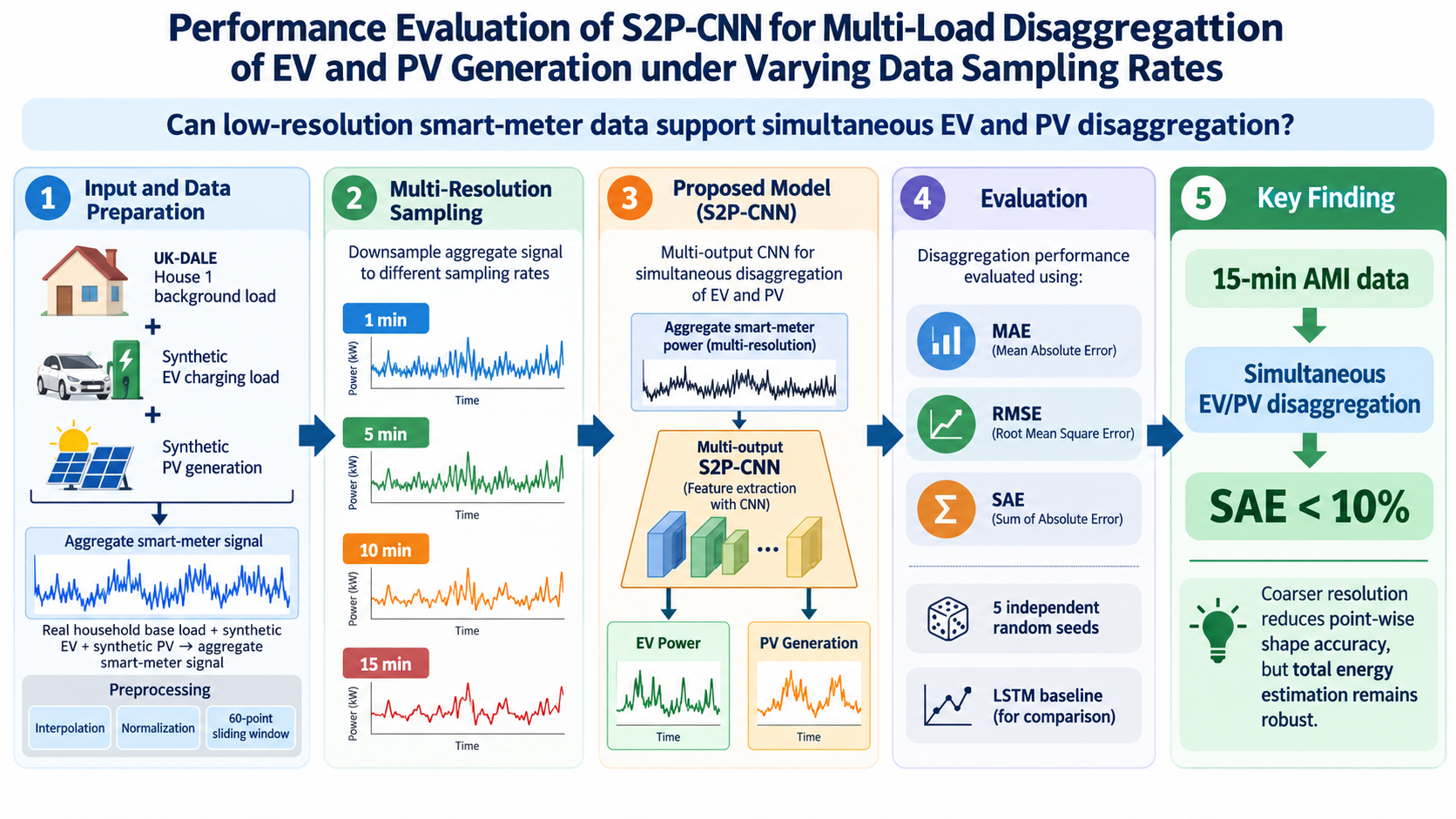
This study evaluates the performance of a multi-output regression Sequence-to-Point Convolutional Neural Network (S2P-CNN) for Non-Intrusive Load Monitoring (NILM), with a specific focus on disaggregating Electric Vehicle (EV) charging load and Photovoltaic (PV) generation under varying data sampling rates. While the growing integration of Distributed Energy Resources (DERs) has increased the complexity of household energy patterns, most utility smart meters still record data at low resolutions (e.g., 15 minutes), presenting a significant challenge for traditional algorithms. To address this issue, experiments were conducted utilizing the real-world UK-DALE dataset solely as a background load, onto which synthetic EV and PV profiles were superimposed at resolutions of 1, 5, 10, and 15 minutes. To ensure statistical robustness, all evaluations were validated across multiple random seeds and compared against a standard Long Short-Term Memory (LSTM) sequence-modeling baseline. The quantitative results reveal a clear engineering trade-off: while lowering the sampling rate degrades point-wise signal shape accuracy due to the loss of high-frequency transients, the model successfully preserves the total energy mass. Crucially, multi-seed validation highlights a specific sensitivity at certain resolutions (e.g., 10 minutes), causing feature extraction to be highly dependent on initial weights. However, at the primary target resolution of 15 minutes, the model regains stability and demonstrates highly consistent behavior, maintaining Signal Aggregate Error (SAE) values safely below the 10% acceptable threshold. Furthermore, baseline evaluations indicate that the S2P-CNN architecture offers greater robustness and computational efficiency under coarse sampling conditions compared to the LSTM. These findings demonstrate that the S2P-CNN is a viable solution for aggregate-level energy estimation using existing Advanced Metering Infrastructure (AMI), offering a practical and cost-effective deployment pathway for smart grid management without necessitating immediate hardware upgrades.
References
Al-Shetwi, A. Q. (2022). Sustainable development of renewable energy integrated power sector: Trends, environmental impacts, and recent challenges. Science of The Total Environment, 822, Article 153645. https://doi.org/10.1016/j.scitotenv.2022.153645
Dash, S., & Sahoo, N. C. (2023). Attention-based deep learning approach for nonintrusive and simultaneous state detection of multiple appliances in smart buildings. IEEE Journal of Emerging and Selected Topics in Industrial Electronics, 5(3), 1248-1258. https://doi.org/10.1109/JESTIE.2023.3333308
Dobos, A. P. (2014). PVWatts version 5 manual (NREL/TP-6A20-62641). National Renewable Energy Laboratory. https://doi.org/10.2172/1158421
Fang, X., Misra, S., Xue, G., & Yang, D. (2012). Smart grid—The new and improved power grid: A survey. IEEE Communications Surveys & Tutorials, 14(4), 944-980. https://doi.org/10.1109/SURV.2011.101911.00087
Hart, G. W. (1992). Nonintrusive appliance load monitoring. Proceedings of the IEEE, 80(12), 1870-1891. https://doi.org/10.1109/5.192069
Himeur, Y., Ghanem, K., Alsalemi, A., Bensaali, F., & Amira, A. (2021). Artificial intelligence based anomaly detection of energy consumption in buildings: A review, current trends and new perspectives. Applied Energy, 287, Article 116601. https://doi.org/10.1016/j.apenergy.2021.116601
Huber, P., Calatroni, A., Rumsch, A., & Paice, A. (2021). Review on deep neural networks applied to low-frequency nilm. Energies, 14(9), Article 2390. https://doi.org/10.3390/en14092390
IEEE Standards Association. (2018). IEEE Standard for Smart Energy Profile Application Protocol. New York, US: The Institute of Electrical and Electronics Engineers, Inc.
International Electrotechnical Commission (IEC). (2020). Electricity metering data exchange—The DLMS/COSEM suite—Part 1-0: Smart metering standardisation framework (IEC 62056-1-0:2014+AMD1:2020). IEC.
Jaime, H. C., de Souza, A. D., Santos Machado, R. C., & Gomes, O. d. S. M. (2026). Machine learning models for non-intrusive load monitoring: A systematic review and meta-analysis. Inventions, 11(2), Article 29. https://doi.org/10.3390/inventions11020029
Kelly, J., & Knottenbelt, W. (2015). The UK-DALE dataset, domestic appliance-level electricity demand and whole-house demand from five UK homes. Scientific Data, 2(1), Article 150007. https://doi.org/10.1038/sdata.2015.7
Nizami, M. S. H., Hossain, M. J., Amin, B. R., & Fernandez, E. (2020). A residential energy management system with bi-level optimization-based bidding strategy for day-ahead bi-directional electricity trading. Applied Energy, 261, Article 114322. https://doi.org/10.1016/j.apenergy.2019.114322
Sykiotis, S., Kaselimi, M., Doulamis, A., & Doulamis, N. (2022). Electricity: An efficient transformer for non-intrusive load monitoring. Sensors, 22(8), Article 2926. https://doi.org/10.3390/s22082926
Todic, T., Stankovic, V., & Stankovic, L. (2023). An active learning framework for the low-frequency non-intrusive load monitoring problem. Applied Energy, 341, Article 121078. https://doi.org/10.1016/j.apenergy.2023.121078
Vavouris, A., Garside, B., Stankovic, L., & Stankovic, V. (2022). Low-frequency non-intrusive load monitoring of electric vehicles in houses with solar generation: Generalisability and transferability. Energies, 15(6), Article 2200. https://doi.org/10.3390/en15062200
Völker, B., Reinhardt, A., Faustine, A., & Pereira, L. (2021). Watt’s up at home? Smart meter data analytics from a consumer-centric perspective. Energies, 14(3), Article 719. https://doi.org/10.3390/en14030719
Yin, Y., Xu, B., Zhong, Y., Bao, T., & Wang, P. (2023). A non-intrusive load monitoring model for electric vehicles based on multi-kernel conventional neural network. World Electric Vehicle Journal, 14(2), Article 51. https://doi.org/10.3390/wevj14020051
Zeifman, M., & Roth, K. (2011). Nonintrusive appliance load monitoring: Review and outlook. IEEE Transactions on Consumer Electronics, 57(1), 76-84. https://doi.org/10.1109/TCE.2011.5735484
Zhang, C., Zhong, M., Wang, Z., Goddard, N., & Sutton, C. (2018). Sequence-to-point learning with neural networks for non-intrusive load monitoring. Proceedings of the AAAI Conference on Artificial Intelligence, 32(1), 2604-2611. https://doi.org/10.1609/aaai.v32i1.11873
Zoha, A., Gluhak, A., Imran, M. A., & Rajasegarar, S. (2012). Non-intrusive load monitoring approaches for disaggregated energy sensing: A survey. Sensors, 12(12), 16838-16866. https://doi.org/10.3390/s121216838
Downloads
Published
How to Cite
Issue
Section
Categories
License
Copyright (c) 2026 Journal of Current Science and Technology

This work is licensed under a Creative Commons Attribution-NonCommercial-NoDerivatives 4.0 International License.