Phytoextraction Potential of Colocasia esculenta for Cadmium- and Zinc-contaminated Soils under Moderate Drought Stress: A Short-Term Pot Study
DOI:
https://doi.org/10.59796/jcst.V16N3.2026.193Keywords:
cadmium, Colocasia esculenta, drought stress, metal stress, phytoremediation, zincAbstract
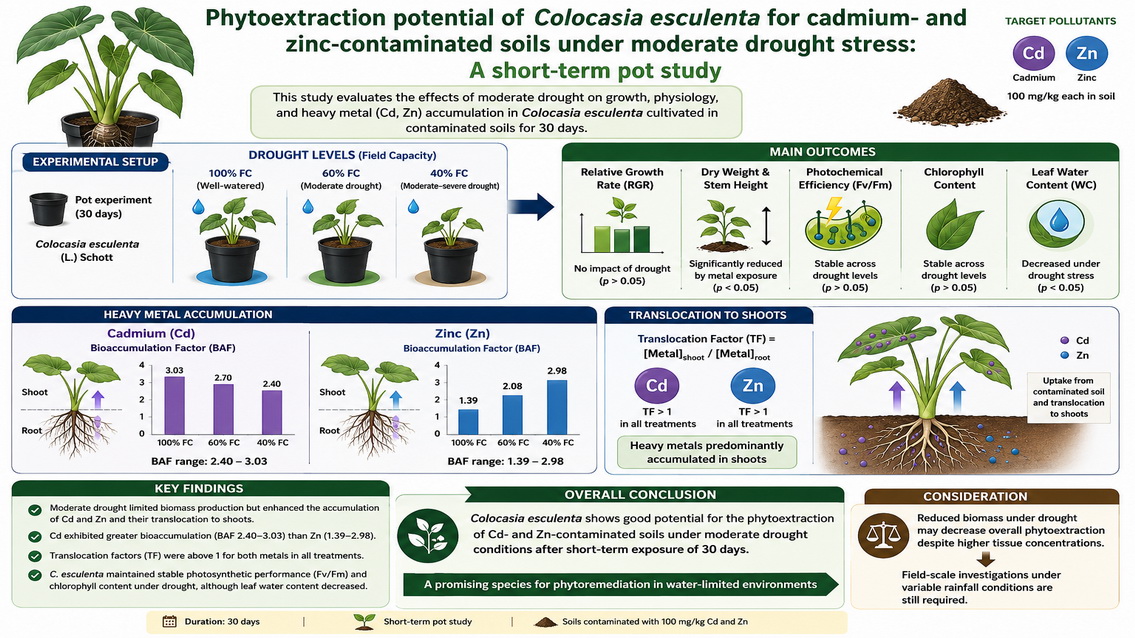
This study investigates the effects of moderate drought on growth, physiology, and heavy metal accumulation in Colocasia esculenta cultivated in cadmium (Cd) and zinc (Zn) contaminated soils. Plants were grown for 30 days under moisture levels of 100% (well-watered), 60%, and 40% field capacity (FC), representing moderate drought, in soils containing 100 mg/kg Cd and Zn. Drought had no impact on the relative growth rate (RGR), whereas metal exposure significantly reduced dry weight and stem height (p < 0.05) of the plants. The photochemical efficiency of PSII (Fv/Fm) and chlorophyll content remained stable (p > 0.05), but the water content (WC) of the leaves decreased under drought stress (p < 0.05). Translocation factors (TF) for both metals were above 1 in all treatments, indicating that heavy metal predominantly accumulated in shoots, with Cd exhibiting greater bioaccumulation factors (BAF) (2.40–3.03) than Zn (1.39–2.98). Overall, moderate drought limited biomass production but enhanced the accumulation of Cd and Zn and translocation to the shoots. These findings suggest that C. esculenta is suitable for the phytoextraction of Cd- and Zn-contaminated soils under drought-stress conditions after short-term exposure of 30 days. However, reduced biomass under drought may decrease overall phytoextraction despite higher tissue concentrations. Therefore, field-scale investigations under variable rainfall conditions are still required.
References
Angon, P. B., Islam, M. S., Das, A., Anjum, N., Poudel, A., & Suchi, S. A. (2024). Sources, effects and present perspectives of heavy metals contamination: Soil, plants and human food chain. Heliyon, 10(7), Article e28357. https://doi.org/10.1016/j.heliyon.2024.e28357
Bhat, S. A., Bashir, O., Haq, S. A. U., Amin, T., Rafiq, A., Ali, M., ... & Sher, F. (2022). Phytoremediation of heavy metals in soil and water: An eco-friendly, sustainable and multidisciplinary approach. Chemosphere, 303, Article 134788. https://doi.org/10.1016/j.chemosphere.2022.134788
Chayapan, P., Kruatrachue, M., Meetam, M., & Pokethitiyook, P. (2015). Phytoremediation potential of Cd and Zn by wetland plants, Colocasia esculenta L. Schott., Cyperus malaccensis Lam., and Typha angustifolia L. grown in hydroponics. Journal of Environmental Biology, 36(5), 1179-1183.
Cui, S., Zhou, Q., & Chao, L. (2007). Potential hyperaccumulation of Pb, Zn, Cu and Cd in endurant plants distributed in an old smeltery, northeast China. Environmental Geology, 51(6), 1043-1048. https://doi.org/10.1007/s00254-006-0373-3
Guidi, L., Lo Piccolo, E., & Landi, M. (2019). Chlorophyll fluorescence, photoinhibition and abiotic stress: Does it make any difference the fact to be a C3 or C4 species?. Frontiers in Plant Science, 10, Article 174. https://doi.org/10.3389/fpls.2019.00174
Gupta, A., Rico-Medina, A., & Caño-Delgado, A. I. (2020). The physiology of plant responses to drought. Science, 368(6488), 266-269. https://doi.org/10.1126/science.aaz7614
Hunt, R. (1978). Plant growth analysis, London, UK: Edward Arnold.
Islam, M. M., Saxena, N., & Sharma, D. (2024). Phytoremediation as a green and sustainable prospective method for heavy metal contamination: A review. RSC Sustainability, 2(5), 1269-1288. https://doi.org/10.1039/D3SU00440F
Khamsuk, O., Sonjaroon, W., Suwanwong, S., Jutamanee, K., & Suksamrarn, A. (2018). Effects of 24-epibrassinolide and the synthetic brassinosteroid mimic on chili pepper under drought. Acta Physiologiae Plantarum, 40(6), Article 106. https://doi.org/10.1007/s11738-018-2682-z
Korkmaz, A., Korkmaz, Y., & Demirkıran, A. R. (2010). Enhancing chilling stress tolerance of pepper seedlings by exogenous application of 5-aminolevulinic acid. Environmental and Experimental Botany, 67(3), 495-501. https://doi.org/10.1016/j.envexpbot.2009.07.009
Kumar, A., Kumar, A., Chaturvedi, A. K., Shabnam, A. A., Subrahmanyam, G., Mondal, R., ... & Yadav, K. K. (2020). Lead toxicity: Health hazards, influence on food chain, and sustainable remediation approaches. International Journal of Environmental Research and Public Health, 17(7), Article 2179. https://doi.org/10.3390/ijerph17072179
Kundu, G. K., Biswas, M., Annana, R. P., & Rahman, A. H. (2024). Unveiling taro's (Colocasia esculenta) potential as a source of antioxidants and nutritional elements: Industrial impact on quantitative risk assessment of potentially toxic metals accumulation. Applied Food Research, 4(2), Article 100586. https://doi.org/10.1016/j.afres.2024.100586
Mariwy, A., Selanno, D. A. J., Male, Y. T., & Tupan, C. I. (2024). Heavy metal mercury accumulation using taro plant (Colocasia esculenta). Pakistan Journal of Life & Social Sciences, 22(2), 18851-18862. https://doi.org/10.57239/PJLSS-2024-22.2.001382
Maxwell, K., & Johnson, G. N. (2000). Chlorophyll fluorescence-a practical guide. Journal of Experimental Botany, 51(345), 659-668. https://doi.org/10.1093/jexbot/51.345.659
Muhammad, M., Waheed, A., Wahab, A., Majeed, M., Nazim, M., Liu, Y. H., ... & Li, W. J. (2024). Soil salinity and drought tolerance: An evaluation of plant growth, productivity, microbial diversity, and amelioration strategies. Plant Stress, 11, Article 100319. https://doi.org/10.1016/j.stress.2023.100319
Mukherjee, S., Leri, A. C., Bandaranayaka, C., Vázquez-Núñez, E., Barros, R., Khan, A. H. A., ... & Bolan, N. (2025). Sustainable management of post-phytoremediation biomass. Energy, Ecology and Environment, 10(6), 675-709. https://doi.org/10.1007/s40974-025-00364-w
Nas, F. S., & Ali, M. (2018). The effect of lead on plants in terms of growing and biochemical parameters: A review. MOJ Ecology & Environmental Sciences, 3(4), 265-268. https://doi.org/10.15406/mojes.2018.03.00098
Nugroho, G. A., Desmiaty, Y., Sumiyati, Y., Suherman, S. L., & Lim, H. (2025). Phenolic content and antioxidant activity of Colocasia esculenta in commercial herbal products. Sciences of Phytochemistry, 4(1), 33-39. https://doi.org/10.58920/sciphy0401288
Ozturk, M., Turkyilmaz Unal, B., García‐Caparrós, P., Khursheed, A., Gul, A., & Hasanuzzaman, M. (2021). Osmoregulation and its actions during the drought stress in plants. Physiologia Plantarum, 172(2), 1321-1335. https://doi.org/10.1111/ppl.13297
Peng, X., Li, J., Sun, L., Gao, Y., Cao, M., & Luo, J. (2022). Impacts of water deficit and post-drought irrigation on transpiration rate, root activity, and biomass yield of Festuca arundinacea during phytoextraction. Chemosphere, 294, Article 133842. https://doi.org/10.1016/j.chemosphere.2022.133842
Rashid, A., Schutte, B. J., Ulery, A., Deyholos, M. K., Sanogo, S., Lehnhoff, E. A., & Beck, L. (2023). Heavy metal contamination in agricultural soil: Environmental pollutants affecting crop health. Agronomy, 13(6), Article 1521. https://doi.org/10.3390/agronomy13061521
Reeves, R. D., & Baker, A. J. M. (2000). Metal accumulating plants. In I. Raskin & B. D. Ensley (Eds.), Phytoremediation of toxic metals: Using plants to clean up the environment. New York, US: Wiley.
Rucińska-Sobkowiak, R. (2016). Water relations in plants subjected to heavy metal stresses. Acta Physiologiae Plantarum, 38(11), Article 257. https://doi.org/10.1007/s11738-016-2277-5
Saeng-Ngam, S., & Jampasri, K. (2022). Effects of drought stress on the growth and heavy metal accumulation by Chromolaena odorata grown in hydroponic media. Bulletin of Environmental Contamination and Toxicology, 108(4), 762-767. https://doi.org/10.1007/s00128-021-03401-6
Slawinski, L., Israel, A., Artault, C., Thibault, F., Atanassova, R., Laloi, M., & Dédaldéchamp, F. (2021). Responsiveness of early response to dehydration six-like transporter genes to water deficit in Arabidopsis thaliana leaves. Frontiers in Plant Science, 12, Article 708876. https://doi.org/10.3389/fpls.2021.708876
Tan, H. W., Pang, Y. L., Lim, S., & Chong, W. C. (2023). A state-of-the-art of phytoremediation approach for sustainable management of heavy metals recovery. Environmental Technology & Innovation, 30, Article 103043. https://doi.org/10.1016/j.eti.2023.103043
Thai Meteorological Department (TMD). (2025). Monthly weather summary in Thailand. TMP Publications. Ministry of Digital Economy and Society. Retrieved from https://www.tmd.go.th/media/climate/climate-monthly/august-2025.pdf
Wang, X., Liu, W., Li, Z., Teng, Y., Christie, P., & Luo, Y. (2020). Effects of long-term fertilizer applications on peanut yield and quality and plant and soil heavy metal accumulation. Pedosphere, 30(4), 555-562. https://doi.org/10.1016/S1002-0160(17)60457-0
Wilson, B., & Pyatt, F. B. (2007). Heavy metal bioaccumulation by the important food plant, Olea europaea L., in an ancient metalliferous polluted area of Cyprus. Bulletin of Environmental Contamination and Toxicology, 78(5), 390-394. https://doi.org/10.1007/s00128-007-9162-2
Yan, A., Wang, Y., Tan, S. N., Mohd Yusof, M. L., Ghosh, S., & Chen, Z. (2020). Phytoremediation: A promising approach for revegetation of heavy metal-polluted land. Frontiers in Plant Science, 11, Article 359. https://doi.org/10.3389/fpls.2020.00359
Zhao, Q., Wang, J., Li, H., Wang, Z., Makar, R. S., Yao, L., ... & Han, H. (2025). Phosphate-solubilizing bacteria reduce Cd accumulation in spinach by forming P–Ca adhesive films in the roots and altering the structure of soil macroaggregates. Journal of Hazardous Materials, 494, Article 138482. https://doi.org/10.1016/j.jhazmat.2025.138482
Downloads
Published
How to Cite
Issue
Section
License
Copyright (c) 2026 Journal of Current Science and Technology

This work is licensed under a Creative Commons Attribution-NonCommercial-NoDerivatives 4.0 International License.