An Ontology-Driven Ambient Assisted Living Framework for Personalized Elderly Care with Health-Risk Inference
DOI:
https://doi.org/10.59796/jcst.V16N3.2026.201Keywords:
ambient assisted living, ontology, SWRL, SPARQL, semantic web, semantic reasoning, knowledge graphAbstract
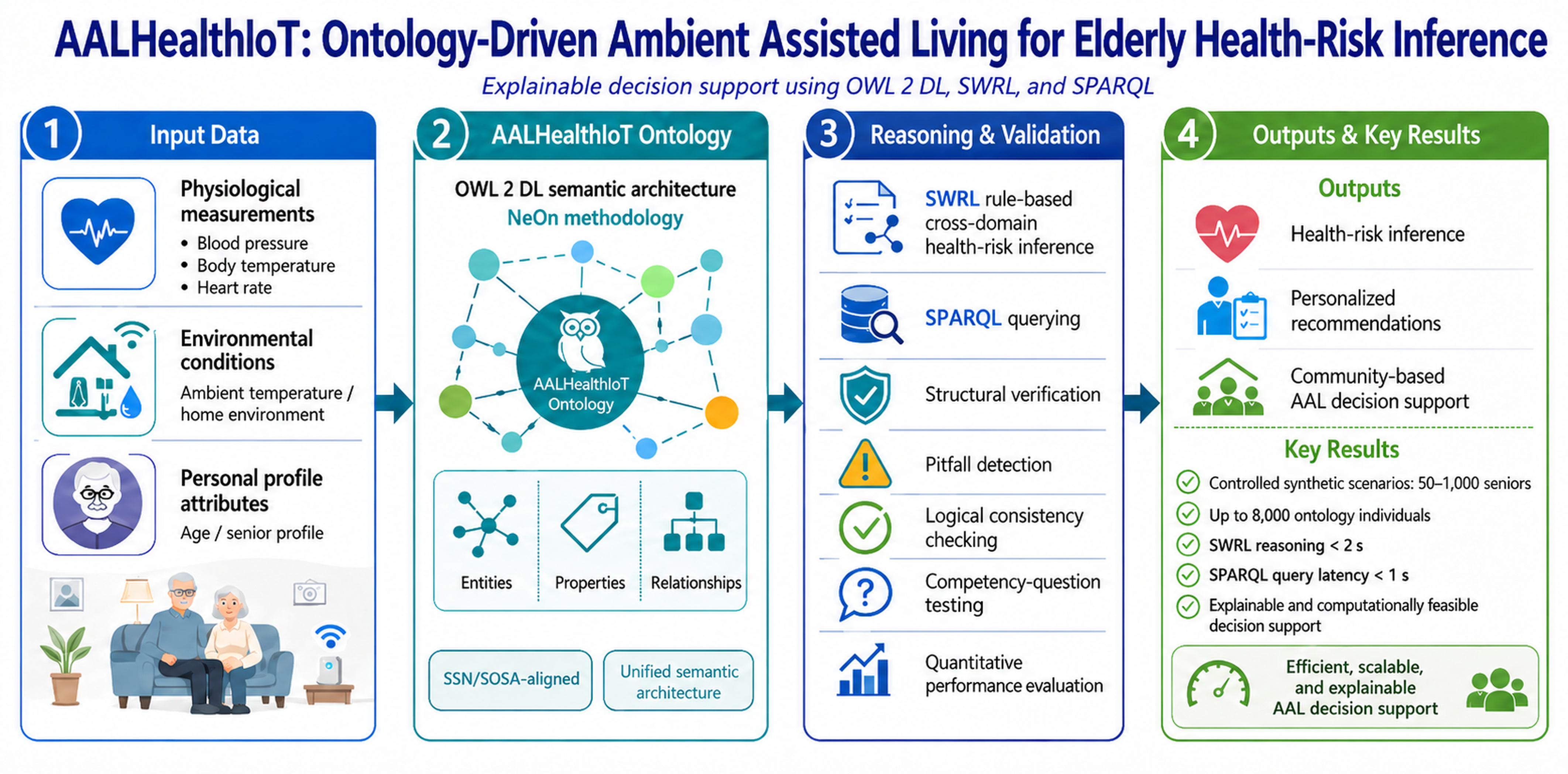
As the global elderly population increases, there is a growing need for structured long-term care systems that support independent living and explainable health monitoring. This study presents AALHealthIoT, a Web Ontology Language (OWL) 2 DL–based ontology framework for Ambient Assisted Living (AAL) that integrates physiological measurements, environmental conditions, and personal profile attributes within a unified semantic architecture. Unlike existing Internet of Things (IoT) ontologies such as SSN/SOSA, SAREF, SAREF4EHAW, and OntoDomus, which primarily emphasize interoperability, AALHealthIoT operationalizes cross-domain health-risk inference using Semantic Web Rule Language (SWRL) rules grounded in publicly available clinical guidelines. The ontology comprises 188 classes, 159 object properties, 30 data properties, and 2,077 axioms and was developed using the NeOn methodology. Validation included structural verification, pitfall detection, logical consistency checking, competency-question testing, and quantitative performance evaluation. Under controlled synthetic scenarios ranging from 50 to 1,000 seniors (up to 8,000 ontology individuals), SWRL reasoning remained under 2 seconds, while SPARQL Protocol and RDF Query Language (SPARQL) query latency remained below 1 second, even for the most complex cross-domain queries. These results demonstrate that ontology-driven semantic reasoning can provide an explainable and computationally feasible foundation for decision support in community-based AAL environments.
References
Bampi, M. D., de Morais, W. O., Olszewska, J. I., & De Freitas, E. P. (2025). Ontology-driven monitoring system for ambient assisted living. The Knowledge Engineering Review, 40, Article e2. https://doi.org/10.1017/S0269888925000037
Chan, R. J., Parikh, N., Ahmed, S., Ruzicka, M., & Hiremath, S. (2024). Blood pressure control should focus on more potassium: Controversies in hypertension. Hypertension, 81(3), 501-509. https://doi.org/10.1161/HYPERTENSIONAHA.123.20545
Chanprasert, P. (2021). Long-term care policy and implementation in Thailand. Coping with Rapid Population Ageing in Asia, Jakarta, Indonesia: Economic Research Institute for ASEAN and East Asia (ERIA).
Choi, U. Y., Patterson, P., & Chinho, N. (2024). Reducing the burdens of paid caregivers of older adults by using assistive technology: A scoping review. Western Journal of Nursing Research, 46(4), 315-326. https://doi.org/10.1177/01939459241234233
Ennab, M., & Mcheick, H. (2022). Designing an interpretability-based model to explain the artificial intelligence algorithms in healthcare. Diagnostics, 12(7), Article 1557. https://doi.org/10.3390/diagnostics12071557
European Telecommunications Standards Institute. (2024). SmartM2M; Extension to SAREF; Part 8: eHealth/Ageing-well Domain (SAREF4EHAW) (ETSI TS 103 410-8 V2.1.1). Retrieved from https://www.etsi.org/deliver/etsi_ts/103400_103499/10341008/02.01.01_60/ts_10341008v020101p.pdf
Haller, A., Janowicz, K., Cox, S., Lefrançois, M., Taylor, K., Phuoc, D., … Stadler, C. (2018). Semantic Sensor Network Ontology [Technical report]. Retrieved from https://www.w3.org/ns/sosa/
Jovanovic, M., Mitrov, G., Zdravevski, E., Lameski, P., Colantonio, S., Kampel, M., ... & Florez-Revuelta, F. (2022). Ambient assisted living: Scoping review of artificial intelligence models, domains, technology, and concerns. Journal of Medical Internet Research, 24(11), Article e36553. https://doi.org/10.2196/36553
Kim, T. H., Ojo, S., Krichen, M., Alamro, M. A., Mihoub, A., & Sampedro, G. A. (2025). Automated explainable and interpretable framework for anomaly detection and human activity recognition in smart homes. Neural Computing and Applications, 37(16), 9295-9308. https://doi.org/10.1007/s00521-025-10991-3
Li, D., Wang, R., Huang, J., Cai, Q., Yang, C. S., Wan, X., & Xie, Z. (2019). Effects and mechanisms of tea regulating blood pressure: evidences and promises. Nutrients, 11(5), Article 1115. https://doi.org/10.3390/nu11051115
Mihoub, A. (2021). A deep learning‐based framework for human activity recognition in smart homes. Mobile Information Systems, 2021(1), Article 6961343. https://doi.org/10.1155/2021/6961343
Ministry of Public Health. (2022). Guidelines for Protecting Older Adults from Heat and PM2.5 Exposure. Retrieved from https://hia.anamai.moph.go.th/web-upload/12xb1c83353535e43f224a05e184d8fd75a/m_magazine/35644/4954/file_download/5c100aef7ef0e2e23c7fd5f2685ebdde.pdf
Ministry of Public Health. (2024). Guidelines for the Training of Elderly Caregivers (Caregiver), 70-Hour Program. Retrieved from https://eh.anamai.moph.go.th/th/ltc/download?id=119448&mid=33527&mkey=m_document&lang=th&did=33799
Mir, A. A., Khalid, A. S., Musa, S., Fauzi, M. F. A., Razak, N. N., & Tang, T. B. (2025). Machine learning in ambient assisted living for enhanced elderly healthcare: A systematic literature review. IEEE Access, 13, 110508 – 110527. https://doi.org/10.1109/ACCESS.2025.3580961
Musen, M. A. (2015). The protégé project: A look back and a look forward. AI Matters, 1(4), 4-12. https://doi.org/10.1145/2757001.2757003
Ngankam, H. K., Pigot, H., & Giroux, S. (2022). OntoDomus: A semantic model for ambient assisted living system based on smart homes. Electronics, 11(7), Article 1143. https://doi.org/10.3390/electronics11071143
Peffers, K., Tuunanen, T., Rothenberger, M. A., & Chatterjee, S. (2007). A design science research methodology for information systems research. Journal of Management Information Systems, 24(3), 45-77. https://doi.org/10.2753/MIS0742-1222240302
Reda, R., Carbonaro, A., de Boer, V., Siebes, R., van der Weerdt, R., Nouwt, B., & Daniele, L. (2022). Supporting smart home scenarios using OWL and SWRL rules. Sensors, 22(11), Article 4131. https://doi.org/10.3390/s22114131
Sakamoto, R. (2025). Aging in Southeast Asia and Japan: Challenges and opportunities. Geriatrics & Gerontology International, 25(7), 837-854. https://doi.org/10.1111/ggi.70062
Suárez-Figueroa, M. C., Gómez-Pérez, A., & Fernandez-Lopez, M. (2015). The NeOn Methodology framework: A scenario-based methodology for ontology development. Applied Ontology, 10(2), 107-145. https://doi.org/10.3233/AO-150145
Thai Hypertension Society. (2024). Thai Guidelines on the Treatment of Hypertension. Retrieved from https://thaihypertension.org/wp-content/uploads/2025/07/Guideline2024.pdf
Valero, C. I., Gil, A. M. M., Gonzalez-Usach, R., Julian, M., Fico, G., Arredondo, M. T., ... & Palau, C. E. (2021). AIoTES: Setting the principles for semantic interoperable and modern IoT-enabled reference architecture for Active and Healthy Ageing ecosystems. Computer Communications, 177, 96-111. https://doi.org/10.1016/j.comcom.2021.06.010
Vo, M. T. H., & Fong, B. Y. F. (2025). Long-term care initiatives in southeast Asian countries with emerging ageing population and the sustainability of health and social care systems. The Handbook of Public Health in the Asia-Pacific. Singapore: Springer Nature Singapore. https://doi.org/10.1007/978-981-97-1788-0_31-1
Wang, K., Saragadam, A., Kaur, J., Dogra, A., Cao, S., Ghafurian, M., ... & Morita, P. P. (2025). A contactless method for recognition of daily living activities for older adults based on ambient assisted living technology. Internet of Things, 30, Article 101502. https://doi.org/10.1016/j.iot.2025.101502
Zeshan, F., Ahmad, A., Babar, M. I., Hamid, M., Hajjej, F., & Ashraf, M. (2023). An IoT-enabled ontology-based intelligent healthcare framework for remote patient monitoring. IEEE Access, 11, 133947-133966. https://doi.org/10.1109/ACCESS.2023.3332708
Zhang, L., & Lobov, A. (2024). Semantic web rule language-based approach for implementing knowledge-based engineering systems. Advanced Engineering Informatics, 62, Article 102587. https://doi.org/10.1016/j.aei.2024.102587
Zieni, B., Ritchie, M. A., Mandalari, A. M., & Boem, F. (2025). An interdisciplinary overview on ambient assisted living systems for health monitoring at home: Trade-offs and challenges. Sensors, 25(3), Article 853. https://doi.org/10.3390/s25030853
Downloads
Published
How to Cite
Issue
Section
Categories
License
Copyright (c) 2026 Journal of Current Science and Technology

This work is licensed under a Creative Commons Attribution-NonCommercial-NoDerivatives 4.0 International License.