A Reinforcement Learning–Guided Hybrid NSGA-II + ALNS Framework for Large-Scale Capacitated Transportation Optimization in Thai Sugarcane Logistics
DOI:
https://doi.org/10.59796/jcst.V16N3.2026.189Keywords:
reinforcement learning, hybrid NSGA-II, adaptive large neighborhood search, ALNS, Sugarcane transportation, agricultural logistics, capacitated transportation problemAbstract
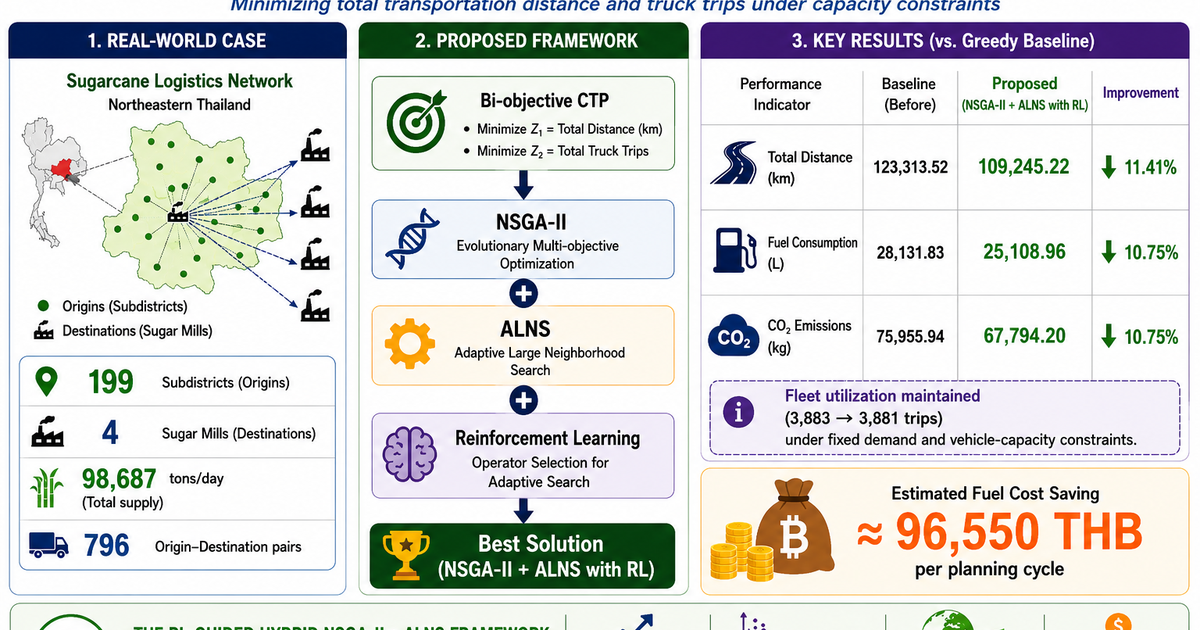
Efficient planning of large-scale agricultural transportation requires balancing travel distance, fleet utilization, and factory capacity constraints. While mixed-integer linear programming (MILP) becomes computationally intractable for large-scale instances and conventional metaheuristics rely on static operator-selection mechanisms, adaptive learning-guided approaches for multi-objective capacitated transportation remain limited. This study proposes a reinforcement learning–guided hybrid NSGA-II + ALNS framework to minimize total transportation distance and truck trips in sugarcane logistics. A real-world case involving 199 subdistricts and four processing plants (796 origin–destination pairs) in northeastern Thailand is examined. Compared with a greedy nearest-assignment baseline, the proposed method reduces total transportation distance from 123,313.52 km to 109,245.22 km (by 11.41%), fuel consumption from 28,131.83 L to 25,108.96 L (by 10.75%), and CO₂ emissions from 75,955.94 kg to 67,794.20 kg (by 10.75%), resulting in an estimated fuel cost saving of approximately 96,550 Thai Baht per cycle. Statistical validation using ANOVA and Tukey’s HSD confirms that performance differences are significant at the 95% confidence level. The results demonstrate that reinforcement learning–guided operator adaptation improves convergence stability, Pareto-front quality, and environmental performance in large-scale bi-objective agricultural transportation systems.
References
Aliano Filho, A., Melo, T., & Pato, M. V. (2020). Tactical planning of sugarcane harvest and transport operations. Retrieved from https://www.econstor.eu/handle/10419/224073
Arabani, A. B., & Farahani, R. Z. (2012). Facility location dynamics: An overview of classifications and applications. Computers & Industrial Engineering, 62(1), 408-420. https://doi.org/10.1016/j.cie.2011.09.018
Bengio, Y., Lodi, A., & Prouvost, A. (2021). Machine learning for combinatorial optimization: A methodological tour d’horizon. European Journal of Operational Research, 290(2), 405-421. https://doi.org/10.1016/j.ejor.2020.07.063
Chetthamrongchai, P., Auansakul, A., & Supawan, D. (2001). Assessing the transportation problems of the sugar cane industry in Thailand. Transport and Communications Bulletin for Asia and the Pacific, 70(2001), 31-39.
Deb, K., Pratap, A., Agarwal, S., & Meyarivan, T. A. M. T. (2002). A fast and elitist multiobjective genetic algorithm: NSGA-II. IEEE Transactions on Evolutionary Computation, 6(2), 182-197. https://doi.org/10.1109/4235.996017
Energy Policy and Planning Office. (2025). Retail diesel price in Thailand. Ministry of Energy. Retrieved from https://www.eppo.go.th
Higgins, A. (2006). Scheduling of road vehicles in sugarcane transport: A case study at an Australian sugar mill. European Journal of Operational Research, 170(3), 987-1000. https://doi.org/10.1016/j.ejor.2004.07.055
Hoff, A., Andersson, H., Christiansen, M., Hasle, G., & Løkketangen, A. (2010). Industrial aspects and literature survey: Fleet composition and routing. Computers & Operations Research, 37(12), 2041-2061. https://doi.org/10.1016/j.cor.2010.03.015
Jena, S. D., & Poggi, M. (2013). Harvest planning in the Brazilian sugar cane industry via mixed integer programming. European Journal of Operational Research, 230(2), 374-384. https://doi.org/10.1016/j.ejor.2013.04.011
Johnn, S. N., Darvariu, V. A., Handl, J., & Kalcsics, J. (2024). A graph reinforcement learning framework for neural adaptive large neighbourhood search. Computers & Operations Research, 172, Article 106791. https://doi.org/10.1016/j.cor.2024.106791
Karimi-Mamaghan, M., Mohammadi, M., Meyer, P., Karimi-Mamaghan, A. M., & Talbi, E. G. (2022). Machine learning at the service of meta-heuristics for solving combinatorial optimization problems: A state-of-the-art. European Journal of Operational Research, 296(2), 393-422. https://doi.org/10.1016/j.ejor.2021.04.032
Krungsri Research. (2023). Business/industry outlook 2024–2026: Sugar industry. Krungsri Bank. Retrieved from https://www.krungsri.com/getmedia/cb3b7846-61c0-4e0b-bffc-b1a44380f9d6/IO_Sugar_240725_EN_EX.pdf.aspx
Naparswad, T. (2013). A study of fuel consumption of trucks [Master’s thesis]. Suranaree University of Technology. Retrieved from https://eng.sut.ac.th/ce/ce_course/download/project/7-1-55/20THOSSAPOL%20NAPARSWAD.pdf
Office of the Cane and Sugar Board (OCSB). (2023). Sugarcane cultivation report 2023/24. Ministry of Industry, Thailand. Retrieved from https://www.ocsb.go.th/2024/reports-articles/area-yield/27524/
Pisinger, D., & Ropke, S. (2018). Large neighborhood search. Handbook of metaheuristics. Cham: Springer International Publishing. Retrieved from https://doi.org/10.1007/978-3-319-91086-4_4
Reijnen, R., Zhang, Y., Lau, H. C., & Bukhsh, Z. (2024). Online control of adaptive large neighborhood search using deep reinforcement learning [Conference presentation]. Proceedings of the international conference on automated planning and scheduling, Washington, DC, US. https://doi.org/10.1609/icaps.v34i1.31507
Rein, P. (2016). Cane sugar engineering. Retrieved from https://www.cabidigitallibrary.org/doi/full/10.5555/20173154754
Ropke, S., & Pisinger, D. (2006). An adaptive large neighborhood search heuristic for the pickup and delivery problem with time windows. Transportation Science, 40(4), 455-472. https://doi.org/10.1287/trsc.1050.0135
Solomon, S., Banerji, R., Shrivastava, A. K., Singh, P., Singh, I., Verma, M., ... & Sawnani, A. (2006). Post-harvest deterioration of sugarcane and chemical methods to minimize sucrose losses. Sugar Tech, 8(1), 74-78. https://doi.org/10.1007/BF02943746
Sun, Y., & Lang, M. (2015). Bi-objective optimization for multi-modal transportation routing planning problem based on Pareto optimality. Journal of Industrial Engineering and Management, 8(4), 1195-1217. https://doi.org/10.3926/jiem.1562
Teixeira, E. D. S., Rangel, S., Florentino, H. D. O., & de Araujo, S. A. (2023). A review of mathematical optimization models applied to the sugarcane supply chain. International Transactions in Operational Research, 30(4), 1755-1788. https://doi.org/10.1111/itor.13056
U.S. Environmental Protection Agency. (2025). GHG emission factors hub. Office of Climate Change Programs. Retrieved from https://www.epa.gov/system/files/documents/2025-01/ghg-emission-factors-hub-2025.pdf
Zitzler, E., & Thiele, L. (1998). Multiobjective optimization using evolutionary algorithms a comparative case study [Conference presentation]. International Conference on Parallel Problem Solving from Nature. Berlin, Heidelberg: Springer Berlin Heidelberg. https://doi.org/10.1007/BFb0056872
Zitzler, E., Deb, K., & Thiele, L. (2000). Comparison of multiobjective evolutionary algorithms: Empirical results. Evolutionary Computation, 8(2), 173-195. https://doi.org/10.1162/106365600568202
Downloads
Published
How to Cite
Issue
Section
Categories
- Industrial engineering > Systems Modeling and Simulation
- Industrial engineering > Statistical and Data Analysis
- Industrial engineering > Operations Research
- Industrial engineering > Logistics and Supply Chain Management
- Industrial engineering
- Computing (Computer Science; Computer Engineering) > Artificial Intelligence (AI)
- Computing (Computer Science; Computer Engineering) > Computer Software
- Computing (Computer Science; Computer Engineering) > Data Science and Analytics
- Computing (Computer Science; Computer Engineering) > Machine Learning and Intelligent Systems
License
Copyright (c) 2026 Journal of Current Science and Technology

This work is licensed under a Creative Commons Attribution-NonCommercial-NoDerivatives 4.0 International License.