Process Indicators of 2018 WHO Cervical Cancer Elimination in Personnel of a Medical School and Their Daughters
DOI:
https://doi.org/10.59796/jcst.V16N2.2026.182Keywords:
cervical cancer elimination, cervical cancer prevention, cervical cancer screening, cervical cancer treatment, HPV vaccination, medical school personnel, WHO targetsAbstract
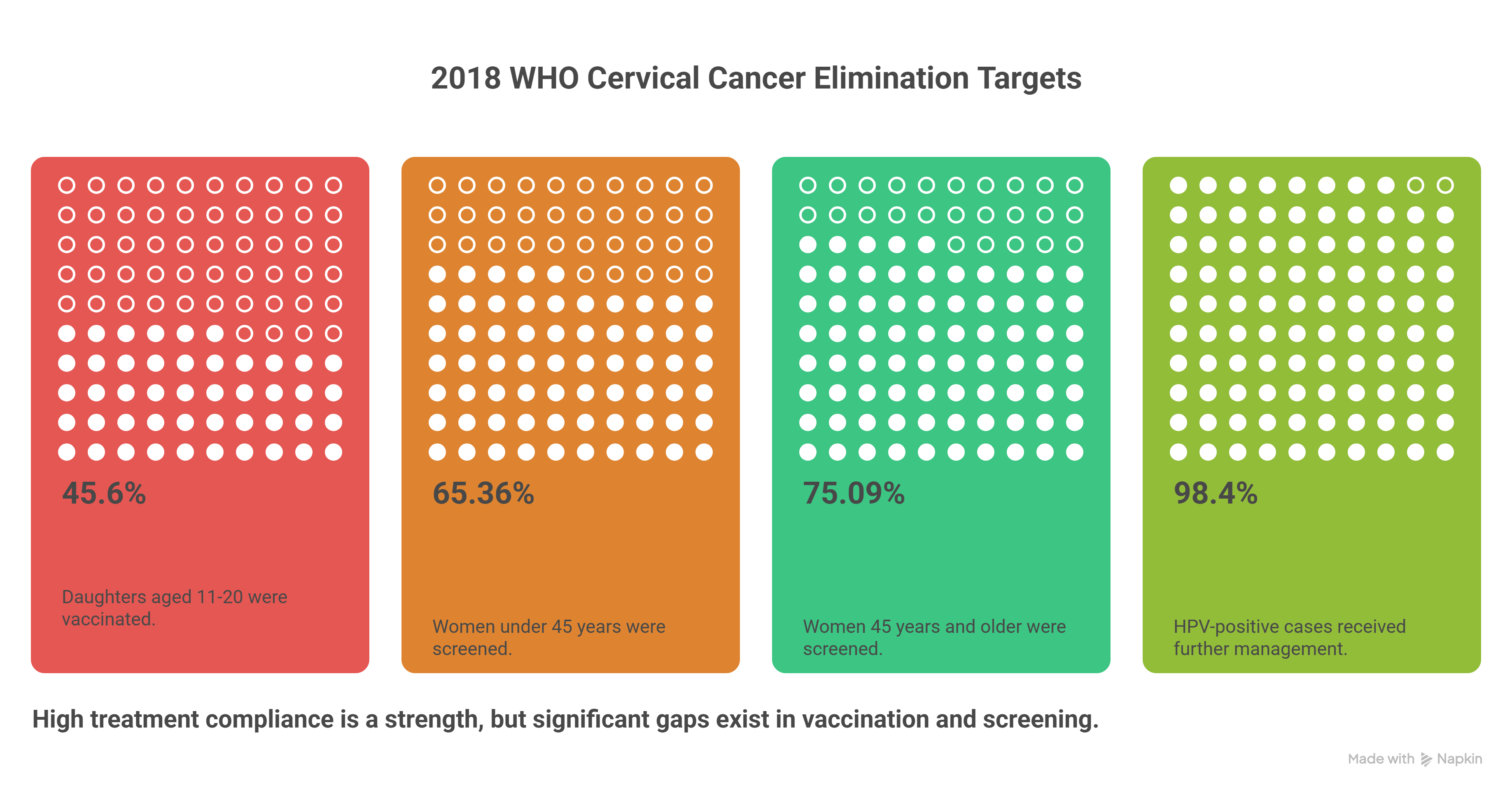
This study aimed to evaluate progress toward the WHO's 2018 cervical cancer elimination targets (90-70-90: % vaccinated, % screened, and % treated) among medical school personnel. This prospective descriptive-analytic study enrolled female medical school personnel aged 20-65 who participated in annual health examinations from March to December 2024. We collected Human Papillomavirus (HPV) vaccination uptake among participants' daughters aged 11−20, cervical cancer screening uptake, and further management data for participants who received abnormal results. Main outcomes were benchmarked against the WHO elimination targets. Among a total of 4,127 female medical school personnel aged 20-65, 3,034 came for the 2024 health check, but only 1,185 participated in cervical screening, and 669 gave their informed consent. Thirteen of them were further excluded because of a previous total hysterectomy, leaving only 656 for analysis. The HPV vaccination rate among the participants' daughters (n = 125) reached only 45.6%, which was significantly below the 90% target. Age-stratified cervical screening rates were 65.36% in women < 45 years (n = 393), and 75.09% in women ≥ 45 years (n = 263)—only those aged ≥ 45 years achieved the 70% target. Sixty-four participants (9.94%) tested positive for HPV. Further management compliance for the HPV-positive cases (n=64) was as high as 98.4%, exceeding the 90% target. Despite high treatment compliance, critical gaps persist in their daughters’ vaccination and screening uptake among medical school personnel. Institution-specific interventions addressing accessibility and workflow optimization are essential to achieve the WHO targets. Such improvements would demonstrate that medical school personnel can serve as a model for community-wide cervical cancer elimination efforts.
References
Bloom, A., Springer, R., Angier, H., Heintzman, J., Likumahuwa-Ackman, S., Huguet, N., ... & DeVoe, J. (2024). Association between a mother’s cervical cancer screening and child’s human papillomavirus (HPV) vaccination status. Maternal and Child Health Journal, 28(12), 2137-2146. https://doi.org/10.1007/s10995-024-03998-0
Brisson, M., & Drolet, M. (2019). Global elimination of cervical cancer as a public health problem. The Lancet Oncology, 20(3), 319-321. https://doi.org/10.1016/S1470-2045(19)30072-5
Brisson, M., Kim, J. J., Canfell, K., Drolet, M., Gingras, G., Burger, E. A., ... & Hutubessy, R. (2020). Impact of HPV vaccination and cervical screening on cervical cancer elimination: A comparative modelling analysis in 78 low-income and lower-middle-income countries. The Lancet, 395(10224), 575-590. https://doi.org/10.1016/S0140-6736(20)30068-4
Bureau of Information, Office of the Permanent Secretary of MOPH. (2017). MOPH signs MOU with all Royal Colleges to develop health system for the first time in Thailand. Retrieved from https://pr.moph.go.th/?url=pr/detail/all/04/104188
Crippin, T., Tounkara, K., Munir, H., Squibb, E., Piotrowski, C., Koita, O. A., ... & De Groot, A. S. (2024). Our daughters-ourselves: evaluating the impact of paired cervical cancer screening of mothers with HPV vaccination for daughters to improve HPV Vaccine coverage in Bamako, Mali. Vaccines, 12(9), Article 1019. https://doi.org/10.3390/vaccines12091019
Department of Disease Control. (2024). Guideline for the second dose HPV vaccination in girls aged 11-20 years after receiving the first dose. Retrieved from https://www.ddc.moph.go.th/uploads/publish/1607620240902103035.pdf
Haruyama, R., Obara, H., & Fujita, N. (2021). What is the current status of Japan's efforts to meet global goals and targets to eliminate cervical cancer?. Global Health & Medicine, 3(1), 44-47. https://doi.org/10.35772/ghm.2020.01070
Health Intervention and Technology Assessment Program. (2020). Announcement of new benefits, 2020, from research to health policy. Retrieved from https://www.hitap.net/178896
Hussein, K., Kokwaro, G., Wafula, F., & Kassie, G. M. (2024). Assessing the influence of the health system on access to cervical cancer prevention, screening, and treatment services at public health centers in Addis Ababa, Ethiopia. Plos One, 19(5), Article e0300152. https://doi.org/10.1371/journal.pone.0300152
Lubeya, M. K., Sinyani, A., Mukosha, M., Lindsay, B., Mumbula, E. M., Agbakwuru, C., ... & Mulundu, G. (2024). Self-reported cervical cancer screening uptake among women of reproductive age in zambia: Evidence from the 2021 Zambia Population-Based HIV impact assessment (ZAMPHIA) survey. Cancer Control, 31, Article 10732748241307361. https://doi.org/10.1177/10732748241307361
Muñoz, N., Franceschi, S., Bosetti, C., Moreno, V., Herrero, R., Smith, J. S., ... & Bosch, F. X. (2002). Role of parity and human papillomavirus in cervical cancer: The IARC multicentric case-control study. The Lancet, 359(9312), 1093-1101. https://doi.org/10.1016/S0140-6736(02)08151-5
Mwalwanda, A., Chavura, E., Chisale, M. R., & Mbakaya, B. C. (2024). Cervical cancer screening among female health workers: Evidence from a secondary health facility in Northern Malawi. Preventive Medicine Reports, 37, Article 102581. https://doi.org/10.1016/j.pmedr.2023.102581
Pasane, J., Sriwatana, K., Krasairsom, K., Suwunnapang, N., Santong, C., & Chumworathayi, B. (2025). Incidence and survival trends of cervical cancer in Khon Kaen, Thailand. Asian Pacific Journal of Cancer Prevention, 26(4), Article 1393. https://doi.org/10.31557/APJCP.2025.26.4.1393
Petersen, Z., Jaca, A., Ginindza, T. G., Maseko, G., Takatshana, S., Ndlovu, P., ... & Moyo, S. (2022). Barriers to uptake of cervical cancer screening services in low-and-middle-income countries: a systematic review. BMC Women's Health, 22(1), Article 486. https://doi.org/10.1186/s12905-022-02043-y
Simms, K. T., Steinberg, J., Caruana, M., Smith, M. A., Lew, J. B., Soerjomataram, I., ... & Canfell, K. (2019). Impact of scaled up human papillomavirus vaccination and cervical screening and the potential for global elimination of cervical cancer in 181 countries, 2020–99: A modelling study. The Lancet Oncology, 20(3), 394-407. https://doi.org/10.1016/S1470-2045(18)30836-2
Spencer, A. M., Brabin, L., Verma, A., & Roberts, S. A. (2013). Mothers’ screening histories influence daughters’ vaccination uptake: An analysis of linked cervical screening and human papillomavirus vaccination records in the North West of England. European Journal of Cancer, 49(6), 1264-1272. https://doi.org/10.1016/j.ejca.2012.12.001
Tekalegn, Y., Sahiledengle, B., Woldeyohannes, D., Atlaw, D., Degno, S., Desta, F., ... & Kene, C. (2022). High parity is associated with increased risk of cervical cancer: Systematic review and meta-analysis of case–control studies. Women's Health, 18, Article 17455065221075904. https://doi.org/10.1177/17455065221075904
Thanasitthichai, S., Ingsirorat, R., Chairat, C., Chiawiriyabunya, I., Wongsena, M., Sripratak, K., et al. (2025). Cancer in Thailand (Vol. XI, pp. 1–232). National Cancer Institute. Retrieved from https://nci.go.th/files/cancer_stat/1771382030_file.pdf
World Health Organization. (2018a). WHO Director-General Calls for All Countries to Take Action to Help End the Suffering Caused by Cervical Cancer. Retrieved from https://www.who.int/news/item/18-05-2018-who-dg-calls-for-all-countries-to-take-action-to-help-end-the-suffering-caused-by-cervical-cancer
World Health Organization. (2018b). Accelerating Cervical Cancer Elimination: Report by the Director-General. Retrieved from http://apps.who.int/gb/ebwha/pdf_files/EB144/B144_28-en.pdf
World Health Organization. (2019). Draft: Global Strategy towards Eliminating Cervical Cancer as a Public Health Problem. Retrieved from https://www.who.int/docs/default-source/cervical-cancer/cerv-cancer-elimn-strategy-16dec-12pm.pdf
World Health Organization. (2022). WHO Updates Recommendations on HPV Vaccination Schedule. Retrieved from https://www.who.int/news/item/20-12-2022-WHO-updates-recommendations-on-HPV-vaccination-schedule
World Health Organization/United Nations Children's Fund. (2019). Progress and Challenges with Achieving Universal Immunization Coverage 2019, 2020. Retrieved from https://www.who.int/docs/default-source/documents/immunization/data/who-unicef-immunisation.pdf?sfvrsn=6bc33c2d_2
Downloads
Published
How to Cite
Issue
Section
Categories
License
Copyright (c) 2026 Journal of Current Science and Technology

This work is licensed under a Creative Commons Attribution-NonCommercial-NoDerivatives 4.0 International License.