Detection of Estrus in Dairy Cows: A Proof-of-Concept Near-Infrared Milk Sensing and Machine-Learning Study
DOI:
https://doi.org/10.59796/jcst.V16N2.2026.181Keywords:
dairy cows, estrus detection, near infrared spectroscopy (NIR), reproductive managementAbstract
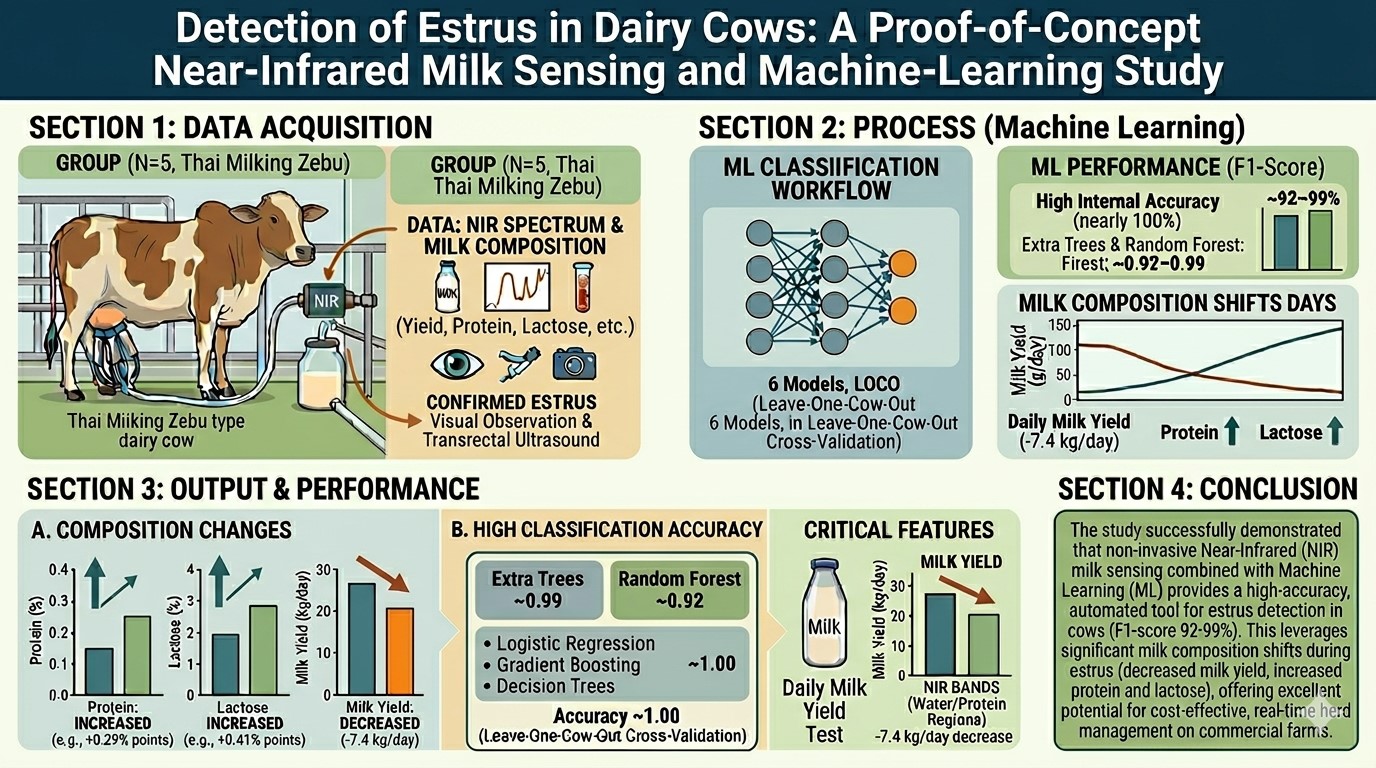
Accurate estrus detection is critical for reproductive management in dairy herds, yet current methods are either labor-intensive or require dedicated hardware. This proof-of-concept study investigated whether near-infrared (NIR) milk spectra, combined with routine milk-composition data, can be used to detect estrus in dairy cows. Five clinically healthy Thai milking cows were monitored for 21 days each (total 593 milk samples), with estrus labels assigned based on experienced stockperson observations confirmed by behavioral signs and tail-paint rubbing. For each sample, inline NIR transmission spectra (860–1754 nm) and milk composition (fat, protein, lactose, solids-not-fat, density, pH, daily yield) were acquired. During estrus, milk composition showed modest but consistent shifts: protein increased by approximately 0.29 percentage points and lactose by 0.41 percentage points, while daily milk yield decreased by about 7.4 ± 2.7 kg/day relative to non-estrus days. A leakage-aware, leave-one-cow-out cross-validation framework was used to compare six classifiers. Logistic regression, gradient boosting, and decision-tree-based ensembles achieved internal accuracies of between 0.99 and 1.00, with Extra Trees and random forest yielding F1-scores of 0.99 and 0.92, respectively. Feature-importance analysis indicated that specific NIR bands in the water and protein-related regions, together with milk yield and protein percentage, contributed most strongly to estrus discrimination, whereas density and pH had minimal influence. These proof-of-concept results (N = 5, single site) demonstrate technical feasibility but require multi-site validation in substantially larger cohorts (N ≥ 50) before any clinical or on-farm adoption can be recommended.
References
Aernouts, B., Polshin, E., Saeys, W., & Lammertyn, J. (2011). Mid-infrared spectrometry of milk for dairy metabolomics: A comparison of two sampling techniques and effect of homogenization. Analytica Chimica Acta, 705(1-2), 88-97. https://doi.org/10.1016/j.aca.2011.04.018
Aernouts, B., Van Beers, R., Watté, R., Huybrechts, T., Lammertyn, J., & Saeys, W. (2015). Visible and near-infrared bulk optical properties of raw milk. Journal of Dairy Science, 98(10), 6727-6738. https://doi.org/10.3168/jds.2015-9630
Agutu, F. O., Mbuku, S. M., Ondiek, J. O., & Bebe, B. O. (2024). Economic viability of using OvSynch and fixed timed artificial insemination protocol in breeding improvement of pastoral herds in the rangelands. Tropical Animal Health and Production, 56(2), Article 68. https://doi.org/10.1007/s11250-024-03907-1
Arıkan, İ., Ayav, T., Seçkin, A. Ç., & Soygazi, F. (2023). Estrus detection and dairy cow identification with cascade deep learning for augmented reality-ready livestock farming. Sensors, 23(24), Article 9795. https://doi.org/10.3390/s23249795
Baeten, V., & Dardenne, P. (2021). Application of NIR in agriculture. In Y. Ozaki, C. Huck, S. Tsuchikawa, & S. B. Engelsen (Eds.), Near-infrared spectroscopy: Theory, spectral analysis, instrumentation, and applications (pp. 331–345). Springer. https://doi.org/10.1007/978-981-15-8648-4_14
Behdad, S., Pakdel, A., & Massudi, R. (2024). A novel diagnostic approach to Paratuberculosis in dairy cattle using near-infrared spectroscopy and aquaphotomics. Frontiers in Cellular and Infection Microbiology, 14, Article 1374560. https://doi.org/10.3389/fcimb.2024.1374560
Benos, L., Tagarakis, A. C., Dolias, G., Berruto, R., Kateris, D., & Bochtis, D. (2021). Machine learning in agriculture: A comprehensive updated review. Sensors, 21(11), Article 3758. https://doi.org/10.3390/s21113758
Caponigro, V., Marini, F., Scannell, A. G., & Gowen, A. A. (2023). Single-drop technique for lactose prediction in dry milk on metallic surfaces: Comparison of Raman, FT–NIR, and FT–MIR spectral imaging. Food Control, 144, Article 109351. https://doi.org/10.1016/j.foodcont.2022.109351
Chen, Y., Wang, S., & Zhang, F. (2023). Near-infrared luminescence high-contrast in vivo biomedical imaging. Nature Reviews Bioengineering, 1(1), 60-78. https://doi.org/10.1038/s44222-022-00002-8
da Silva Santos, A., de Medeiros, V. W. C., & Gonçalves, G. E. (2023). Monitoring and classification of cattle behavior: A survey. Smart Agricultural Technology, 3, Article 100091. https://doi.org/10.1016/j.atech.2022.100091
Denis-Robichaud, J., Oliveira, A. P., Sica, A., Soriano, S., Araújo, R. L., Pereira, M. H. C., ... & Vasconcelos, J. L. M. (2024). Is prolonged luteal phase a problem in lactating Holstein cows?. Journal of Dairy Science, 107(10), 8582-8591. https://doi.org/10.3168/jds.2024-24792
Džermeikaitė, K., Bačėninaitė, D., & Antanaitis, R. (2023). Innovations in cattle farming: application of innovative technologies and sensors in the diagnosis of diseases. Animals, 13(5), Article 780. https://doi.org/10.3390/ani13050780
Evangelista, C., Basiricò, L., & Bernabucci, U. (2021). An overview on the use of near infrared spectroscopy (NIRS) on farms for the management of dairy cows. Agriculture, 11(4), Article 296. https://doi.org/10.3390/agriculture11040296
Folman, Y., Kaim, M., Herz, Z., & Rosenberg, M. (1984). Reproductive management of dairy cattle based on synchronization of estrous cycles. Journal of Dairy Science, 67(1), 153-160. https://doi.org/10.3168/jds.S0022-0302(84)81279-5
Golic, M., Walsh, K., & Lawson, P. (2003). Short-wavelength near-infrared spectra of sucrose, glucose, and fructose with respect to sugar concentration and temperature. Applied Spectroscopy, 57(2), 139-145. https://doi.org/10.1366/000370203321535033
Hempstalk, K., McParland, S., & Berry, D. P. (2015). Machine learning algorithms for the prediction of conception success to a given insemination in lactating dairy cows. Journal of Dairy Science, 98(8), 5262-5273. https://doi.org/10.3168/jds.2014-8984
Ho, P. N., & Pryce, J. E. (2020). Predicting the likelihood of conception to first insemination of dairy cows using milk mid-infrared spectroscopy. Journal of Dairy Science, 103(12), 11535-11544. https://doi.org/10.3168/jds.2020-18589
Ho, P. N., Bonfatti, V., Luke, T. D. W., & Pryce, J. E. (2019). Classifying the fertility of dairy cows using milk mid-infrared spectroscopy. Journal of Dairy Science, 102(11), 10460-10470. https://doi.org/10.3168/jds.2019-16412
Holroyd, S. E. (2013). The use of near infrared spectroscopy on milk and milk products. Journal of Near Infrared Spectroscopy, 21(5), 311-322. https://doi.org/10.1255/jnirs.1055
Islam, R. (2011). Synchronization of estrus in cattle: a review. Veterinary World, 4(3), 136-141. https://doi.org/10.5455/vetworld.2011.136-141
Kaddour, A. A., Grand, E., Barouh, N., Baréa, B., Villeneuve, P., & Cuq, B. (2006). Near‐infrared spectroscopy for the determination of lipid oxidation in cereal food products. European Journal of Lipid Science and Technology, 108(12), 1037-1046. https://doi.org/10.1002/ejlt.200600132
Karamizadeh, S., Abdullah, S. M., Manaf, A. A., Zamani, M., & Hooman, A. (2013). An overview of principal component analysis. Journal of Signal and Information Processing, 4(3B), 173-175. https://doi.org/10.4236/jsip.2013.43B031
Kawamura, S., Kawasaki, M., Nakatsuji, H., & Natsuga, M. (2007). Near-infrared spectroscopic sensing system for online monitoring of milk quality during milking. Sensing and Instrumentation for Food Quality and Safety, 1(1), 37-43. https://doi.org/10.1007/s11694-006-9001-x
Kleanthous, N., Hussain, A. J., Khan, W., Sneddon, J., Al-Shamma'a, A., & Liatsis, P. (2022). A survey of machine learning approaches in animal behaviour. Neurocomputing, 491, 442-463. https://doi.org/10.1016/j.neucom.2021.10.126
Lanjewar, M. G., Parab, J. S., & Kamat, R. K. (2024). Machine learning based technique to predict the water adulterant in milk using portable near infrared spectroscopy. Journal of Food Composition and Analysis, 131, Article 106270. https://doi.org/10.1016/j.jfca.2024.106270
Le, A. T., Shakiba, M., Ardekani, I., & Abdulla, W. H. (2024). Optimizing plant disease classification with hybrid convolutional neural network–recurrent neural network and liquid time-constant network. Applied Sciences, 14(19), Article 9118. https://doi.org/10.3390/app14199118
Liakos, K. G., Busato, P., Moshou, D., Pearson, S., & Bochtis, D. (2018). Machine learning in agriculture: A review. Sensors, 18(8), Article 2674. https://doi.org/10.3390/s18082674
Mahendran, S. A., Wathes, D. C., Booth, R. E., & Blackie, N. (2023). Effects of the individual and pair housing of calves on long-term heifer production on a UK commercial dairy farm. Animals, 14(1), Article 125. https://doi.org/10.3390/ani14010125
McDougall, S. (2006). Reproduction performance and management of dairy cattle. Journal of Reproduction and Development, 52(1), 185-194. https://doi.org/10.1262/jrd.17091
Muncan, J., Tei, K., & Tsenkova, R. (2021). Real-time monitoring of yogurt fermentation process by aquaphotomics near-infrared spectroscopy. Sensors, 21(1), Article 177. https://doi.org/10.3390/s21010177
Paisley, L. G., Mickelsen, W. D., & Frost, O. L. (1978). A survey of the incidence of prenatal mortality in cattle following pregnancy diagnosis by rectal palpation. Theriogenology, 9(6), 481-491. https://doi.org/10.1016/0093-691X(78)90113-9
Palmer, M. A., Olmos, G., Boyle, L. A., & Mee, J. F. (2010). Estrus detection and estrus characteristics in housed and pastured Holstein–Friesian cows. Theriogenology, 74(2), 255-264. https://doi.org/10.1016/j.theriogenology.2010.02.009
Petit, H. V., Dewhurst, R. J., Proulx, J. G., Khalid, M., Haresign, W., & Twagiramungu, H. (2001). Milk production, milk composition, and reproductive function of dairy cows fed different fats. Canadian Journal of Animal Science, 81(2), 263-271. https://doi.org/10.4141/A00-096
Phuphaphud, A., Saengprachatanarug, K., Posom, J., Taira, E., & Panduangnate, L. (2022). Prediction and classification of energy content in growing cane stalks for breeding programmes using visible and shortwave near infrared. Sugar Tech, 24(5), 1497-1509. https://doi.org/10.1007/s12355-021-01075-2
Ramirez-Morales, I., Aguilar, L., Fernandez-Blanco, E., Rivero, D., Perez, J., & Pazos, A. (2021). Detection of bovine mastitis in raw milk, using a low-cost NIR spectrometer and k-NN algorithm. Applied Sciences, 11(22), Article 10751. https://doi.org/10.3390/app112210751
Recio, J. A., Hermosilla, T., Ruiz, L. A., & Palomar, J. (2013). Automated extraction of tree and plot-based parameters in citrus orchards from aerial images. Computers and Electronics in Agriculture, 90, 24-34. https://doi.org/10.1016/j.compag.2012.10.005
Reith, S., & Hoy, S. (2018). Review: Behavioral signs of estrus and the potential of fully automated systems for detection of estrus in dairy cattle. Animal, 12(2), 398–407. https://doi.org/10.1017/S1751731117001975
Sayid, A., Mosissa, D., Asnaku, F., Tamrat, D., Ayda, M., & Asmarech, Y. (2024). Behavioral and physical signs of estrous manifested in hormonally estrus-induced boran and holstein friesian dairy cattle. EAS Journal of Veterinary Medical Science, 6, 1-8. https://doi.org/10.36349/easjvms.2024.v06i01.001
Schilkowsky, E. M., Granados, G. E., Sitko, E. M., Masello, M., Perez, M. M., & Giordano, J. O. (2021). Evaluation and characterization of estrus alerts and behavioral parameters generated by an ear-attached accelerometer-based system for automated detection of estrus. Journal of Dairy Science, 104(5), 6222-6237. https://doi.org/10.3168/jds.2020-19667
Sharma, A., Jain, A., Gupta, P., & Chowdary, V. (2020). Machine learning applications for precision agriculture: A comprehensive review. IEEE Access, 9, 4843-4873. https://doi.org/10.1109/ACCESS.2020.3048415
Shine, P., & Murphy, M. D. (2021). Over 20 years of machine learning applications on dairy farms: A comprehensive mapping study. Sensors, 22(1), Article 52. https://doi.org/10.3390/s22010052
Sokolova, M., & Lapalme, G. (2009). A systematic analysis of performance measures for classification tasks. Information Processing & Management, 45(4), 427-437. https://doi.org/10.1016/j.ipm.2009.03.002
Sveberg, G., Rogers, G. W., Cooper, J., Refsdal, A. O., Erhard, H. W., Kommisrud, E., ... & Ropstad, E. (2015). Comparison of Holstein-Friesian and Norwegian Red dairy cattle for estrus length and estrous signs. Journal of Dairy Science, 98(4), 2450-2461. https://doi.org/10.3168/jds.2014-8905
Szenci, O. (2021). Recent possibilities for the diagnosis of early pregnancy and embryonic mortality in dairy cows. Animals, 11(6), Article 1666. https://doi.org/10.3390/ani11061666
Takemura, G., Bázár, G., Ikuta, K., Yamaguchi, E., Ishikawa, S., Furukawa, A., ... & Tsenkova, R. (2015). Aquagrams of raw milk for oestrus detection in dairy cows. Reproduction in Domestic Animals, 50(3), 522-525. https://doi.org/10.1111/rda.12504
Tenghe, A. M. M., Bouwman, A. C., Berglund, B., Strandberg, E., Blom, J. Y., & Veerkamp, R. F. (2015). Estimating genetic parameters for fertility in dairy cows from in-line milk progesterone profiles. Journal of Dairy Science, 98(8), 5763-5773. https://doi.org/10.3168/jds.2014-8732
Toledo-Alvarado, H., Vazquez, A. I., De Los Campos, G., Tempelman, R. J., Gabai, G., Cecchinato, A., & Bittante, G. (2018). Changes in milk characteristics and fatty acid profile during the estrous cycle in dairy cows. Journal of Dairy Science, 101(10), 9135-9153. https://doi.org/10.3168/jds.2018-14480
Tsenkova, R., Atanassova, S., Morita, H., Ikuta, K., Toyoda, K., Iordanova, I. K., & Hakogi, E. (2006). Near infrared spectra of cows' milk for milk quality evaluation: Disease diagnosis and pathogen identification. Journal of Near Infrared Spectroscopy, 14(6), 363-370. https://doi.org/10.1255/jnirs.661
Vance, C. K., Tolleson, D. R., Kinoshita, K., Rodriguez, J., & Foley, W. J. (2016). Near infrared spectroscopy in wildlife and biodiversity. Journal of Near Infrared Spectroscopy, 24(1), 1-25. https://doi.org/10.1255/jnirs.1199
Wang, J., Zhang, Y., Bell, M., & Liu, G. (2022a). Potential of an activity index combining acceleration and location for automated estrus detection in dairy cows. Information Processing in Agriculture, 9(2), 288-299. https://doi.org/10.1016/j.inpa.2021.04.003
Wang, Y., Kang, X., He, Z., Feng, Y., & Liu, G. (2022b). Accurate detection of dairy cow mastitis with deep learning technology: A new and comprehensive detection method based on infrared thermal images. Animal, 16(10), Article 100646. https://doi.org/10.1016/j.animal.2022.100646
Wenz, J. J. (2021). Influence of steroids on hydrogen bonds in membranes assessed by near infrared spectroscopy. Biochimica et Biophysica Acta (BBA)-Biomembranes, 1863(4), Article 183553. https://doi.org/10.1016/j.bbamem.2021.183553
Weyer, L. G., & Lo, S.-C. (2006). Spectra–structure correlations in the near-infrared. In J. M. Chalmers & P. R. Griffiths (Eds.), Handbook of Vibrational Spectroscopy. John Wiley & Sons, Ltd. https://doi.org/10.1002/0470027320.s4102
Workman Jr, J. J. (1996). Interpretive spectroscopy for near infrared. Applied Spectroscopy Reviews, 31(3), 251-320. https://doi.org/10.1080/05704929608000571
Wu, D., He, Y., & Feng, S. (2008). Short-wave near-infrared spectroscopy analysis of major compounds in milk powder and wavelength assignment. Analytica Chimica Acta, 610(2), 232-242. https://doi.org/10.1016/j.aca.2008.01.056
Wu, X., Wu, B., Sun, J., & Yang, N. (2017). Classification of apple varieties using near infrared reflectance spectroscopy and fuzzy discriminant c‐means clustering model. Journal of Food Process Engineering, 40(2), Article e12355. https://doi.org/10.1111/jfpe.12355
Yang, K., An, C., Zhu, J., Guo, W., Lu, C., & Zhu, X. (2022). Comparison of near-infrared and dielectric spectra for quantitative identification of bovine colostrum adulterated with mature milk. Journal of Dairy Science, 105(11), 8638-8649. https://doi.org/10.3168/jds.2022-21969
Yeung, K. Y., & Ruzzo, W. L. (2001). Principal component analysis for clustering gene expression data. Bioinformatics, 17(9), 763-774. https://doi.org/10.1093/bioinformatics/17.9.763
Yizengaw, L. (2017). Review on estrus synchronization and its application in cattle. International Journal of Advanced Research in Biological Sciences, 4(4), 67-76. http://doi.org/10.22192/ijarbs.2017.04.04.010
Downloads
Published
How to Cite
License
Copyright (c) 2026 Journal of Current Science and Technology

This work is licensed under a Creative Commons Attribution-NonCommercial-NoDerivatives 4.0 International License.