Integrating Perceived Risk and Spatial Data for Urban Junction Safety: A Micro-Spatial Machine Learning Approach
DOI:
https://doi.org/10.59796/jcst.V16N2.2026.185Keywords:
crash risk perception, ensemble machine learning, geographic information systems, near-miss identification, road safety, spatial analysis, urban mobilityAbstract
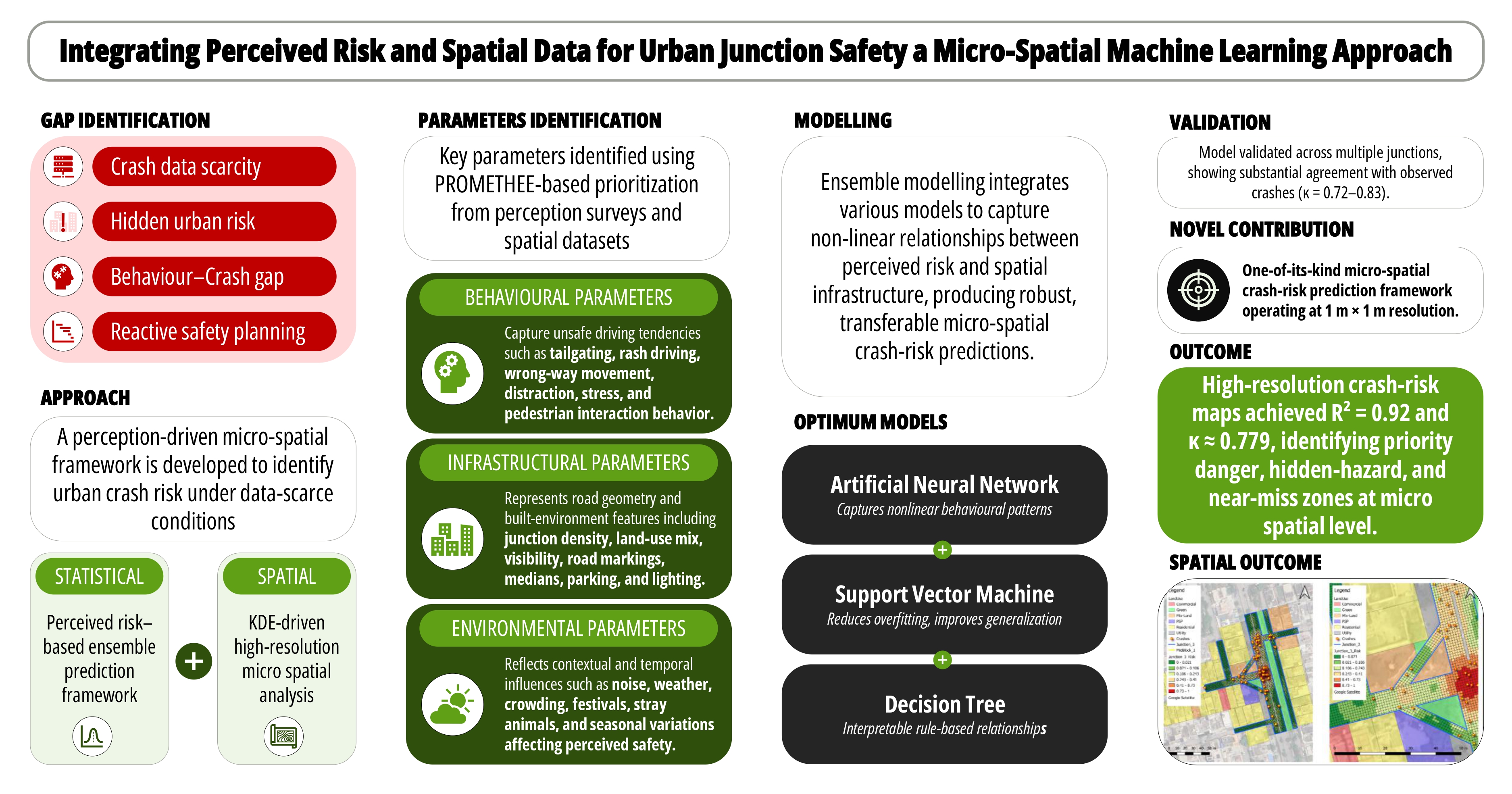
Road traffic crashes (RTCs) remain a leading global cause of mortality, yet conventional safety analyses often overlook how individuals perceive road risk, a key behavioral dimension influencing crash likelihood. In many developing cities, the absence of comprehensive crash databases further limits evidence-based safety planning. This study addresses these challenges by developing a transferable ensemble machine learning framework across junctions that predicts crash-risk hotspots using perceived risk as a proxy under data-scarce conditions. The framework integrates GIS (Geographic Information Systems)-based infrastructure mapping, KDE (Kernel Density Estimation)-derived spatial perception maps, PROMETHEE-based parameter prioritization, and an ensemble of Artificial Neural Networks (ANN), Support Vector Machines (SVM), and Decision Trees (DT) to enable scalable, microspatial safety analysis. Perceptions of risk across behavioral, infrastructure, and environmental factors were systematically mapped using Geographic Information Systems (GIS) and modeled through the ensemble model. The optimized ensemble achieved high predictive performance (R² = 0.92, kappa = 0.779), effectively integrating psychological perception with spatial infrastructure data at a micro-spatial resolution of 1 m × 1 m. Strong correlations emerged between perceived risk and determinants such as tailgating tendency (r = 0.9347), building density and land-use mix (r = 0.9497), and poor lighting in dense areas (r = –0.3714). The resulting Crash Risk Perception Index (CRPI) revealed distinct spatial clusters, distinguishing validated danger zones from perceptual–empirical divergences. Hidden hazard zones (6.1% of cells) - high crash frequency but low perceived risk - and near-miss zones (12.7% of cells) - low crash frequency but high perceived risk - were identified as priority locations for targeted awareness, enforcement, and design interventions. Validation across three additional urban junctions (kappa = 0.72–0.83) demonstrated robustness and transferability. The framework enables cities lacking crash databases to proactively identify high-risk and near-miss zones, supporting perception-informed and evidence-based strategies for safer, more resilient urban mobility systems.
References
Abdulhafedh, A. (2017). Road traffic crash data: An overview on sources, problems, and collection methods. Journal of Transportation Technologies, 7(2), 206-219. http://doi.org/10.4236/jtts.2017.72015
Adanu, E. K., Smith, R., Powell, L., & Jones, S. (2017). Multilevel analysis of the role of human factors in regional disparities in crash outcomes. Accident Analysis & Prevention, 109, 10-17. https://doi.org/10.1016/j.aap.2017.09.022
Akanbi, O. G., Charles‐Owaba, O. E., & Oluleye, A. E. (2009). Human factors in traffic accidents in Lagos, Nigeria. Disaster Prevention and Management: An International Journal, 18(4), 397-409. https://doi.org/10.1108/09653560910984456
Albert, G., & Bekhor, S. (2019). Modelling risky driving behaviour: The role of latent variables in overtaking decision on two-lane highways. European Journal of Transport and Infrastructure Research, 19(3), 196-213. https://doi.org/10.18757/ejtir.2019.19.3.4385
Andersson, H. (2011). Perception of own death risk: An assessment of road‐traffic mortality risk. Risk Analysis: An International Journal, 31(7), 1069-1082. https://doi.org/10.1111/j.1539-6924.2011.01583.x
Berhanu, Y., Alemayehu, E., & Schröder, D. (2023). Examining car accident prediction techniques and road traffic congestion: A comparative analysis of road safety and prevention of world challenges in low‐income and high‐income countries. Journal of Advanced Transportation, 2023(1), Article 6643412. https://doi.org/10.1155/2023/6643412
Bivina, G. R., & Parida, M. (2019). Modelling perceived pedestrian level of service of sidewalks: A structural equation approach. Transport, 34(3), 339-350. https://doi.org/10.3846/transport.2019.9819
Black, W. R. (1991). Highway accidents: A spatial and temporal analysis. Transportation Research Record, 1318, 75-82.
Black, W. R., & Thomas, I. (1998). Accidents on Belgium's motorways: A network autocorrelation analysis. Journal of Transport Geography, 6(1), 23-31. https://doi.org/10.1016/S0966-6923(97)00037-9
Brüde, U., & Larsson, J. (2000). What roundabout design provides the highest possible safety?. Nordic Road and Transport Research, 12(2), 17-21.
Bucsuházy, K., Matuchová, E., Zůvala, R., Moravcová, P., Kostíková, M., & Mikulec, R. (2020). Human factors contributing to the road traffic accident occurrence. Transportation Research Procedia, 45, 555-561. https://doi.org/10.1016/j.trpro.2020.03.057
Cabrera-Arnau, C., Prieto Curiel, R., & Bishop, S. R. (2020). Uncovering the behaviour of road accidents in urban areas. Royal Society Open Science, 7(4), Article 191739. https://doi.org/10.1098/rsos.191739
Chen, S., & Zheng, W. (2025). RRMSE-enhanced weighted voting regressor for improved ensemble regression. PloS One, 20(3), Article e0319515. https://doi.org/10.1371/journal.pone.0319515
Choudhary, J., Ohri, A., & Kumar, B. (2015). Spatial and statistical analysis of road accidents hot spots using GIS [Conference presentation]. 3rd Conference of Transportation Research Group of India (3rd CTRG), West Bengal, India.
Dai, D. (2012). Identifying clusters and risk factors of injuries in pedestrian–vehicle crashes in a GIS environment. Journal of Transport Geography, 24, 206-214. https://doi.org/10.1016/j.jtrangeo.2012.02.005
de Blaeij, A. T., & van Vuuren, D. J. (2003). Risk perception of traffic participants. Accident Analysis & Prevention, 35(2), 167-175. https://doi.org/10.1016/S0001-4575(01)00100-2
Elander, J., West, R., & French, D. (1993). Behavioral correlates of individual differences in road-traffic crash risk: An examination of methods and findings. Psychological Bulletin, 113(2), Article 279. https://doi.org/10.1037/0033-2909.113.2.279
Erdfelder, E., Faul, F., & Buchner, A. (1996). GPOWER: A general power analysis program. Behavior Research Methods, Instruments, & Computers, 28(1), 1-11. https://doi.org/10.3758/BF03203630
Erdogan, S. (2009). Explorative spatial analysis of traffic accident statistics and road mortality among the provinces of Turkey. Journal of Safety Research, 40(5), 341-351. https://doi.org/10.1016/j.jsr.2009.07.006
Ewing, R., & Dumbaugh, E. (2009). The built environment and traffic safety: A review of empirical evidence. Journal of Planning Literature, 23(4), 347-367. https://doi.org/10.1177/0885412209335553
Goswami, S. S. (2020). Outranking methods: Promethee i and promethee ii. Foundations of Management, 12(1), 93-110. https://doi.org/10.2478/fman-2020-0008
Guerrero, T. E., de Dios Ortuzar, J., & Raveau, S. (2020). Traffic accident risk perception among drivers: A latent variable approach. Transportation Planning and Technology, 43(3), 313-324. https://doi.org/10.1080/03081060.2020.1735763
Halabaku, E., & Bytyçi, E. (2024). Overfitting in machine learning: A comparative analysis of decision trees and random forests. Intelligent Automation & Soft Computing, 39(6), 987-1006. https://doi.org/10.32604/iasc.2024.059429
Hallett, C., Lambert, A., & Regan, M. A. (2012). Text messaging amongst New Zealand drivers: Prevalence and risk perception. Transportation Research Part F: Traffic Psychology and Behaviour, 15(3), 261-271. https://doi.org/10.1016/j.trf.2011.12.002
Ialongo, C. (2016). Understanding the effect size and its measures. Biochemia Medica, 26(2), 150-163. https://doi.org/10.11613/BM.2016.015
Iamtrakul, P., & Chayphong, S. (2023). Factors affecting the development of a healthy city in Suburban areas, Thailand. Journal of Urban Management, 12(3), 208-220. https://doi.org/10.1016/j.jum.2023.04.002
Jadaan, K., Al-Braizat, E., Al-Rafayah, S., Gammoh, H., & Abukahlil, Y. (2018). Traffic safety in developed and developing countries: A comparative analysis. Journal of Traffic and Logistics Engineering, 6(1), Article 157. https://doi.org/10.18178/jtle.6.1.1-5
Kam, B. H. (2003). A disaggregate approach to crash rate analysis. Accident Analysis & Prevention, 35(5), 693-709. https://doi.org/10.1016/S0001-4575(02)00048-9
Keken, Z., Sedoník, J., Kušta, T., Andrášik, R., & Bíl, M. (2019). Roadside vegetation influences clustering of ungulate vehicle collisions. Transportation Research Part D: Transport and Environment, 73, 381-390. https://doi.org/10.1016/j.trd.2019.07.013
Kemal, Ö. (2020). Power analysis and sample size, when and why?. Turkish Archives of Otorhinolaryngology, 58(1), 3-4. https://doi.org/10.5152/tao.2020.0330
Legree, P. J., Heffner, T. S., Psotka, J., Martin, D. E., & Medsker, G. J. (2003). Traffic crash involvement: Experiential driving knowledge and stressful contextual antecedents. Journal of Applied Psychology, 88(1), 15-26. https://doi.org/10.1037/0021-9010.88.1.15
Levine, N., Kim, K. E., & Nitz, L. H. (1995). Spatial analysis of Honolulu motor vehicle crashes: I. Spatial patterns. Accident Analysis & Prevention, 27(5), 663-674. https://doi.org/10.1016/0001-4575(95)00017-T
Lund, I. O., & Rundmo, T. (2009). Cross-cultural comparisons of traffic safety, risk perception, attitudes and behaviour. Safety Science, 47(4), 547-553. https://doi.org/10.1016/j.ssci.2008.07.008
Ma, Y., Meng, H., Chen, S., Zhao, J., Li, S., & Xiang, Q. (2020). Predicting traffic conflicts for expressway diverging areas using vehicle trajectory data. Journal of Transportation Engineering, Part A: Systems, 146(3), Article 4020003. https://doi.org/10.1061/JTEPBS.0000320
Machado-León, J. L., de Oña, J., de Oña, R., Eboli, L., & Mazzulla, G. (2016). Socio-economic and driving experience factors affecting drivers’ perceptions of traffic crash risk. Transportation Research Part F: Traffic Psychology and Behaviour, 37, 41-51. https://doi.org/10.1016/j.trf.2015.11.010
McKenna, F. P., Horswill, M. S., & Alexander, J. L. (2006). Does anticipation training affect drivers' risk taking?. Journal of Experimental Psychology: Applied, 12(1), Article 1. https://psycnet.apa.org/doi/10.1037/1076-898X.12.1.1
Mukherjee, D., & Mitra, S. (2020). Modelling risk factors for fatal pedestrian crashes in Kolkata, India. International Journal of Injury Control and Safety Promotion, 27(2), 197-214. https://doi.org/10.1080/17457300.2020.1725894
Özkan, T., Lajunen, T., Doğruyol, B., Yıldırım, Z., & Çoymak, A. (2012). Motorcycle accidents, rider behaviour, and psychological models. Accident Analysis & Prevention, 49, 124-132. https://doi.org/10.1016/j.aap.2011.03.009
Panimalar, S. A., & Krishnakumar, A. (2023). A review of churn prediction models using different machine learning and deep learning approaches in cloud environment. Journal of Current Science and Technology, 13(1), 136-161. https://doi.org/10.14456/jcst.2023.12
Petch, R. O., & Henson, R. R. (2000). Child road safety in the urban environment. Journal of Transport Geography, 8(3), 197-211. https://doi.org/10.1016/S0966-6923(00)00006-5
Petridou, E., & Moustaki, M. (2000). Human factors in the causation of road traffic crashes. European Journal of Epidemiology, 16(9), 819-826. https://doi.org/10.1023/A:1007649804201
Prasannakumar, V., Vijith, H., Charutha, R., & Geetha, N. (2011). Spatio-temporal clustering of road accidents: GIS based analysis and assessment. Procedia-Social and Behavioral Sciences, 21, 317-325. https://doi.org/10.1016/j.sbspro.2011.07.020
Ram, T., & Chand, K. (2016). Effect of drivers’ risk perception and perception of driving tasks on road safety attitude. Transportation Research Part F: Traffic Psychology and Behaviour, 42, 162-176. https://doi.org/10.1016/j.trf.2016.07.012
Rankavat, S., & Tiwari, G. (2015). Association between built environment and pedestrian fatal crash risk in Delhi, India. Transportation Research Record, 2519(1), 61-66. https://doi.org/10.3141/2519-07
Rankavat, S., & Tiwari, G. (2016). Pedestrians risk perception of traffic crash and built environment features–Delhi, India. Safety Science, 87, 1-7. https://doi.org/10.1016/j.ssci.2016.03.009
Retting, R. A., Ferguson, S. A., & McCartt, A. T. (2003). A review of evidence-based traffic engineering measures designed to reduce pedestrian–motor vehicle crashes. American Journal of Public Health, 93(9), 1456-1463. https://doi.org/10.2105/AJPH.93.9.1456
Sajed, Y., Shafabakhsh, G., & Bagheri, M. (2019). Hotspot location identification using accident data, traffic and geometric characteristics. Engineering Journal, 23(6), 191-207. https://doi.org/10.4186/ej.2019.23.6.191
Shahi, S., Brussel, M., & Grigolon, A. (2023). Spatial analysis of road traffic crashes and user based assessment of road safety: A case study of Rotterdam. Traffic Injury Prevention, 24(7), 567-576. https://doi.org/10.1080/15389588.2023.2234530
Simmachan, T., & Boonkrong, P. (2025). Effect of resampling techniques on machine learning models for classifying road accident severity in Thailand. Journal of Current Science and Technology, 15(2), Article 99. https://doi.org/10.59796/jcst.V15N2.2025.99
Sjöberg, L., Moen, B. E., & Rundmo, T. (2004). Explaining risk perception. An evaluation of the psychometric paradigm in risk perception research. Rotunde Publikasjoner Rotunde, 84, 55-76.
Soltani, A., & Askari, S. (2017). Exploring spatial autocorrelation of traffic crashes based on severity. Injury, 48(3), 637-647. https://doi.org/10.1016/j.injury.2017.01.032
Steenberghen, T., Dufays, T., Thomas, I., & Flahaut, B. (2004). Intra-urban location and clustering of road accidents using GIS: A Belgian example. International Journal of Geographical Information Science, 18(2), 169-181. https://doi.org/10.1080/13658810310001629619
Vergel-Tovar, C., López, S., Lleras, N., Hidalgo, D., Rincon, M., Orjuela, S., & Vega, J. (2020). Examining the relationship between road safety outcomes and the built environment in Bogotá, Colombia. Journal of Road Safety, 31(3), 33-47. https://doi.org/10.33492/JRS-D-20-00254
Verma, N. K., Chaudhary, M. H. K., & Soni, M. D. K. (2022). A Study of on-Street Parking Vehicle in Sonipat City. International Journal for Science Technology and Engineering, 10, 37-42. https://doi.org/10.22214/ijraset.2022.46948
von Stülpnagel, R., & Lucas, J. (2020). Crash risk and subjective risk perception during urban cycling: Evidence for congruent and incongruent sources. Accident Analysis & Prevention, 142, Article 105584. https://doi.org/10.1016/j.aap.2020.105584
Wang, X., Peng, Y., Yi, S., Wang, H., & Yu, W. (2021a). Risky behaviors, psychological failures and kinematics in vehicle-to-powered two-wheeler accidents: Results from in-depth Chinese crash data. Accident Analysis & Prevention, 156, Article 106150. https://doi.org/10.1016/j.aap.2021.106150
Wang, M., Yi, J., Chen, X., Zhang, W., & Qiang, T. (2021b). Spatial and Temporal distribution analysis of traffic accidents using GIS‐Based data in Harbin. Journal of Advanced Transportation, 2021(1), Article 9207500. https://doi.org/10.1155/2021/9207500
World Health Organization. (2021). WHO Kicks Off a Decade of Action for Road Safety. Retrieved from https://www.who.int/news/item/28-10-2021-who-kicks-off-a-decade-of-action-for-road-safety
Xiao, T., Lu, H., Wang, J., & Wang, K. (2021). Predicting and interpreting spatial accidents through MDLSTM. International Journal of Environmental Research and Public Health, 18(4), Article 1430. https://doi.org/10.3390/ijerph18041430
Xie, Z., & Yan, J. (2008). Kernel density estimation of traffic accidents in a network space. Computers, Environment and Urban Systems, 32(5), 396-406. https://doi.org/10.1016/j.compenvurbsys.2008.05.001
Yao, S., Loo, B. P., & Yang, B. Z. (2016). Traffic collisions in space: Four decades of advancement in applied GIS. Annals of GIS, 22(1), 1-14. https://doi.org/10.1080/19475683.2015.1085440
ZahranEl-Said, M. M., Jiann, T. S., Mohamad’Asri, N. A. A. B., Tan, E. H. A., Yap, Y. H., & Rahman, E. K. A. (2019). Evaluation of various GIS-based methods for the analysis of road traffic accident hotspot. MATEC Web of Conferences, 258, Article 3008. https://doi.org/10.1051/matecconf/201925803008
Zhang, Y., Jing, L., Sun, C., Fang, J., & Feng, Y. (2019). Human factors related to major road traffic accidents in China. Traffic Injury Prevention, 20(8), 796-800. https://doi.org/10.1080/15389588.2019.1670817
Downloads
Published
How to Cite
Issue
Section
License
Copyright (c) 2026 Journal of Current Science and Technology

This work is licensed under a Creative Commons Attribution-NonCommercial-NoDerivatives 4.0 International License.