Rainfall Variability Analysis Using Rolling Statistics in Chiang Rai Province
DOI:
https://doi.org/10.59796/jcst.V16N2.2026.179Keywords:
Chiang Rai, rainfall variability, rolling statistics, Mann–Kendall test, climate changeAbstract
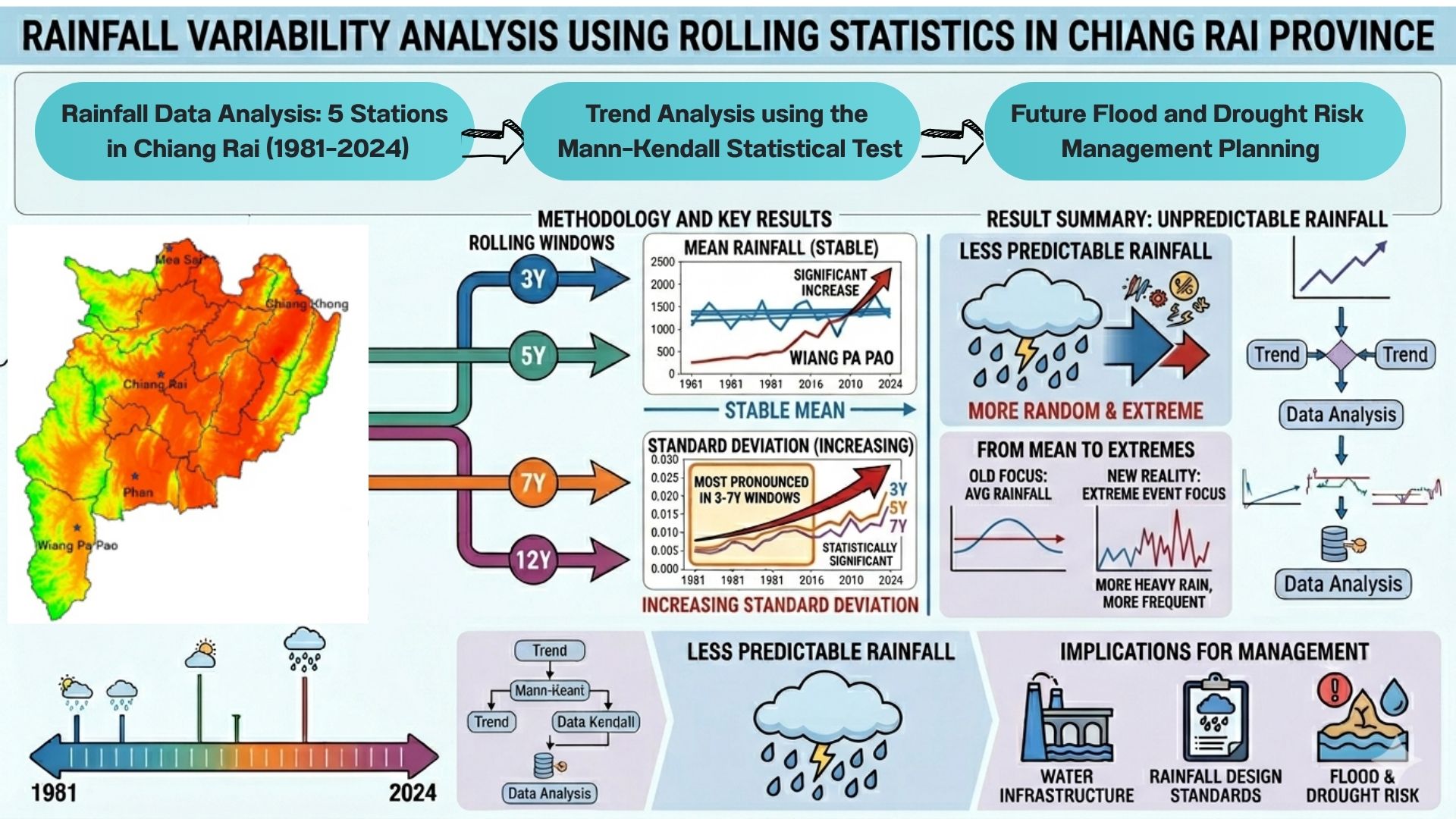
This study analyzed long-term rainfall variability in Chiang Rai Province (1981–2024) using rolling statistics and the non-parametric Mann–Kendall test to detect temporal changes in both the mean and variability of annual rainfall. Annual rainfall data from five meteorological locations were examined using 3-, 5-, 7-, and 12-year moving windows to characterize short-, medium-, and decadal-scale fluctuations. Although previous studies in northern Thailand have examined trends in total or extreme rainfall, multi-scale variability has not been systematically assessed, leaving uncertainty about how rainfall behavior is changing across different temporal windows. Results indicate that mean annual rainfall remains statistically stable (p > 0.05) at most locations, except for Wiang Pa Pao, which shows a significant upward trend (Z = 3.79–5.35). In contrast, the rolling standard deviation increased consistently across all locations, suggesting intensifying interannual variability. These findings indicate that rainfall in northern Thailand has become more unpredictable, with larger departures from the mean despite relatively stable long-term averages. The results point to practical needs for updating design-rainfall criteria and integrating variability-based assessments into regional water-resource and climate-adaptation planning.
References
Calma, J., & Fajardo, S. M. (2025). Climate trend analysis using Mann–Kendall and Sen’s slope estimator tests in Central Luzon, Philippines. Interdisciplinary Research Review, 20(1), 21–31. https://doi.org/10.14456/irr.2025.3
Chaisompran, Y., & Chaipimonplin, T. (2017). Water level forecasting by artificial neural network model with rainfall data from WRF–ECHAM5 model. Srinakharinwirot University Journal of Sciences and Technology, 9(17), 83–95. https://ph02.tci-thaijo.org/index.php/swujournal/article/view/93891
Chaithong, T. (2023). Influence of changes in extreme daily rainfall distribution on the stability of residual soil slopes. Big Earth Data, 7(1), 101–125. https://doi.org/10.1080/20964471.2022.2046306
Chaito, T., & Khamkong, M. (2020). Extreme value model for monthly rainfall in the upper Ping River Basin of Chiang Mai Province. Journal of Applied Statistics and Information Technology, 5(1), 32–40.
Chaiwino, W., Chaisee, K., Oonariya, C., & Wongsaijai, B. (2025). Analysis of long-term rainfall trend and extreme in upper northern Thailand. Scientific Reports, 15(1), Article 33380. https://doi.org/10.1038/s41598-025-18217-1
Chanthon, N., Treewannakul, P., & Rengkwunkway, M. (2021). Adaptation to drought situation of vegetable growers in Na Khu Sub-district, Phak Hai District, Phra Nakhon Si Ayutthaya Province. Agricultural Science Journal, 52(1), 1–10.
Chitwatkulsiri, D., Irvine, K. N., Chua, L. H. C., Teang, L., Charoenpanuchart, R., Likitswat, F., & Sahavacharin, A. (2025). Assessing urban resilience through physically based hydrodynamic modeling under future development and climate scenarios: A case study of northern Rangsit area, Thailand. Climate, 13(10), Article 200. https://doi.org/10.3390/cli13100200
Chueasa, B., Humphries, U. W., & Waqas, M. (2024). Influence of El Niño–Southern Oscillation on precipitation variability in Northeast Thailand. MethodsX, 13, Article 102954. https://doi.org/10.1016/j.mex.2024.102954
de Oliveira-Júnior, J. F., Mendes, D., Porto, H. D., Cardoso, K. R. A., Neto, J. A. F., da Silva, E. B. C., & Jamjareegulgarn, P. (2025). Analysis of drought and extreme precipitation events in Thailand: Trends, climate modeling, and implications for climate change adaptation. Scientific Reports, 15(1), Article 4501. https://doi.org/10.1038/s41598-025-86826-x
Drake, K., & Hogan, M. (2013). Watershed management guidebook: A guide to outcome-based watershed management. Integrated Environmental Restoration Services. Retrieved from http://efaidnbmnnnibpcajpcglclefindmkaj/https://ierstahoe.com/pdf/research/watershed_management_guidebook.pdf
Gocic, M., & Trajkovic, S. (2013). Analysis of changes in meteorological variables using Mann–Kendall and Sen’s slope estimator statistical tests in Serbia. Global and Planetary Change, 100, 172–182. https://doi.org/10.1016/j.gloplacha.2012.10.014
Hidayat, Z., Indra, R., Lidya, W. E., & Tukina, S. S. (2022). Impact of information technology, leadership communication, protection facility, and local wisdom practice on social readiness for disaster in Krakatoa. Journal of Theoretical and Applied Information Technology, 100(1), 192–208.
Jeeranan, Y., & Kampanart, W. (2021). Drought management guidelines in the area of Pong Daeng Sub-district Administrative Organization, Mueang Tak District, Tak Province. Journal of Modern Learning Development, 6(2), 87–99.
Limsakul, A., & Singhruck, P. (2016). Long-term trends and variability of total and extreme precipitation in Thailand. Atmospheric Research, 169, 301–317. https://doi.org/10.1016/j.atmosres.2015.10.015
Narudeesri-Utai, R., Chompuchan, C., & Sittichok, K. (2025). Comparison of bias correction methods for general circulation rainfall projections under CMIP6 climate change scenarios. Journal of Engineering and Innovation, 18(2), 101–115.
Nassor, S. H., Matlan, S. J., Taha, N. A., & Mukhlisin, M. (2025). Influence of hydraulic properties on the slope stability of unsaturated soil from the Garinono Formation in Sabah. Journal of Current Science and Technology, 15(1), Article 88. https://doi.org/10.59796/jcst.V15N1.2025.88
Praveen, K., & Roy, C. (2022). Assessment of irrigation and agricultural potential of the Sone command area in Bihar, India applying geospatial techniques. Journal of Current Science and Technology, 12(3), 568–581. https://doi.org/10.14456/jcst.2022.43
Rojpratak, S., & Supharatid, S. (2023). Regional-scale flood impacts on a small mountainous catchment in Thailand under a changing climate. Journal of Water and Climate Change, 14(12), 4782–4801. https://doi.org/10.2166/wcc.2023.527
Srivichai, M. (2025). Analyzing drought risks and impacts in the Kok River Basin. Interdisciplinary Research Review, 20(1), 32–41. Retrieved from https://ph02.tci-thaijo.org/index.php/jtir/article/view/255744
Supharatid, S., & Nafung, J. (2021). Projected drought conditions by CMIP6 multimodel ensemble over Southeast Asia. Journal of Water and Climate Change, 12(7), 3330–3354. https://doi.org/10.2166/wcc.2021.308
Supharatid, S., Nafung, J., & Aribarg, T. (2022). Projected changes in temperature and precipitation over mainland Southeast Asia by CMIP6 models. Journal of Water and Climate Change, 13(1), 337–356. https://doi.org/10.2166/wcc.2021.015
Thapthai, C., & Prathumchai, K. (2025). Projected future changes in extreme daily rainfall in Southern Thailand based on CMIP6 models. Journal of KMUTNB, 35(2), 1–18.
United Nations Development Programme (UNDP). (2013). Guidelines for assessing the human impact of disasters. Retrieved from https://www.undp.org/sites/g/files/zskgke326/files/publications/Guidelines%20for%20Assessing%20the%20Human%20Impact%20of%20Disasters%20HR.pdf
United Nations Development Programme (UNDP). (2018). Five approaches to build functional early warning systems. Retrieved from https://www.adaptation-undp.org/resources/manual/five-approaches-build-functional-early-warning-systems
United Nations Development Programme (UNDP). (2024). Nature for water security. Retrieved from https://www.undp.org/sites/g/files/zskgke326/files/2024-10/undp_nature_for_water_security.pdf
Downloads
Published
How to Cite
Issue
Section
Categories
License
Copyright (c) 2026 Journal of Current Science and Technology

This work is licensed under a Creative Commons Attribution-NonCommercial-NoDerivatives 4.0 International License.