Artificial Artificial Neural Network–Genetic Algorithm Integrated Approach for Optimizing Residual Stress and Crystallite Size in Incremental Forming of Ti–6Al–4V Alloy
DOI:
https://doi.org/10.59796/jcst.V16N2.2026.176Keywords:
incremental sheet forming, Ti–6Al–4V, Artificial Neural Network (ANN), Genetic Algorithm (GA), residual stress, crystallite sizeAbstract
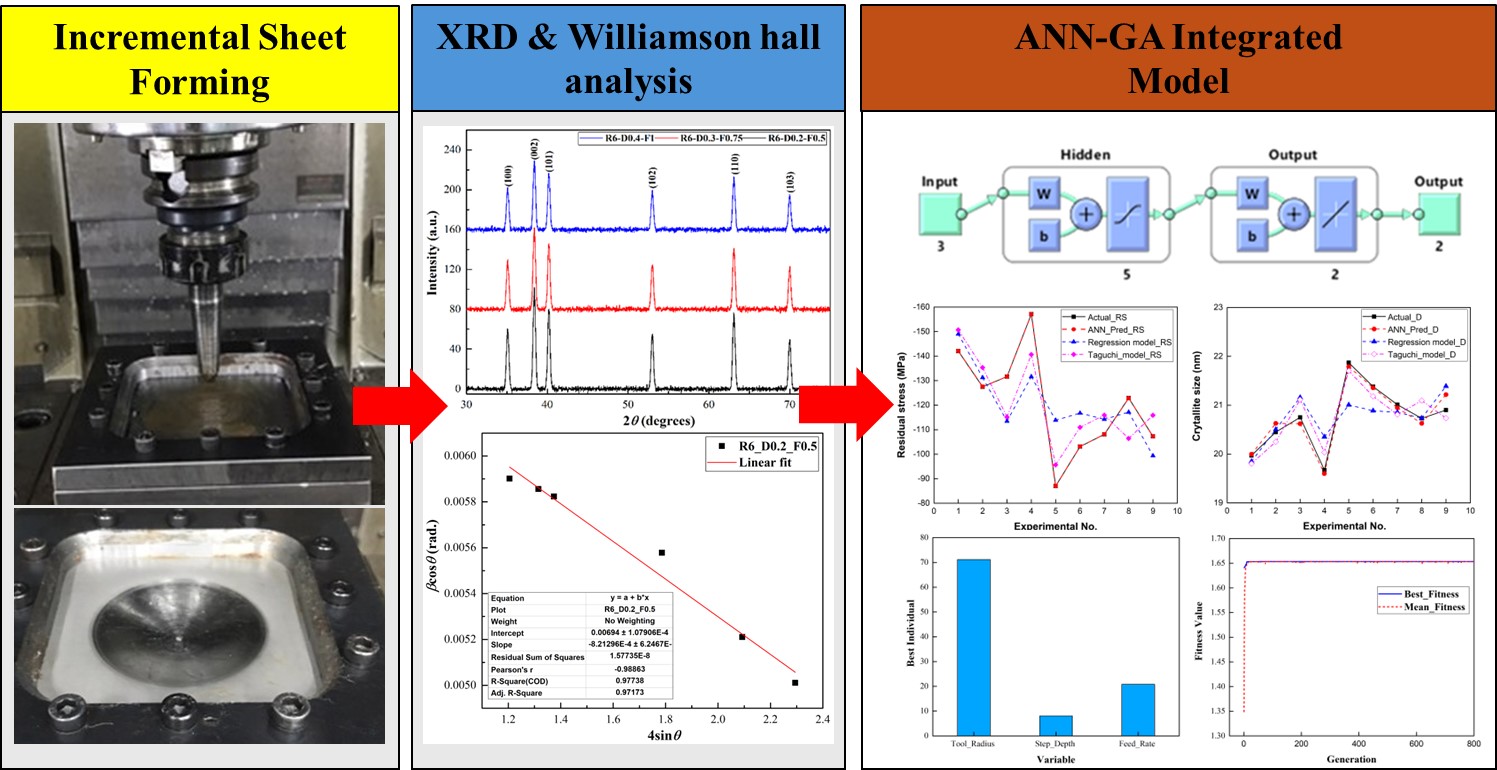
This study develops an integrated Artificial Neural Network–Genetic Algorithm (ANN–GA) approach to optimize process parameters in incremental sheet forming (ISF) of Ti–6Al–4V alloy, aiming to minimize residual stress (RS) and maximize crystallite size (D) to improve product quality. Three parameters tool radius (R), incremental step depth (S), and feed rate (F) were arranged using a Taguchi L9 orthogonal array. An ANN model (3–5–2 architecture), trained with the Levenberg–Marquardt algorithm, predicted RS and D, while GA was employed to determine optimal parameter combinations for simultaneous multi-response optimization. Experimental results showed RS between −157.11 MPa and −86.99 MPa and D from 19.67 to 21.87 nm. The ANN–GA method achieved superior prediction accuracy. The ANN model achieved a training RMSE of 0.0301 MPa for RS and 0.1394 nm for D, whereas validation RMSE values were 1.842 MPa and 0.229 nm, respectively, confirming good generalization performance. The optimal settings (R = 8.725 mm, S = 0.2588 mm, F = 1 mm·min⁻¹) reduced the magnitude of residual stress by 9.18% and increased D by 5.27% compared with the best Taguchi results. This integrated framework enhances process reliability, enables precise control of surface integrity, and provides practical guidelines for manufacturing high-performance titanium components for aerospace and biomedical applications.
References
Acevedo, R. B., Kantarowska, K., Santos, E. C., & Fredel, M. C. (2023). Residual stress measurement techniques for Ti6Al4V parts fabricated using selective laser melting: State of the art review. Rapid Prototyping Journal, 29(8), 1549-1564. https://doi.org/10.1108/RPJ-04-2019-0097
Bastola, N., Jahan, M. P., Rangasamy, N., & Rakurty, C. S. (2023). A review of the residual stress generation in metal additive manufacturing: Analysis of cause, measurement, effects, and prevention. Micromachines, 14(7), Article 1480. https://doi.org/10.3390/mi14071480
Charonerat, S., Phatungthane, T., & Summatta, C. (2025). Optimizing friction stir welding parameters for enhanced mechanical properties of dissimilar aluminum alloys AA5083 and AA6063: A Taguchi approach. International Journal of Applied Science and Engineering, 22(3), 1–10. https://doi.org/10.6703/IJASE.202509_22(3).006
Chen, X., Xie, X., Wu, H., Ji, X., Shen, H., Xue, M., ... & Liu, Q. (2023). In-situ control of residual stress and its distribution in a titanium alloy additively manufactured by laser powder bed fusion. Materials Characterization, 201, Article 112953. https://doi.org/10.1016/j.matchar.2023.112953
Coman, C. C., Mazurchevici, S. N., Carausu, C., & Nedelcu, D. (2023). Analysis of incremental sheet forming of aluminum alloy. Materials, 16(19), Article 6371. https://doi.org/10.3390/ma16196371
Costa, A., Buffa, G., Palmeri, D., Pollara, G., & Fratini, L. (2022). Hybrid prediction-optimization approaches for maximizing parts density in SLM of Ti6Al4V titanium alloy. Journal of Intelligent Manufacturing, 33(7), 1967-1989. https://doi.org/10.1007/s10845-022-01938-9
Kajal, G., Tyagi, M. R., & Kumar, G. (2023). A review on the effect of residual stresses in incremental sheet metal forming used in automotive and medical sectors. Materials Today: Proceedings, 78(3), 524-534. https://doi.org/10.1016/j.matpr.2022.11.235
Kumar, P., Karsh, P. K., Misra, J. P., & Kumar, J. (2021). Multi-objective optimization of machining parameters during green machining of aerospace grade titanium alloy using Grey–Taguchi approach. Proceedings of the Institution of Mechanical Engineers, Part E: Journal of Process Mechanical Engineering, 235(1), 93–106. https://doi.org/10.1177/09544089211043610
Kumar, R., Kumar, G., & Singh, A. (2020). An assessment of residual stresses and micro-structure during single point incremental forming of commercially pure titanium used in biomedical applications. Materials Today: Proceedings, 28(2), 1261-1266. https://doi.org/10.1016/j.matpr.2020.04.147
Liao, J., Huang, Y., Lu, X., Jiang, Y., & Hussain, G. (2025). Hybrid incremental forming processes: a review. The International Journal of Advanced Manufacturing Technology, 136(7), 3077-3109. https://doi.org/10.1007/s00170-025-15075-z
Maqbool, F., & Bambach, M. (2019). Experimental and numerical investigation of the influence of process parameters in incremental sheet metal forming on residual stresses. Journal of Manufacturing and Materials Processing, 3(2), Article 31. https://doi.org/10.3390/jmmp3020031
Maqbool, F., Maaß, F., Buhl, J., Hahn, M., Hajavifard, R., Walther, F., ... & Bambach, M. (2021). Targeted residual stress generation in single and two point incremental sheet forming (ISF). Archive of Applied Mechanics, 91(8), 3465-3487. https://doi.org/10.1007/s00419-021-01935-z
Nakamura, K., Kawaguchi, T., Ikeda, H., Karntiang, P., Kakura, K., Taniguchi, Y., Toyoda, K., Shimizu, H., & Kido, H. (2022). Bond durability and surface states of titanium, Ti-6Al-4V alloy, and zirconia for implant materials. Journal of Prosthodontic Research, 66(2), 296–302. https://doi.org/10.2186/jpr.JPR_D_20_00297
Muiruri, A., Maringa, M., & Du Preez, W. (2020). Evaluation of dislocation densities in various microstructures of additively manufactured Ti6Al4V (ELI) by the method of x-ray diffraction. Materials, 13(23), Article 5355. https://doi.org/10.3390/ma13235355
Murugesan, M., Yu, J. H., Jung, K. S., Cho, S. M., Bhandari, K. S., & Lee, C. W. (2022). Optimization of forming parameters in incremental sheet forming of AA3003-H18 sheets using Taguchi method. Materials, 15(4), Article 1458. https://doi.org/10.3390/ma15041458
Oleksik, V., Trzepieciński, T., Szpunar, M., Chodoła, Ł., Ficek, D., & Szczęsny, I. (2021). Single-point incremental forming of titanium and titanium alloy sheets. Materials, 14(21), Article 6372. https://doi.org/10.3390/ma14216372
Ortiz, M., Penalva, M., Iriondo, E., & Lopez de Lacalle, L. N. (2019). Accuracy and surface quality improvements in the manufacturing of Ti-6Al-4V parts using hot single point incremental forming. Metals, 9(6), Article 697. https://doi.org/10.3390/met9060697
Popp, G. P., Racz, S. G., Breaz, R. E., Oleksik, V. Ș., Popp, M. O., Morar, D. E., ... & Popp, I. O. (2024). State of the art in incremental forming: Process variants, tooling, industrial applications for complex part manufacturing and sustainability of the process. Materials, 17(23), Article 5811. https://doi.org/10.3390/ma17235811
Prasomthong, S., & Onbat, K. (2023). The Optimization of sheet forming on residual stress and surface roughness with two point incremental forming process (TPIF) of aluminum alloy parts. Applied Science and Engineering Progress, 16(4), 6059-6059. https://doi.org/10.14416/j.asep.2022.06.003
Radu, C., Tampu, C., Cristea, I., & Chirita, B. (2013). The effect of residual stresses on the accuracy of parts processed by SPIF. Materials and Manufacturing Processes, 28(5), 572-576. https://doi.org/10.1080/10426914.2013.763967
Shang, X., Liu, Z., Zhang, J., Lyu, T., & Zou, Y. (2023). Tailoring the mechanical properties of 3D microstructures: A deep learning and genetic algorithm inverse optimization framework. Materials Today, 70, 71-81. https://doi.org/10.1016/j.mattod.2023.09.007
Szpunar, M., Trzepieciński, T., Ostrowski, R., Żaba, K., Ziaja, W., & Motyka, M. (2024). Thermo-mechanical numerical simulation of friction stir rotation-assisted single point incremental forming of commercially pure titanium sheets. Materials, 17(13), Article 3095. https://doi.org/10.3390/ma17133095
Zou, Z., Zhang, T., He, L., Zhao, X., & Zhou, T. (2024). Hybrid modeling prediction of residual stresses in turned Ti6Al4V considering frictional contact. Journal of Materials Research and Technology, 30, 4377-4392. https://doi.org/10.1016/j.jmrt.2024.04.157
Downloads
Published
How to Cite
Issue
Section
Categories
License
Copyright (c) 2026 Journal of Current Science and Technology

This work is licensed under a Creative Commons Attribution-NonCommercial-NoDerivatives 4.0 International License.